Search Results
874 results found with an empty search
- Ashley Yablon: How I Exposed a CCP Tech Giant’s Elaborate Scheme to Evade US Sanctions
“As I was scrolling through it, I saw a section of the contract that was titled, ‘How we will get around U.S. export laws’ … And I nearly fell out of my chair when I saw that, and I knew that I needed to do something,” says attorney and whistleblower Ashley Yablon. In 2011, Yablon landed his dream job working as general counsel for ZTE, a multi-billion dollar Chinese telecom company subsidized by the regime. He quickly learned, however, that ZTE was under investigation for breaking U.S. sanction laws. “They had set up shell companies that were buying these component parts … and then selling them to the embargoed countries,” says Yablon. We discuss his book, “Standing Up to China: How a Whistleblower Risked Everything for His Country.” Yablon and his family had to go into hiding after his affidavit to the FBI detailing ZTE’s shocking activities was leaked to the public. “My wife was followed in a car by a Chinese gentleman as she was walking the dog down the street. And with each turn that she made, the car turned with her. And as she picked up the pace, the car picked up the pace, until she was in a full sprint all the way up to the house,” says Yablon. Interview trailer: Watch the full interview: https://www.theepochtimes.com/ashley-yablon-how-i-exposed-a-ccp-tech-giants-elaborate-scheme-to-evade-us-sanctions_4923801.html FULL TRANSCRIPT Jan Jekielek: Ashley Yablon, such a pleasure to have you on American Thought Leaders. Ashley Yablon: Thank you so much for having me. Mr. Jekielek: I just finished reading your book, Standing Up to China: How a Whistleblower Risked Everything for His Country. What a tale. It’s almost hard to believe, except that I know a lot of the realities around communist China, so it’s not actually that hard to believe. But how did you stand up to China? Why don’t you tell me about that? Mr. Yablon: Sure. I was the attorney for one of the largest telecom companies in the world, a Chinese telecom company named ZTE. I got my dream job to go there and started in 2011. I quickly learned that ZTE was under House investigation for being a threat to national security here in the United States. And a few months later an article came out in Reuters magazine where they got a copy of a contract between ZTE and the country of Iran, and ZTE was selling hundreds of millions of dollars of spying technology. The problem was that they were using U.S. component parts to do that. And again, that’s against U.S. export laws, which say that you cannot sell component parts to embargoed countries such as Iran. What ZTE had done, and what I discovered, was that ZTE had created an elaborate scheme where they had set up shell companies that were buying these component parts. Then, through a series of interactions, were getting those component parts back to China, and then selling them to the embargoed countries. What ZTE was going to do once the U.S. was investigating them was to lie. They wanted me to be the scapegoat for them saying that they were not doing anything illegal. That’s when I became what is known as a whistleblower, and I had to go to the FBI and explain what was going on. Mr. Jekielek: Well, you didn’t have to, right? Mr. Yablon: Correct. Mr. Jekielek: You chose to. Mr. Yablon: I chose to. And so, as an attorney, that’s a good point. We have a thing called attorney-client privilege, and certainly when your client comes to you and tells you they’ve done something illegal in the past, you as an attorney have a duty to keep that confidential—that’s the attorney-client privilege. The exception to that is the crime fraud exception, and that’s when your client comes to you as an attorney, and they tell you that they’re going to commit a crime in the future. At that point you have an ethical duty as an attorney to report that. That’s what ZTE was doing. They were telling me that they were going to further a crime. And this wasn’t a small petty crime. This was a crime against our country and a threat to our security and our democracy. So, I felt obligated to do this, not only as an attorney, but as a U.S. citizen. Mr. Jekielek: Before we dig into this whole thing, this whole caper in 2017 resulted in one of the largest settlements in U.S. history. Mr. Yablon: Correct. In 2017, ZTE and the government entered into a settlement where ZTE paid the largest penalty at the time of 1.2 billion dollars in fines and penalties. Mr. Jekielek: First of all, this was your dream job, not specifically because you wanted to work for a Chinese telecom company. This was your dream job because strangely, at least to me, and perhaps to our viewers, you were dead set on becoming a general counsel for a large corporation. So, that’s very interesting. That was your dream? Mr. Yablon: Correct. When I graduated from law school, I got out and was looking for a job. I had a mentor, the one who had actually encouraged me to go to law school, and I had lunch with him. At the time he was the general counsel of a company. A general counsel, again, is a little different than being an attorney at a law firm. At a law firm you’re practicing one type of law, but you have many clients. As a general counsel, you have one client, but you’re practicing many types of law. That interested me more, this idea of assisting business, versus working at a law firm and just billing business. I liked the idea of partnering with a company and assisting them through all the legal aspects that they might have. When he mentioned what a general counsel did, I was immediately intrigued, and that’s what I wanted to do. For the next six years, I spent that whole time learning what he told me to do, which was to round out my tool belt. What he meant was, learn how to do a little bit of everything. A good general counsel doesn’t need to be a subject matter expert on everything, but a generalist on everything. I took that advice, and I went to work at law firms and learned litigation and tried cases and took many depositions. I went and learned contracts at another law firm, and learned how to do what they called transactional work. Then, I went to another law firm and learned how to do HR and employment law. After years of working at these law firms and rounding out that tool belt, I had the opportunity to go to work at the lowest level of McAfee, a U.S. based antivirus software company in Texas. After four years of working there, I had an opportunity to be the assistant general counsel for Huawei. Again, I thought, “What an unbelievable opportunity. Here’s a multi-billion-dollar international company and I’m assistant general counsel.” I had no idea of what I was stepping into working at Huawei, but I quickly learned the difference between American culture and Eastern culture, or specifically Chinese culture. Mr. Jekielek: And perhaps, I would argue communist culture. But okay. How is it that you didn’t understand what Huawei was, or what did you learn Huawei was? Mr. Yablon: I didn’t understand what it was because, to be honest, and like I talk about in the book, I didn’t want to know. Initially, I was laser-focused on just working my way up that corporate ladder and working my way up to be a general counsel. What Huawei was or what any company was wasn’t really my interest. To your point, I quickly learned and soon saw what the red flags were of working with a Chinese telecom company such as Huawei, and then eventually ZTE. The way it works at these large Chinese tech companies, 80 per cent of your staff are Chinese nationals here on visas. Only 20 per cent of the staff are U.S. citizens. Part of that 80 per cent were Chinese attorneys who were here in the general counsel role. They’re not licensed to practice here in the United States, but one of them was asking me about the law. I said, “Well, we need to do this. This is the law. This is a requirement.” I remember that she leaned in and said, “No, it’s just a suggestion.” And I said, “No, no, no. It’s the law. We are required to do this.” And she leaned in for effect and said, “No, it’s just a suggestion.” I quickly learned that is their culture. That’s what they believe. The way we have a moral compass or we believe that things are immoral, they don’t see it that way. It’s not that they’re immoral people, but it’s that they don’t look at business or decisions like that in the same way that we do here in the West. Mr. Jekielek: That didn’t make you reconsider things? Mr. Yablon: At the time, no. It made me question, but didn’t make me stop in my hubris or my desire to want to work my way up to be the general counsel. Like I said, looking back now there were a number of what should have been called red flags, and I detail those quite a bit in the book. Mr. Jekielek: Please tell me about that. Mr. Yablon: Sure. When I first started at ZTE in October of 2011, it was the Wednesday before Thanksgiving and a meeting was called in the main conference room with all the executives. Like I mentioned, all the executives that were here in the U.S. from ZTE were Chinese nationals. The only executive who was not a Chinese national and was a U.S. citizen was me as their general counsel. The meeting was called, and there was an article that had come out where the House Intelligence Committee was investigating both Huawei, my former employer, and ZTE as a threat to US national security. And they looked at me. All eyes turned on me, and they said, “Well, Ashley, what do we do?” I said, “We need to hire a large Washington, DC-based lobbying firm to assist us with this House investigation.” And they huddled, they spoke in Mandarin, then came back to me and said, “Well, you’re our attorney. We don’t understand. Can’t you handle this?” I had to explain to them that no, we need a high-powered DC lobbying firm to assist us. The red flag that came out of that meeting was, “Yes, we can go and look for a law firm to assist us, but it’s going to be you, Ashley, who’s going to stand up in front of the Congress and say that we’re doing nothing wrong.” Again, looking back that was a huge red flag, but I didn’t see it, because I didn’t want to see it. Here I am as their general counsel and I felt I had a duty and a job to assist my company in what was a huge scandal and what was a huge investigation. Four months later, Reuters got a copy of the contract with ZTE, and I want to preface this, ZTE China. I was the general counsel for ZTE USA, but what Reuters had gotten a copy of was the contract between ZTE China and the country of Iran. What it contained was that ZTE was selling hundreds of millions of dollars of spying technology, whether it was cell towers, or whether it was modems at the time. They also got a copy of an over 900-page packing list. We all know what a packing list is when we go to IKEA, and we open up the box and it tells us everything that’s in there. Now imagine a 900-page packing list that’s telling you not only everything that’s in these huge wooden crates that have been shipped to Iran, but it’s also telling you the component parts within them. It might mention one spying tower, but it also mentioned that it contained this US-based company widget and another US-based gizmo. So, that was the problem. I remember one of the Chinese attorneys, when I said, “Why is everyone here so concerned about how they got it? We should be more focused on what we do now.” She said to me, “Because now we can’t hide anything.” When she said we can’t hide anything, that was the major red flag for me to realize, “Uh-oh, I’m really in a real pickle here.” When all those things went down when I was there in 2012 and right before I left, ZTE denied everything, was stonewalling our government, was not cooperating, was not providing documents, and it continued that front, like you said, for five years. The U.S. put a full court press on ZTE by every branch of the government, whether it was the Department of Commerce, you name it, the FBI, all of them were working towards a case against ZTE as well as Huawei, but mainly ZTE. Again, ZTE is not publicly traded here in the U.S. It is traded in China, but at the time it was also traded in Hong Kong, and the U.S. government somehow was able to get ZTE off the Hong Kong exchange. The moment that happened ZTE said, “We give up. We’ll comply and we’ll pay whatever we need to. We need to keep being able to do business.” So, it was at that moment that they paid the largest penalty, which we mentioned earlier was 1.2 billion dollars. Mr. Jekielek: The way you’re describing it, this is just whatever the cost of doing business is, and that’s what we’ll do. Mr. Yablon: Correct. Mr. Jekielek: Explain to me what you learned about the philosophy of business and how the Chinese Communist Party plays in decision-making, and also their attitude or approach to dealing with business in the West. Mr. Yablon: If you think about ZTE, ZTE went out of its way to show to the U.S. government that they were not run by the Chinese government. That was their whole angle. That’s why they wanted to show they were not a threat to U.S. national security. But the reality is that they are run by the Chinese government, or subsidized, or assisted. That’s hard for us to understand here in the West. And so everything is for business. Everything is to keep business going. I liken it to water that’s going to find its way through a crack or a hole. You can stop them here. And the U.S. government was able to do that with the penalties and sanctions. But immediately we saw, even after ZTE got penalized and was put on a probation, within less than a year, they were fined again for breaking the rules and regulations again. They had to pay an additional 1.2 billion dollars. If you think about it, they have paid nearly two-and-a-half billion dollars in penalties, and as recently as just this year were in trouble again for violating terms of the order. In our minds, we think that they will stop doing this, but in theirs they just won’t. It’s just their culture of always finding a way around things. Mr. Jekielek: I would like to highlight the fact that this complete culture of immorality is a hallmark of communist culture. You saw it in the Soviet Union. You saw it communist Poland where my parents came from, and you see it in China. Sometimes people equate this sort of thing to Chinese culture. And many, many Chinese have explained to me, nothing can be further from the truth. Mr. Yablon: Right. Mr. Jekielek: And you’re correct. When did you fully realize what you had gotten yourself into? Mr. Yablon: I mentioned that the House Intelligence Committee was doing an investigation and they wanted to come in, I believe it was April of 2012, to Shenzhen where both ZTE and Huawei are based. And they came there and they didn’t want a dog and pony show. They wanted to see concrete evidence that both companies were not run by the Chinese government. ZTE went out of its way to show that they were not run by the Chinese government and were going to show that to the U.S. committee. Huawei took just to the opposite course and really didn’t care about showing that they were run by the government or not. When I was there in China, and again, that Reuters article had just come out, I was led to a room, because I needed to see this contract. I needed to see what it truly said. They wouldn’t give me a copy of the contract. I was led into a dark room without any windows, like something out of a movie, and they wouldn’t give me an actual physical copy. They projected it up on a wall. I had 15 minutes to look through this contract. Every international contract is the same. It’s split right down the middle. One side is in English, and the other is in the native language. Here it was in Chinese. But as I was scrolling through it, I saw a section of the contract that was titled, How We Will Get Around U.S. Export Laws. It laid out all the shell companies. It described what each one would do. And I nearly fell out of my chair when I saw that, and I knew that I needed to do something. Fast forward to later that afternoon. That’s when the heads of ZTE said to me, “They say that we have all this spying technology in Iran. What if we go over there and we take out all the U.S. component parts?” I said, “Well, it’s too late. They already know that you’ve shipped it over.” And they said, “Okay, what if we lie and say that we never shipped anything over there?” I said, “Again, they already know you’ve done it.” And each scheme, each idea, I would have to shoot down until finally they said, “We will comply, and we will give the U.S. government all the information they want to know.” I thought, “Great. Finally, we’re going to be doing the right thing.” When I turned around, one of the Chinese attorneys who worked for me said, “Ashley, they’re speaking in Mandarin right now behind your back, and they’re saying that they’re not going to comply and they’re going to make you, Ashley, the scapegoat, and that you’re going to have to swear to their lies.” So, I immediately flew back home to the United States. I’m a lawyer. My wife at the time was a lawyer. All my friends are lawyers. But I ended up hiring five different lawyers to assist me in this, one being a criminal lawyer who said I had criminal implications. That’s when my attorney worked with the FBI and I gave them the information that led to an affidavit, which pretty much became what is in the order that is out against ZTE today. Mr. Jekielek: This caused quite a big issue for you, because you were still working for this company. You provided this very damning affidavit, which as I understand reads very similarly to the final settlement order that they signed in 2017. Someone released this onto the world, and then your life changed. Mr. Yablon: Correct. What happened was I did give that information to the FBI. I spent two days providing them with all the details of everything I knew; the shell companies, and the people involved. They created the affidavit, and I was told by my attorneys that I needed to go back to work as if nothing happened. The affidavit was presented to a judge to sign an order to allow them to come to the ZTE office and look for documents and do what we consider a raid. That affidavit was going to be filed under seal, meaning privileged. No one was to know it ever existed. But what happened was, it got leaked. That’s when I got the phone call from a journalist who had a copy of it and said he was running the story. Obviously I was in a panic thinking that my life was over. And we could never find out, to your point, who leaked that affidavit. But somewhere in the clerk’s office, somehow it got leaked, and that’s when everything just went crazy in my life. Mr. Jekielek: Even to this day you have no idea? Mr. Yablon: No. I’ve been approached by several people with what I like to call grassy knoll theories on how that was leaked, and why it was leaked, but I don’t have a definitive answer as to how or who leaked it. Mr. Jekielek: You don’t at least have a working theory? Mr. Yablon: I have a working theory. Yes, I do. My theory is this. And as an attorney, I know how clerk’s offices work. Certainly, a lot of big things that should be filed under seal are sometimes leaked. I have a feeling that someone in the clerk’s office who is friends with some kind of journalist or someone in the media provided that, and I think that’s how it got leaked. Mr. Jekielek: That’s the least grassy knoll explanation of such a thing I’ve ever heard, I think. Mr. Yablon: Probably so. Probably so. Mr. Jekielek: Why don’t you explain to me what you were concerned about, and why things went haywire? Mr. Yablon: You have to realize what I had just provided to the FBI. It ended up being 32 pages of an affidavit of all the information. What the information said was, “Here is how ZTE is getting around U.S. export laws, selling to the embargoed countries, and making hundreds of millions, if not billions of dollars in revenue.” So, you can only imagine that when the affidavit gets leaked and ZTE gets in trouble, I have just cost this multi-billion-dollar company billions of dollars in income and revenue by my leaking and giving away the secret sauce of how they went about doing it. And I knew that I’ve also put a threat on my life. Again, I’m thinking the Chinese government is running the company and that they’re not going to be very happy with this U.S. citizen who’s just cost them all this money. And so, when the article was going to be coming out, I knew it was going to be published. My wife and I were sitting at our computer just hitting the refresh button, waiting and waiting for that article to come out, because I knew my life would never be the same after that. And that’s certainly what happened. The moment it hit, we jumped up. My wife said to me, “We have 30 minutes to get out of this house or we’re going to get killed.” That’s what we believed. Immediately, my cell phone just blew up from every news agency calling me, you just can’t imagine. Finally, I had to turn my phone off. But we went into hiding, and went to the FBI here in Dallas and met with them. My criminal lawyer turned to me when we were at the FBI office and he said, “I’ve been coming here as an attorney representing clients for 30 or 40 years.” His words were, “I’ve never seen the level of heavy hitters that the FBI has flown in to meet with you on your case.” The FBI apologized and claimed that they had no idea how this information got leaked, but offered my wife and I the Witness Protection Program and offered to come and check our home to see if it was bugged, and a number of other things. So, we had a real decision to make. I also had to go back to work. My employment lawyer said, “We need to preserve your employment claims against ZTE, so you need to go back to the office.” I thought, “How in the world am I going to go back to the office when I’ve done all that?” But I did. We had four FBI agents around the building in plain clothes. I had what I referred to at the time as the bat phone, which was a number that I could call at any time and FBI would be there in three to four minutes. And I did have to use that number on one occasion. But that’s how my life turned upside down. And then I was receiving death threats from ZTE saying that they were going to kill me. These death threats were coming in on ZTE telephones. All ZTE employees are given a ZTE-issued cell phone. As you move up within ZTE and new models come out, you turn in your phone, and you’re given a new phone. The older phones are given to newer employees. But the phone number was from my former employee, a ZTE employee, a Chinese national, saying from ZTE, “We, ZTE, are going to kill you. We’re going to kill your family. We’re going to kill your children. We’re going to kill your children’s children.” It went on and on. It wasn’t just one, but it was several. If you think about a text message, with mine you could just keep scrolling and scrolling and it kept saying the same things over and over again. I ended up giving all that information and those text messages to the FBI. Mr. Jekielek: What were you thinking at this time? Mr. Yablon: I was scared to death, because this wasn’t just a random employee. Here I have not only a company, but I have a whole country, the Chinese country after me. The FBI even came and did a sweep of my house. We were concerned that my house was bugged. Even after the sweep, my wife and I wouldn’t have conversations inside the house. All the discussions were outside with the sprinklers on. It was really something out of a movie. My wife was followed in a car by a Chinese gentleman as she was walking the dog down the street. With each turn that she made, the car turned with her. As she picked up the pace, the car picked up the pace until she was in a full sprint all the way up to the house. And that’s when the car drove off. Things like that happened. At a restaurant 25 miles away from the house, we saw two Chinese gentlemen. As we sat down, they sat down right next to us. Again, like something out of a movie, both in black suits, white shirts, black ties. They sat down right next to us. They were given their menus. They threw their menus straight down, turned directly to my wife and I, and just stared. I mentioned the bat phone, the number I could call at any time to call the FBI. I reached down as I was holding the menu and I’m talking to my wife just like you and I are speaking and we’re holding it and she can see it out of the corner of her eye. And I said, “This isn’t good.” And she said, “No, it’s not.” So, I fumble for my cell phone. I dial and hit the FBI. I said, “We’re in a bad situation and we are at..” And before I could even say where we were, they said, “We know where you are, and we’ll be there in three minutes.” And that’s what happened. I could see people coming in quickly. They didn’t look like restaurant patrons. And the moment they were coming in, my wife and I got up. The two Chinese gentlemen got up at the same time. I said, “They’re right here,” to the FBI. And we ran out, jumped in our car and sped away. Mr. Jekielek: You did get offered this witness protection, but you didn’t want it? Mr. Yablon: I didn’t. My wife and I talked about it. I came home and I told her what had been offered to us. My wife was an attorney, and she had just started her own law practice. I thought, “She has her own practice that she’s going to give up, and wouldn’t be able to speak to my family.” So, we made a decision and in fact we said, “We’ll just take our chances.” And that’s what we’ve done for over a decade now. Eventually, I did leave ZTE less than a year after that all went down, and I thought my career had ended. Even my criminal lawyer told the FBI, “You’ve ruined his life. You have ruined his life. He came to you. He provided you all this information, and somehow it got leaked. Now who’s going to want to hire him? What company wants to hire the guy that’s going to whistle blow on them?” That was my concern. It came to fruition because for the next two-and-a-half years, I couldn’t get a job. Mr. Jekielek: If I was a large business owner, I might want to have someone on my staff as a general counsel who made the decisions that you made. So, I’m kind of surprised that it was hard for you to find work. Mr. Yablon: That’s what everyone says to me now. But at the time, I couldn’t get a job. For a little over two-and-a-half years, no one would return my calls. Here I am, a highly skilled attorney with unbelievable experience working as a general counsel, and I couldn’t even get even entry level positions with companies. I just figured, at least at the time I thought, “Well, they just didn’t want me. ‘We don’t want that guy.'” Maybe I had a scarlet letter on me that said, “We don’t want him, the whistleblower, to come into our company.” Thank goodness at the time I was able to work for my wife and assist her in her practice because if not, I would have been out of work. It was like that for about two-and-a-half years. Mr. Jekielek: But then it changed. Mr. Yablon: I had an opportunity with someone that I knew and someone who had worked with me at ZTE actually, and had now moved on and was working elsewhere. Again, he wasn’t an attorney, but was more in an HR position, and he suggested that I could be their general counsel. And it was a U.S.-based company. I did that for 2015 through about 2018. Mr. Jekielek: It’s great to hear that you were able to recover from all of this to some extent. Are you worried that something could still happen, or has this passed now? Mr. Yablon: I’ll never feel safe. I’ll say that. Things won’t add up. I’ll be somewhere and things just don’t look right, and things don’t make sense. Then, I realize it’s more than just happenstance, there’s probably some validity to it. Obviously, I’ve been told by our government as well as every attorney who’s ever represented me that I can never travel to China again, that I won’t ever go back. And I believe that. So, do I feel safe? No, I don’t think I’ll ever feel safe. Mr. Jekielek: One of the things I really like about your book is that it’s very introspective. What would you say is the biggest lesson that you learned through all of this? Mr. Yablon: Wow. When I sat down to write the book, I didn’t have an agenda as to a lesson that I wanted someone to learn. But looking back, and once I completed it, two lessons really stand out in my mind. Number one, the idea of ambition or in my case, blind ambition. Obviously, ambition is great, and it is what fuels all of us, but left unchecked it can be disastrous. So, I think theme one is, be careful what you wish for, because you just might get it. And the second theme is, how far will you go to do the right thing? And in my situation, I went as far as you could go to do the right thing. I risked not only my job, but I risked my career, and I risked all my finances. But most importantly, I risked my own life. A lot of people might not ever get in a situation like that or be put to that type of test, but I can say I was put to that test, and I feel that I passed. Mr. Jekielek: In China, the truth is what the Chinese Communist Party says it is. Mr. Yablon: Correct. Mr. Jekielek: Even as a means of self-preservation, lying is an important skill that people learn. But how did this manifest in your experiences? Can you comment on this? Mr. Yablon: You’ve hit the nail on the head. They just look straight at you and lie. That just perplexes us here in the West as a way to interact or as a way to do business. The day I went back to the office after the article had come out, I went to the office. Like I mentioned, four FBI plainclothes officers were downstairs. I went in and my door to my office was covered in police crime scene tape. I had a large whiteboard, a six-by-six whiteboard in my office. It had been erased, and all that it said in all caps with three exclamation points was, “Die!!!” I was immediately called into the CEO’s office and he said, “Why are you making up these lies? Why are you lying, Ashley?” I realized that they were going to follow the agenda, and the agenda was to make me the liar and to save the company and to promote the good of the company. And again, it was to gaslight me, to make me to be the person who was making a story up in order to protect the company. In the West we think of everything as very linear. It’s A plus B, and then we get to C. When you talk about business, our business dealings are getting right to the bottom line and talking immediately about the price and shipment and getting right to business. They don’t look at it that way. What we would consider meandering or just wasting time is how they do business. It’s about formality. It’s about getting to know the person. If you come at them directly with business and get right to a bottom line, it turns them off. I talk about this quite a bit in the book as well, and it’s to your point about lying to you. It’s about saving face, and it’s all about looking at you and agreeing and saying what you want to hear. But then again, they always have their goal and their agenda, which is all about their protection of not only the company, but also of the country, and to your point, the communist party and towing the party line. What we consider getting down to the business is not something that’s done until further down the road. Really, at the 11th hour, that’s when business gets done. Mr. Jekielek: My question is, did you find your own ethics, or your own ethical structure being impacted by being in this type of culture? Mr. Yablon: Yes. It weighed on me heavily when someone would look you straight in the eye and tell you something, and you knew that that was a lie or that wasn’t going to happen. As in the instance of, “We’re going to comply. We’re going to provide all the documents to the government.” And it’s hard, like I mentioned, to stick to your guns, to stick to the truth when you’re surrounded by a culture that’s just so diametrically opposed to your beliefs and the way that you operate. Mr. Jekielek: Is there anything that you would’ve done differently, looking back? Mr. Yablon: I’m asked that quite a bit and the short answer is no. I paid quite a price, but I don’t see any other way around it. To do anything else would be treason and lying to our government. And I couldn’t do that. And from an attorney perspective, I had an ethical duty to report the furthering of a crime. Mr. Jekielek: Just prior to the beginning of the Russia/Ukraine war, the Chinese regime in Russia announced this no-limits partnership. What do you expect these large Chinese companies are doing now with respect to these embargoes and sanctions? Mr. Yablon: Like I mentioned, they’re like water. It’s their culture not to stop. They just can’t. So, I think that they will continue on. Sanctions are pointless. They haven’t worked, and sanctioning them hasn’t been effective. They will continue on and find different ways. So, if they stop this way of doing a scheme, they’ll find another. Sanctions aren’t the answer to stopping them. What that answer is, I don’t know. I know that we’ve come up with trying to rely less upon trade. Take, for instance, the Biden administration with the recent chip laws and orders and things like that, trying to reduce our dependence upon foreign companies for technology and things like that, which I is a good start because sanctions have proven to be ineffective. Mr. Jekielek: Decoupling is something that’s often mentioned. Mr. Yablon: Right. Mr. Jekielek: Right. So, based on your experiences, you would advocate for more of this direction of decoupling from the CCP? Mr. Yablon: Yes, for sure. The U.S. is so dependent upon trade with China, anything that we can do to reduce that dependency would be in our best interest. The whole world is dependent upon trade with China, and I think China realizes that. And so they’re in a strong position. Mr. Jekielek: What are you doing these days? Mr. Yablon: Again, after I left ZTE, it took a while to become a general counsel or to get even a job. But I did that for a company for about three years. In 2018 I decided to take time off, write my book, but I still worked for companies and assisted them, and that’s what I do now. I’m brought into companies’ legal departments, and I provide guidance on how to make their systems more smoothly, as well as to assist them with compliance and to make them more compliant with the laws. Mr. Jekielek: Are these companies that are interacting with the Chinese regime, or is this just in general? Mr. Yablon: It’s just in general, being in compliance with U.S. laws or foreign laws, it’s not just specific to China. Mr. Jekielek: Ashley Yablon, it’s such a pleasure to have you on the show. Mr. Yablon: Thank you so much. Mr. Jekielek: Thank you all for joining Ashley Yablon and me on this episode of American Thought Leaders. I’m your host, Jan Jekielek. To get notifications about new Kash's Corner and American Thought Leaders episodes, please sign up for our newsletter! Here 👉 Get Alerts - PRE-ORDER "The Shadow State" DVD: https://www.epochtv.shop/product-page/the-shadow-state-dvd The Real Story of January 6 | Documentary BUY Jan 6 DVD: https://www.epochtv.shop/product-page/dvd-the-real-story-of-january-6, Promo Code “Jan” for 20% off. - Follow American Thought Leaders on social media: Twitter: https://twitter.com/AmThoughtLeader Truth Social: https://truthsocial.com/@AmThoughtLeader Gettr: https://gettr.com/user/amthoughtleader Facebook: https://www.facebook.com/AmericanThoughtLeaders Gab: https://gab.com/AmThoughtLeader Telegram: https://t.me/AmThoughtLeader
- LIVE: CPAC 2023 in Washington—March 3
The 2023 Conservative Political Action Conference (CPAC) is taking place in Washington from March 1 to March 4. The conference is the largest and most influential gathering of conservatives in the world. Former President Donald Trump will give a speech on March 4 as the keynote speaker. Featured speakers on March 3 include Rep. Marjorie Taylor Greene (R-Ga.), Rep. Matt Gaetz (R-Fla.), Donald Trump Jr., former U.S. ambassador to the U.N. Nikki Haley, former Secretary of Housing and Urban Development Ben Carson, co-founder of Strive Asset Management Vivek Ramaswamy, former Trump adviser Steve Bannon, and more. Watch Here: Schedule for March 3 All times are in Eastern Time. Schedule is subject to change. 8:55 a.m.–9:05 a.m. Speech Sebastian Gorka, Host, America First 9:05 a.m.–9:35 a.m. Taking on the Swamp Jack Posobiec, Host, Human Events Daily Kash Patel, Former Pentagon Chief of Staff and Author of Government Gangsters Julie Kelly, Senior Writer for American Greatness Amanda Milius, Director of “The Plot Against the President” 9:35 a.m.–10:00 a.m. Begging for Oil Tim Stewart, President of the US Oil & Natural Gas Association David Bernhardt, 53rd Secretary of the Interior, Chairman of the AFPI Center for American Freedom Brad Little, Governor of Idaho Ryan Zinke, Congressman (R-Mont.) 10:00 a.m.–10:10 a.m. Speech Marjorie Taylor Greene, Congresswoman (R-Ga.) 10:00 a.m.–6:00 p.m. CPAC Central 10:10 a.m.–10:30 a.m. A Time for Courage Terry Schilling, President, American Principles Project Chloe Cole Riley Gaines, 12x All-American Swimmer 10:30 a.m.–10:40 a.m. Speech Matt Gaetz, Congressman (R-Fla.) 10:40 a.m.–11:05 a.m. The New Axis of Evil: Soros, Schwab, and Fink Sean Spicer, SeanSpicer.com Andrew Puzder, Senior Visiting Fellow, Heritage Foundation Charles McCall, Oklahoma Speaker of the House 11:05 a.m.–11:35 a.m. The Biden Crime Family Bob Beauprez, Former Congressman and CPAC Board Member James Comer, Chairman House Oversight Committee, Congressman (R-Ky.) Mollie Hemingway, Editor in Chief of the Federalist 11:35 a.m.–11:45 a.m. Speech Kimberly Guilfoyle, Former Senior Advisor to the 45th President & Host of the Kimberly Guilfoyle Show 11:45 a.m.–12:00 p.m. Speech Donald Trump Jr., Executive Vice President of The Trump Organization & Host of “Triggered with Don Jr.” on Rumble 12:05 p.m.–12:30 p.m. A Rabbi, a Christian, and a Cardinal Walk Into a Bar Elaine Beck, Host of “It’s Not About Us” Jack Brewer, Deal Hudson, Host of the “Church and Culture” Radio Show Rav. Shlomo Chayen 12:30 p.m.–12:45 p.m. Speech Byron Donalds, Congressman (R-Fla.) 12:45 p.m.–1:05 p.m. Speech Nikki Haley, Former United States Ambassador to the United Nations 1:05 p.m.–1:20 p.m. Speech Lara Trump, Former Trump 2020 Senior Adviser and Host of the Right View 1:20 p.m.–1:40 p.m. From Tariffs to Taiwan Mercy Schlapp, Co-Host CPAC Now Robert Lighthizer, Former United States Trade Representative 1:40 p.m.–2:15 p.m. Open Borders Kill Sara Carter, Host, Sara Carter Show Sean Reyes, Utah Attorney General Rosi Orozco, Former Deputy Legislature of the Mexican Congress Brandon Judd, Border Patrol Union President David Sunday, York County District Attorney 2:15 p.m.–2:30 p.m. Speech Ben Carson, Former Secretary of Housing and Urban Development 2:30 p.m.–2:40 p.m. Speech Wayne LaPierre, CEO of the National Rifle Association 2:40 p.m.–3:05 p.m. Debanking: J.P. Morgan “Chase”ing Away Small Business Bill Walton, CPAC Board Member & Host of the Bill Walton Show and CPAC Board Member Wendy Kinney, CEO of Revere Payments John Cardillo, Former NYPD Officer and Radio Host Glenn Story, Co-Founder and CFO of Patriot Mobile 3:05 p.m.–3:10 p.m. Speech Francis X. Suarez, Mayor of Miami 3:10 p.m.–3:20 p.m. The Holy Land Viana Schlapp David Milstein, Principal, Magen Strategies LLC and Former Special Assistant to the U.S. Ambassador to Israel 3:20 p.m.–3:40 p.m. What’s Yiddish for Judicial Activism Josh Hammer, Newsweek Eugene Kontorovich, Director, Center for the Middle East and International Law at George Mason’s Antonin Scalia School of Law 3:40 p.m.–4:00 p.m. Speech Vivek Ramaswamy, Co-Founder of Strive Asset Management 4:00 p.m.–4:20 p.m. Speech Steve Bannon, Host of War Room 4:20 p.m.–4:40 p.m. Speech Nigel Farage, Former Leader of the Brexit Party Watch more new videos every day: epochtv.com Follow EpochTV on social media: Twitter: https://twitter.com/EpochTVus Rumble: https://rumble.com/c/EpochTV Truth Social: https://truthsocial.com/@EpochTV Gettr: https://gettr.com/user/epochtv Facebook: https://www.facebook.com/EpochTVus Gab: https://gab.com/EpochTV Telegram: https://t.me/EpochTV
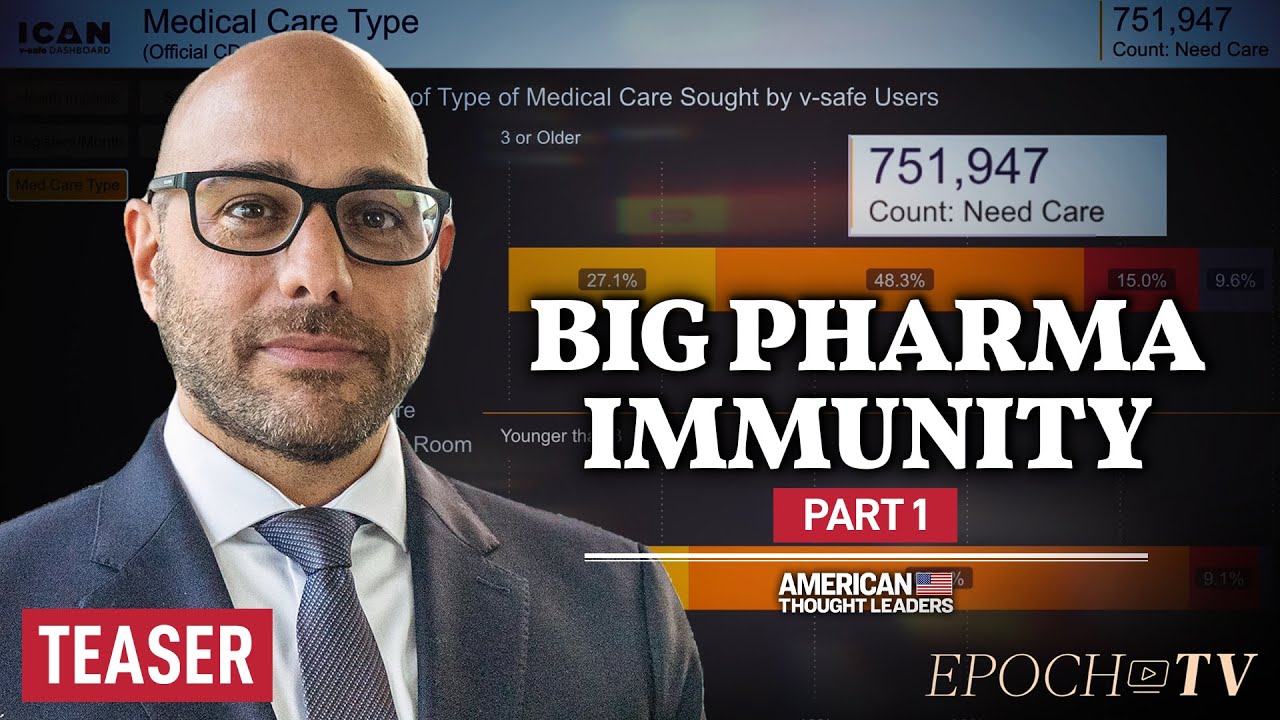
- Aaron Siri: How the Vaccine Paradigm Has Led to Medical Coercion and Conflicted Health Agencies
“I was always told that vaccines are safe. And if a product is safe, why do you need to give the manufacturer … essentially immunity to liability for the injuries that that product causes? Because if it’s safe, certainly in the way that our public health authorities project it safe to the public, there shouldn’t be any injuries, or there should be one in a million, as you often hear.” Previously, in part one of my interview with Aaron Siri, managing partner at Siri and Glimstad, he broke down how vaccine manufacturers secured unprecedented protections from liability three decades ago. “COVID vaccines didn’t enter into a vacuum. They were rolled into a very long established paradigm and way things are done,” says Siri. “They had a narrative around natural immunity that they determined fit in with their policy. And then the studies followed to make it fit.” In part two, we discuss natural immunity from COVID-19 and what he discovered in the clinical safety trials of other vaccines, such as one of the Hepatitis B products: “147 kids. Five days of safety monitoring after injection. There’s no indication there was a control group,” says Siri. “COVID-19 vaccines—they were called ‘rushed.’ They said the clinical trials were rushed. They said development was rushed. But the reality is the clinical trials for the COVID-19 vaccines that the average American received, compared to the clinical trials for almost every childhood vaccine, were the most robust studies that have been done on vaccines.” We also look at the conflicts of interest between America’s health agencies and pharmaceutical companies. “Think about this business model. You have a vaccine. You can’t be sued for harms. You have a guaranteed market because kids are required to get it for school. And your health agencies promote it for you and defend against any harm,” says Siri. Interview trailer: Watch the full interview: https://www.theepochtimes.com/aaron-siri-part-2-how-the-vaccine-paradigm-has-led-to-medical-coercion-and-conflicted-health-agencies_5041802.html FULL TRANSCRIPT Jan Jekielek: You’re flipping the way I’ve been thinking about all of this on its head. Let me explain why. You have all these doctors out there that are saying, “I was doing early treatment, I was saving people. My hospital stopped me. I had better results than hospital protocols. They stopped me, they did not let me.” Doctors were in tears. Dr. Paul Marik, who created the sepsis protocol used around the world, couldn’t do his work. Their world has been shattered in many ways. Their whole paradigm and their view of medicine has changed. You’re telling me that this has happened in the past, just on a much smaller scale, and that what we’ve seen is not that different. Is this what you’re telling me? Aaron Siri: From my vantage point, what is happening with the COVID vaccine is not very different from what has happened with other vaccines in the past. The difference is the public’s interest in this particular vaccine and also the media’s willingness to cover alternatives, I’ll call it, or the views of those that are not just in lock step with pharma and the health agencies involved with these products. I just have to stress these are medical products sold by pharmaceutical companies for profit that have immunity to any injury. They’re not given by Moses at Sinai. They have no magical properties. They’re just a medical product. They have a certain safety profile and a certain efficacy profile. There’s a reality to that. And then, there’s what you’re taught to think. Those are the two things. With that said, COVID vaccines didn’t enter into a vacuum. They were rolled into a very long established paradigm and way things are done with regards to vaccines in America. People are shocked that you can’t sue a COVID manufacturer for injuries from their vaccine. Doesn’t that create a moral hazard? That disincentivizes them from doing a proper clinical trial because their interest is to make as much money as possible. That disincentivizes them from studying safety. Sure it does, of course it does. But that’s the same with every other vaccine. And those vaccines are given to babies who can’t talk, who can’t describe their symptoms, and it’s given to a very small cohort. And it’s rolled out over time. Mr. Jekielek: But presumably because you will see a safety signal early on in that small cohort, you can stop the use, which has obviously happened. Mr. Siri: See a signal where? Mr. Jekielek: Well, you tell me. Mr. Siri: Let’s step all the way back then, and let’s just look at product safety. We talked about this a lot earlier when we started here, but there are basically two ways you can assure product safety. The way you really assure it is letting class action and product liability attorneys sue the manufacturer if their product has a problem, if it has an efficacy issue or it has a safety issue. That is how you assure products are safe in America. That is what makes products safe in America. That is why your car is safer. That normal market force has gone away. All the class action attorneys, all the product label attorneys have been neutered. They can’t do anything. They have no incentive to sue the pharmaceutical companies to make them safer. It is not only the suits that assure the products are safer, it is the threat. It is the potential of those suits, of that liability that assures the products are safer. So, you have taken away the primary way we can really assure product safety in this country, and it has been gone since 1986. There’s a secondary way we assure products are safe in America. It’s a far weaker way, and that is regulatory oversight. There are regulators, and even in the car industry, there are regulators. They do some good. But in this case those regulators are completely conflicted for two reasons. Number one, the very same department of the United States government, the Department of Health and Human Services, that is the department under which you have the CDC, the FDA, the NIH, and go down the list of over 20 health agencies, they all live in that one department. That department is responsible for promoting vaccines, and yet, they also made it responsible for the safety of vaccines. Those two things are in conflict. You tell an agent’s department to promote this product, and then you tell them to ensure it’s safe. Finding any safety issue undermines the promotion function. That is why whenever there has been a department in the United States government that is responsible for promoting an industry, the Congress has taken away the safety function. The Department of Transportation is responsible for promoting aviation. That’s why the NTSB was created, the National Transportation Safety Board, completely independent of the Department of Transportation. They’re completely independent. They are responsible for safety. Similarly, for nuclear power, there’s a Department of Energy that promotes nuclear energy. There is a completely separate department, completely independent, that is responsible for regulating nuclear power plant safety. But when it comes to vaccines, it’s one department. That’s the first problem. The second problem, and I don’t know of any other product that has this problem, and I mentioned this earlier. In 1986 Congress gave vaccine manufacturers immunity for injuries caused by their vaccine products, not just the three that were hurting people back in ’86, but for any of the future ones. And if you go look at a child’s schedule, there’s a lot more, it’s a gold rush in many ways. One thing provided an avenue for people to get some financial relief, and that was creating the Vaccine Injury Compensation Program, which is within HHS. And who do you sue? I mentioned this earlier. You sue the secretary of the Department of Health and Human Services. That’s what our firm does every day. We sue on behalf of people injured by vaccines. And when we do, we literally name the plaintiff, their name, versus the name of the Secretary of the Department of HHS in his capacity as the secretary of the Department of Health and Human Services. The very same department that’s responsible for safety. Think about that. You are making it so that if the CDC or FDA or NIH published any study that shows a Hep B vaccine causes X issue or any other vaccine has a problem, you have just created the evidence against yourself. HHS will have just created evidence to indict itself that then makes it liable in vaccine court. There’s an entire specialized department in the Department of Justice of attorneys who fight against people injured by vaccines bringing a claim. Before we talk about that for a second, I just want you to really put that in perspective. It’s so bad. Our health agencies are really, in many ways, they’re hopelessly conflicted. They are in a position where they focus on the promotion function really well and the defense function really well. That has subsumed what they do around the safety function, which has basically become a PR issue. That’s what it is. Anytime they do safety studies, they’re never studies to really show that it’s safe. They are reactionary to a PR issue around a vaccine. If you look at the vaccine safety literature, you’ll find that. When the COVID vaccine came around, it loaded onto this same exact paradigm. Our health agencies for decades now have been so attuned to just promoting vaccines and defending vaccines that the COVID vaccine just slots right into that. Mr. Jekielek: What about this whole natural immunity? This is one of the things that made me question a lot of things early on, when natural immunity was denied, that it was a thing for this disease. Whereas, for every other coronavirus it was fine. Early on I wondered, it did come from China and it likely came from a lab, is this maybe the reason? I don’t know. But very quickly we found out that natural immunity was a thing, in fact, and it was very effective. Was it just standard operating procedure for the promotion arm of these agencies to basically deny natural immunity? Mr. Siri: You found out that natural immunity, which has kept humans alive forever, is a thing? Mr. Jekielek: Yes, well no. I mean the default. Mr. Siri: Do you see what I mean? This is the narrative that is being pushed on the American public, this idea that natural immunity is something that needs to be verified, that needs health authority approval, with all of our tax money in the health agencies and billions of dollars of pharmaceutical company revenue every year. That machine is able to turn and there’s really no money on the other side pushing back on any of that. So, they can push almost any narrative, frankly, with the exception of brave journalists like yourself. And I mean that. You and many others who are willing to actually look critically at these health agencies despite the potential costs that you might pay for doing that. But to answer your question, do they just deny natural immunity? I found the way that the health authorities dealt with natural immunity to be not uncommon, in that they decided on the narrative they wanted. And then, they have a review process for the studies they put out. The MMWR [Morbidity and Mortality Weekly Report], is the CDC’s equivalent of a science journal. I call it a newsletter, but they call it a science journal. It doesn’t go through peer review, it goes through CDC’s clearance process. Everything that ends up in the MMWR then gets touted all over the news. CNN and MSNBC pick this up like it’s the holy grail of what is reality in terms of scientific knowledge. The MMWR is used as a tool to assure that CDC’s policy is then reflected in the science. Their policy comes first. There’s a clearance process to review all studies published in MMWR. That’s not me saying that, you can look it up. The CDC’s available literature explains this. And only if the quote unquote, study, the science, comports with their policy, does it get published. So, with natural immunity, you’re asking, “Is this standard operating procedure?” In that regard it is. They had a narrative around natural immunity that they determined fit in with their policy, and then the studies followed to make it fit. There were studies involving millions of people out of Israel and other places that showed natural immunity was more robust than vaccine immunity. And the CDC concocted this ridiculous case control study of one little small data set that they claim showed that natural immunity may not be as good as vaccine immunity. That study drew the ire of a lot of scientists, because they actually read it and they thought about it, because it affected them, and not some infant. It affected whether they could keep their job, and whether they could keep going to work if they didn’t want the shot. They actually started looking at that science and it’s amazing what happened, isn’t it? Mr. Jekielek: So, what happened? Mr. Siri: Public outrage and public outcry. People were like, “What are you doing, CDC? Don’t you see all these studies?” We had an exchange with the CDC. There’s a formal process where you can petition the CDC under a particular section of law and they must respond. They have to. On behalf of ICAN [Informed Consent Action Network], we submitted one of these formal requests. You can go to ICAN’s website and look at this. It’s an amazing exchange in my opinion. We did this early on. We submitted a request to the CDC and we said, “Look, here’s all these studies that show that natural immunity is more robust than vaccine immunity in terms of preventing transmission, in terms of hospitalizations, and in every category.” “So, why does your guidance say if you’re vaccinated, it’s okay for you to X, Y, Z. You can have your civil liberties, and you can participate in American life. But if you have natural immunity you can’t participate in American life.” Obviously, it’s a legal issue and it’s a civil rights issue. Those CDC guidelines affected whether you can go into a restaurant, whether you can have a job, and whether you can go to school. They made it a legal issue. That’s why we formally petitioned them and said, “You have brought this out of the realm of just science and you’ve made this something that attacks the civil rights and individual rights of everybody in this country. So, answer to this. How in the face of all of this data can you say that vaccine immunity is okay for you to participate in American life, but natural immunity is not sufficient?” They responded by ignoring all that data and citing that one study of these few hundred people that wasn’t even a cohort study. I don’t want to get into epidemiology. Every epidemiologist who’s got any integrity tells you this one study is garbage and it’s ridiculous. And even if it happened to be correct, it’s a chance finding, and it’s of no weight in the face of the studies involving millions of people. But yet, that’s what they responded with. We then replied to them, and they never responded to our reply pointing out the ridiculous nature of this, and you can read that exchange. Mr. Jekielek: Hey everyone, I’ve got a special announcement. We’re launching a Sunday watch party series. Many of you have told us that you want to share some of our best episodes with your friends and family so they can be more informed about what’s going on. So, every Sunday at 7:30 PM Eastern, we’ll be re-premiering some of our best “American Thought Leaders” episodes for subscribers and non-subscribers alike. It’s free to everybody. If you have a suggestion for the next “American Thought Leaders” episode that you’d like to see for our Sunday watch party, please tag us on Twitter at ATL Sunday Watch Party. Again, that’s ATL Sunday Watch Party, Or email us at atl@epochtimes.com. I look forward to seeing you all on the live chat this Sunday. Mr. Jekielek: At this point I have to go back to this incredibly disturbing thing you told me earlier, which was that there are really short safety study times for childhood vaccines. What do you mean by a very, very short time period? I’ll tell you why I’m asking, because people typically say, “It takes 10 years or many years to develop a vaccine. People said, “There’s no way they’ll be able to develop these COVID-19 shots because how will we know? These safety studies take a long time. Please explain to me what you’re saying here. Mr. Siri: The COVID-19 vaccines, they were called rushed. They said the clinical trials were rushed. They said the development was rushed. But the reality is the clinical trials for the COVID-19 vaccines that the average American received were, compared to the clinical trials for almost every childhood vaccine, were the most robust studies that have been done on vaccines. Let me tell you why. One, when people talk about other vaccines and they say, “Oh, it took a decade to develop it,” they’re not talking about the clinical trial done in human beings to assure that it was safe and effective. They’re talking about the timeline it took to develop the technology needed to create the vaccine. Take Recombinant Hep B vaccines, which are DNA vaccines. It took a long time to create that technology of taking the DNA from hepatitis B and then putting it into a yeast, growing it in yeast, and getting that DNA to multiply and then injecting it in. It took a long time to create that technology. But that’s different from how long the clinical trial then assessed its safety and efficacy before you licensed it. When it comes to COVID vaccines, the technology needed to actually create the mRNA vaccines, that also had been going on for decades. In the same way, it took over a decade to create the recombinant technology to create the hepatitis B vaccines, as an example. What’s critical though, is not how long it takes to create the technology. It’s that once you’ve created it, what is its effect on human beings? That is what’s critical. And how do you assess that? You assess it in a clinical trial where you give one group of people the product, the experimental product, and you don’t give it to another group of people. Instead, you give them a placebo control, a saline injection. And then, you compare the total health outcomes between those groups. That’s how you study the efficacy and how you study the safety. There are three critical components when you think about a clinical trial and assessing whether it was a good clinical trial? Was it able to really assess those two things, efficacy and safety? The first component is how long did it review safety in the clinical trial? COVID vaccine trials reviewed safety for over six months. The second thing you looked at, how many people are in the trial, meaning how well powered is it? The more people in the trial, the more likely you are to pick up a safety signal or an issue. That’s the second factor you look at. The third factor you look at is what did the control group receive, or was there a control group? Because if you don’t have one that’s basically getting something inert, or something that has a clearly defined, well known, well established safety profile, if you don’t have that, what are you comparing? If I compare giving you anthrax with another anthrax, or giving you arsenic with giving you arsenic, or compare arsenic with shooting you, maybe they’re equally as safe. They both cause the same amount of harm. But that’s why you need a proper control group. For the first thing, with COVID vaccines, for six months of the safety review period, we had 30,000 people, and they had a placebo control group for an average of two months. We know that at some point they vaccinated the placebo control group, but at least they had one for an average of two months. Let’s look at the hepatitis B vaccine given to babies. There are two hepatitis B vaccines given to babies when they’re first born; first day of life, and then at one month and at six months. One is made by Merck, Recombivax HB, and one is made by GSK, Engerix-B. Before I tell you how long the safety was, before I tell you how many kids were involved, and before I tell you what the control was, let me just say that what I’m about to tell you, if you told me what I’m about to tell you, I’d say no way, I don’t believe it. Here it is; 147 kids, five days of safety monitoring after injection. There’s no indication there was a control group. COVID vaccines have over six months of safety review in a clinical trial that was relied upon by the FDA to license it. Hepatitis B vaccine given to a newborn had five days of safety monitoring after injection. There were 30,000 people in the COVID 19 vaccine clinical trial for Pfizer, even more for Moderna. Or maybe I have that backwards, one of the two. One had about 45,000. For the Hep B vaccine, it doesn’t appear there was even control. Even if there was, what are you going to get with 147 kids for data, unless the injury is like one in five, one in three kids? Mr. Jekielek: You’re right, it does strain credulity. Mr. Siri: For anybody watching this, don’t take my word for it. Go to the FDA website. In fact, can I show it to you right now? Mr. Jekielek: Yes, please. Mr. Siri: You can go to FDA licensed vaccines. Go to Google and you can search for it, or go to DuckDuckGo, or your search engine of choice and search for FDA licensed vaccines. The first result will be a page on the FDA website called vaccines licensed for use in the United States. And I’ve actually got it open right here. I’m going to scroll down to hepatitis B and Recombivax HB. I’m going to click on it, and then I’m going to click on the package insert. In the package insert you then go to section 6.1. Section 6.1 in all these package inserts is the clinical trials experience. You know how when you get a drug, there’s a piece of paper inside, and you open it up? Section 6.1 is where the FDA requires the manufacturer to explain the clinical trial experience. That’s where it will tell you what the clinical trial is. I will read to you exactly what it says regarding the clinical trial in infants. Again, this is on the FDA website. This is Merck’s package insert for the Recombivax HB hepatitis B vaccine approved by the FDA. It says, “In three clinical studies, 434 doses of Recombivax HB five micrograms were administered to 147 healthy infants and children up to 10 years of age who were monitored for five days after each dose,” period, end quote. Now, I will tell you when I saw that and when the folks at ICAN saw that, we also said, “It cannot be, it can’t be.” So, we FOIA’d the FDA for the actual clinical trial reports submitted to license both this vaccine and Engerix-B, and we have them. I can confirm to you the monitoring for safety was five days after injection for a product given to a newborn, a one-month-old, and a six-month-old. So yes, I think the word I said was ridiculously short. Yes, I stand by that. I would say five days is ridiculously short. And by the way, the other Hep B vaccine, Engerix-B, for the safety review period, and again, everybody can look this up just like I did for Recombivax HB—four days of safety monitoring after the shot. Four days. These are the only two shots that a newborn can get in America. That’s the first shot they get in life. So yes, I’d say ridiculous might be too soft of an adjective to describe that safety review period. And again, we FOIA’d the FDA, we have the clinical trial documents for both of these vaccines, just like we did for the Pfizer clinical trial docs, and it is that safety review. In fact, on behalf of ICAN, we have actually filed a formal petition with the FDA to either do a proper clinical trial of this product or withdraw the licensure. They have six months under the law to respond. That six months has long come and gone. Despite our constant follow up, they have not given us a formal response. We will soon be suing them in federal court over this exact issue. Either do the proper clinical trial because Congress said you are only to license products that are proven as safe and effective. That clinical trial cannot do that. How long do you need to review safety? How many kids, and what should the control receive? There is probably a gray area, but four or five days, that is definitely in the area that is not sufficient. That is probably why, despite it being well over a year at this point, the FDA has no response to our formal petition. Because what are they going to say? How do you justify that? Mr. Jekielek: Has anyone tried to justify it to you? Mr. Siri: I’ll tell you the answer because I pondered this for a long time. It really troubled me. My presumption is that most people in quote, unquote, public health, are good people. How could the FDA have done this? Why would the FDA have done this? It doesn’t make sense. The best I could come up with is the following. When you look back at the ’80s and ’90s when pretty much half of the vaccines on the current childhood schedule were added, and in the early 2000s when the most of the rest of them were added, when you look at the people who sat on the FDA and CDC vaccine committees, many of them had serious pharma conflicts. Many of them were consultants, and many of them worked for pharma. The very people who were effectively deciding whether or not the FDA and CDC should license the product on the FDA side and the CDC side, and recommend them on the child schedule, were highly conflicted. I’m not saying they’re bad people. I’m just saying that probably clouded their judgment. They were of the motto, “Vaccines are the holy grail.” I don’t want to make excuses for them, I just don’t know. By the way, that’s not me saying that these folks had high conflicts with pharmaceutical companies. In 2000, there was a Congressional oversight committee investigation into the FDA and the CDC vaccine committees. They found that the majority of the members had significant ties to pharmaceutical companies. Some of them were receiving seven figures. They were consultants, and there were all kinds of issues. I recently deposed an individual, who is actually the head of one of the four safety systems at the CDC, she runs it. This doctor also sat on the FDA or CDC vaccine committee from 1991 to 2000. I had an opportunity to depose her. Before the deposition, we looked at all her published studies. When we looked at those published studies, we found studies that reflected that at the same time she was sitting on the FDA and CDC vaccine committees and voting on these products, whether they licensed them or recommended them, she also had significant conflicts with those same companies disclosed in her peer review studies. I’m not the first one to raise this issue. That congressional report raised it in 2000. Another report by the HHS Inspector General in 2008 raised it again. This same doctor that I just told you who is the head of one of the safety systems at the CDC, is also on the Vaccine Safety Monitoring Board of the Pfizer COVID vaccine. She presents to ACIP [Advisory Committee on Immunization Practices], she’s the head of one of their safety systems. And at the same time she’s paid by Pfizer to be on their quote, unquote, independent vaccine safety monitoring board, overseeing the safety of the COVID 19 vaccine during its clinical trial. That board is effectively five people, and I think they added two people over time. But she was the vaccinologist on that committee. They have other disciplines, epidemiologists and so forth, but she was the vaccinologist. She was the person that this country was relying upon, basically, to assure the safety of the COVID-19 vaccine while the clinical trial was rolling out. This committee is supposed to be independent. Not only was she part of the head of the CDC safety system while she had that position, directly before being on the independent Data Safety Monitoring Board for the Pfizer COVID-19 vaccine, guess who she was a consultant for? Pfizer. When I think of an independent Data Safety Monitoring Board, I don’t really think of it as having the vaccinologist on it directly before being a consultant for the very company that you’re now supposed to be independently evaluating for the safety of the clinical trial, and at the same time having all these conflicts vis-a-vis the CDC. That’s just me. Mr. Jekielek: The thing that really jumps out to me right now is that these types of conflicts have lasted for a long time and clearly not enough has been done to change that reality. Mr. Siri: Our health authorities have all our money, it’s called taxes. They have billions of our dollars, and they deploy it to tell the public, safe and effective, safe and effective. That’s all they tell you pretty much, over and over and over and over again. They use the MMWR to create science studies, and otherwise, they don’t engage in doing any studies other than those that seek to affirm their policy objectives. And then, you have the pharmaceutical industry that’s a revolving purse of billions of dollars every year selling these products. They have really great PR firms down on Park Avenue in Manhattan. They do an exceptional job for them. You have the pharmaceutical industry that pumps billions of dollars every year, and that is getting billions of dollars. They have the health agencies, and they are all on the same page. Who is on the side of vaccine safety? Who’s assuring it? Again, normally it would be the product liability lawyers pushing back on pharma, but that doesn’t exist. Or it would be the regulatory agencies pushing back on the industry, which doesn’t exist. Who’s there? Who is there assuring the safety of childhood vaccines? There are over 1400 pharma lobbyists in Congress. How many vaccine safety lobbyists are there? Zero, as far as I know. There is no moneyed interest that assures the safety of these products like there is for virtually every other product. You may not like them, but product liability lawyers and class action attorneys have a really important societal function. And they’re not here, they’re out of this picture. Drugs come off the market all the time. You think pharma companies do it because they’re altruistic? No, they do it because they are sued, and there is the threat of liability. Or maybe the regulators actually do their job with drugs sometimes. Here is the craziest part. For almost every other product, there is a nonprofit organization or a group that seeks to assure the safety of that product. You have consumer groups that want to make cars safer, and want to make drugs safer. You want to make the various products that you deal with every day safer. They’re lauded, typically. People appreciate them. They are viewed as a public service, and they are appreciated, even if you don’t necessarily always agree with them. They want to make food safer, they want to make food less contaminated, they want to get rid of toxins, and people typically appreciate it. But do you want to make these products safer? Mr. Jekielek: You’re an anti-vaxxer. Mr. Siri: You get labeled with that pejorative and others. But really at the end of the day, these groups out there are fighting for everybody, even those who don’t realize it. ICAN, the nonprofit we represent, is not looking to take a vaccine away from anybody. They’re not looking to pass laws that prevent you from getting shots. They’re not looking to pass any laws, they are a 501c3. Everybody out there right now in America that is saying to themselves, “Everybody should have to get them. They’re great, I love them all.” Great, maybe you love them. Maybe you love every vaccine. Maybe you love having to wear masks. Maybe you love having to engage in stay at home protocols. And maybe you love every one of these coerced medical interventions. What happens when the day comes that there’s a product you don’t want? Then, you will appreciate ICAN. Then, you’ll appreciate all of these folks who have been fighting to assure the right to informed consent and bodily integrity, and for your right to say, “No.” Because at the end of the day, you’re not going to be able to fix clinical trials. They’re done by pharmaceutical companies. They have a revolving cash fund of billions of dollars every year. Unless you take away their profits, that machine is not stopping. You’re not going to be able to assure that the health agencies don’t have conflicts, unless you can undo the ’86 Act at a minimum. With the 1400 lobbyists that pharma has, I don’t see that happening. That conflict in our health agency apparatus is not going away. You’re not fixing that, most likely. You’re not going to be able to fix the litany of issues that we’ve discussed here over the last 45 minutes. At the end of that long train of issues, there is one thing that has to remain sacrosanct, something that this country was founded on. It’s an individual right—the individual right to say, “No, I don’t want that product in my body or on my body, whether it’s a drug, whether it’s a vaccine, whether it’s a mask, or whether it’s anything. No.” It’s the ability to say no that is so critical, because it is the last stop on that train to protect you and your child from a product that you think might harm you or your child. If you can’t do that without being kicked out of school, thrown out of your job, or excluded from civil society, then you don’t really have the right to say no. That is incredibly dangerous. Pharmaceutical companies are very, very smart. You let that platform exist, and that platform permits them to not only have a liability-free product, they have a captive market. Think about this business model. You have a vaccine and you can’t be sued for harms. You have a guaranteed market because kids are required to get it for school, your health agencies promote it for you, and defend against any harm. It’s an incredible business model. If you let that keep going, if you let that extend to other drugs and other interventions to the adult population, they’re smart, and they will load onto it as many drugs as they can. You’ve watched it happen over the last two years. And there’s no intent to stop it. So, I hope people will come to appreciate these nonprofits who are fighting for the right to informed consent, and fighting for the right to bodily integrity. Hopefully one day, maybe not today, we will recognize what they were doing is an incredible public service. Mr. Jekielek: Aaron, I have one final question as we finish up. There is the subcommittee on weaponization of the federal government which has been formed. What you described to me could be conceived of as a kind of weaponization of the federal government. If you had a wishlist of what this committee would do, what would that be? Mr. Siri: In the framework of what we have seen over the last two years, there would be a number of things. One would be that the federal government would stop engaging in any of the coercive measures they’re currently engaged in to coerce people to get medical products that they don’t want. That has to stop. Whether it’s by presidential decree, by regulatory mandate, or by the use of the purse strings to bludgeon states into doing things that they may not even want to do, like requiring vaccines, withholding funds, or requiring masks. Second, the federal government has to get out of the business of violating the First Amendment. It needs to stop trying to control what the media does and says, or trying to get them to censor. Social media is there to make money. Facebook, Twitter, all of these platforms left to their own devices want as many users as possible. They would not have deplatformed folks who are basically saying the stuff that when certain people go on CNN and say it now, it’s fine. But when folks were saying it over the last a year-and-a-half, they had to be thrown off of social media. It is destructive to our democracy, and it is destructive to the entire notion of free speech, which is a founding principle that makes this country great. From there I would eliminate any immunity for any company making any medical product, period. If they can’t make a product that’s safe enough and effective enough such that the amount of revenue they’re generating doesn’t exceed the amount of harm measured by dollars, how else are you going to measure it? Then, they should be out of business and they should go make a better product. So, I’ll give you those top three. I could probably keep going for a long time, by the way, but I would stop there. The other thing is that there needs to be a return to a respect for individual and civil rights. I have to say it again. It is a lack of respect for individual and civil rights that has wrought more harm to humanity than anything else, when you look back over the ages. It is the idea that a king, a lord, a noble or some centralized government can make decisions for you, and can take away your right to decide. That has caused more harm, more death, and more destruction than anything else in human history. The creation of this country was a rebellion against that notion that we are not free, and that we should have individual and civil rights, and that the government shouldn’t be telling us what to do. Up until a few years ago, a good portion of Americans understood that when the U.S. Supreme Court found that neo-Nazis can, as long as there wasn’t violence, walk through a Jewish town in Illinois and be able to say what they want to say, because that is free speech from the First Amendment in a public street. Most Americans understood about protecting the rights of neo-Nazis, as deplorable as you might find them, and as deplorable as you might find their message about Jews, protecting their right to say what they want to say as long as it doesn’t lead to violence. Protecting their right to say that, protected all of our rights to free speech. That ethos and that understanding, it is amazing how quickly so many people in America have lost that understanding over the last two years, which is the greater harm is taking away those rights. That’s the greater harm. I hope that we can return as a government and as a country to appreciating and respecting those rights, because without them, we just descend into all the governments of yore before the creation of this country that have brought so much harm and destruction. I would say that is an overarching concern that I hope this committee looks at, thinks about, and addresses, and it’s my bigger hope in 2023 for this whole country. Mr. Jekielek: Aaron Siri, it’s such a pleasure to have you on the show. Mr. Siri: Thank you. Mr. Jekielek: Thank you all for joining Aaron Siri and me on this episode of “American Thought Leaders”. I’m your host, Jan Jekielek. To get notifications about new Kash's Corner and American Thought Leaders episodes, please sign up for our newsletter! Here 👉 Get Alerts - PRE-ORDER "The Shadow State" DVD: https://www.epochtv.shop/product-page/the-shadow-state-dvd The Real Story of January 6 | Documentary BUY Jan 6 DVD: https://www.epochtv.shop/product-page/dvd-the-real-story-of-january-6, Promo Code “Jan” for 20% off. - Follow American Thought Leaders on social media: Twitter: https://twitter.com/AmThoughtLeader Truth Social: https://truthsocial.com/@AmThoughtLeader Gettr: https://gettr.com/user/amthoughtleader Facebook: https://www.facebook.com/AmericanThoughtLeaders Gab: https://gab.com/AmThoughtLeader Telegram: https://t.me/AmThoughtLeader
- Aaron Siri (Part 1): Why Are Vaccine Manufacturers the Most Protected Companies in America?
“When we finally had that data, you got a sense of why they didn’t want the public to have it, because it showed that 7.7 percent of the over 10 million V-safe users reported needing medical care after a COVID-19 vaccine.” Aaron Siri, managing partner at Siri & Glimstad, has led several high-profile lawsuits against vaccine manufacturers and federal health agencies since the start of the COVID-19 pandemic. “If they prevail … in five to 10 years, what will happen is it will reset the normal health baseline in America for heart issues, cardiovascular issues, right? That will be the new normal,” Siri says. In this comprehensive two-part interview, Aaron Siri breaks down how vaccine manufacturers secured unprecedented protections from liability three decades ago. “There is no other product that I’m aware of that is afforded this level of protection,” Siri explains. “When you look around you, all the products you experience every day, they’re safer because the manufacturer is worried about liability.” Siri was always told that vaccines are safe. But if a product is safe, he explains—at least in the way that public health agencies project it to be safe to the public—the injuries would be exceedingly rare, and thus, there would be no need for the manufacturer to be granted immunity from liability. “They were going to stop producing those vaccines because they could not make a profit because the amount of liability they had to pay exceeded the revenue,” Siri says. “You learn things along the way that you just can’t unlearn.” Interview trailer: Watch the full interview: https://www.theepochtimes.com/aaron-siri-part-1-why-are-vaccine-manufacturers-the-most-protected-companies-in-america_5035884.html FULL TRANSCRIPT Jan Jekielek: Aaron Siri, such a pleasure to have you on American Thought Leaders. Aaron Siri: Pleasure to be here. Mr. Jekielek: Aaron, you are very, very serious about mandates, mandates of any sort of foreign substance being put into someone’s body. You are deeply against these things, and you’ve done a number of court cases related to this, most recently around the COVID-19 genetic vaccines. Let’s start here, because your law firm focuses on this now. How did you get into this? Mr. Siri: I should just say I’m not deeply against people taking medical products, or injecting medical products. In fact, I fully support everybody’s right to take as many medical products as they want, as many times as they want. The only opposition that I have is when you force somebody to do it, either through coercion and punishments when they don’t want to, because it’s just a basic civil right that everybody should be able to make their own medical choices without coercion. In terms of how I got into this, so to speak, I was a commercial litigator for many years. Somebody I had worked with at a firm that I had been with for many years, Latham & Watkins, was going to go work with the Department of Justice; he had gotten a job there. And at this point in my career, I had left my former firm, one of the biggest firms in the country where that represents Goldman Sachs. He contacted me and said, “I’m going to work for the Department of Justice. I’ve got this flu shot case where I have this nurse who’s seriously injured from a flu shot, and I can’t represent her anymore, because I’d be conflicted.” Because it’s the Department of Justice that defends against all of these lawsuits brought by people claiming a vaccine injury. If you’re injured by a vaccine you can’t sue the manufacturer, you have to sue the federal government, the Secretary of the Department of Health and Human Services, in something called the Vaccine Injury Compensation Program, part of the U. S Court of Federal Claims. He asked me if I would be interested in taking the case, because I had done some related work up until that point, and so I said, “Sure.” I took the case on, and we ended up obtaining compensation for a case from the flu shot, and there were a number of other cases at the time that I took on in a related kin, I should call it. And you learn things along the way that you just can’t unlearn. Mr. Jekielek: One of the things you learned was that you’re suing the Secretary of Health and Human Services? How many people know this, or even that this is the reality? Mr. Siri: I remember that was one of the very first things I learned about vaccines, these products. I remember working at a law firm where I looked it up and it was the National Childhood Injury Act of 1986. I looked at it and I was incredibly surprised. If anybody out there wants to look it up, it’s 42 U.S.C. 300aa-11. Just type in what I just said, and you can read that section of law, read the third paragraph, and in effect, it says that you cannot sue a vaccine manufacturer or administrator for any injury or death from a vaccine. I remember thinking, “Wow. I know that gun manufacturers have some level of immunity to liability, but we know guns can be dangerous. I know that nuclear power plants have a level of immunity to liability given to them by Congress as well, if there is a nuclear meltdown, but we know nuclear power can be dangerous. But I was always told the vaccines are safe. If the product is safe, why do you need to effectively give the manufacturer blanket immunity to liability for the injuries that that product causes? Because if it’s safe, certainly in the way that our public health authorities project it’s safe to the public, there shouldn’t be any injuries or there should be one in a million, as you often hear.” Mr. Jekielek: And you hadn’t thought about this before? Mr. Siri: No. I just thought the same thing everybody else thought. I drink water because that’s good for me. I eat healthy food because that’s good. I go to sleep every night. What is generally projected about these products by public health authorities typically is that, similar to water, food and sleep, you get vaccines. But that was an eye-opening moment. When I looked into it just a little further, it didn’t take much to scratch the surface. And then you say, “Okay, why then? Why did they get this immunity?” You can read the Wyeth v. Bruesewitz U.S. Supreme Court decision of 2011 that even discusses it. Part of what that explains is that the liability that vaccine manufacturers were facing leading up to 1986 was so great, that either Congress had to step in and give them immunity liability, or at that point, with the three routine vaccines given to children—that’s all there were, three, and there was only one manufacturer left for each—they were going to stop producing those vaccines, because they could not make a profit due to the amount of liability they had to pay exceeded the revenue. But that’s how it works in America. If your product is causing more harm than it is good, the way we measure it, for better or worse in America, is by dollars. Then, you have to go make a better product. You have to go make a safer product. Had Congress just done nothing, and just let the market forces do what they do, those vaccine manufacturers, would they have just gone out of business? No, they’re in the business to make money. They probably would have retooled, and made a better product, and presumably, a safer product. But Congress in its wisdom said, “It’s okay. You can keep selling your vaccines that are causing a level of harm that is making you almost go out of business. We’ll just give you immunity, so nobody can sue you.” So, the vaccine manufacturers were given immunity to liability for their product, and not only for the three vaccines that were routinely given then, but for any future routinely recommended childhood vaccines, prospectively. And it was that act, it was that immunity to liability, that in my opinion, has set off the cascade of events that we now see manifesting today around these products; how they’re viewed, how the public views them, how our health authorities treat them, and how pharma has been able to basically run amok. There is no other product that I’m aware of that is afforded this level of protection. When you look around you at all the products you experience every day, they’re safer because the manufacturer is worried about liability. Your car is safer, not because of some regulatory agency, maybe to some degree, but it’s because they don’t want to get sued, and they don’t want to have to pay billions of dollars in damages. With virtually every product you interact with in America every day, the manufacturers can be sued for design defects, claims that the product could’ve been made safer, and claims that they failed you to warn about risks. But you can’t sue pharmaceutical companies with regards to those claims in the same way for vaccine products. What that has essentially done, it has left pharmaceutical companies for the last over almost 40 years with complete control of the narrative around these products, and they’ve done a very good job in making sure that the public thinks their products are great. Mr. Jekielek: You’ve been involved in a few quite high-profile cases, probably many. There are two that come to mind. One is the Pfizer clinical trial data lawsuit. The other one is the V-safe data lawsuit, which you talked about at the recent hearing in December that Senator Ron Johnson held. Why don’t you give me an overview of the V-safe piece? A lot of people might be familiar with the Pfizer data, and maybe we can look into that more, but please explain why you went after the V-safe data, and what exactly is that? Mr. Siri: The vaccine policy work that our firm does, and we have a big vaccine injury practice and we have a vaccine exemption practice. But the core of our vaccine practice is the vaccine policy work. Most of that is done on behalf of a nonprofit called the Informed Consent Action Network. It’s a nonprofit started by an individual named Del Bigtree. The Informed Consent Action Network asked us to get the data from the V-safe database. The V-safe database is what the CDC basically calls it, its premier safety system for COVID-19 vaccines. It was rolled out specifically for COVID-19 vaccines. For decades, the CDC has said that their VAERS [Vaccine Adverse Event Reporting System] database is their premier database for assuring vaccine safety essentially. It’s their signal detection system. If there’s a problem out there with a vaccine, they’ll pick it up in VAERS, saying, “Don’t worry.” And then, they will go to other databases to assess it. All of a sudden, just as the first COVID vaccine was about to be authorized in December 2020, the CDC and the FDA actually started changing their tune about VAERS. They very quickly changed their tune about it, after lots of reports started coming into VAERS. They started saying, “Actually, there are issues with VAERS, and so we’re going to roll out a new system called V-safe and this is going to help us,” and these are the CDCs words, “rapidly detect issues with the COVID-19 vaccine safety issues, so that we can address them.” In designing V-safe, the CDC basically had check the box options and it had a free text field. It had two categories of check the box options. The first category was asking people for one week after the COVID-19 shot to check the box about 18 or so symptoms, whether they experienced them, and whether they were low, mild or severe. The thing is, those symptoms are the same symptoms that the CDC tells you are normal, and are in fact good for you to have after a COVID vaccine, they call it reactogenicity. They say that those symptoms show the vaccine is working, and that you are having an immune reaction, which is what they want you to have after the vaccine. They don’t want it to be severe, but they want you to have it. The truth is, no matter how high those rates would have been reported, it wouldn’t have mattered. So, that data is basically useless. Then, there’s a second category of check the box data in V-safe that was collected, and that was one of three options that users could have checked. One; did they need medical care? And then, they could have sub-checked whether it was hospitalization, urgent care, emergency room, or telehealth. The second one they could have picked; did they miss school or work? And the third option that was provided; were they unable to perform normal daily activities? It must be in what the CDC said is their rapid detection system to ensure the safety of the COVID-19 vaccines, it was in those three options where they were going to assess safety. Where else would it be? So, ICAN, my client, wanted to know at what rate did people check they needed medical care after a COVID-19 vaccine? Presumably, that’s basically the only metric you’re really asking the people using V-safe to provide in a systematic way, where you could get an enumerator and a denominator. You can say, “Here’s the number of people that say they need medical care, and here’s the total number of V-safe users; divide that and you have a rate. We asked the CDC, “Can you provide that data?” The CDC said, “No.” As usual with our health agencies, despite their claims of transparency, we had to sue them in federal court to get the V-safe data. In the first lawsuit, they raised objections that were interesting. So, we bought a second lawsuit that basically addressed their objections in the first one to lock them in. At that point, they finally capitulated—it took almost a year-and-a-half—and they provided all the check the box data in V-safe. When we finally had that data, you got a sense of why they didn’t want the public to have it, because it showed that 7.7 per cent of V-safe users, out of a little over 10 million V-safe users, reported needing medical care after a COVID-19 vaccine. These 10 million users, these are not folks that are like with VAERS, they are just using the system to report an issue. They are signing up right when they get the shot, at the CDC’s urging, and most of them signed up in December 2020, in the first few months of the vaccine’s rollout. These are folks who are the enthusiasts, they were going out to get the shot. These are the ones who are fighting, clamoring over each other to get the shot. Nobody’s being mandated to get it. When 7.7 per cent of them are reporting needing medical care, it’s probably a very good reflection of the full population that got the vaccine. You probably can extrapolate, and if anything, it is probably underreported, because they were more likely to be vaccine enthusiasts. Of that 7.7 per cent, there was another 25 per cent that separately reported being unable to go to school or work, and weren’t able unable to perform normal daily activities. So, 32 cent of folks reported having some issue. And so, the fact that a medical product can cause you to go to the emergency room, that is not shocking. I mean, drugs get pulled from the market all the time. What’s concerning here is the CDC province transparency. During the year-and-a-half that they were hiding this data from the public while we fought with them to get it, repeatedly, they were publishing over a dozen studies using V-safe data, and relying on V-safe to promise the public that these vaccines are safe. And when you look at those studies, what did the CDC include in them? They only included the first week of data reporting in V-safe, of people needing medical care after the shot. And that rate was something like half-a-percent. First of all, I don’t know why one in 200 people needing medical care after the COVID shot in the first week is somehow comforting. When you look at subsets in the V-safe data, which we now are able to do, it’s as high as 3 per cent in the first week for certain subsets, if you do by age and shot, which should be extremely concerning. But even half-a-percent, that should be concerning. They publish that to the public knowing that injuries from vaccines don’t only arise in the first seven days after a shot. We do cases in the Vaccine Injury Compensation Program all the time. It is well known that immunological issues with vaccines often take at least a week to manifest. It doesn’t just happen in a minute. You have to build up those self-antibodies that cause a problem, and that takes time. This idea that the first week is somehow representative of safety, they know that’s not the case. They’ve had that full dataset for a year-and-a-half. They used only the first week to claim it’s safe, where had they looked for the first six weeks, that number is way larger. They knew that, and they never disclosed it to the public. And it wasn’t like the public wasn’t asking; we were demanding it, and we were suing them over and over for it. This is very concerning. Mr. Jekielek: There is another issue. If I understand it correctly, they already knew at the outset from some FOIAs that we did, that there were very specific adverse reactions to these vaccines. So, it would not have been too difficult to include those in one of these dropdown menus. Mr. Siri: Yes. What you’re talking about is, as part of the lawsuit we did on behalf of ICAN against the CDC, we not only ask for all of the data in V-safe, we also ask for all the documentation and communications surrounding V-safe. And some of that documentation included the protocol that the CDC published for designing V-safe. And there were many iterations of that protocol. Version one of the protocol was from before December 2020, as you would expect. If you’re going to design the system, you need to have the protocol, the design document before you launch it. That first protocol from a few months before V-safe was launched, if you go to the very last page, it has what was labeled adverse events of special interest in a table that’s entitled pre-specified conditions. It listed 15 medical conditions, many of which are now the same issues that people with COVID vaccines are saying they are experiencing; myocarditis, pericarditis, and transverse myelitis. You can go down the list and see them. The CDC knew about those conditions, and knew the COVID-19 vaccine could likely cause them, before it launched V-safe. It had an opportunity to take those 15 conditions and make them check the box options in V-safe. Had it done that, we would be able to calculate a rate for these conditions among the V-safe users like this; if 500,000 people using V-safe reported myocarditis and you had 10 million users, that’s 5 per cent, 500,000 divided by 10 million and boom, you would have a rate. That would give you real safety. When the CDC called it a rapid system for detecting safety, that would have been rapid. You would actually have that. When you think about criminal cases or criminal law, what you need to prove is called scienter. You have to prove a guilty state of mind, that the person acted with forethought, and that they knew what they were doing was wrong. Here the CDC was aware, it itself listed myocarditis, and many of the issues we see today as adverse events of special interest. It is very aware that by not including those as check the box options, it relegated people who wanted to report those issues, to a free text field that is included in V-safe. People would just type it in, but nobody types in the same thing the same way. Somebody says, “I have a heart chest pain, I have a heart attack, I’ve got heart issues, my arm hurts, I’ve got tingling in my side, tingling in my right arm, tingling my left arm.” People report cardiovascular issues in hundreds of different ways. Taking those free text fields and then trying to standardize them and create a rate would be very difficult. Moreover, it clearly never intended to release to the public what was actually written in those free text fields. How do I know that? Because they’re refusing to do it in the federal lawsuit we are in. They have taken a position in our federal lawsuit that they will not disclose the data in those free text fields. The CDC; were they just negligent, or did they really go into this with some forethought to try to hide harms? To me that is probably one of the best pieces of evidence. They went into this knowing this shot could cause these harms, and they designed V-safe in a way that would allow them, if it came to be that the vaccines caused harms, that they could hide that data, and not have to disclose it to the public, or at least they were hoping for this. The lawsuit is far from over. Mr. Jekielek: Incredible. I want to mention, having a background in survey and experimental design, 10 million is a pretty good sample size. What you’re saying that it is likely representative of the general population makes a lot of sense. Mr. Siri: Yes, and in many ways it’s better than the Pfizer data. With the Pfizer clinical trial data, it got a lot of news that about 30,000 people were in the clinical trial. That data was filtered through Pfizer before it got to the FDA, and then got released to the public. And what do they do in the clinical trial? They ask participants to tell them about issues. What does V-safe do? It asks participants to tell them about issues. But instead of asking 30,000 people, it asks 10 million. And instead of having to filter through Pfizer, it just goes straight to the public without that filter. That’s why, in my opinion, with the V-safe data, that 7.7 per cent number is probably the best reflection of the safety of COVID vaccines you’re likely to ever get on a mass scale out of our health authorities. Mr. Jekielek: Compared to VAERS, it has the denominator, which is critical at figuring out what rates are. Mr. Siri: Right. Mr. Jekielek: It’s not just a signal, it’s an actual rate. Mr. Siri: That’s right. With VAERS, you don’t know what denominator to use. If you find 10,000 reports of an issue, you don’t know what you divide that with. How many people that had the issue are reporting it to VAERS? Out of what universe of individuals, you just don’t know. It’s harder to calculate a rate. Although I will say pre-COVID, HHS, with the agency for Health Research and Quality, with an HRQ-funded study, one of our health agencies, funded Harvard Pilgrim and Harvard University scientists to do a study of VAERS. In that study they noted that less than 1 per cent of adverse events are reported to VAERS. I think that rate probably increased during the COVID era, but that number is probably very accurate. It was less than 1 per cent before the COVID era, and probably not much more than that after the COVID era. Mr. Jekielek: It’s very interesting to me that you said that prior to 2021, VAERS was considered to be the premier safety system. I didn’t know what VAERS was until recently, in the last few years. All I’ve heard is that it’s this discredited system because anyone can report. But you’re telling me for the history of vaccine safety, it has been a very different tune. Mr. Siri: Yes. The fact that you’d never heard of it and most folks hadn’t heard of it, and actually even many doctors had never heard of it, is why the rates in pre-COVID, not surprisingly, were probably far less than 1 per cent of the actual injuries from the vaccines that you find in that system. But to answer your question directly; yes, pre-COVID, if you go and look at the peer-reviewed literature around vaccine safety, which is very thin, pick a vaccine, go to PubMed, and try and see how many studies you can find on that particular vaccine, how many safety studies, and you’d be surprised there are not very many. We know this because at our firm, when somebody calls us up, and says, “My child got a shot and was totally healthy and totally fine, and then all of a sudden developed X issue. Where do we go? We start with the clinical trial data, which is usually useless for childhood vaccines, because the safety review period is ridiculously short, there’s not enough people in the studies, they are not well powered and there’s typically no placebo control, actually there’s virtually never any. We then go to the post-licensure studies and there aren’t many. But the few that there are, and many of them are from our health authorities, often use what database? VAERS. And what they did, especially in pre-COVID, is they would use the lack of a safety signal in VAERS to say it’s safe. They say, “You can’t use VAERS to establish a safety issue because it’s only a signal detection,” meaning if there’s a quote unquote, “signal,” that doesn’t mean the vaccine causes that issue, that just means they have to do further studies. These studies, by the way, rely on data which they won’t make available to you, because they’ll use something called the Vaccine Safety Datalink, and they have one or two other systems. They will not give you the underlying data, contrary to the way science is supposed to work. The underlying data study should be available for everybody to look at, but they won’t let you see it. When I say pre-COVID vaccine era, they always maintained that VAERS could not be used to establish causation or to show a vaccine causes an injury, but they frequently used it to say a vaccine is safe, because they can’t find a signal for an issue. And they’ve continued to do that even during the COVID era. VAERS could only be used to show a vaccine is safe, and it could never be used to show a vaccine has an issue. Mr. Jekielek: Fascinating. You said a couple of things again that I find very disturbing. One of them was something about very, very short safety review periods for childhood vaccines. I’m going to put a pin in that. Mr. Siri: Sure. Mr. Jekielek: But we definitely have to hit that. You can’t just casually say something like that. So, I’m going to hit you up on that again. Mr. Siri: Sure. Mr. Jekielek: In terms of harms, there is a lot of discussion about vaccine harms. The most recent interview as we’re recording here is with someone who was harmed in the AstraZeneca trial, Brianne Dressen, who’s working with about 21,000 people who have been injured as part of the React19 project that she runs. Is there any way to measure the harms associated with COVID-19 genetic vaccines and everything that’s come before? Is there a way to assess that? Mr. Siri: I can’t tell you definitively because the studies to answer the question that you just posed have not been done, or have not been done with large scale, robust studies that I would like to have at my fingertips. These are studies that could easily be done using retrospective data and existing databases, whether they be insurance databases, or whether it be the Vaccine Safety Datalink that has tens of millions of people in it, which includes thousands or tens of thousands of completely unvaccinated children. All you would have to do is take that existing data. You don’t need to leave any child unvaccinated, these kids were already not vaccinated. All you have to do is look at their health outcomes. In a captive HMO environment, for example, you typically have all of those kids’ health records, with an insurance company like Kaiser Permanente. They give the insurance, and they provide the medical care. You could just compare all of what they call the ICD-9, ICD-10 codes, which are billing codes. Look at all the billing codes for the kids that are completely unvaccinated, and compare it to all the kids that have one or more vaccines. With those two groups, let’s look at the outcome. What are the rates of the immune-related or immune-mediated neurological disorders that we have seen explode in children between 1986 and the present? What is the rate between those kids who got no vaccines and the kids that got one or more vaccines? In 1986, according to public health data, only 11 per cent of kids in this country had a chronic health issue. As of 2011, according to the CDC’s own data, around half of children in America today have a chronic health issue. I don’t think that definition has changed. If you want to know the safety of the current childhood schedule, the rate of what you’re asking, that’s the comparison you should do. What I just described to you is a simple study to do, it’s not hard. I’m not the first person to ask for it. I am in a long line of stakeholders, and this has been going on for decades, asking for the study that I just described. Even our own federal health authorities published an entire white paper, and they spent a million dollars to put it together on how to do exactly that study, in the Vaccine Safety Datalink, that system I described to you. After scientists were able to get access to it in 2000, the CDC then moved it out of the CDC and put it in a trade organization that represents HMOs so that nobody could FOIA it, and nobody can get access to it from the public. They literally created that transition. That report itself verified there are thousands of children in that Vaccine Safety Datalink that are completely unvaccinated. They even did a check, a medical review of their medical records to confirm that in fact, what they’re seeing, the system reflects reality, and it was a very high statistical confidence level. Those kids have never gotten a shot. Our health authorities, they still haven’t done it. I shouldn’t say that, I should say they haven’t published it. I don’t know if they’ve done it, but I know they never published it. Mr. Jekielek: And you know, they won’t give it to you. Mr. Siri: You cannot get access to the Vaccine Safety Datalink. It’s about a dozen health systems around the country, Kaiser Permanente Southern California, Kaiser Permanente Northern California, and various others. What they do is take all of the billing codes, and strip out all personal identifiable information, so you can really never go back and figure out who anybody is. They have the vaccination information, and then they take that de-identified data and they put it in a database, so that you could then query it and you can run searches between somebody who got these vaccines, and then what medical conditions were they diagnosed with? You can do that comparison, and you can have the rate that you’re talking about, and then you can have the data you need to compare what you’re saying is COVID-19 vaccine injury, with what the childhood vaccines cause, and how common is it? Are childhood vaccines contributing to some degree or some stripe to the childhood chronic health issues, which would result in the adult health issues that we’re seeing? There have been smaller studies of that nature done, not by health authorities. There is, for example, a study out of the University of Jackson, Department of Epidemiology. It involved a few hundred kids, homeschool kids, and was based on parental surveys. It’s wonderful that the study was done. I give a lot of credit to the scientists who did it. It’s extremely brave to do that study, and then publish the results. Those results showed that children who had been vaccinated had 30 times the rate of rhinitis, compared to kids who had no vaccines. Mr. Jekielek: What is that? Just quickly. Mr. Siri: Rhinitis, there are various kinds. The important point is that it has an immune component, let’s put it that way. Mr. Jekielek: Okay. Mr. Siri: Actually, that was the case for the issues that they looked at. The rates between the vaccinated kids were multiple times for all kinds of health issues; ADHD, and various other health issues, than the unvaccinated kids. The unvaccinated kids had twice the rate of chickenpox, and the unvaccinated kids had more pertussis, but those are transient. The vaccinated kids had health issues that were chronic and for life. I would like to see that study repeated in a few million parts and a large database and data set. But that should be a canary in the coal mine. That should make health authorities go, “Oh my gosh.” The other thing I’ll say is the difference between COVID vaccines and all other vaccines is this. The COVID vaccine was rolled out on the public all at once. Pretty much you saw almost the entire population or a very significant portion get a shot in a very narrow window of time. If there are health impacts, they would become a lot more pronounced and easier to pick up on. And you’re seeing that. Most of the other vaccines were rolled out and slowly had uptake over two decades, even many of the common vaccines you think of. First of all, they’re only given to one age cohort of children; just four-year-olds, just six-month-olds, or just two-month-olds. It’s only given to a percentage of them when they’re first rolled out, only a small percentage. Only a very tiny fraction of our population in this country ever got any vaccine when it was first rolled out. It took a decade or two, two decades before even those who are just up to 20-years old got the shot, right? And so, if it causes the health effect, what will happen is that the health effect would recede into the backdrop and would become the “new normal.” I’m not going to speculate. The important point is this; at the end of the day, the question of whether it causes this or causes that should be answered, and those studies should be done. Those who are saying vaccines are not properly clinical trialed, they’re not properly safety studied out, they are right. And they’re right no matter what the outcome, and they shouldn’t be chastised, and put down and attacked, as they are for just asking for the studies. They are the pro-science folks, in a way, though that term, I don’t even know what that means to most people, in any event. So, that’s a long way of answering your question. Mr. Jekielek: It’s fascinating because there is some way to measure this. But even this kind of long rollout versus the instant rollout obfuscates the reality somewhat. Mr. Siri: Oh, absolutely. Mr. Jekielek: It’s very interesting. Mr. Siri: Yes. 10 years from now, five years from now, I’ll make a prediction for you about those who seek to censor the current doctors and medical professionals that are trying to shine a light on the myocarditis, COVID pericarditis issue. If they prevail—and the CDC is working very hard, you can see their most recent data study and they’re saying that COVID itself causes worse heart and more cardiovascular issues—if that narrative wins out, in 5 to 10 years, what will happen is they will reset the normal health baseline in America for heart issues and cardiovascular issues. That will be the new normal. The new normal will be what is now occurring in the hearts and cardiovascular systems of Americans after COVID vaccines. Had you rolled COVID shots out slowly over a 20-year period, that change in the cardiovascular issues, I would be shocked and very surprised if that connection would have been made. I shouldn’t say that. If it was made, it would not have anybody to really listen to it, other than the few people who would have been quick to cast off to the side. COVID has been an incredible revolution in that it’s made many people look at vaccines for the first time; they saw the clinical trials happen, they saw the coercion, they saw the rollout, and they even saw how some of the science was being mucked with on natural immunity. It made them go, “Whoa, whoa, whoa.” They are actually paying attention. Scientists who take issue with these products—they’re just products—are actually getting on the media, and they’re being interviewed. There are many such scientists for Hep B vaccines. There were such scientists for many of the other vaccines. I know them. To get notifications about new Kash's Corner and American Thought Leaders episodes, please sign up for our newsletter! Here 👉 Get Alerts - PRE-ORDER "The Shadow State" DVD: https://www.epochtv.shop/product-page/the-shadow-state-dvd The Real Story of January 6 | Documentary BUY Jan 6 DVD: https://www.epochtv.shop/product-page/dvd-the-real-story-of-january-6, Promo Code “Jan” for 20% off. - Follow American Thought Leaders on social media: Twitter: https://twitter.com/AmThoughtLeader Truth Social: https://truthsocial.com/@AmThoughtLeader Gettr: https://gettr.com/user/amthoughtleader Facebook: https://www.facebook.com/AmericanThoughtLeaders Gab: https://gab.com/AmThoughtLeader Telegram: https://t.me/AmThoughtLeader
- Victor Davis Hanson: The Chinese Spy Balloon, Orwellian Newspeak & the Woke Revolution
“I’m just bewildered that these two evil regimes are so asymmetrically treated as we saw with the balloon … Had Russia done that, we would have shot that down the moment it got near the Aleutians,” says Victor Davis Hanson, a classicist, military historian, and author of a number of best-selling books, including most recently “The Dying Citizen.” In this broad-ranging interview, we discuss the Chinese spy balloon, Orwellian newspeak, and the woke revolution he sees gripping America. “When they were trapped about the balloon, the new Soviet talking point came: ‘Balloons came in during Trump. Trump ignored them. Trump ignored balloons.’ And that talking point, it was sort of like the old Roman maxim that a lie travels around the world before the truth can catch up. And that’s how they operate.” Unlike the protests of the 1960s, this current woke revolution “was staged from the top,” Hanson says. “The left was not marching on the Pentagon. The left was not marching on the campus administrator. The left was not marching on Anaconda Copper or I.T.T. as they had been. They were inside the boardroom. They were inside the president’s office. They were inside the FBI. They were inside the CIA. They were inside the Pentagon.” Ultimately, we are witnessing the unraveling of Western civilization, Hanson says. “It’s actually an attack on meritocracy, and the whole empirical system of hiring the most qualified better person for the stability and success of society … Where this ultimately goes … it means that, as you see in Cuba or Venezuela or Colombia, very successful societies start to break down and they can’t deliver the essentials of life because they have a commissariat, a commissar system of ideology trumping empiricism,” Hanson says. Interview trailer: Watch the full interview: https://www.theepochtimes.com/victor-davis-hanson-the-chinese-spy-balloon-orwellian-newspeak-and-the-top-down-revolution-engulfing-america_5051212.html FULL TRANSCRIPT Jan Jekielek: Victor Davis Hanson, such a pleasure to have you back on American Thought Leaders. Victor Davis Hanson: Thank you for having me. Mr. Jekielek: Victor, you wrote a piece recently titled “Anarchy, American Style.” You talk about a revolution that’s happening here in America, but you actually describe it as being something more serious and more dangerous than what was happening in the ’60s. Can you explain this? Mr. Hanson: The ’60s was a cultural revolution, and it was largely confined to young people. It germinated from the Vietnam War, to be frank. When the all-volunteer army came into practice, it petered out, and it was bottom-up or middle class-up. This is very different. It’s holistic, almost totalitarian. By that I mean it affects all aspects of our lives. We woke up one day and instead of 70 per cent of the electorate voting on election day, it was 30 per cent. We woke up in California and mailed a ballot out to every single person they had on their files, 10 million of which were never returned. They don’t know what happened to them. So, the very aspect of voting changed. Suddenly, everything was on the table. The filibuster of 180 years, the Electoral College of 233 years. Packing the court was a slur. Now it’s a serious discussion. Whoever thought that you would bring in Washington, D.C. and Puerto Rico? And then, all of our references like the border. It’s not that the border was as porous as it had been, it doesn’t exist. Five to six million illegal entries. Nobody ever thought that the savior of the American energy industry, natural gas, of which we were the largest producer in the world and gave us options in the Middle East—it cut back the consumers’ energy bills. It was clean burning and all of a sudden we were told that it was a pollutant and it caused asthma and you were going to ban natural gas stoves, which people had been urged to buy. This revolution was staged from the top. It was Al Gore-down, John Kerry-down, CIA-down, and FBI-down. What that meant was that the protests were flip-flopped. The Left was not marching on the Pentagon. The Left was not marching on the campus administrator. The Left was not marching on Anaconda Copper or ITT as they had been. They were inside the boardroom. They were inside the President’s office. They were inside the FBI. They were inside the CIA. They were inside the Pentagon. They were mandating radical reforms that didn’t have public or popular support, and that was very new. I think people on the traditional conservative side said, “This can’t be happening. Nobody would open the border and destroy it.” I’m a big supporter of the defense budget. I grew up with Efrem Zimbalist Jr. and The F.B.I. on television every Saturday night. I supported the CIA. These became revolutionary, weaponized institutions. The same thing with the school boards at K-12. The same thing with the old stereotype of the liberal professor with elbow patches and wire-rimmed glasses, kind of an eccentric old Adlai Stevenson liberal. He vanished and was taken over by these wokesters. We’re still baffled by it, and that’s why it has been so successful, because people have not yet galvanized a counter-revolution. I think it’s coming, but when you have control of all the institutions, it’s very hard. Mr. Jekielek: There are some mea culpas that are coming in, and this is interesting. I did notice that you were discussing, and this is something I was looking at as well, in this recent article in the “Columbia Journalism Review,” basically talking about the Russiagate hoax as a real hoax in a very important publication that I wasn’t expecting to see that in. Mr. Hanson: Yes, that was a 79-year-old veteran Pulitzer Prize winner. He systematically went through the media collapses of the last four years, the Russian collusion hoax, the Alfa Bank ping hoax, and the laptop disinformation hoax. He even went into some of the January 6th exaggerations. He was trying to show and he was giving a warning to the media that prior to the woke movement of 2020, they were starting to incrementally regain some credibility, but after they had completely given up their independence as the Trump administration wore on. And as the woke George Floyd phenomenon absorbed them, they had no credibility. That showed in the poll. Only 26 per cent, he points out, support the media now. You see that, and you can see it in the latest Newsweek. There’s a graduate student, PhD and MD, and he’s now mea culpa. He uses the word mea culpa, that we were wrong. By insisting on total lockdowns and quarantines, we didn’t evenly apply them across class lines. We spiked the suicide rate, the familial abuse rate, and the spousal abuse rate. We robbed kids of two years of school. They have never recovered. We created psychological problems for people en masse that made them more prone to act erratically, i.e. rioting and things like that. That was all an introduction to the economic damage we did, and now he’s saying, “I was wrong.” But juxtaposed to that, you see Dr. Fauci announced today that he’s getting $100,000 on the lecture circuit and he’s in demand. So, he will never issue an apology, and yet he’s more culpable than anybody. Also in all of this, we’re starting to see it in entertainment, Dave Chappelle, Bill Maher, and some people like that. And I think they say if this goes on, we know how it ends—the Salem witch trials, Mao’s Cultural Revolution, the Robespierre Brothers, it eats or devours its own, and they understand that. The people in the street are starting to worry that they felt the woke revolution was kind of crazy. It affected history departments or English departments or Hollywood actors squabbling for parts or Disney cartoons. They’re starting to see that it’s actually an attack on meritocracy and the whole empirical system of hiring the most qualified, better person for the stability and success of society. We’re starting to hear about in the last 30 days two near-misses of aircraft. There has been some suggestion of pilot error and air traffic control error. I was traveling the other day, and I went very early to the airport in Los Angeles. That was last week, at LAX, when the whole power went off, and everything went off; the scanners, the boards, and the planes couldn’t get passengers out. It was just total. It was somebody that had damaged the electrical system during construction. These are things getting more and more common. Here we have the wettest year in memory up to now, and we’ve let about 75 or 80 per cent of that precious water out to the ocean. It’s either ideological, anti-empirical activity by government employees, or it’s promoting people like Pete Buttigieg who are total incompetents. They have enormous power and they’re failing. Where this ultimately goes, we know where it goes. It means that, as you see in Cuba or Venezuela or Colombia, very successful societies start to break down and they can’t deliver the essentials of life, because they have a commissariat, a commissar system of ideology trumping empiricism. Mr. Jekielek: I’m remembering Alana Newhouse’s piece from perhaps a couple of years ago, “Why Everything Is Broken.” Mr. Hanson: Yes. Mr. Jekielek: I hadn’t really thought of it as the consequence of ideology incrementally trumping good governance or good decision-making and even engineering. Mr. Hanson: Yes. Everybody thought that the United States ran on autopilot, that from Little League you picked kids to Babe Ruth to high school sports, that you picked people based on their ability. It was a good thing to be a National Merit Scholar. And yet, we learned that that information was suppressed from students so they would not be better than someone else. Teachers deliberately tried to hurt the college application process of National Merit Scholars, because of their superb scores. Or to take another example, Stanford University just announced the incoming class of 2026, and they boasted that there were only 23 per cent white applicants in a demographic that has three times that number. In other words, we’re into compensatory or repertory admissions. But here’s what was interesting. They would not tell you of the people who were admitted how many did or did not take the SAT, which is optional now. But they did want to emphasize that those that took the SAT and got a perfect score, which is almost impossible to do, a perfect score on the SAT, they proudly announced they rejected 75 per cent of them. It’s almost a boast that we’re not going to be bound by meritocracy and what that means. So, I was very interested in this phenomenon because I knew it was not new, and it had been going on. I talked to some people off the record in Silicon Valley and I said, “Is this affecting you the last two or three years?” They said, “We have our own test that we have to give now. We don’t talk about it.” And one person, if I were to name his name, everybody would know him. He said “We would rather have a coder from Georgia Tech than we would from Stanford.” Stanford was the birthplace of the whole Silicon Valley phenomenon. It’s electrical engineering, it produced Hewlett Packard and Terman and all these people. And so, it’s starting to affect us everywhere. It’s a war on meritocracy, and it’s inequality by results-enforced mandate. It’s all done under the guise of being morally superior, but it’s a very amoral system, because it destroys the lives of people who play by the rules and try to achieve. If it’s aimed at repertory advantages for “marginalized people,” then you would be much better to start at K-1, 2, 3 and go into the inner city and have Latin required or mathematics rather than woke education, but they don’t want to do that. If they don’t want to do that, then we know where it’s going to go, because we can see it in Cuba, we can see it in Russia, we can see it in areas of Iran, we can see it in North Korea, anywhere where ideology replaces empirical discussion and merit. That is really scary. Nobody thought the United States would do that. Mr. Jekielek: One of the things that disturbs me the most is it’s all done under the guise of a moral quest. But in reality, it seems to be patronizing and looking down on people, like you’re not capable of doing certain things, so we will lower the standards for you, as opposed to helping people shine and be the best they can be, actually. Mr. Hanson: That’s a good take on it. That take is saying that a bi-coastal, largely white, and to a lesser degree Asian elite who’s very Left-wing says, “We’re going to help people.” It is very condescending in that they establish how they are going to help and what they are going to do. But a more conspiratorial exegesis might say that they have something wrong with them. I can look at the lives that they live, and I see them going from a very poor area in the San Joaquin Valley on a Monday and then going to work at Stanford on a Tuesday. It’s almost like, when I look at their lives, they’re not comfortable with the people that they help and they abstract them. In other words, it’s almost like a psychological mechanism, and it functions across these issues. So, John Kerry wants that private jet, but he says he’s for climate change, so that’s a circle he can’t square, except he says, “Well, I’m not just going to be for climate change. I’m going to be a fanatic for climate change. I’m going to tell you that your leaf blower or your lawnmower is a problem. And the more radical I or Al Gore get, the more exemption I get to fly my jet.” Or the Stanford administrator, the more that he virtue signals and does performance art that he only has 23 per cent whites, and that basically means he eliminated the entire white male working class from Stanford, the more likely he’s going to have his child get in through special admittance as an administrator, or he will call up a donor and let that person in. A lot of this wokeness is self-serving, you can see it, and I’ve used this kind of metaphor. You have the Duchess of Sussex, Meghan Markle, and she has that iconic interview with Oprah Winfrey, another billionaire from Montecito, and when you listen to them and they were swapping stories of microaggressions, you got the impression that they were desperately trying to dig up some victim status to justify their privilege. Because they understand that in America, race and class are no longer synonymous. That’s something that they don’t want to talk about. They don’t want to talk about the white working class, that’s something that’s a taboo subject. They keep saying, “White privilege, white privilege, white rage, white rage, white supremacy.” And then you say, “Okay, let’s look at this very carefully. So, you’re suggesting that the white male is raging and doing all this damage to people of color. Let’s look at some statistics. With homicide, is he vastly overrepresented? No, he’s not. He’s underrepresented as a demographic. With suicide, he’s vastly overrepresented. He commits suicide twice as often as latinos or blacks per capita.” “How about we look at people of color in a white man’s war overseas, as we heard of Vietnam, which was untrue by the way. No, he dies at double his demographics. 75 per cent of the deaths in Iraq and Afghanistan were white male. How about the rare interracial crime? He must be preying on people of color since he’s raging. No, he’s more likely to be a victim of interracial crime. African Americans commit six times the racial crimes against whites as vice versa.” You think, “If it’s white, white, white, white, white, he’s committing hate crimes.” No, he’s vastly underrepresented as a demographic in hate crimes. The marginalized group, African Americans, commit double the number of hate crimes based on their population percentage. When you look at who would be the most likely victim of a hate crime, it’s Jewish white people. It’s just not even close. They are 3 per cent of the population, and it’s about 10, 15 per cent of all hate crimes. When you look at anti-Asian hate crimes and you look at the perpetrator, it’s not white males. It’s African American, disproportionately, and yet we don’t talk about that. When they keep talking about this, it’s very hard to find data that would support it. It’s almost a rage. When you hear it, what’s scary is this is not coming from Black Lives Matter, Antifa, or the academic lounge. This is coming from Lloyd Austin and Mark Milley. The other thing about it is when they’re doing all of this woke commissariat, what are they not doing? We look at the Pentagon and we say, “You told us that Ukraine would fall in a week. It didn’t, and you were wrong, but then you were wrong when you told us in June and July that Afghanistan was sustainable when it collapsed. And then, you left somewhere between 10 and $50 billion of equipment and you told us that the Taliban would never sell it and Putin wouldn’t want it. And Putin is now negotiating to buy some of it.” “At first, you told us that this balloon was a weather balloon, and then you said it was a spy balloon, but that it had no efficacy because it was slow. When we learned that in fact it had advantages over a satellite, then you told us that you didn’t shoot it down, because you were afraid of hurting people. But it entered the Aleutians with one person per square mile or five or six in Montana, where it would have been easy to shoot down.” “When that kind of folded and the State of the Union was coming up, then you told us that these balloons came in during Donald Trump’s administration and he didn’t do anything. We talked to the head of NORAD and he said, ‘They may have come in, but we didn’t spot them, so of course we didn’t tell anybody.'” All these people in the military are not doing what they should be doing. They’re doing other things, and the result is that some areas of the Army and the Air Force and the Navy are 50 per cent short on soldiers. People are not enlisting. We have a great walkout. Everybody thinks everybody’s walking to Tennessee from California or from New York to Florida. It’s also that they’re walking out of these institutions. They’re leaving the military because they feel insulted and targeted. The Grammy’s, the Tonys, and the Emmys are failing. Nobody watches them. Even the NBA is going down like this. Netflix, when they went on the whole woke theme and Michelle and Barack advised them on that type of woke material, it went like this. So far, half the country or 55 per cent doesn’t want all this, but they’re not galvanized to fight for their institutions. They say, “I’m going to walk away,” or, “I want to make sure my representative doesn’t vote for a new $100 million FBI building.” But what they should be doing is saying, “These institutions are ours. We built them just as much as you did. We’re not giving up Stanford University. We’re not giving up the CIA. We’re not giving up the FBI. We’re not going to make alternatives. You hijacked them.” And then, they can take them back. Mr. Jekielek: So many things I want to talk about with you right now, but one thing you mentioned was the Grammys, and there was this unholy piece. I don’t know if you’ve seen it. Mr. Hanson: I saw it, the Satanic… Mr. Jekielek: I saw a clip of it and I just couldn’t watch further. But what do you make of that? Are we supposed to think this is somehow normal? This is the part that I find so bizarre. Is this part of the revolution? Mr. Hanson: Yes. I got a PhD in philology, so you specialize in both Latin and Greek literature, and you can pick areas of emphasis. One of my areas of interest was the author Petronius who wrote a novel called The Satyricon. It’s about cross-dressing, transgendered issues, dancing, public fornication, defecation, urination, it’s all in there. This author wrote around 60 AD in the reign of Nero, and he was called the arbiter elegantiae, the tester for elegance, what they called elegance for the emperor. What he’s trying to convey is that this society is so affluent and leisurely and so disconnected from its agrarian past and the ethos that created it, that it’s doomed. It’s eerie that when you watched that, it was the first thing I noticed. I looked at the ratings and they had gone from just 20 years ago 40 or 50 million people down to 12 million. It had gotten down to eight million, and they thought this was the recovery from COVID. But they have only 25 per cent of the audience they had just at the millennium. It’s because nobody wants to turn on their screen and one; be lectured by a very, very wealthy, privileged person about how illiberal they are. And two; they don’t want to look through a window at these people’s lives, because they feel that they’re decadent, morally bankrupt, and dangerous. When you see these people, and these people know, they would rather be right with a revolution and have no audience, than wrong with a revolution and be popular. So, when this person puts on devil horns and gets into a red union suit and then is dressed up as a woman and then simulates fornication with dancers and sex acts, he’s saying, “I’m part of the revolution and I have revolutionary fetes, and I don’t care that I’m destroying this institution. In fact, I’d probably like to destroy this institution.” He feels that he has an embryo or a blanket around him that will protect him as an elite. We’ll see if that’s true. I don’t think that is true. I think that you will see people walk. People are walking away from Disney. People are walking away from the Grammys. When zero people watch them, then you go broke, unless you can change the capitalist system, and they know it. That explains why politically they’re so intent on this new protocol. Tear up the State of the Union address on national TV. Deny the Minority House Leader the ability to select committee members. Put Steve Bannon or Peter Navarro in leg irons and use performance art arrests if they do exactly what Eric Holder did who refused to go when subpoenaed to Congress. They’re trying to change the rules or change the system like you see in Venezuela or Colombia or Nicaragua or Peru or Cuba, because they understand there’s no political support. So, we’re kind of in a race right now, and that is, can they change the system and capture the so-called administrative state to such a degree where popular counter-revolutionary activity will be nullified? They understand that nobody wants this. That’s why you can see poor Karine Jean-Pierre, the Press Secretary, is in an impossible situation. She has to take revolutionary fervor and then spoon it out to the media as good old Joe Biden from Scranton. Because if she would deliver what Joe Biden is really doing, destroying the border or destroying the energy industry or destroying the centuries of jurisprudence, nobody would want it. I don’t know how long this is going to go on. Mr. Jekielek: A couple of things. First of all, do you think these mea culpas are starting to come? I’ll just mention that I noticed that at the National Press Club, where I’m a member, Dr. Anthony Fauci was actually there swearing in the new president recently. Certainly, there aren’t mea culpas in some areas. But the Columbia Journalism Review was unexpected. As well as the young scientists like this one that was published in Newsweek. Do you think that is the sign of the change? Mr. Hanson: It is, with one caveat. I think the fellow’s name was Bass in the “Newsweek” article. Mr. Jekielek: Yes. Mr. Hanson: We look at Bari Weiss who was forced out of The New York Times and started this Substack phenomena or energized it. Glenn Greenwald and Matt Taibbi, these were all people on the Left, and they all bumped into the Left. At some point they were not revolutionary enough, not that they didn’t try to be, but they were turned on in a very unfair manner. It could be because of their desire to be a classical liberal and be fair. So, we’re having people that the Left cannibalized and then they become anti-woke and they’re very valuable, but so far we have not seen the conservatives that were always skeptical about this. The majority of people, we haven’t seen what they’re saying about it. And we didn’t see it in the midterm elections. Partly it’s because they still don’t control the institutions. We can talk about these changes all we want, but Mark Zuckerberg is Mark Zuckerberg. He’s still going to give millions of dollars. He gave $419 million to warp the election in key precincts in 2020, and Disney is still doing it. They had a cartoon the other day about race saying that Lincoln was basically a racist. Professional sports are still woke, and you can argue that so is the corporate boardroom and BlackRock investment. We haven’t seen people say, “We’re losing the country. We played by the Marquess of Queensberry Rules. We tried to elect Trump so he wouldn’t be a John McCain or Mitt Romney, and they destroyed him, basically. We should have won in 2020. We should have won in 2022.” But when you don’t understand absentee mail-in balloting or vote curing or vote harvesting, and the Left does, we got stymied there. We’re frustrated because we feel the country is slipping through our fingers. What are we going to do? We are going to have to go to a whole new mentality of getting organized and raising money, and everybody has to get involved. If they do that, it will be like the French Revolution where one day Robespierre is in the French assembly basically saying, “Then this person, this person, and this person is going to be beheaded.” And the next moment the Thermidor comes in and grabs him. They take him in and that’s the end of him. He gets what he did to other people. Of course, I’m not using that simile to suggest the guillotine, but what I’m suggesting is that it can happen very quickly if people will get galvanized. It just takes one or two very prominent people to say, “I’m not going to do this anymore.” You just need one S. I. Hayakawa. When I was a student and people were yelling profanities at San Francisco State, he just walked up and pulled out the cord. He was the president and that was it. Basically he just clamped down. When the Weathermen were blowing up people, they indicted them. It wasn’t like Antifa. They indicted them and they sentenced them and they were in prison for 20 years. We had six or seven Antifa members who went down to Georgia and shot people and they were arrested. If they try them and convict them if they’re guilty, and they sentence them to 20 years, that will send a message, but so far we haven’t done that. But it can be done very easily if people will just follow existing laws and understand that all of us have a target on our back. We all have a rendezvous in some manner or another. It could be you’re a teacher and a woke administrator, your child could be beaten up on a bus like in Florida and you complain. You can be a doctor riding down the PCH [Pacific Coast Highway] near Dana Point. A person can run you over, injure you, and kill you. You can be lying on your back in the intersection and someone who hit you can come up and say, “White privilege, white privilege,” reportedly, and stab you to death, and it won’t be covered in the news at all. Nobody will know about it, essentially. That fate is everywhere, unless we change. It’s very scary. It’s Orwellian, because Orwell was trying to warn us that when you married electronic technology with totalitarianism then you destroyed individuals, and so we’re creating a level of cynicism. When you see a crime reported such as the recent Florida attacks where two young African American youth beat up a nine-year-old girl who happened to be white and the bus driver did nothing and the attendant did nothing and it’s not reported, then people think, “Didn’t this happen? Was I just imagining that?” And then, you can read the comments. It’s very weird in the comments section, have you noticed that? People are almost hyper-Right-wing, almost racist, they’re so angry. The media allows those comments after these stories. In other words, they so warp the news that they want to get people angry to go in and comment, and then they uncensor that. They say things that are almost revolutionary. What I’m getting at is people understand that you could walk out of this room today and somebody could shoot you, and if it was a transgendered person who shot you or somebody who was not a white male, it wouldn’t be a news story in this revolutionary climate that we’re in. It really wouldn’t. Everything is predicated on ideology. I thought I saw a balloon on television. I thought I saw somebody take a picture, and I thought it was from China. I thought that it was a sophisticated spy device, because somebody said it had the weight of two buses. But over that week I was told that it was inadvertent, or it was, as I said earlier, of no value or it was just a mistake. There was a very sophisticated article trying to explain that China lost control of this device. And then, we were told, “Well, there were a few others.” We get these narratives similar to the Russian collusion hoax or Hunter Biden’s laptop. The president of the United States says on the debate stage, “That is not my son’s laptop. That is Russian,” and then he never apologizes. He said the other day, “When I came in, inflation was roaring.” It was about 1.6. It got up to seven. It’s down to about five-and-a-half to six now. Even his reduced rate is three or four times higher, and nobody in the media challenges that. We have all of these narratives where the poor citizen is now saying, “Wow, I feel like Big Brother is watching me or I’m feeling this is groupspeak or newspeak.” It’s an alternate reality. Mr. Jekielek: What is the impact on a society when the media stops being truth-seeking? Mr. Hanson: It’s the same thing as people in Eastern Europe circa 1965, or in the Soviet Union in 1958 with Pravda. In other words, they usually thought that whatever Pravda told you it was the opposite, so it created mass cynicism. We’re in a fluid revolutionary system where someone like Jordan Peterson or Joe Rogan or Ben Shapiro has a much larger audience than CNN, which used to be in every airport when I was growing up. With Ted Turner, it was mildly left of center, but it was pretty empirical. Now, they’ve blown it up. We’re in a radical chain of flux. You can see it in Silicon Valley where they are issuing massive layoffs at Facebook,Twitter and Google. They’re not resonating like they used to is what I’m saying. People are looking for alternatives, and it’s very hard to find alternatives, because we have been asleep for 20 years. They make J.P. Morgan and the Rockefellers of the 19th century look like amateur monopolists. They control the whole thing, and they’re highly weaponized. That was very radical, and we still haven’t appreciated it. If you do a Google search and you say, “Russian disinformation,” it will take you 200 entries until you find the truth. It’s usually going to say that the collusion was true. People are starting to catch on, but it’s so bewildering, and it’s on almost all of the (search) engines. You can see people who are so wealthy and so privileged lecture people on revolution with revolutionary fervor. If you look at “The View” and you see multimillionaires Joy Behar or Whoopi Goldberg or Sunny Hostin, and they’re lecturing people about their white privilege, they are the most privileged people. You think, “What is so wrong with your lives? What is so wrong with the system? How did you become so successful? Who did it? Who created this system?” “Why do you hate it so much? Why are there 5 million people trying to get into this country? Why is China trying to destroy this country? What is it that you hate about it?” Why is Ilhan Omar so critical of a country that took her from god-awful Somalia, which was basically a hellhole on Earth, and she never has a nice word to say about the United States? I don’t know if it’s performance art or what, but people are getting very tired of it. Every once in a while I go to my upstairs bookcase and I pull out letters from my namesake, Victor Hanson who was killed on Okinawa. He came out of a rural high school. He was 22. He went to the University of Pacific. He got a bachelor’s degree, very rare for that Swedish family. They put him in the 6th Marine Division, and that division had 92 per cent casualties and was completely destroyed on Okinawa. He was writing letters to my Swedish grandfather from Guadalcanal right before he landed in Okinawa. He was adopted, because his mother died during his childbirth and his father was blind. So, my father, who was his first cousin, adopted him as a brother. He’s writing, “Gosh, Grandpa, here’s $50. If you could just go to a Fresno pawn shop, here’s a picture of a 1911 .45 automatic. We don’t have money in the Marine Corps, gosh darn it, but they’re great people and would you please buy it, Grandma, and I promise to send you the money as soon as I get off Okinawa. If you could just send it to Guadalcanal.” He’s got all of these letters about how wonderful it is to fight for the Marine Corps, and then he’s killed. I was thinking about that. I thought, “Wow, all those people.” And that was just repeated thousands of times, millions of times in our history by people of every race and every background—and it’s all coming to this? That’s what it was all for? For the Grammy show, or what the halftime show in the Super Bowl? That’s what it’s all for? And then, to add insult to injury, this generation with the most sophisticated computers in the world, can’t stop two planes from almost hitting each other twice in one month. Then, they have the audacity to go back and blame these prior generations for defeating the Kaiser or Hitler or Mussolini or Tojo or Brezhnev or Mao. It is really stunning how arrogant, incompetent, and bankrupt this generation is. Mr. Jekielek: Victor, as you’re speaking about all this, I am thinking back to this piece that you alluded to that Bill Maher put out recently. The message was, “If you’re involved in the revolution, you should look at history.” And frankly, that is one of your most powerful contributions to this discourse. Mr. Hanson: What he was trying to say is that the reference for the woke movement is not Lenin or Marx, it’s Mao. Because they believe in a class revolution and they tried to change vocabulary on the whole, but not to the degree that Mao did. Mao was responsible for killing 60 to 70 million people. And that was a totality, 24/7, 360 days a year. They went after people with eyeglasses. They went after people that had a foreign accent or had a degree. They had the Red Guards going out. They had dunce caps. It was sort of like this woke revolution, permeating every part of society. It’s not just political—it’s cultural, it’s social, it’s racial, and it’s trying to change the way we think about our country. And that’s what is scary. Orwell would always say, when he talked about Eastasia and Oceania and the memory hole, and it’s mentioned explicitly twice in the novel, he says, “We in the present can control and alter the past to ensure the future.” What he’s saying is you can go back and if you’ve got control of the institutions, like Harvard and The New York Times, you can convince people that 1776 was not the founding of the country. It was 1619 when the first slave was landed by the British, and your revolution was not what you think it was for in fighting the British, because they wanted to free slaves and you wanted to keep them. You can make that false narrative. You can institutionalize it, then in the future you can justify everything from reparations to repertory admissions and hiring. Ultimately, it’s always these revolutions from Mao or Stalin or Robespierre, they’re always from the upper middle class. It’s the nomenklatura, and this thing is top-down. You can look at Ta-Nehisi Coates or Professor Kendi or Van Jones, a recipient of $100 million Bezos award who lectured people that the five African American policemen were guided by white racism, in a city that’s 68 per cent black, against a poor innocent African American man who was beaten to death by the Scorpion Unit, which came from appeals in the black inner city to a black police chief, and a black assistant police chief to deal with out of control black crime. Van Jones is going to take that entire matrix, and from his $100 million perch is going to say, “That’s white racism and whitelash.” Then, you jump the shark. Nobody believes you anymore. What’s the use of arguing anymore if everything is racism? You couldn’t go beyond that, but they do go beyond that, because then they said, and I’m talking about they being the wokesters in the media, “Well, the fact is these people were so quickly charged with murder. Chauvin wasn’t charged with murder as quickly as they were. It was racist because they were black, and the unit was racist. The idea of having a special anti-crime unit to help the inner city helpless was racist.” That’s where we are going, and we’re cannibalizing people. That’s why you see, as we said earlier, Matt Taibbi or Bill Maher defecting or peeling off. You would think by now, when it has been two years since George Floyd, you would think if you were an alumnus of Stanford University and you thought it was a great university that had helped cure cancer, and it has, and you saw what they were doing to their admissions and you saw all this woke stuff on campus, you just wouldn’t write them a check anymore. But no, it’s not happening yet. Mr. Jekielek: You’re reminding me of a very short tweet that I noticed, and it said something really profound. Basically, and this is me paraphrasing, “Just remember you have the opportunity to change your society until you don’t.” Mr. Hanson: Yes, that’s a good point. At some point it doesn’t matter anymore. I don’t know how close we are to that point, because what that means is that at some point you’ve lost control of the institutions and the institutions are reformulated in a way that ensures you have no power. So the FBI has been reformulated. We’ve talked about that before. Robert Mueller, Andrew McCabe, James Comey, Christopher Wray, they all have something in common. They all falsely pled amnesia under oath. If you were Mueller, you say you didn’t know what the Steele dossier was. If you’re Comey, you say you can’t remember 245 times. If you’re McCabe, you lie four times to a federal investigator. If you’re in the CIA, John Brennan, you lie twice under oath and there’s no consequences for any of this. If you’re James Clapper, he weighed in the other day on the balloon and said, “This is nothing. This is just Right-wing paranoia.” This is a man who said Donald Trump was a Russian asset, and then he lied under oath. Rather than face perjury charges, he said, “I gave the least untruthful answer.” And he’s still a commentator. The FBI, IRS, DOJ, CIA, Homeland Security, I think they’re gone right now. I don’t mean that the Pete Buttigiegs and the Andrew Mayorkas have taken over. I’m talking about the permanent employees in the GS class. They’ve been completely permeated by those people and warped. You saw it with Donald Trump when he was trying to make changes and you had “Anonymous,” a low-level person in Homeland Security bragging that they were opposing every single executive order or trying to derail every type of legality, and he had faced no consequences. He was made a hero. So yes, at some point, I just don’t know. It will be very interesting, the 2024 election, if conservatives can say COVID is over. Before COVID, 70 per cent of people voted on election day. You’re going to have to show your driver’s license or some ID just like you do to cash a check. We want you to be in person. We’re not going to mail out ballots to everybody. We’re not going to change balloting law and see if the courts will allow that to happen or the Left will allow that to happen. You and I talked previously about Molly Ball’s February 2021 seminal essay where she bragged in Time magazine. She used the word cabal and conspiracy. The gist of that article was that these conservatives are so stupid they didn’t understand the power we have with social media, Silicon Valley, the Chamber of Commerce, the corporate boardroom, and the DNC. “We were ready to control the Antifa BLM riots to go back on if Trump got elected, and to stop them if Biden was elected. We were ready to send our people into pre-selected precincts to absorb the work of registrars. We were able,” and this was very eerie, “to modulate news and disinformation.” She really tipped her hand, because a year later we learned from Elon Musk exactly what was going on. When you have the FBI hiring Twitter at $3 million a year, and then you have Twitter, finally, the most Left-wing organ in Silicon Valley, the old Twitter saying, “Wait a minute, we don’t do that, Adam Schiff, we don’t do that.” Even they were outraged at the level of turning them into ancillaries of the government. That’s what is scary. I don’t know why a man like Christopher Wray is still at the FBI, given the performance art rating of James O’Keeffe or the Mar-a-Lago raid or the asymmetrical treatment of the FBI with the Biden papers vis-a-vis the Trump papers or those silly confrontations where the media’s tipped off about a Navarro or a Bannon or a John Eastman or going after parents at school board meetings. Until those agencies are brought back under civilian control and they’re not rogue agencies like they are, it’s going to be scary. I think everybody understands that. You can look at the asymmetrical sentences that were handed out; 13 months for illegal parading for being at January 6th, for parading around without doing any damage. You can look at people who in 120 days of rioting and mayhem in 2020 burned and torched precincts, courthouses, and iconic churches with very little consequences. We woke up one day and the whole canon of jurisprudence had changed—smash and grab and carjackings with no penalties. Hit a guy in the head with an ax at 9:00 in the morning and be out by 5:00. It doesn’t make any sense. Mr. Jekielek: We have a new Congress, and there is a committee on the Weaponization of the Federal Government. There is a whole subcommittee on that, and there’s a subcommittee looking at the COVID response. What do you see these entities can do here? Mr. Hanson: With our government, in Article I, II, III of the Constitution, there’s three parts of government. Even with the Trump appointments, the majority of judges are still Left-wing. Second, we have a bicameral legislative body, and the Senate is Left-wing, especially with the Vice President. You might get a rogue Democrat that votes 50-50, which won’t happen. You look at the presidency, who can veto legislation, and that’s Left-wing. You’re essentially saying you have half of a third, which is the House, and in that House you only have a four to five vote margin. That requires an enormous amount of discipline. What can one half of one third do as far as stopping the woke revolution? It seems to me they can do three things. They can propose legislation that they know the Senate will not approve and will die, but they can do that as an iconic sort of display of consciousness. Do people really want to vote against closing the border? Do people really want to vote against allowing the American consumer to have cheap natural gas? They can do that and they will do that. It will fail, but it will send a message for the next election. Then, they can shut down the government and say, “We’re in the House. We have the majority. We’re not going to fund these programs.” The problem is that every time they have shut it down for the debt ceiling, they get demagogued as robbing your Social Security check, so they lose politically. The third thing is that they have the power to subpoena people and have these investigations. And out of these investigations, they can issue criminal referrals. But you don’t have the executive branch, and they don’t, and you don’t have the DOJ. In fact, it’s not that you have a Democratic DOJ, you have a woke, weaponized DOJ under Merrick Garland. No referral will have anything that will happen to it. They have to count on having a lot of hearings that expose this skullduggery. They have to hope that the media can get it out and that there will be like the Church Committee of 1975. If they can show that the CIA, which I think the most recent news report suggests were working in concert with the FBI and Silicon Valley, if they can show the CIA was monitoring people, that is a red line no matter what the Left’s control is. If it comes out that members of the CIA were negotiating with the FBI to work with Twitter, as these latest revelations suggest, then they can’t stop that, the Left can’t. If they show either through a word search of the laptop contents or they have DNA or fingerprints on any of these classified documents that were in the various Biden locations, if any of them can be shown to have been used by Hunter Biden, who did not have a security clearance and his father or somebody gave him a classified document, then that is a red line, and that will end the Biden presidency and get Hunter indicted, and maybe his father. What I’m getting at is we’ve come to such a degree of this woke revolution that if you were able to show that, and the people could digest that, there would be a terrible popular outcry. They’re going to do that, and I admire them. They’re going to have to do it at the same time they’re trying to be constructive and pass legislation they know will be vetoed, which is always hard to do. It’s like going into a class and saying I’m gonna write the best PhD exam that I’ve ever done, but I can’t use it because they won’t accept it. And so, that’s what happens when you use all that energy. When people say, “Well, they have to be positive. They have to pass legislation.” Yes, they do, but it’s hard to do that when you know it’s going nowhere and you’re not going to appeal. These are not Democrats. They’re not progressives. They’re woke radicals, so they have ironclad discipline, almost Leninist discipline. You saw that with the McCarthy speaker votes. Every time there was a vote, there were Republicans peeling off. And they had not one person waver, they were a block, and on every single vote they had internal discipline. If there’s a few radicals that didn’t want to give money to Ukraine on the Democratic side, they were squashed. It was almost Stalinist. I would conclude that it’s mostly minority revolutions that succeed. They don’t have popular support, but they have ironclad discipline and they have media talking points and they have party lines that are very effective. During the Russian collusion hoax, somebody writes in the DNC the words, “operative, as walls are closing in, and bombshells.” And then, for 48 hours, in every single media outlet, “Bombshell, Trump’s bank is communicating with Russia. Walls are closing in.” It was exactly the same. When they were trapped about the balloon, the new Soviet talking point came, “Balloons came in during Trump, Trump ignored them. Trump ignored balloons.” With that talking point, it was like the old Roman maxim that a lie travels around the world before the truth can catch up, and that’s how they operate. Mr. Jekielek: Victor, I actually want to talk about the balloon narrative, but just this final thing, I refuse to believe that all of the Democrats think this way in a block with this woke ideology. My supposition is that it’s more party discipline than ideological agreement. What we’ve been discussing here is hopefully there’s some people who are getting closer to making the decision to break away. Mr. Hanson: I wish that were true, but I could point to maybe three or four fissures that I thought would allow an opening and a Democrat could come through and be an old JFK Democrat or Bill Clinton Democrat. One of them was the vote to keep Ilhan Omar off the Foreign Relations Committee given her long record of antisemitism, and given that there are a lot of Jewish congresspeople on the Democratic side. Not one of them, not one of them. They all supported her maintaining this position. When you get to that point where somebody who is Jewish and is a member of a constituency that has been libeled and smeared by one of your colleagues, and yet you still will vote for her to be in a position on the Foreign Relations Committee that will affect Israel, then I don’t see it. They’ve created a climate of fear such that if you’re a Democratic person, they’re going to call you a racist, or they’re going to call you a homophobe, or they’re going to call you a bigot, and they are going to cancel culture you, isolate you, and ostracize you. If you’re a corporation, they’re gonna boycott. They do it with NBA players that try to defect and say things. The Turkish American NBA guy who tried to complain about their incestuous relationships with China, they all pounced on him. You wish that there would be people who would make this decision, “We only have one life, and it’s still a comfortable country. If I speak out and I’m canceled, I can still maintain a lifestyle, but I won’t be a slave to this woke movement.” So far, the people who have defected have made the decision after they were attacked and destroyed, and they then got angry and they bounced back. But what we need is people who do that before they’re destroyed, and a lot of them. You could destroy the whole woke insanity if tomorrow we woke up and the president of Princeton, Stanford, Harvard, and Yale, said, “We’re not going to use race. We’re going to have meritocratic criteria. We’re going to try to help people from marginalized communities at K-12, so that we don’t have to worry about what one’s superficial appearance is. But right now we’re not going to do that. We’re not going to do race-based criteria, we’re not going to have theme houses, we’re not going to have segregated dorms, and we’re not going to have safe spaces set aside. That was what the civil rights movement was about. Or you could have people in the FBI or the CIA who said, “We’re not going to do that. If you had an FBI director who said, “Look, we’re not the private retrieval service for the Biden family. This is the laptop. It was entrusted to us. We did forensics. It is an authentic laptop no matter what Joe Biden says or what the President says.” And until that happens, nothing is going to change. Mr. Jekielek: I don’t see a solution without there being some kind of action across the aisle. Mr. Hanson: I noticed something. I have an office up in the tower at the Hoover Institution, and I would say once a week a student will contact me. There are two types of students. One is because of the classics, and I don’t know what their politics are. Others are Stanford Review-types, conservative students, and they come up. I can tell within five minutes without any reference to politics who’s conservative and who’s Left-wing. Because the conservative students have taken traditional coursework in language, philosophy, history, and they have deliberately avoided this therapeutic stuff. They’re far better educated, far better. I’m not saying they’re nicer or anything, or better people. I’m just saying that our side, the conservative, traditional side, is far more educated, populist, and more aware. All of the statistics show that when they used to attack Rush Limbaugh’s audience, they would do studies of people and ask some general questions of his audience versus NPR, and it was amazing. They were better informed on the news of the day, and that’s something that’s valuable. Thucydides in the third book of his history, ostensibly, he wrote a history of the Peloponnesian War, but it wasn’t really. It was a philosophical treatise on events within the Peloponnesian War that reflected wider themes. He picked and chose what to emphasize or to diminish, but it’s also a history. He writes about a little revolution on what is ancient Corfu, Corcyra. The Left goes after the Right and vice versa, and it’s brother against brother and language changes its name and there’s radicalism and they start killing everybody. But he says a very interesting thing. One of the reasons why the traditionalists lost is he said that the blunter wits were unthinking. The blunter wits had advantages over them, because they, themselves, were too complex. They thought, “This can’t happen. We have certain protocols that we follow,” but the blunter wits were more determined. He was really talking about Bolshevism, Robespierreism, Jacobinism, and Maoism. You get to that state where the means are always justified by this one focus, and they can be blunt. I would like to think that our side, conservative thinkers, intellectuals, Hillsdale College, some people on television, Fox News, some brilliant guys on the Republican side, that they can win this. But the other side is more determined and they’re blunter. You have Chuck Schumer, who used to be an old liberal, and now he’s woke. He goes before the Supreme Court doors and he says, “Gorsuch, Kavanaugh, you don’t know what’s going to hit you. You sow the wind and you’re gonna reap the whirlwind.” And then later, against the law, people go outside on the Supreme Court justices’ lawns and demonstrate about an impending case, and then an assassin pulls up. So, that has zero impression on trying to influence Supreme Court cases or intimidation, and there’s no penalties for that or for breaking into the Kavanaugh hearings and disrupting the hearings or swarming a congressman? With all these Jan 6th people, not the people who were damaging the Capitol, let’s write them off. But there were other people surrounding the Capitol that were nonviolent, and some people walked through an open door. You’re calling it illegal parading, and you’re going to sentence them more? You’re going to say that we had representatives that are insurrectionists? And yet, this senior senator who at the time was the Minority Leader of the Senate directly threatened two Supreme Court justices by name and said, “You don’t know what’s going to hit you if you go through with this.” And there were no consequences. That was pretty blunt is what I’m saying. And he didn’t care. Or you have Harry Reid who was asked, “Senator Reid, in the 2012 campaign, you lied. You said that Mitt Romney had tax consequences, and hadn’t paid his income tax, and when he was finally forced to release them, he did. Do you have any comment?” And he said, “We won, didn’t we? I just think, like all of these Jacobites in history, they feel that they’re morally superior and that their agendas are so enlightened and rarefied and necessary that they’re not bothered by the means of obtaining them. And so, it’s going to be very difficult. And again, to reiterate, I’m very happy about Bill Maher, and I admire what he’s doing. I admire Bari Weiss. I admire Dave Chappelle. I admire all these people speaking out. I admire Mr. Bass in “Newsweek.” I admire the “Columbia Journalism Review” for doing what it does. But until you get a mass of people and from the conservative side that is, “Non hic porkus, not this pig. I’m not going to do it anymore. No more, no more. I don’t have any fear of you. I don’t.” Then, they can be liberated. The veil of fear will be away and they’ll just do what they have to do—vote accordingly and speak accordingly and discredit these people and not worry about the consequences. Everybody’s worried about something. I don’t know what, their careers or their image. They don’t know what has happened to the country. I’m kind of rambling, but one thing I thought of when you mentioned the dancing at the Satanic transgendered spectacle that almost nobody can really watch, they just got glimpses of it because it was so disgusting. But the Left had told us and Nancy Pelosi was always saying, “Children are sacrosanct and you don’t subject them to matters of sex. And I think that was a good development. If somebody commits statutory rape or downloads one picture of a child underage, then we throw the book at them. With many of these spectacles, and we see them at libraries and everywhere, there’s young kids there. There’s young underage kids that are watching adult men dressed up as women simulating sexual intercourse and saying things in the lyrics that you have to bleep out, and the Left has no problem with it. In fact, they have a new word for underage sexual relationships that’s not pedophilia or pederasty anymore, it’s underage minors. They’ve even created a lexicon of euphemism. So, everything is topsy-turvy. The woke obliterates everything, and it’s destroyed liberalism. It’s taken a sledgehammer and destroyed it. It used to be, when we were growing up, all these brilliant, innovative, hard working women athletes said, “You know what? We’re gonna get Title IX. We’re going to have swimming records. We’re going to try to get as many men to watch women’s tennis, and we’re going to have parity on the golf course. It was wonderful what they did. They created the whole phenomenon of highly-qualified, engaging, and entertaining women’s sports. And then suddenly these Leftists came along and they destroyed it. They said, “You know what? This man who is a biological male who went through puberty, who has testicles and testosterone, now once he’s had the benefit of that muscularity and genetic advantage, he has decided he is going to compete.” “He was a mediocre swimmer as a male, but he’ll be the top woman, and he’s going to destroy a whole record of women’s achievement.” And liberals say, “That’s great.” If you disagree, like the author of “Harry Potter,” her only advantage is that she’s a multi-billionaire. Otherwise, they’re trying to destroy her. It’s something else. Mr. Jekielek: Tough times, indeed. I’m aware that many people in what you might call the health freedom movement, who hardly would call themselves conservative, have started asking a lot of the same questions and started taking action as a result of some of the COVID policies. They are asking themselves, “What are my political affiliations?” There may be a broader movement afoot than just conservatives, but maybe we can put a pin in that and build on it in a future interview. Before we finish, we talked earlier about this bizarre ever-evolving Chinese balloon narrative and some of the implications that it raises given our apparent deep, deep commitment on the Ukraine side of things. Because of this capture of the media and this unilateral voice in which information is put out, it continues to be very, very difficult to know what is going on, both with respect to the balloon and with respect to Ukraine. Mr. Hanson: This trial balloon was very important, because it was what the Left calls a teachable moment. Because what the Chinese did is obviously they’re developing a balloon technology and they feel that while most sophisticated rivals have abilities to stop satellites in space or spycraft, that a low-tech primitive device in some ways can get through NORAD. We now know that the NORAD Director said, “In fact, that’s true, three of them have gotten through.” Of course, they blamed them on Donald Trump, when even NORAD didn’t know it. Nevertheless, we know what this was. It was a “weather balloon,” but was an actual surveillance system that in the past had gotten through. And they thought, “We’re going to increase the size and we want to see how big it could be. How daring could we be, and at what point could we get it through the United States, and it would be a win-win situation. It would convey data back that is in some ways ancillary or better than spy data.” Mr. Jekielek: Like from satellites, you mean? Mr. Hanson: Yes, because they’re so quick and this is so much closer to Earth and it’s much slower and you can stop it. With a satellite, you can’t tell the satellite to stop. You can reverse course. So, there were some advantages. Then they thought, “We want to know how to pursue this technology, because it’s worked in the past and it was undetected. This is going to show us, and not only going to give us information, but we’re going to see at what point it is detectable, and then we can find out whether we went too far or not with the design.” And then third, even if they shoot it down, it’s going to go through. We have a hunch that given what we saw in Afghanistan and what we’ve seen in Anchorage, Alaska with their diplomats, they will probably embarrass themselves as they argue back and forth. The Left is in control now and they’ll let it go a long distance. And if that’s true, then China can take this and apologize publicly. They can then go back to the Philippines, Australia, Japan, Taiwan, and South Korea and say to them, “Do you really want to be under these people’s nuclear umbrella? Do you really think they’re going to help you? Do you really think that if you’re in our neighborhood and when we tell you to jump, they’re going to say you don’t have to? We just sent a balloon across the continental United States and they could not even shoot it down.” What happens if anybody tries that over China? If you don’t believe me, look at 2001 when we had a spy plane in international airspace. China said, “We don’t like it.” So, they took the life of a pilot to crash that thing and bring it down. And then they took those 24 people and kept them for 11 days and dismantled that plane. They said, “That’s what we do. That’s what you’re up against. That is your protector.” I think it was very successful. Why was that? That’s what is interesting because there’s some subtext to that. You get to this ridiculous situation that we are pledged to Ukraine to preserve the sovereign borders of Ukraine at any cost, apparently. We have defined victory in accordance with Zelenskyy’s agenda that every Russian must be out of Ukraine so that the borders resemble 2013. We know that contrary to the Verdun-Somme stalemate where 200,000 had died, Ukraine cannot do that against a country three-and-a-half times more populous, with 10 times greater GDP and 30 times more territory, unless we give it not 100 billion, but probably 200 or 300 or 400 billion of our most sophisticated weapons, which will drain our arsenal and put us very vulnerable. It will take five years to get back to a Javelin level of what we were before we gave them to Ukraine. We’re willing to do all that for the principle of sovereign borders, but we’re not willing to protect our airspace in the same fashion, unless we deprecate our own security needs and enhance other countries. That’s another question because that involves the southern border as well. We don’t care about the southern border. We care about Ukraine’s border more. But more importantly, ideologically, it shows you that if you’re a Left-wing country, you will go to great lengths to make sure Ukraine fights against this evil Russia, but you will go to great lengths to deprecate or diminish the threat from China. Why is that? Because you and I know, and I think everybody knows that if the Russians and Vladimir Putin wanted to embarrass us like he did, and he had the ability, which he probably doesn’t, to release a similar balloon, and had it crossed the United States and Donald Trump was president in 2019 and he was deliberating whether or not to shoot that down for a week and then only under pressure, he would be impeached. He would’ve been impeached a third time. You had James Clapper say, “I told you he was an asset.” We have to explain that asymmetry, and there’s a lot of explanations. One is China vis-a-vis Russia. Russia is the stereotypical Hollywood villain. Russia is the personified tattooed, gap toothed, baldhead you see in every Hollywood movie. China runs Hollywood. China says, “I don’t want dark-skinned actors.” And that’s okay. Hollywood jumps to it. Why do they jump to it? For two reasons. Russia is a midget in the financial world compared to 1.4 billion people in China. They have all the money, and China has much more effective propaganda. We wanted to shut down flights from Wuhan to SFO and LAX 11 days after the outbreak. They’re shutting down all travel outside of Wuhan in their own country, but sending people all over the world, and you can’t even fly to Beijing from Wuhan. But then you’re called a racist or, “This is like the Yellow Peril again.” Some Chinese propaganda said, “This was like the way they treated us during the railroads’ construction.” They deliberately entered into the race diversity, equity, inclusion stuff. They said, “We are not white people, and the Russians are hyper-white people.” That’s one thing. The second thing is, everybody understands that Putin is a thug, and everybody understands that his government is Right-wing. China is thuggish, but they’re Left-wing because they’re communist. So, the Left in the United States, as China knows, will give them a pass on the Uyghurs. They will give them a pass on forced sterilization or forced organ harvesting. Any horrible thing that the Chinese government institutionalizes, the Left will give them a pass on, at least compared to what they do with Russia. Of course, I’m not defending Russia. I’m just bewildered that these two evil regimes are so asymmetrically treated, as we saw with the balloon. And again, if Russia did that, we would’ve shot that down the moment it got near the Aleutians. The third thing is, psychologically, the Left was so invested in the Russian reset in 2009. We forget these origins. The Russian reset was created by Barack Obama and Hillary Clinton. They were the ones that pushed the jacuzzi button, the red one, and mistranslated it in Geneva in 2009. Remember, it was directed at George W. Bush and his mild sanctions of Russia over Georgia and Ossetia. They said, “We’re not going to have a confrontation. We’re not cowboys anymore. We want to reach out.” The Russian Foreign Minister was there and it was a love fest. And then systematically, we had Barack Obama on the hot mike in March of 2012, “Tell Vladimir if he’ll just give me some space, this is my last election, and I’ll be flexible even on missile defense.” What’s forgotten about that conversation is that he was very flexible. He canceled missile defense, which would’ve been of some advantage, as you know, in Poland and the Czech Republic. Putin was very happy to give Obama space during his reelection. He didn’t go into Ukraine. He didn’t go into Crimea. He waited till he was reelected, and 16 months later he went into both. Remember what that reset was. It was to talk loudly about human rights and carry a twig. Be Left-wing risk-averse and be so arrogant, like the Left’s attitude in Kabul where you put up George Floyd posters and pride flags and do gender studies, and then you skedaddle. The same thing with Russia. We let them do almost anything they wanted from 2009 until 2017, and yet we harped on them. We lectured them. Putin’s got to let up on his opposition. They have no human rights. That was the worst combination. Then, Trump came in, and he killed Russians in Syria, mercenaries. He got the missile treaty, he upped sanctions, he flooded the world with cheap oil, and he sent Javelin missiles. For all the impeachment talk, he did send them offensive weapons that Biden wouldn’t do. Mr. Jekielek: The Ukrainians. Mr. Hanson: Yes. Out of that whole matrix, the Left then got very angry. They had been embarrassed by the Russians. When Trump rubbed it in and said, “If you want to look at Hillary’s email, ask Vladimir, maybe he can find them, “ that just enraged them, and he played on that. He would say to them, “Putin’s no different than anybody else.” And so, they created this false narrative of collusion and disinformation, and they were wedded together. That all failed, it failed. Mueller, their godhead failed. The whole laptop affair helped them get elected by them lying about it, but it did ultimately fail. It was false. Everything they said about Russia was false. Now they’re trying to say, “We were right all along about Putin. He was always evil and we empowered him and now we’re going to stop him.” It’s almost like he’s some kind of totem or surrogate for all of the disappointments, as if anybody on the conservative side ever thought that Putin was anything other than a thug. We all knew he was, but for them it’s fixated. You drive or walk around Palo Alto or Menlo Park and what do you see? You see Ukrainian flags on the lawn. You don’t see Uyghur flags. You don’t see Tibetan flags. You don’t see anything about the poor people of Cuba. This has become their cause celebre, and they’re going to show everybody that Putin is evil, and he was evil all along, and he was disinformationing and he was colluding. They’ve blown it all out of proportion. You talk about, “Let’s have negotiated settlements where we have a plebiscite with the major powers to survey the people in Crimea and the Donbas regions. Let them vote. If they’re the Russian majority, let them vote. We’ll have a demilitarized zone like Korea.” They say, “You’re a Russian puppet, you’re an asset. You can’t discuss it. I don’t think we should give F-16s for a variety of reasons. You’re a Russian puppet.” So it’s the same idea. They’ve taken these other failures and now they’ve made this the litmus test or the benchmark of who is moral and who isn’t. It’s so glaring because the bookend of it is China. You would think they would apply the same rigid, absolute moral standards to China and say, “My God, what China is threatening Taiwan with every day, what they’re doing to their own people, what they’re doing to the Uighurs, what they did to Tibet, and now they’re doing this balloon, this is horrible. No, no, no, no, no, no, no.” That’s what’s so inexplicable about this balloon story that there had been no anger. The only anger, the only effort they took to react to the balloon was to create another false narrative that Donald Trump knew about similar attacks and like Biden or worse than Biden, he never shot them down. He just let them go across. Then, you get John Bolton who hates Donald Trump’s very existence saying in front of a camera, “No, that didn’t happen. No one ever told us.” You get the head of NORAD saying, “No that didn’t happen. They never told us.” The other subtext of this is when you have the head of NORAD saying that the Chinese on previous occasions apparently sent balloons that apparently we didn’t know about, the Left is insisting that this is either a weather balloon or would be so primitive a device that it would be ridiculous. Then the head of NORAD says, “No, it’s such a sophisticated low-tech device that we never expected it.” That’s pretty amazing. Mr. Jekielek: As we finish up, I can’t help but think about your “Pravda” comparison earlier in the discussion where we have some considerable number of people on the Right, conservatives who somehow, because they’ve been told all the narratives that you’ve just been discussing, believe the opposite. For example, they discount the right of self-determination for the Ukrainian people or believe that somehow Putin is a good guy in all of this. Mr. Hanson: Yes. That is a problem because Putin is not stupid. He doesn’t have the propaganda resources that the Chinese do, but his propaganda is for the Europeans and the Americans, and he’s made commercials. If you’ve seen them, they’re very brilliant, but they’re nefarious. What he’s saying is, “I’m an alt-white Russian federationist, and I stand for Christianity and I stand for traditional values and I stand for whiteness. You people are being swarmed by Western decadence and consumer capitalism and transgenderism and cross-dressing and wokeness.” And that’s who he is trying to appeal to. What I’m saying is, if you’re a conservative, you can reject all that. You can despise Putin. You can want Ukraine to win. You can even want them to have weapons to expel Russia back to where they were in 2014. And I think that’s where most of us are. They don’t like Putin. They know what he’s doing. They want Zelensky to win. But at some point you say, as a disinterested observer, “Wait a minute. Zelensky and the Ukrainians are six or seven prominent names that interfered in the 2016 election just as much as the Russians did. They had the ambassador to the United States writing op-eds endorsing Hillary Clinton among other things, and trying to find dirt on the Trump campaign. The Ukrainians did this, and they were involved with the Biden family and they may have compromised the Biden family. They’re not saints.” You can say, “If this war continues, in terms of humanity, it’s going to be a disaster. You’re going to get up to 400 or 500,000 dead. It’s going to be the largest death count since Vietnam with 3 million people on all sides dead. And then, you can say, “Geostrategically, we don’t have the same interests as Ukraine. Our interest, according to foreign policy canons throughout the Cold War, is that we want communist China to be no friendlier to Russia than it is to us, and Russia no friendlier to China. That was the hallmark of Kissingerian realist realpolitik.” “What are we doing now? We’re drawing Russia in with China. Well, that’s hard to do. They’re both now taking the former clients of each, i.e. Iran and North Korea. So, Russia is now supporting North Korea and China’s supporting Iran, and they’ve got kind of a new satellite on the periphery of India, which is buying Russian oil. We’ve got Turkey over here buying Russian oil and being a haven for Russian oligarchs and talking about attacking Greece and talking about vetoing Finland and Sweden.” “What we’ve done is we’ve almost created a coalition of half the world’s population with China, Russia, India, Turkey, North Korea, Iran, and that’s hard to do.” And yet, we don’t care about it, and if you discuss it then you’re a Putin apologist. I’d like to know, and I wrote this article, and I was asking these questions. One, “If you’re for giving Zelensky everything he wants and you know that that drains the arsenal, then obviously you’re going to ask to up the defense budget from 3 to 5 per cent GDP, because we’re going to have to have a Marshall Plan-type of rearmament. Five years to get back to some of these stocks, draining 300,000 artillery shells from Israel.” Number two, “If you’re going to really be zealous about it, then you’re going to apply that same theory that America has to be a deterrent, and has to take an active role in the world and support people who are quasi-democratic against China. Otherwise you’re a complete hypocrite because China’s a far greater offender, not by intent necessarily, but by means, than Russia is.” Mr. Jekielek: Right, and Taiwan’s strategic importance, I might add. Mr. Hanson: Yes, and that’s the third thing I was going to say. We are not talking about the destruction of all of Ukraine. Even the most confident Putinist does not believe they can take all of Ukraine. They’re talking about taking the borderlands and Crimea. They don’t have the wherewithal. They proved that with Kiev. China has the wherewithal to take all of Taiwan. So, if you’re fighting tooth and nail, and you’re trying to convince us to give everything we possibly can, and you’re not worried about the human cost to save the borders of Ukraine, then surely you would make the commiserate effort to save all of Taiwan. You don’t see that same zealousness, especially when they’re interconnected. Because to the degree that we’re draining our resources on Ukraine, if China was wise in the sinister fashion, and they are, in the next two or three years they might say, after sophisticated analysis, they might say, “We’re not able to do this. We don’t have the stocks or the supplies, and the Left is in power and they’re not going to up the defense budget and they’ve drained everything.” What I’m getting at it is that the Left hijacked the government and the Pentagon and said, “We like you for your woke agenda that we forced upon you and we like all the stuff you have, but we’re going to use it for this particular ideological crusade, but we don’t like what you represent. We just want to use you. When it’s over and we’ve exhausted your stocks and we’ve hollowed out your recruitment so you’re only at 50 per cent, you won’t be able to do anything. And we’re not going to reenlist and suddenly say, ‘Just as we stopped Putin in Ukraine, we’re gonna stop Xi in Taiwan.’ It’s not going to happen, not going to happen.” If you don’t believe me, just look at the NBA, for example, the woke NBA and what they say about China. Or look at the corporate boardroom. Look at Michael Bloomberg, the fifth richest man in the world. It’s basically a consensual society. Or look at what Bill Gates said, “They’ve handled COVID really well.” And I could go on, but there’d be no point in further embarrassment. Mr. Jekielek: It’s a very depressing interview, isn’t it? Mr. Hanson: I hope not. But my wife said that to me the other day. She said, “You’re very effective about pointing out the pathologies, but that has a depressing effect on people, because it makes them feel impotent. So, what do we have to do?” I’ve said this before, but I’ll reiterate it. Everybody has to vote. There’s no excuse for sitting out a vote because your candidate is 52 per cent conservative, and you say, “I don’t care who wins the nomination. I’ll probably have a preference, but if they’re not woke, I’ll vote for any of them over the woke party.” That’s where we are now. You have to unite around a candidate. That’s number one. Do not give any money whatsoever to a university that is woke, even with strings attached. If you want to give money, give it to Hillsdale College or St. Thomas Aquinas College or the new University of Austin. They all could use it. Give all you can. But do not give it to Stanford or Harvard or Yale or Princeton or any of those places. Just don’t do it. It’s like giving heroin to a heroin addict. Speak up. If somebody calls you a racist when you haven’t done anything that mildly implies racism, then just say, “Call me anything else. Call me five times, I don’t care anymore. You understand that? It means nothing. That word has been so overused it means nothing.” In your own life, try to reach out to people who are not like you. I don’t mean not like you just in race, but class. With the bi-coastal elite, let’s get Maria their housekeeper and Fernando their landscaper, and instead of saying, “I gave Maria some used clothing. I gave Fernando an extra shovel he needed,” why don’t you say, “I’m going to go out to dinner with him.” Take your kids out of a prep school and put them in the public schools, if that’s what you need on the Left. On the Right, it is monitoring the schools. Monitor the schools all you can. Encourage people who are making podcasts. Listen to them and grassroots media like you guys are doing, new media organizations that nobody knew 20 years ago. It’s important for people to support the Epoch Times, and you’re growing in support. Again, there has to be a recapture of the language. When you mentioned the GRAMMY shows, I don’t know what you said, decadent or something like that. Yes, it’s decadent. It’s disgusting. We have to say that. It’s disgusting, it’s decadent. We don’t just say it’s problematic, it’s disgusting. Recapture the vocabulary from there. You made a good point that people on the Left feel that the revolution is inevitably going to devour them. You don’t say to Matt Taibbi or Bill Maher or Bari Weiss or Kevin Bass in Newsweek, you don’t say, “You guys are hypocrites because when we were fighting this, you were in on it and you’re only gonna join us because they’re after you now.” No, you say, “We don’t care what your past is. Join us because we’re trying to save the United States.” And then, don’t let them change things. Don’t let them topple statues. Sue them. People are suing in the courts all the time. I know that when I was at Stanford University and a wonderful colleague, Scott Atlas, warned in a series of op-eds before he went to the White House, that the utility of a mask is problematic to use their word. And social distancing can work in particular areas, but it’s not a cure-all. And natural immunity will prove as efficacious, if not better than the vaccine. And if you spread all of your assets over all the age groups, you’re wasting limited assets when you should concentrate on 60 years old and above. Do not let anybody into a nursing home without an antigen test, but don’t shut down the schools. And you don’t need to test somebody K-12 or K-8, that was all proven. But when he did that and he tried to argue with the Stanford medical faculty, 85 of them wrote a letter and said that he should be dismissed and he was promoting false knowledge. The faculty senate went after him. People at my own institution went after him, and only about two of us spoke up on his behalf. He was a wonderful person. When you see somebody like Scott Atlas or Jay Bhattacharya or John Ioannidis or Martin Kulldorff, who were the best doctors, speak up for them. Speak up for them, that’s really important. I just hope that they don’t get into a civil war with DeSantis-Trump in these primaries. I think we need the primaries. They both need to perform on stage and the debates. The other candidates should have a legitimate right to run even though Trump has been president and he’s trying to be reelected, sort of like Teddy Roosevelt coming back or Grover Cleveland after a hiatus. But whoever it is will be, I don’t know what, I can’t get the right adverb, but so much more preferable than Kamala Harris or Joe Biden in their current manifestation, and don’t forget that. And I think that’s very important as well. Make sure there’s no third-party candidate. Make sure the party coalesces. Speak out against the Never-Trump people because they have been taking Left-wing money. They said their animus was directed only at Trump, and yet any other candidate that embodies a conservative platform who is not Trump, they will oppose. They will oppose everything they’ve done their entire life and say that it is affected by Donald Trump, even though he, if he’s not the nominee, will have a conservative probably in the Reagan mode and yet they will oppose him now. It’s very important that people understand that. There’s a lot we can do. And then, you can do negative things, too. Don’t go to a first-run Hollywood movie. When I read about the NBA and the China stuff, I don’t watch the NBA, not one game. I won’t watch it because of that. If you think Elon Musk is trying to do something good, you don’t have to be a saint. Then my wife said to me, “Let’s buy a Tesla. Let’s hook up to Starlink. He needs support,” and we did. You have to act a little bit like the Left does. There’s nothing wrong with that. If they have institutionalized boycotting, do the same thing. If during the next election, you have to, if it’s legal, vote harvest just like they do. Don’t do the Mitt Romney Marquess of Queensberry Rules. Don’t do that. If you don’t do that, you’re going to end up like the Mensheviks and Kerensky or Chiang Kai-shek. I hope that’s an upbeat way to think. I have never quite put it this way, but here’s a positive thing. Mr. Jekielek: Victor Davis Hanson, it’s such a pleasure to have you on again. Mr. Hanson: Thank you for having me. Mr. Jekielek: Thank you all for joining Victor Davis Hanson and me on this episode of “American Thought Leaders.” I’m your host, Jan Jekielek. To get notifications about new Kash's Corner and American Thought Leaders episodes, please sign up for our newsletter! Here 👉 Get Alerts - PRE-ORDER "The Shadow State" DVD: https://www.epochtv.shop/product-page/the-shadow-state-dvd The Real Story of January 6 | Documentary BUY Jan 6 DVD: https://www.epochtv.shop/product-page/dvd-the-real-story-of-january-6, Promo Code “Jan” for 20% off. - Follow American Thought Leaders on social media: Twitter: https://twitter.com/AmThoughtLeader Truth Social: https://truthsocial.com/@AmThoughtLeader Gettr: https://gettr.com/user/amthoughtleader Facebook: https://www.facebook.com/AmericanThoughtLeaders Gab: https://gab.com/AmThoughtLeader Telegram: https://t.me/AmThoughtLeader
- Chloe Cole: The Dark Side of Unconditional Gender Affirmation
“We bar kids … from being able to drink or smoke cigarettes or buy marijuana or rent a car. I’ve been traveling a lot and sometimes I can’t even get a hotel room because I’m under the age of 21. And yet, I still was able to get my breasts removed when I was 15,” says Chloe Cole. “I fell into the delusion that I was actually a boy just living within a girl’s body,” Cole says. She began taking puberty blockers and then testosterone at age 13. She got a double mastectomy at age 15. And at age 16, she realized she had made a terrible mistake. Cole shares her story and why she is going to sue the medical group and hospital that facilitated and advised her and her parents on her medical transition. “They said that there was less than a one to two percent regret rate,” Cole says. “And they never brought up what might happen, what the process would look like for that to happen. I didn’t even know that it was possible until it happened to me … They said that it was really a matter of life or death if I wasn’t allowed to transition.” Interview trailer: Watch the full interview: https://www.theepochtimes.com/chloe-cole-the-dark-side-of-unconditional-gender-affirmation_5062267.html FULL TRANSCRIPT Jan Jekielek: Chloe Cole, such a pleasure to have you on American Thought Leaders. Chloe Cole: Yes. Thank you so much for having me here. Mr. Jekielek: You’re here at this summit on ending gender ideology here in Washington, DC. Ms. Cole: Yes. Mr. Jekielek: Why don’t we just start with that. Tell me what you were talking about. Ms. Cole: Yes. That was at the Heritage Foundation Building. On the second day of the summit, I gave an account of my experiences transitioning as a minor. Mr. Jekielek: This was a long path for you, and it started very, very early. I think you were only 12. Ms. Cole: Yes, I was 12 when I first started identifying as transgender. Mr. Jekielek: Give me a picture of what happened. For some people it’s even hard to imagine how you get that idea. Ms. Cole: In order to get into that, I do have to talk about my early childhood. From a pretty young age, my parents were constantly in a fight with both my school and my doctors. I had some difficulties with things like getting my assignments done or staying organized in class. I also had some issues socializing and getting along with other kids my age, especially girls. My teachers noticed this and they suggested to my parents that I might be on the spectrum. But when my parents tried to get me diagnosed with autism, the physician just said, “There’s no way that she’s autistic. She’s too smart.” That was the answer they got, and they were refused a second opinion. But I was diagnosed with ADHD when I was around six or seven, and then they started putting me on medication for it at age 10. So, I wasn’t the easiest kid to raise. I was a bit of a tomboy growing up. I’ve got two older brothers. Growing up, I would play with their toys and play video games with them and play in the dirt, things like that. I did have a feminine side, but as I got older, I started to feel almost ashamed about that and I repressed that part of me. I think it was due in part to the teasing that I got from boys. Then eventually when I was in middle school, I started to feel inadequate compared to other girls and women. I started using social media and there was a specific body type and certain features that were presented as the ideal that I felt like I couldn’t really match up to. At the time I didn’t really understand it. A lot of what I was going through as a kid was pretty normal, but I never really had these conversations with anybody growing up. When I got my first phone, everybody in my class was using apps like Snapchat and Instagram, and I made my first Instagram account. I was seeing a lot of things that I guess you’d say were either questionable or just not really easy for an 11-year-old to understand, not only the images of young women that I was seeing, but also the content posted by other people my age. I started getting exposed to a lot of feminist ideology. It implanted this idea in my head that being a woman in this world was awful and dangerous. A lot of the women and girls that I talked to growing up would complain about getting their periods and having to go through the physical changes of puberty, their fear of becoming pregnant and giving birth, and eventually getting older, aging, going through that process and going through menopause. It was often talked about in a negative light. Hearing all this stuff about growing from a girl into a woman without being told about the benefits that really come with it made me not want that for myself. Some of the posts that I was reading even said things like, “Oh, we’ve historically been oppressed and it’s still that way.” Some even said that it was getting worse, that our reproductive rights are being taken away. It was quite scary for me to be reading all of that at a young age. At roughly the same time, in the online communities that I was browsing, I was a nerdy kid. I liked my video games and cartoons and things like that. In a lot of the communities based around those topics, there happened to be a lot of people around my age in their early teens to their 20s where there seemed to be a lot of overlap between that and identifying as LGBT or gay or bisexual or transgender. The algorithms and the content that I was seeing started to shift. I started seeing content that was focused specifically on the topic of sexuality or gender identity. A lot of them were infographics about the process of transitioning and how gender dysphoria works. I started noticing some parallels with myself, especially with the gender stuff. First, I started questioning maybe what if I’m bisexual or pansexual, and then it became questioning of my gender identity. After being exposed to all that for some time, and especially at such an impressionable age, it was a natural progression, and there is an appeal for kids. It’s all these phrases and these colorful flags, and even almost a culture around it that draws you in, especially if you’re a kid who struggles to socialize in-person and doesn’t really have much of a community. That was definitely me. At some point, I decided that it just made sense that I wasn’t actually a girl and that I was instead a boy. There was one theory that I read that the reason why people experience gender dysphoria is because they actually have the brain of the opposite sex. And so, that makes them take on characteristics and behaviors that are more frequently associated with one sex or the other. This has been debunked several times, but I was only 12 and I was impressionable. Mr. Jekielek: And there’s this whole world that you were in, an online world, that reinforced all of this. Ms. Cole: Yes. At school, I did struggle a bit to make friends, especially after I moved schools before middle school. So I turned to the internet. At first, I started just cutting my hair a little bit shorter each time I got a haircut, then buying more clothing from the boys section. Then eventually, I decided to change my name and I came out to some people at school, some people online, and my oldest sister. Eventually, after a few months, I decided that I wanted to go through the process of medically transitioning. It was scary, and I knew that I would have to at least talk to my parents about it and get them on board with it. I wasn’t sure how they would react. It’s really a big conversation to have, and as a parent, that’s not really something you would expect to hear out of your kid. I knew this at the time, and I wanted to allow them some time to think about it. I started the conversation through a letter that I left on the coffee table, actually. They were surprised, but they wanted to support me. They were cautious. They weren’t really sure what to do. They decided maybe we should try to get to the bottom of this and get a professional involved so that we know how to deal with this. Mr. Jekielek: Just a quick question. Up to now, this is you interacting with people online, and reading things. There are no teachers, medical professionals, or anybody else involved. Ms. Cole: No, I never saw anything like that. I never saw anything about this subject in school, actually. I graduated last year. It was never discussed in any class I had, actually. But at this point in time, I wasn’t really directly interacting with people about this subject specifically online either . I was mostly just following or viewing these communities, but it still left a pretty considerable impact on me. Mr. Jekielek: Sure, clearly. Ms. Cole: The power of suggestion. Mr. Jekielek: Yes, absolutely. You’ve told your parents now, so what happens? Ms. Cole: Yes, they decided it was a good idea to start sending me to a therapist. They didn’t get what they wanted and what I really needed. The causes behind my dysphoria were really never explored. Instead, it was really just like, “Oh, okay. You say you’re a boy and you want to be referred to by this name. Yeah, that’s true. You’re a boy.” No real questioning. I was referred to a general specialist after about a month or so, and I had been diagnosed with gender dysphoria. Shortly after that, I started expressing to my parents and my physicians that I had a desire to transition medically. My mom and dad pushed back on this, actually, especially my dad. He wanted me to wait until I was 18. He didn’t want to have me make such a complicated decision at such a young age. He wanted to leave that responsibility to me when I was legally an adult. But they were effectively coerced into allowing me to do this, because the medical professionals talked to them about it. They said that there’s less than a one to two per cent regret rate when people would transition. They never brought up what might happen, or what the process would look like for that to happen. I didn’t even know that it was possible until it happened to me. Mr. Jekielek: The regret rate? Ms. Cole: Yes. My dad asked about that. That was what they told him. They never presented any other options to them. They just cited the suicide statistics. They said that it was really a matter of life or death if I wasn’t allowed to transition. Mr. Jekielek: I’ve often heard, and people have told me on this show, that it’s very common for parents and kids and even adults who are thinking about this to be told, “If you don’t let your kid transition, they’re going to commit suicide.” Ms. Cole: I don’t remember them saying this to me. They actually told that to my parents while I was out of the room even. I didn’t believe this at the time. I wasn’t suicidal until I was about 14 or 15, a year or so after I started these treatments. But the way I saw it at the time was that it was a condition that I had, and because it was a condition, it needed to be treated, and this was the treatment. Mr. Jekielek: So, you’re 13, and you are beginning the process of medical transition. What does that look like? Ms. Cole: After only about a half-a-year between getting the diagnosis, I was referred to an endocrinologist. I would be put on blockers. Then after I got my first blocker shot, about a month later, I had gotten my prescription for testosterone as well. So, it was really quite quick. Mr. Jekielek: That’s almost unbelievable. Were you told of the potential side effects of these treatments? Ms. Cole: They did list some side effects on the consent forms. They weren’t comprehensive. They didn’t list some commonly known side effects. But I was told that the testosterone, or really the lack of estrogen in my body, would cause an atrophy in certain reproductive organs. I was also told that it might affect my ability to conceive children as an adult. But I was 13 at the time when I consented, when I signed off on these. I wasn’t thinking about having kids. I was being expected to make an adult decision on things that I had no experience with and no knowledge on. Mr. Jekielek: It really does sound like that, doesn’t it? Let’s go a little further along the way. Very quickly, you’re on puberty blockers, you’re on testosterone. Then what happens? Ms. Cole: In the amount of time between starting the blockers and the testosterone, after all the hormones were cleared out of my body, I was in a state of what could be considered an artificial menopause. It caused me to experience hot flashes and itching all over my body. It did make me lethargic and I struggled to focus just a little bit more in class. I pretty much woke up every day just hoping for the next big step, which for me was testosterone. When I started on the testosterone, I felt great. I finally had hormones back in my body. I had my energy back, and I had my appetite back. Very shortly after, I started seeing the effects of it, the first of which would be my voice dropping. That came in only a matter of probably two weeks. It was pretty dramatic. My voice dropped pretty low, actually, a lot lower than it is now. But I also started building a little bit of muscle. My facial features started to become a little more rough and squarish. My hair and my eyebrows got thicker. I started growing a very small amount of facial hair. My shoulders got bigger and I became stronger and more physically fit. For the first time, really, I felt confident about myself. Mr. Jekielek: Wow. At this point, you’re thinking this is something that’s working? Ms. Cole: Yes. I would say there was a bit of a honeymoon period even. About halfway through my sophomore year, I started expressing to my therapist that I wanted to get a double mastectomy, which at the time we called top surgery. Mr. Jekielek: Right. What do you think of that euphemism? I’ve heard about that. Ms. Cole: It really downplays the real seriousness of this operation almost in a childlike way. It’s almost like it’s really being broken down to make it easier for a kid or somebody who’s young to digest it a little bit more easily. Mr. Jekielek: You are a kid going through all this. Trace to me to the point where you realized that something’s wrong. Ms. Cole: Before I got the surgery, by the time I was in my sophomore year, I really was not in my best shape. I was diagnosed with depression and social anxiety, and they started medicating my depression. I just continued to get worse. I was also using a chest binder since my eighth grade year, after an incident of a boy at school who had assaulted me. I would wear this thing for, I’d say, about eight to 12 hours a day. I would be at school for eight hours. I would wear it whenever I was out of the house, whenever there were people over, or whenever I was working out outside or swimming. I just got so sick of it. It wasn’t painful, but it was very uncomfortable. During the summer, it was especially suffocating and I wanted to be free of it. I fell into the delusion that I was actually a boy just living within a girl’s body. I wanted to look like the other boys my age. I had that trauma from being assaulted as well, and had a fear of it happening again. Mr. Jekielek: This might be a bit of a strange question, but did you really believe you were a boy, or that you could become a boy? Ms. Cole: Really, I’d say it was the former. It’s hard to explain because it doesn’t make sense, but it was almost a spiritual or religious belief. There were a lot of motivations behind getting my breasts removed, some of which I didn’t realize were there at the time. When I had been assaulted, this was while I was early in my transition, and I just thought of it as boys being boys, and I should just man up if I wanted to be one. I was in a delicate situation anyway, because I knew that if I wanted to speak up and bring it up to a staff member or somebody in the office at school, more likely than not, the kid would have just received a weeklong suspension or something and come back and possibly do something worse. I didn’t want to deal with that. Mr. Jekielek: So, you go through this surgery. What is supposed to happen after that in this progression? Ms. Cole: I believed that after the healing process was over, I would be happy. I would be happy about being closer to my true self as a real man and finally be able to go out shirtless and work out and swim without worrying. But that never happened. I never fully healed, and I’ve even had some complications pop up years afterward. But after I woke up from the surgery, I felt pretty happy. It was an outpatient surgery, so I was sent home pretty much as soon as I was conscious and the meds had worn off. It was a major surgery and I had lost pretty much my entire range of motion in my upper body. I had to have my mom take a few weeks off of work and stay home to help me around the house and feed me. After that period, though, once I had the stitches taken out and I had to start bathing again and wrap and unwrap the dressings, it started to take a turn for the worst. It was like a slap to the face. Every night when I looked down or when I looked in the mirror, I would just see my wounded chest. Looking at myself, I felt disgusting. I felt like a freak. I hoped that one day it would be over and I would finally feel better, but I didn’t. It just kept getting worse. I kept justifying it in my head as just being part of the post-op process. Some people get depressed after they have a major surgery like this, but it never really improved. Over time I started to realize that I missed having a more feminine form. I missed wearing makeup and doing my hair and wearing dresses and skirts and pink and things like that. Pretty, I guess you’d say, stereotypical, trivial stuff, but there were some things about being a woman that I just missed. Over the course of my social transition, I learned that certain things are pretty restricted for boys and socialization, not only in terms of how you express yourself, but also even in just the way you interact and bond with other people. A lot of my relationships started to feel more superficial, and I couldn’t really bond with people of either sex as well. Once the honeymoon period was over, I started to learn that I was taking on a role that I really wasn’t prepared for, and that I really wasn’t fit for, and that I didn’t want. It wasn’t until I had a class in psychology, though, that the realization had fully hit me that transition was my biggest mistake, actually. In that class, I learned about child psychology and development and parenting and maternity. There was a particular lesson about a study on monkeys using either a cloth mother or a wire mother with an apparatus in the chest to simulate breastfeeding. One of the findings was that the ones who were able to cling to their mothers and feed from them and had that physical affection and that warmth, tended to perform better socially, cognitively, and emotionally. They did tell me before the surgery that I would lose my ability to breastfeed, but this meant nothing to me at the time because I believed I was a boy, and that I was going to grow up into a man, and men don’t do things like that. But I also didn’t know how important it really was. I hadn’t really thought of how being a parent would look like for me even because I was just a kid. Mr. Jekielek: You’re just a kid. How could you possibly know? Ms. Cole: They justified it by saying, “Oh, kids already know their gender by a certain age, so they know what’s best for themselves.” Mr. Jekielek: What do you think of that now? Ms. Cole: Any parent and anybody who has a younger sibling or a niece or a nephew, or knows even a little bit about child psychology, knows that this is not true, not one bit, and that children need to be protected from themselves. They need guidance. That was not what I was given at all. Mr. Jekielek: I get the sense you’re telling me that you think your parents did try to do the best they could, but they were misled. I don’t want to put words in your mouth. Ms. Cole: They were very misled. They were even manipulated by our doctors. Mr. Jekielek: If I may, and you don’t have to respond, but there was a moment where you said you did get suicidal. What was it? Was it just the hopelessness of the whole situation? What was it that prompted that? Ms. Cole: I felt quite hopeless for a lot of reasons, with the changes in socialization, and with my friendships and relationships becoming less close and less satisfactory. There was a lot of stress placed onto me because I was living a lie, really. I had a fear of going to the male facilities. I did use the boys’ restrooms and locker rooms at school, but it was scary. I was really terrified of eventually being found out and something terrible happening to me. I didn’t know what I would do. It’s not like I could have used the girls’ restrooms because then I would be making the girls uncomfortable. There weren’t any accessible bathrooms that I could use that were available to students, so I just used the male restrooms. Another thing about the change, the social changes, was that I was still attracted to guys, but I was starting to look like one as well, and there’s really not very many males out there who are attracted to other males. Even if I wasn’t actually a guy, I looked like one. My dating pool was quite limited. I mean as a teen, things like dating really shouldn’t be that important. But I was watching all my friends get into relationships and develop really close bonds with other people our age. I was just missing out on this completely and I felt like there was something wrong with me. I think really that was one of the biggest things feeling my depression, not necessarily being unable to get into a relationship, but just lack of intimacy and community in general. Mr. Jekielek: I would imagine people in the trans community or those pursuing the gender ideology or believe in this would say, “Everything you’ve just talked about is proof of our case. Look, society doesn’t understand us. We’re oppressed. This is wrong. We need to have tolerance.” Do you see what I mean? What do you think? Ms. Cole: Every person that I know my age who has transitioned has only become a lot worse off after they started. After socially transitioning, after starting on hormones or getting surgeries, they’ve become so much worse. A lot of them have developed issues with substance abuse, or their relationships with their families and friends have become completely destroyed. All of them, actually, have some sort of sexual or familial trauma. Mr. Jekielek: This is like from beforehand, is that what you mean? Ms. Cole: Yes. Then, I see it get worse after they start, so much worse. Mr. Jekielek: This is one of the things that I’ve understood from talking to people like Dr. Miriam Grossman on this show and others, that very commonly people that have this gender dysphoria diagnosis have other underlying conditions that are very important. Ms. Cole: Almost always. Mr. Jekielek: Right. So, this is your experience with the people you know as well. Ms. Cole: They’re really quite vulnerable people, and they change completely. They become new people after they transition. It’s almost always a change for the worse. Even within these communities, they encourage others to cut off contact with their family over differences in opinions or feelings. A lot of them even get each other started on drinking or smoking or using psychedelics. It is encouraged. Mr. Jekielek: There’s the whole community element. You discovered this community online, but then in the process you also found them in real life? Ms. Cole: Yes. It started online. In middle school, I didn’t know anybody else who was transitioning. I knew a lesbian or two, but it wasn’t until my sophomore year that I started noticing these other girls my age starting to identify as non-binary or transmasculine or as a trans boy. With each school year after that, more and more of them started popping up. It was always girls who had eating disorders or body image issues, or they were overweight, or they didn’t really have very many friends. I always noticed some sort of pattern. Mr. Jekielek: It just became much more of a thing over time. Ms. Cole: Yes. Mr. Jekielek: Do you think you’ve influenced any of them along the way? Ms. Cole: Yes. I had a few friends who transitioned after I did. I never pushed anybody into transitioning. But when you’re a kid, you are impressionable and you tend to copy the behaviors and sometimes even the presentation of the people around you. Mr. Jekielek: What do you make of that now that you’ve decided to detransition? Ms. Cole: I do feel a little bit of guilt, even if I never told them, “Hey, you should transition,” even if it was them making that choice. I still get this feeling like if it never happened, would they be like this right now? A lot of my former transgender friends, both online and from school, have cut ties with me after I’ve started speaking out about my experience. Mr. Jekielek: What was the moment where you realized that, okay, I’m going to go in the other direction? Because it sounds like there’s this progression to this point. Please tell me what you were thinking. Ms. Cole: After I finished that psychology class, a few weeks afterward was when it really started to hit me that I just couldn’t keep going on like this. I stopped taking my testosterone shots entirely, and I started growing out my hair and buying new clothes. Mr. Jekielek: You stopped, you just cut it off, the testosterone? Ms. Cole: Yes. Mr. Jekielek: What was that like? Ms. Cole: It was horrific. I dropped 25 pounds in a matter of two months. I lost my appetite almost entirely, and I was having digestive issues alongside that. I was already experiencing some issues with my urinary tract about a year into testosterone, and going off of it made it so much worse, at least temporarily. In terms of my physical health, I’ve been getting a lot better the longer that I’m off it. But when I went off it initially, the emotional adjustment and the psychological adjustment was very difficult. Mr. Jekielek: You have this letter of intent to sue out for some of the people that were involved, the medical professionals that were involved in the process of your transitioning. When you made this decision to detransition, did you alert any medical professionals? Were you looking for help there, or did you just say, “This is up to me. I’m on my own here.” Ms. Cole: I made the decision to go off testosterone completely on my own. I wasn’t exactly sure what to do, and what the overall picture might be for my health and my fertility and how my life really would go from there. So, naturally, I sought the help of the people who helped me get into the situation in the first place, and there really wasn’t any help. Mr. Jekielek: What did they say? Ms. Cole: The first person that I reached out to was my endocrinologist. I requested some blood work. I told her specifically I no longer identify as transgender. I want the results back for a female my age. But when I got my results back, the guidelines for my hormone levels were showing up as the averages for a teenage boy my age. That was really the first thing that made me realize I’m not going to get any help with this. I reached out to my therapist, my general specialist, and they had no clue what to do with me. Eventually, I reached out to my surgeon as well to report that I regretted my mastectomy and my transition as a whole, and that I was still experiencing some complications, some of which had popped up well after they should have. It’s to the point that every day I have to bandage up my chest. He told me to keep doing that, but also to put Vaseline on my chest, which actually temporarily gave me a skin infection. That was the last straw for me. That was when I knew these people had no intent to help me. Mr. Jekielek: But you did find support somewhere. Ms. Cole: From my family. I lost a lot of friends through this process, but in the end I figured out who my real friends were, and I’ve managed to make some more outside of school. Mr. Jekielek: Given everything you’ve just told me, the decision to go public with this, that’s quite the decision. Ms. Cole: It’s not easy. Even when I started expressing my regret with transitioning and just bringing it up, I would get attacked on my personal social media by other transgender people, even by people who weren’t trans but call themselves allies. It got to the point that I just stopped speaking about it for a little bit, because I just couldn’t handle it. I couldn’t handle that kind of treatment. These are people that I thought cared about me, that I shared a common experience with, and that I could bond with and that could understand me. But because I stopped, I guess they started seeing me as some sort of traitor. Eventually, though, I realized how unfair this treatment was and that I was being lied to, not only by my doctors, but even my friends in the community. Around this time, I was also starting to speak with other people who have regretted or stopped their transitions. I learned that there’s a lot more. This experience of going through all the motions, thinking it’s the best thing ever, and eventually being hit with this wave of regret, and then eventually losing your friends and your community is so much more common than I thought. But I was pretty lucky to make it to that point. Not everybody can, and not everybody has a voice. So, I took it upon myself to start speaking up because I don’t know who will. Mr. Jekielek: I don’t know how much you’ve been following the Twitter Files, the releases. There’s a lot of censorship of certain viewpoints, and there’s this ability through social media, and this was demonstrated and we’ve known in theory. But with these Twitter Files that really showed itself, that you can shape the perception of reality for a whole swath of society. What you’re describing strikes me as one of these areas, where one viewpoint is dominant and celebrated and the only correct one, the only way you can really view things, and the other one is not supposed to exist. Ms. Cole: Yes, it’s ridiculed and laughed at even. It’s a joke. Mr. Jekielek: You’ve become somewhat of a face for the detransitioning movement, or detransitioners. How common is this? We don’t even really know. It’s hard to get information about this. Ms. Cole: We don’t know. We don’t have enough studies on this yet. There’s plenty of studies out there, but not without major flaws. The dropout rate of these studies, a lot of them are upwards of 20 per cent. They’re very skewed, and very biased in the criteria for reasons to detransition. They often cite societal reasons, like feeling pressured, or not having enough money to continue a full medical transition. But none of those people ever stopped identifying as trans, and most of them expressed regret. Mr. Jekielek: You’re talking about studies where you’re trying to look at what is the regret rate, what is the likelihood that someone will be happy with their decisions. What is that? Ms. Cole: They’re studying people who still identify as trans, even if they’re not medically transitioning. Mr. Jekielek: Right. Is this because there’s only one real answer that’s allowable? Is that how you understand it? Ms. Cole: Yes. Mr. Jekielek: Okay. So, what to do in the face of this? What do you do? What’s your approach here? Ms. Cole: I just keep giving my testimony and bring light to what’s happening to children at the hands of negligent medical professionals, and now even schools. My hope in doing this was not only to give my own account, but also to encourage other people in the situation to give theirs. I’ve seen so many more people in this situation popping up almost every day on social media, and even some people who, like me, had transitioned medically as minors. Mr. Jekielek: In a number of countries in Europe, they’re approaching this whole question of transitioning as a solution, very differently than they do in the U.S. these days. Ms. Cole: They’re slowing down. Mr. Jekielek: Right. Ms. Cole: Almost a total halt in some countries. Mr. Jekielek: Right. What do you make of the fact that the Tavistock clinic is being sued for something similar to what you’ve been describing? Ms. Cole: Yes. But in the U.S., it’s not slowing down anytime soon. I feel like that’s mostly because the U.S. is just more motivated by money and by political power. Mr. Jekielek: How does the money fit into this? Ms. Cole: The surgeries, I would say, are the most lucrative. The figures for the average cost for full medical transition, including hormonal treatments and surgeries, is around $300,000 for a single patient. It’s pretty lucrative. Mr. Jekielek: Basically you’re saying that there’s a financial incentive for hospitals or clinics to do this. Ms. Cole: Yes. Mr. Jekielek: We mentioned your intent to sue. What is that? Please explain that to me. What is your plan here? Ms. Cole: I teamed up with the Center for American Liberty, with Harmeet Dhillon as my lawyer, to sue my surgeon, my gender specialist, and my endocrinologist, as well as Kaiser Permanente as a whole, and also the hospital that did it. Right now, we’re still in the 90-day period. We haven’t filed a lawsuit yet or gotten a response, but it’s coming pretty soon. Mr. Jekielek: What is it that they did that you think they did wrong? Ms. Cole: They withheld information from my parents and me. They didn’t give a fully comprehensive list of the side effects that blockers and testosterone and the surgery would give me. I also wasn’t capable of making that kind of decision at the age that I was. My parents did sign off on everything because they were required to, but they were scared into it. They were manipulated. Not only that, it’s caused me physical and emotional harm. Those are years that I will never get back. I don’t know if I’ll be able to carry a child to term, and I certainly won’t be able to feed them naturally. Mr. Jekielek: You described this situation in your school where as time went on, more and more girls are basically coming out as trans. There’s a lot of parents out there right now who are maybe seeing this happen to their child or the child of a family next door. What would you say to parents that are seeing this? What advice would you give them? Ms. Cole: You have to be strict, but loving. Really, you have to be as involved in their lives as you can and show them how much you love them without affirming their desire to become the opposite sex, or their belief that they actually are. Some telltale signs of a kid wanting to or trying to socially transition would be that they’re changing their expression. If they’re a boy, they’re starting to wear makeup or to grow their hair out or wear clothes of the opposite sex. I’d say, for girls, it would be pretty similar, but instead it would be like haircuts or stopping wearing makeup or wearing different clothes, which is often pretty normal. Kids, and especially teens, like to experiment with that, but it’s often in combination with a drop in their grade performance or attendance or who they associate with at school. Oftentimes they’ll have a friend who identifies as trans or non-binary, or even multiple friends, or entire groups of kids who have some transgender identity. They might even start to withdraw from you. They might start getting secretive. They might start keeping things from you. They might not talk to you as often. They might be always out of the house or withdrawing, staying in their room, and always using social media. It’s important to monitor what your kid is looking at on social media, how long they’re looking at it, and who they might be interacting with. Mr. Jekielek: You’re 18 now. Is that right? Ms. Cole: Yes. Mr. Jekielek: It doesn’t feel like the advice of an 18-year-old. There’s probably a lot of young people in your situation out there. What do you say to them? Ms. Cole: People who want to transition or people who regret their transition? Mr. Jekielek: Great question. Let’s start with people who might be wondering about whether transitioning is the right thing for them. Ms. Cole: Yes. It’s really best to just wait until you’re an adult, and that might not necessarily mean reaching 18 to make a decision like that. Sometimes it might take until you’re 21, or you’re 25, or even much older to really determine whether this is something that might benefit you in the long run and make you feel better. But it’s something that’s hard to admit as a kid. Your mind isn’t always in the right place. It’s harder to really introspect and figure out where certain desires, certain feelings might come from. Not only that, but there are a lot of things about transitioning socially and medically that people don’t really touch upon. There’s a lot of things that I didn’t realize would happen until it happened to me. Even if those things were disclosed to me, I feel like I still wouldn’t have really understood. That’s the case for a lot of things, really. We bar people under the ages of 18, 21, 25, and so on from being able to drink or smoke cigarettes or buy marijuana or rent a car. I’ve been traveling a lot and sometimes I can’t even get a hotel room because I’m under the age of 21, and yet I still was able to get my breasts removed when I was 15, because I wanted to. When you’re young, you don’t really realize the dangers of certain things such as this. It is a decision that impacts things like sexual function and your sexual relationships, as well as your ability to have kids. Until those are things that you really consider or have had experience with, it’s not something that you can really make such an important decision on. There’s men and women out there who don’t realize that they want to have children until they’re well into their 30s or 40s, or even well past the time that they can physically have children. Mr. Jekielek: What about for the prospective detransitioners who are thinking about it? Ms. Cole: I’m not going to encourage anybody to either transition or detransition. I went through both processes, and either way it was really painful and it’s not something that I would wish on anybody. But it gets so much better from here. Those initial stages of stopping the hormones, stopping whatever medications you’re on, and having to physically and emotionally adjust are really tough. They can even be scary at times. The shame of admitting that you were wrong to your friends and your family members and your colleagues is hard to deal with. But it’s important to remember that admitting that you were wrong is not a symptom of being weak. It’s quite the opposite. It only gets so much better from there. Mr. Jekielek: Chloe Cole, it’s such a pleasure to have you on the show. Ms. Cole: It was a pleasure to be here. Mr. Jekielek: Thank you all for joining Chloe Cole and me on this episode of American Thought Leaders. I’m your host, Jan Jekielek. To get notifications about new Kash's Corner and American Thought Leaders episodes, please sign up for our newsletter! Here 👉 Get Alerts - PRE-ORDER "The Shadow State" DVD: https://www.epochtv.shop/product-page/the-shadow-state-dvd The Real Story of January 6 | Documentary BUY Jan 6 DVD: https://www.epochtv.shop/product-page/dvd-the-real-story-of-january-6, Promo Code “Jan” for 20% off. - Follow American Thought Leaders on social media: Twitter: https://twitter.com/AmThoughtLeader Truth Social: https://truthsocial.com/@AmThoughtLeader Gettr: https://gettr.com/user/amthoughtleader Facebook: https://www.facebook.com/AmericanThoughtLeaders Gab: https://gab.com/AmThoughtLeader Telegram: https://t.me/AmThoughtLeader
- Heather Mac Donald on the Tyre Nichols Case, Racism Red Herring, and Civilizational Breakdown
“Policing may enter a death spiral if racism remains the predominant explanation for the Tyre Nichols case,” says Heather Mac Donald. “It’s going to drive more people out of the profession … and it’s going to enter a vicious cycle.” After a traffic stop on Jan. 7, Nichols, 29, attempted to flee and resisted police arrest. Video footage shows him being repeatedly beaten by several police officers. He required hospitalization and died three days later on Jan. 10. “In this case, there’s no evidence of race coming in at all,” says Mac Donald, a Manhattan Institute fellow and author of “The War on Cops” and “The Diversity Delusion.” “What it is an instance of is clearly incompetent officers that never should have been on the force and possibly, totally incompetent training. There’s two possibilities,” she says. Mac Donald’s upcoming book is titled “When Race Trumps Merit.” We discuss the assault on meritocracy, the erosion of education standards, and what she sees as the breakdown of civilization. Interview trailer: Watch the full interview: https://www.theepochtimes.com/heather-mac-donald-on-the-tyre-nichols-case-racism-red-herring-and-civilizational-breakdown_5066901.html FULL TRANSCRIPT Jan Jekielek: Heather McDonald, Such a pleasure to have you back on American Thought Leaders. Heather Mac Donald: Thank you so much, Jan. It’s always a pleasure talking with you. Mr. Jekielek: I want to look at this whole Tyre Nichols attack. I don’t know if we can call it a murder at this point, but it certainly looked like that based on the video footage that I found. I would like to wait and have the dust settle and we can have a bit of perspective on what happened. You always offer a very thoughtful perspective. To start, if you could just tell us based on what you’ve seen and what you know, what happened there. Ms. Mac Donald: There are many different ways of answering that question. There are the brute facts and then there’s the underlying explanation of what happened. How did this happen? As to what happened, we still don’t really know why he was pulled over. The officers initially said he was driving in the wrong direction. There had been a whole history of reckless driving in Memphis, as there has been in many cities after the George Floyd riots. The police have backed off of car stops, and driving, especially in inner city neighborhoods, is completely maniac. The rate of death by traffic crashes is way up in inner city areas. Reckless driving was one of the concerns that the police chief and Memphis residents had. In response to reckless driving, she created one of these specialized units with the acronym Scorpion, that was supposed to go after reckless drivers and be on the lookout for violent crime. Two officers in the Scorpion unit pulled over Mr. Nichols. Again, we don’t know why. They say reckless driving. The authorities in Memphis say, “We have not been able to confirm that.” When the videos kick in, these officers are already basically out of control. They are giving Mr. Nichols contradictory demands. “Show your hands,” “Keep your hands down,” “Get out of the car,” “Stay in the car.” They drag him out of the car. The officer’s tactics for arresting a suspect are incompetent. They have nothing to do with the proper procedure for making a car stop, and for subduing suspects. In car stops when you have multiple officers, one officer is supposed to take the lead and everybody else follows him. Instead you have these contradictory commands. Nobody’s the superior and nobody’s the subordinate in the stop. They drag him out and the violence is already beginning. At some point Mr. Nichols escapes, even though they’ve tried to tase him at that point, and he starts running. Now my usual position on instances of officer use of deadly force or highly physical force is you can basically prevent all such horrible incidents by complying with an officer. Just do not resist arrest. Do what he tells you to do. Don’t run, don’t flee in your car. Take it up with your lawyer afterwards. In this case I don’t blame Mr. Nichols for running, because these officers were behaving like maniacs. I would have been scared out of my life as well. So, he runs. The officers are so out of shape, they lose track of him. Another group catches up with him and one from the original group does. At that point in the second stop it’s even worse.One officer in particular, Officer Martin, seems to be the most sadistic. He’s kicking him in the head when he’s down. The other thing that is heartbreaking about this, officers should be trained these days in deescalation. This is the idea that we want them to have some psychological tools to be able to defuse a situation, because usually it’s the suspect who is escalating things by increasing levels of resistance, and officers should be able to talk him down. It’s also known as verbal jiu-jitsu, to be able to psychologically counter the escalating situation. In this case, in both stops, it was Mr. Nichols who was trying to de-escalate and saying, “Man, I’m on the ground. Here’s my hands. What do you want me to do?” They were the ones that kept up this rain of blows. No supervisor showed up until the very, very end. Again, this is something that is contrary to standard procedure, and what they should be learning in the academy. As soon as one of the officers had used his taser, that should have resulted in a call for the supervisor to show up. The officers at various points appear to have taken off their body cameras or turned them off, and that’s also a violation. This incident has been falsely portrayed by President Joe Biden and by the mainstream media as an instance of white supremacy. Now obviously, there are many ironies there. Yes, Nichols was black, but all five of the main officers who now have been indicted for murder were also black. That is a poisonous narrative, one that does not accord with the facts. It is an instance of clearly incompetent officers that never should have been on the force, and possibly totally incompetent training. Those are two possibilities. The training provided by the Memphis Police Department is grotesquely inadequate and is failing to convey to officers that they’re not practicing car stops, they’re not practicing tactics. Or the training is sufficient, and these officers were simply cognitively and psychologically incapable of absorbing it. Mr. Jekielek: You’ve written the book, The War on Cops. One of the things that cops are charged with in this war on cops, is being brutal and basically out of control. This situation seems to validate that somehow. Ms. Mac Donald: Absolutely, Jan, that’s the worry. The legitimate question to ask is whether this body camera video, and also there was video camera from a pole, a streetlight camera, whether it’s given us a window into day-to-day policing. Now, I happen to think not. Another thing that supervisors in well-managed departments do is they’re supposed to periodically review random snippets of officers’ body camera tape. If there was systemic brutality going on that should have been caught. I don’t think that this situation is representative. The fact of the matter is policing is so much more professional today, especially in departments like New York City. Whether Memphis is a backwater, I don’t know, but I have to think that if this was truly systemic, there would’ve been charges about this before. But it is a valid question. And in this case as well, I usually feel like the civil rights division of the Justice Department is too quick on the trigger. It jumps into departments, wants to put them under these federal consent decrees, and investigates them. In this case, while I don’t think this is a civil rights issue, I don’t mind the Justice Department going in and taking an external look at the Memphis Police Department and trying to figure out if this was predictable. Is it a failure of supervision? Is it a failure of training, or is it a failure totally because of recruitment standards? Mr. Jekielek: You started to talk about this earlier. One of the charges which is being made, which is confusing to many people, is that it’s actually an example of white supremacy. You’ve written that there was actually this kind of pause in trying to understand how this would be the necessary narrative, if I’m reading you correctly. Ms. Mac Donald: It’s a pause in, “Gee, we have to keep the white supremacy narrative going. So, what do we do? We’ve got these black officers. I know…we’ll now redefine racism. Racism now has nothing to do with the perpetrator and everything to do with the victim.” Van Jones, the CNN commentator, was first out of the gate with an essay saying, “Be not abashed you Black Lives Matter activist, this is still racism. It still shows that policing is fundamentally racist, because now anything bad that happens to a black victim is by definition racist.” Now I have to say, there is a shred of a plausible argument in their idea that black officers can be racist too. Their argument is that the whole culture of policing is such that any officer of any color is going to absorb a set of attitudes towards black suspects. Just because you’re black doesn’t mean you can’t be a white supremacist. I think it’s a stretch, but it’s not completely crazy. But in this case there’s no evidence of race coming in at all. On the other hand, Jan, I’m reluctant to quickly say, “Of course it can’t be racism because they were black,” because that presumes that the charge, “It must be racism because they’re white,” is any more legitimate. I’m never going to make that argument either. I want some sort of affirmative evidence in either case that racism played a role. But in any case, the racism thing immediately was reestablished as the dominant narrative. You had President Biden, before the video tapes coming out, saying, “This just shows us once again about the systemic inequities in the criminal justice system.” In other words, towards blacks. After the tapes went out he revived a favorite trope of his own that he picked up from President Barack Obama, which is that every time a black child goes out into the streets his parents are correct to fear that he might be abused or killed by a cop, something that is completely belied by the data. It is just not the case. Yes, blacks have much more reason to fear that they’re going to get shot when they go outside. The reason is not because of white cops or cops or white people, it’s because of black criminals. Blacks between the ages of 10 and 24 die of gun homicide at 25 times the rate of whites between the ages of 10 and 24. They’re not being killed by cops, they’re not being killed by whites, they’re being killed by other blacks. That’s the reality that no one wants to talk about. It’s the reality that explains policing today and the fact that police are more heavily, intensively deployed in black neighborhoods, because that’s where the victims are. Nobody wants to talk about that. We’ve been blaming the messenger for the past 50 years saying, “Police are in black neighborhoods more, it must be because they’re racist.” No, the reason that they’re in black neighborhoods is because that’s where the crime is happening. We blame the messenger rather than looking at the underlying problem. Mr. Jekielek: Two things, okay? The first one is, why is this argument not completely crazy? You said that earlier. I really want to hear that. But the second thing is, you could also make the case that this is precisely this reality that you described; this incredibly high level of crime in inner city, predominantly black communities is a consequence of racism. So, these two things. Maybe the first one, why is it not completely crazy to say that this is racist? Ms. Mac Donald: Let’s just imagine a police department. And again, this is not resembling any police department I know, but we can imagine one that is reinforcing the idea somehow, or maybe even having this be one of the favorite stories of the anti-police activist. “Forget what you learned in the academy, kid. Now I’m going to teach you the ropes.” You’re driving around with a white, bigoted police trainer sergeant, and he’s telling you, “All these blacks are violent, they’re all criminals. The only way you can get them to obey is by roughing them up.” “Everybody in this community is a so-called douchebag,” which is one of the police terms, “and the only thing they understand is force.” Again, this is a grotesque caricature, and I’m not saying that there’s police violence, but one could imagine a police culture that is completely unsympathetic to blacks and has no sense of their humanity. And for black officers, this is what their narrative is. Black officers, in order to fit into the culture, have to absorb those attitudes. So, they identify with their white peers and therefore see any black suspect as beneath humanity. Or possibly, they want to show that they’re one of the guys. Again, I’m not saying that’s the case, but it’s not completely crazy. And as far as why racism doesn’t explain crime in black communities, in one sense, I don’t care what the explanation is, that’s a separate discussion. The fact of the matter is right now, the police are not going to decide to police or not police based on whether the crime is based on racism. They have to be there to fulfill their duty and obligation to protect lives. And the reason they’re in black neighborhoods is to save black lives. There is no government agency, and I would say not many private agencies, certainly not the civil rights and the Black Lives Matter activists, that care about black lives more than the police. The only people who care are the police. Al Sharpton and Benjamin Crump, this civil rights attorney who’s now representing the Tyre Nichols family, show up at every police shooting of a black man. They went to Minneapolis at the one-year anniversary of the George Floyd’s death to commemorate George Floyd, who is sadly our current version of a civil rights hero. This man was a criminal. He had just committed a crime. He had a long history of crime. He’s not somebody for young people to venerate. But today, our civil rights heroes are almost exclusively criminals who have been shot by cops. That’s a sad statement about our current state of the civil rights movement. But in any case, there’s Sharpton and Crump showing up in Minneapolis. At that moment in north Minneapolis in a hospital were two children, two black children, a nine-year-old girl and a 10-year-old boy who had both been recently shot in the head in drive-by shootings by black criminals. The boys’ skull had to be removed. He’s going to be paralyzed for life. The nine-year-old girl was shot in the head; she died several days later. And a few days after that another black child was shot fatally. As to the broader question; does racism cause crime? No it doesn’t. I don’t believe so. It’s not racism that makes these kids go out and start spraying bullets recklessly across sidewalks because they’re hoping to take out their gang enemies, and instead are shooting young children in their parents’ cars, or on their front porches, or coming out of stores. That’s not racism. It’s a total failure of self-control and respect for life. It’s also definitely not poverty. The Left’s favorite explanation for the post-George Floyd crime surge that we had, which was a 29 per cent increase in homicides over one year, which is unprecedented in American history, is that it was the pandemic and everybody was suffering and they couldn’t put bread on the table. Again, it’s not the inability to put bread on the table that causes you to start shooting your gang enemies. It is a civilizational breakdown. These kids all have $1000 smartphones, and social media is the police’s best friend. They’re all throwing their gang videos on Instagram that they took with their smartphones. And so, they’re throwing their gang signals, they’re showing their cash and their guns, and this helps the police a lot. But it’s neither poverty nor is it racism. Mr. Jekielek: The point is that it’s almost become a cultural phenomenon. Is that what you are saying? Ms. Mac Donald: It’s a cultural breakdown and a cultural phenomenon, absolutely. The retaliatory shootings are just standard. And my God, we turn our eyes away from the inner city pathologies. Listen to rap music. We’ve already heard this. Rap music has been telling us about this culture for the last 30 to 40 years. It is the misogyny, the antisemitism, the violence, and the kill-cop, anti-snitching ethic. It’s a culture that celebrates crime and violence, but America turns its eyes away because it’s so disturbing a reality. And instead, you have these mainstream institutions blaming themselves for phantom racism. Mr. Jekielek: You know, one argument that has been growing in my mind over time is that this in itself is a kind of weird, patronizing racism where the basically white elite society tells itself, “Well, you’re not quite up to taking control of your life, so we’ll let you do this.” I find that really troubling. Ms. Mac Donald: Yes. We have heard this from George W. Bush, “The soft bigotry of low expectations. We’re going to tear down standards.” That is what my next book is about, about disparate impact and when race trumps merit. We tear down any standard that has a disparate impact on blacks rather than saying, “How about you meet the standards?” We’re getting rid of LSATs, and we’re getting rid of medical school admissions tests. We’re getting rid of gifted and talented programs. In criminal law we’re getting rid of behavioral standards, because if you enforce the law it will have a disparate impact on blacks. That’s why we have more blacks in prison than is represented by their population ratios. We’re not saying, “How about you do what other discriminated against groups did, like Jews or Asians? Which is to not just meet the standards, but beat them and whoop everybody else’s ass.” It doesn’t help people to have lowered standards. There’s a phenomenon that was written about by Stephen Carter, a Yale Law professor in the 1990s, who wrote a book called Reflections of an Affirmative Action Baby. He wrote about his worries, “Am I the best lawyer for this job or am I the best black lawyer?” Some people are self-aware enough about the ubiquity of racial preferences that is something that gnaws at them. On the other hand I’ve spoken to young black students who feel this is completely their due. They understand that they’re admitted to colleges and graduate schools and professional schools at very, very lower standards than, above all, Asians. But it doesn’t seem to bother them too much. They think, “Well, it’s owed to me.” But it can create a sense of self-doubt. And frankly, it should. I know that as a female, I undoubtedly have been the so-called beneficiary of gender quotas all my life. “We want you on a panel because we can’t have a manel.” A manel is the phrase for a panel that is predominantly male, and manels are totally toxic. Now, nobody would object to a fanel, which is an all-female panel. I’ve been contacted by a producer for a conservative cable network that I’m not going to name, to come and talk about interest rates or something, which I know nothing about. And I said, “Is that because you need a female?” And she said, “Yes.” So, it’s a pernicious game that does nobody any good. Mr. Jekielek: I often rant about this idea, but there are all these self-help books out there, and all of them essentially say you need to take responsibility for yourself. Even if everything’s tough, even if it really is someone else’s fault, if you don’t take full responsibility, you’re not going to succeed. This thing has been repeated so, so many times. Some of the people that preach this stuff say that to their kids and family and you can see it in their lives. But then when it comes to other people they have this very weird double standard that I don’t grasp. Ms. Mac Donald: Absolutely. It is just amazing. We have had for the last 50 or 60 years an excuse conveyor belt or factory that comes up with one excuse after another for inner city pathologies. “We’re not spending enough,” or the usual blanket explanation of racism, which is non-falsifiable and is brought in for anything. It’s an absolute refusal to say, “You are responsible for yourself.” And the worst in that is fathers. The norm in the inner city now is out of wedlock child-rearing. There’s not an expectation that males and boys are going to take responsibility for their children. It’s the norm that you impregnate females serially, and you go on and you have many different children by different females, and that’s not viewed as a massive breaching of a taboo. If you never learn responsibility for your children it’s hard to have any sense of responsibility for anything else, because that’s the primary one. But instead, not only is the community not demanding responsibility, but the outside world is not as well. They have written fathers out of the picture, and it’s always, “Oh, we’re not spending enough on welfare programs.” I’ve been reading a lot about civil rights history and I have to say, I was just reminded of how truly abysmal America’s treatment of blacks always was; gratuitously cruel, gratuitously nasty, and humiliating. It breaks my heart. But with the passage of the 1965 Voting Rights Act you could say that phase of civil rights agitation had reached some kind of logical conclusion. Things were not great, but at that point it would’ve been great if Booker T. Washington could have been resurrected to say, “All right, we’ve torn down most of the legal barricades. Now is the time to start cultivating our garden and work on personal responsibility, economic autonomy—those bourgeois habits of showing up at a job, being on time, respecting your boss, and monitoring your kids’ homework.” Instead, the movement, including Martin Luther King, said, “Okay, we’ve got to find new things to be activists about, whether it’s the Vietnam War, or the war on poverty.” Where it’s been pointed out that other groups have focused on economic advancement, blacks have always chosen the political route. At some point that became not particularly helpful. It would have been much better to focus on cultivating social capital rather than political capital. Mr. Jekielek: A couple of quick thoughts. I always think back to Shelby Steele’s work about white guilt playing a critical role. The other thing is I’ve been thinking a lot about technocracy, for a whole series of reasons that you might imagine. If you’re someone that’s a functionary and you’re dealing with a spreadsheet, it might not matter to you. You’re not thinking about individual people, and you’re not thinking about their success or failure in particular. You’re just thinking that you need to have your spreadsheet read a particular way. It could be just as easy to bring everyone down to a certain level. It really doesn’t matter what method you use, and it’s certainly a lot easier to equalize things across the bottom, than it is to lift everybody up. I’m wondering if you’ve ever thought about this, the idea of this burgeoning bureaucracy and spreadsheets and how much this may be playing a kind of a terrible role in society? Ms. Mac Donald: Whatever your metaphor is, it is definitely what’s going on. We have decided that we would rather not cultivate our top math talent, if that produces racial disparities. At this point the gifted and talented programs are way disproportionately Asian, and they’re being dismantled. California has this insane math curriculum that’s all about equity. It’s all about avoiding disparate impact and hoping that we can narrow those achievement gaps between blacks and Hispanics on the one hand, and whites and Asians on the other. We’re going to defer the teaching of algebra in the hope that if we defer it, blacks and Hispanics will have caught up by then. But then you have less time for the other subsequent math courses across the country. Algebra and calculus is being replaced by this new phony math course called data science, which is basically just reading graphs. They say, “They don’t really need math, but they need to do data science, because that’s what their work is going to be built around.” But it’s completely watered down. It’s really just reading an XY axis graph. It’s certainly not regression analysis or serious statistics. Absolutely, this country, because of its understandable white guilt, has decided it would rather lower everybody to the low level than raise it up. And China, for all its problems, and we shouldn’t romanticize it, because obviously its COVID policies were beyond insane, but they are finding their top math talent and throwing everything they’ve got at it to make sure that those gifted and talented students succeed. There are differences in math ability, sorry. This is not merely some sort of cultural construct. Some people are better at math than others, get over it. China finds those students and puts them in highly accelerated, resource-rich environments to make sure that those are the nanotechnologists and physicists of the future that will destroy America’s military advantage. Mr. Jekielek: They learned that from the U.S. in the first place, as far as I know. It’s just that we’ve forgotten it. Ms. Mac Donald: Those were the olden days here. Yes, we haven’t been doing that for a while. Mr. Jekielek: I do want to talk about this war on merit, the topic of your new book which is coming out in April. I’m very excited to read that. Before we go there, I want to go back to policing for a moment. Where do things stand in your mind? Should we believe something different now, given what we saw with this Tennessee incident? You said maybe this might just be an unusual case. But do you think this changes the equation around how we should be thinking about police, what training police need to have, what they need to be doing, and how they need to be deployed? Ms. Mac Donald: I think policing may enter a death spiral if racism remains the predominant explanation for the Tyre Nichols case. It means it will take all the wrong solutions for what is, as far as I’m concerned, clearly the wrong explanation. It wasn’t an issue of racism. One of the fundamental problems that drove this is the recruiting and retention crisis, which preceded the George Floyd race riots, but got really bad after it. Since Michael Brown in 2014, in the first iteration of the Black Lives Matter movement, you had this growing narrative that to be a cop is to be a racist. And so, officers started de-policing and they also started leaving the profession, or not joining the profession. Staffing levels got low in police departments and they started lowering their standards. Also, thanks to long-standing civil rights pressures, there’s a parallel drive to lower standards for the sake of diversity. That’s been going on for decades, where police departments come under these federal consent decrees, “You don’t have enough black officers.” It’s because the entrance exam has a disparate impact on blacks, meaning they’re not passing at a sufficient rate. These are very basic reading tests, but their reading skills are so low that the exam disqualifies blacks at a higher rate than whites. So, we throw out the test, and we also lower the standards for a clean criminal background. That lowering of standards has led inevitably to corruption and abuse scandals. If racism remains the predominant takeaway from Tyre Nichols, it’s going to drive more people out of the profession. The situation on the streets is going to get worse. There will be fewer cops, they’ll be stressed out more, they won’t have backup when they’re making a car stop, and they won’t have supervisors. It’s going to enter a vicious cycle. There won’t be sufficient training, and it could get very bad. Again, to get to the point of should we think that the Tyre Nichols incident is going on more frequently than many of us would’ve acknowledged? Absent more evidence of that I’m not willing to believe it. Yes, we need more training. Officers are desperate for more tactical training. They want realistic, scenario-based training. The New York Police Department has the money to create a whole village, and you put rookie cops or cops in the academy through these street-scapes where they learn how to take cover behind a building or an alleyway or a car. They need to practice and practice and practice. Mr. Jekielek: I suppose this deescalation would be quite important. Ms. Mac Donald: That too. Stress control, and learning how to talk suspects down. They need that training. Once they’re on the job, the so-called in-service training, which is like continuing ed if you’re a lawyer, takes officers off the job if they’re already short-staffed. Do you want to take your staff off for a day or three days of training? All these things get very hard, but the fundamental driver is the loss of manpower because of this phony narrative about ubiquitous cop racism, and because nobody wants to be a cop anymore. With the situation on the streets, the more you tell inner city people that the cops are racist, the more they’re likely to resist arrest. They don’t respect the legitimacy of the profession. In this Memphis case, we still don’t know what happened before the cameras began. The officers say that he was resisting and tried to grab an officer’s gun. We don’t know that. If that happened, it changes things a lot. It still doesn’t justify the tactics, but it changes things a lot. Apart from Nichols, the narrative that policing is racist will lead to more resistance for sure. And that’s going to lead to more officer use of force. Mr. Jekielek: It has already led to what you dubbed the Ferguson effect, which is basically the reduction in proactive policing, which obviously will create crime, almost as a truism. Ms. Mac Donald: Right. A truism to us, but not to the Left. They don’t believe there’s any connection between policing and crime. Defunding was overdone as a conservative talking point because few people were actually talking about literal funding cuts. But there was this idea that we should de-police in car stops, in turnstile jumping, theft, all of that, because of disparate impact. And that does send a message to criminals that you can get away with whatever. Mr. Jekielek: You’ve painted a picture on this training side of what would be helpful and what is needed in general. It’s going to be difficult, if we understand that this idea that racism is the cause of everything. It’s baked into the ideological viewpoint, as I’ve learned over the last few years in trying to understand all this. It’s like people are asking the question, “How is this racist,” and then they come up with a kind of correct response. How do we shift that? I’m sure you’ve been thinking about this. Ms. Mac Donald: I would challenge the Left to come up with a single institution today that is not giving preferential treatment to blacks, that is not rewarding managers for hiring and promoting blacks. There simply is no discrimination going on. I don’t know if a single black student is checking the white box in his college application form because he thinks there’s white privilege. I have read about white students who are trying to pass as black or as Native American, because to be white now is to be a pariah and to be the bottom of the pecking order as far as being chosen for jobs or promotions or to be admitted to schools or given faculty positions. So, my contra-explanation is, if we’re honest about the academic skills gap, 66 per cent of black 12th graders don’t even have partial mastery of 12th grade math. Partial mastery of 12th grade math skills means being able to do basic arithmetic or to read a linear function on a graph. 66 per cent of black 12th graders don’t even have partial mastery of that. How then do we reach the conclusion that if Google doesn’t have 13 per cent black engineers, Google must be discriminating against competitively qualified black applicants? It’s mathematically impossible. You can either have meritocracy or you can have diversity. You can’t have both. Given those academic skills gaps, it is way, way premature and uncalled for to go around noting the racial ratios of any institution and saying, if it is not proportionally representative our default explanation is racism. As long as racism remains the only allowable explanation for racial disparities, the Left wins. That’s what my next book is about, When Race Trumps Merit. It provides the alternative explanation, and provides the data on the academic skills gaps and on the crime gaps that are a far more robust explanation of ongoing racial disparities than some kind of phlogiston miasma theory of ubiquitous white supremacy. Mr. Jekielek: When we can go back to some semblance of meritocracy, we will also find and be serious about fostering that everywhere. We’ll go back to some kind of diversity as well, actually, across a whole bunch of different factors. Ms. Mac Donald: It’s hilarious. The federal science agencies are now committed to the theory that science is racist. It’s extraordinary. Science is racist, it increases inequities, and we need to increase diversity in the STEM fields. 45 per cent of PhD students in engineering and math in this country are non-U.S. citizens. They’re overwhelmingly Asian and Indian, but they don’t count as diverse according to the policies of the National Institute of Health, the National Science Foundation, and the White House Office of Science and Technology. It’s an extraordinarily limited idea of diversity. The conservatives like to say, “What about intellectual diversity? Blah, blah, blah.” Yes, I’ve heard that argument. Even just defining diversity on the basis of race and ethnicity, it’s making invisible or silencing the voices of Asians. Mr. Jekielek: Heather, I’m very, very excited to be reading When Race Trumps Merit sometime in the near future, I assume. Ms. Mac Donald: It’s available for pre-order now. Mr. Jekielek: April is when it comes out? Ms. Mac Donald: It comes out in April, but you can go to Amazon and order it now. Mr. Jekielek: Wonderful. Any final thoughts? Ms. Mac Donald: I hope that people continue telling the truth, and Epoch Times is a good source of that. You just have to not be frightened to be called a racist by speaking up for colorblind standards and for high expectations for all. More people have to defend the institutions of Western civilization, because if they don’t, it is all coming down. Mr. Jekielek: Strong words. Heather Mac Donald, it’s such a pleasure to have you on again. Ms. Mac Donald: Thank you, Jan. Mr. Jekielek: Thank you all for joining Heather Mac Donald and me on this episode of American Thought Leaders. I’m your host, Jan Jekielek. To get notifications about new Kash's Corner and American Thought Leaders episodes, please sign up for our newsletter! Here 👉 Get Alerts - PRE-ORDER "The Shadow State" DVD: https://www.epochtv.shop/product-page/the-shadow-state-dvd The Real Story of January 6 | Documentary BUY Jan 6 DVD: https://www.epochtv.shop/product-page/dvd-the-real-story-of-january-6, Promo Code “Jan” for 20% off. - Follow American Thought Leaders on social media: Twitter: https://twitter.com/AmThoughtLeader Truth Social: https://truthsocial.com/@AmThoughtLeader Gettr: https://gettr.com/user/amthoughtleader Facebook: https://www.facebook.com/AmericanThoughtLeaders Gab: https://gab.com/AmThoughtLeader Telegram: https://t.me/AmThoughtLeader
- With Large Injury Numbers, Is a Colonoscopy Even Worth It?
A colonoscopy is not a pleasant procedure. But the mainstream medical consensus is that it saves lives from colorectal cancer. And yet, a major European study that involved 84,585 people has left doctors surprised and disappointed. It turns out that a colonoscopy may not be as effective as everyone thought. When we looked into it, the really shocking part was the number of injuries that occur during colonoscopy screenings. So is this procedure worth it? Let’s look at those numbers together so that you can make an informed decision. We’ll also talk about other great options that you can do instead of going for a colonoscopy procedure. Interview trailer: Watch the full interview: https://www.theepochtimes.com/with-large-injury-numbers-is-a-colonoscopy-even-worth-it_5042796.html FULL TRANSCRIPT: Dan Skorbach: For those who don’t know what a colonoscopy is, it goes something like this. You have your large intestine. It’s about five feet long. And I think we all know what it does. During a colonoscopy, a technician puts a fiber optic tube into the anus and gently continues to push it further into the large intestine. The technician also uses a remote control to turn the head of the tube. And that makes it possible for this thing to go up, across, and down the entire large intestine. That takes about 15 minutes one way. The head of the tube has a camera, a light. It can blow air to expand the column to give better room for movement. It can spray water. And it’s got an entire channel that is used to pass up different surgical instruments. This procedure is done for a number of reasons. To investigate bleeding, ulcers, constipation, or persistent diarrhea. It’s used for therapy to straighten out a twisted colon and help remove obstructions. It can also cut off questionable lumps. Which brings us to cancer screening. In 2002, the nation’s top healthcare experts in the U.S. Preventive Services Task Force began recommending colonoscopies to people who turn 50 as the golden standard for screening colorectal cancer. It’s the third most common cancer that is diagnosed in the U.S., And it’s the third leading cause of cancer death. Last year, the Task Force lowered their screening recommendation. So now the American Cancer Society says it’s important for people to get a colonoscopy once they turn 45. And every ten years after that. Why? Well, what they want to check for is polyps. These are abnormal cell growths in the large intestine. Mainstream science doesn’t really know why they form. Some of the polyps are benign. And some can go on to become cancerous within ten to 15 years. So the goal of a colonoscopy is to check if you have polyps, to remove them, and to test if any could become cancerous. In 2023 the American Cancer Society predicts that about 153,020 people will be diagnosed with colorectal cancer. And some 52,550 people are predicted to die from this disease. So it makes sense to save these people’s lives with a procedure. But how effective is colonoscopy? And is it the right procedure for everyone? This past October, a landmark study came out of Europe. A total of 84,585 patients over 55 years old were involved in a randomized trial across three countries. And what they found has definitely shocked some doctors. Some of the people were invited to colonoscopies. The rest were not. The ones that were not invited had a 0.31 percent risk of dying from colorectal cancer. The ones who were invited had a 0.28 percent risk of dying from colorectal cancer. Of course, not everybody who was invited to a colonoscopy decided to go. Less than half of the people did. But the ones who did go to take a colonoscopy, after about 10 years, still had a 0.24 percent risk of dying from colorectal cancer. Now the shocking part of this study is that this number didn’t go anywhere close to zero. Of course, it reduced your risk from 0.31 to 0.24 percent. That’s a good thing. But a colonoscopy doesn’t seem like the holy grail of solving colorectal cancer. After this European study came out, the American College of Gastroenterology offered some criticism. They looked deeper in the numbers and pointed out that if the person went to get a colonoscopy and the cancer was discovered, their risk of dying from that cancer went down by 50 percent from 0.30 to 0.15 percent. They also wanted everyone to know that this study has limitations and may not entirely represent the effectiveness of colonoscopies in America. The College is now concerned that regular folks may shy away from their colonoscopy screenings. And they also said this after some media reports: “characterizing a sophisticated diagnostic medical intervention that can visualize and remove cancers and pre-cancers when performed by trained experts as “awkward” and “invasive” … is fear-based reporting that is potentially harmful.” Dan Skorbach: Now, we are not trying to scare you, but not every colonoscopy procedure goes perfectly well. In fact, the U.S. government funded a meta-study, a study that looks at many studies that tried to determine how many people are seriously injured after a screening colonoscopy. In the U.S., 6.3 million screening colonoscopies are done per year. That’s the colonoscopy the doctor invites you to when you turn 45 or 50 and roughly every decade after that. When it comes to serious injury, 9,198 patients will have major bleeding, and just 1,953 will have their colon punctured. So that’s a total of 11,151 that could be injured this year from a screening colonoscopy. And these rates increase when there’s a biopsy or a polyp is removed. But how many colorectal cancers are prevented? The European study suggests that for every 10,000 people that go to a screening colonoscopy, about 52 cancers are prevented. But according to the U.S. meta-study we cited earlier, for every 10,000 patients, 17 are seriously injured. And this is just major bleeding and punctures. We’re not even talking about infections from the tube itself or pneumonia that could develop from the sedation or the potential harm that’s done to your gut flora after drinking a laxative before the procedure. So is a colonoscopy even worth getting? And even a better question, are there other options? For all the dads in their 50s who are saved by this procedure, yes, 100 percent it’s worth it. But what about the 70-year-old grandmother who died after the procedure. Or a healthy middle-aged man who developed sepsis from a puncture? Do we really need to subject our middle-aged folks to an unpleasant colon flush, sedation, and potential injury? For one, The Lown Institute, a healthcare think tank, has pointed to a study that found a colonoscopy is actually overused by about 17 to 25.7 percent. Nursing homes, for example, seem to invite very old people to get a colonoscopy, even though they are outside of the recommended age. The procedure itself is more taxing for seniors because they have frail intestines, and they’re easier to puncture. If you look at the other side of the age range, healthcare providers say that for women who are young and slim, the procedure can be harder to perform because their intestines are more angular. It’s also complicated if the patient had certain surgeries. And overall, based on the 6.3 million screening colonoscopies done throughout the year, the Lown Institute says that at least a million of them could be unnecessary because either the patient is too young, too old, or has had them too frequently. So, when is colonoscopy actually worth doing? Our contributing doctor recommends a balanced approach. First, determine with your doctor what your risk is of developing colorectal cancer. If you’re healthy and have no family history of it, there are less invasive tests available. There’s sigmoidoscopy, which only travels up to the bottom end of the colon. There are fecal tests that monitor changes in gut chemistry. These can be done at home. The Cologuard test, for example, claims that it can detect 92 percent of colon cancers. And you only need to do it every three years. And if it comes up positive, then you should definitely schedule a colonoscopy. But when it comes down to this procedure, just get familiar with who is doing it. Nationally acclaimed integrative doctors have delved much into this topic. Dr. Sherri Tenpenny says that based on research, technicians with good outcomes should be doing over 591 colonoscopies per year. The risks of injury also seem to increase significantly when a trainee is involved. So ask how many procedures the technician does per year, and try to opt out of tests done by doctors in training. And if you have elderly parents, make sure you all understand the risks that come with age. We can talk a lot more on this topic. But we have the best crowd here on the Epoch Times. Lots of people talk about their experiences in the comments. And we invite you to join the conversation. So please share this video. Especially with people over 45, because informed decisions save lives and avoid unnecessary harm. This is Frontline Health, I’m Dan Skorbach, stay healthy America. - PRE-ORDER "The Shadow State" DVD:https://www.epochtv.shop/product-page/the-shadow-state-dvd The Real Story of January 6 | Documentary BUY Jan 6 DVD: https://www.epochtv.shop/product-page/dvd-the-real-story-of-january-6, Promo Code “EpochTV” for 20% off.
- LIVE: Is Climate Change or Policy the Real Issue?
Is climate change or climate policy the real issue? Experts, advocates, and common sense politicians give their thoughts and ideas at the 15th International Conference on Climate Change (ICCC) held by the Heartland Institute in Orlando, Florida. Geologist Dr. Ian Plimer will give a science presentation, and the treasurer of the state of Utah, Marlo Oaks, will speak at 1:00 p.m. ET on Feb. 24 about his efforts in his state to fight ESG (Environment, Social, Governance) efforts in their keynote speeches of the second day. Is climate change or climate policy the real issue? Many experts, advocates, and common sense politicians would give their thoughts and ideas at the 15th International Conference on Climate Change held by the Heartland Institute in Orlando, Florida. The 4 discussions of Panel A on Feb. 24: Panel 1A – 9:00 a.m. – 10:30 a.m. ET Topic: Taking the Temperature of Global Temperatures Anthony Watts will discuss how the U.S. temperature data has been hopelessly corrupted; Willie Soon, Ph.D., will speak about the effect of the sun on global temperatures, and how that is not taken well enough into account; and Joe Bastardi will speak about the effect of the oceans on global temperatures. Panel 2A – 10:45 a.m. – 12:15 p.m. ET Topic: Understanding What’s Really Happening to the Climate Judith Curry, Ph.D., will give a presentation (remotely via video) titled “Climate Uncertainty and Risk”; Ross McKitrick, Ph.D., will give a presentation titled “Updated Climate Sensitivity and the Social Cost of Carbon”; Richard Lindzen, Ph.D., will give a presentation titled “Actual Climate vs. Policy.” Panel 3A – 2:30 p.m. – 4:00 p.m. ET Topic: Is Climate Science Scientific? We examine the flaws in climate models. Tom Sheahen will explain the need to apply the Scientific Method to modeling. Howard Hayden will point out the glaring numerical inconsistency between AR-6 climate models and physical reality. Ken Haapala will discuss the impact of IPCC’s continuing errors. Panel 4A – 4:15 p.m. – 5:45 p.m. ET Topic: Green Agenda’s Impact on People Donna Jackson will talk about how “environmental justice” for communities of color is a scam; Bob Carlstrom will speak about the impact higher “green energy” costs have on the poor and the elderly; Margaret Byfield will speak about the Biden administration’s “30×30” agenda and its impact on land owners. EpochTV will livestream all the discussions. Watch here: --- The Shadow State | ESG Documentary “The Shadow State,” a feature documentary by The Epoch Times, takes a deep dive inside the environmental, social, and governance (ESG) industry, an emerging multitrillion-dollar power structure that unites governments with corporations in the march toward a brave new world of climate and social justice. See how it works, what its goals are, and who is driving it. Will this new global alliance bring us a cleaner, more peaceful, more equitable future, or will it bring shortages, poverty, and political instability? Will this partnership of government with banking and tech giants deliver prosperity and freedom, or will it control our lives in ways that 20th-century totalitarians only dreamed of? Buy DVDs:
- EXCLUSIVE: Dr. Peter McCullough and Dr. Aseem Malhotra: How the COVID-19 Vaccines Impact the Heart
I sit down with two leading cardiologists from two sides of the Atlantic, Dr. Peter McCullough and Dr. Aseem Malhotra, to understand how the COVID-19 vaccines impact the body, especially the heart. “There has been a suggestion—and I think this is probably subterfuge from the PR industry of pharma—that mild COVID may be causing all the sudden cardiac deaths. And the evidence is just not there for that at all,” says Malhotra. Once an outspoken advocate of the COVID-19 genetic vaccines, Malhotra changed his mind after the sudden death of his father compelled him to take a closer look at the data. “Roughly 15 percent of people who have taken the vaccines are damaged by them,” says McCullough, one of the most published cardiologists in America and the Chief Scientific Officer of The Wellness Company. McCullough says the risk of adverse effects from the mRNA vaccines is particularly high for those who were previously infected with COVID-19. “There are patients who are triple vaccinated, and then they get COVID. So they have a fourth exposure now of the spike protein. There is a cumulative risk here,” he says. In this episode, the two doctors break down the data on the COVID-19 mRNA vaccines, bias in the scientific literature, and what people should do if they are concerned about their health. Interview trailer: Watch the full interview: https://www.theepochtimes.com/dr-peter-mccullough-and-dr-aseem-malhotra-how-the-covid-19-vaccines-impact-the-heart_4929815.html FULL TRANSCRIPT Jan Jekielek: Dr. Aseem Malhotra, Dr. Peter McCullough, such a pleasure to have you on American Thought Leaders. Dr. McCullough: Thank you. Dr. Malhotra: Great to be here again. Mr. Jekielek: The topic of our episode today is going to be COVID-19 and the heart. We are sitting in front of two esteemed cardiologists from different backgrounds, from different countries, different medical systems, and we’re going to find out what you think. Dr. McCullough, let’s start with the basics of COVID-19 and the heart. And you can expand as far as you would like. Dr. McCullough: Looking back, there’s been a published history of the coronaviruses, specifically the betacoronaviruses, and the heart. Ralph Baric at the University of North Carolina at Chapel Hill published in 1992 that he could create animal models with coronaviruses that would damage the heart and cause cardiomyopathy and heart failure. That was in 1992. So, it was well known that there were models, given enough of the virus in the right routes of administration, and the right experimental conditions, to cause this. The part of the virus that causes the heart damage is called the spike protein. This was well known in 1992, well known ahead of the SARS-CoV-2 outbreak. When the SARS-CoV-2 outbreak occurred in the United States in 2000, within a few months, multiple entities were aware of this possibility. The U.S. military had a screening program for myocarditis with COVID, the respiratory illness, so did the Big Ten NCAA athletic league. And so, people were on alert to look for myocarditis in SARS-CoV-2, the respiratory infection. Mr. Jekielek: Dr. Malhotra, your thoughts. Dr. Malhotra: One of the things that became quite apparent early on in the pandemic is that the people who had risk factors for heart disease, who even also had underlying heart disease, were actually at higher risk for adverse outcomes from COVID-19. The issue with the heart and COVID isn’t just about the vaccine, clearly, which we’ve discussed in detail before. It’s about the fact that one was also potentially in a worse off position from having a bad outcome from COVID if you had underlying heart disease. Mr. Jekielek: Would that extend to potentially bad outcomes from the vaccine? Do we know that? Dr. Malhotra: It could be. Certainly the four bits of data that the WHO put out in terms of potential adverse effects from the vaccine were based upon COVID itself, animal studies on the vaccine, and the technology that was being used in previous harms from vaccines. But the fact that COVID itself was part of that as a problematic issue with the vaccine suggests that was just building on what we already knew with heart disease and COVID. Mr. Jekielek: The typical thing that we hear about is myocarditis, and we know that because that’s probably the most developed of the cardiac issues when it comes to vaccination with these genetic vaccines. Why don’t you just give me an overview? Dr. Malhotra: First and foremost, there’s been a lot of debate about whether COVID increased myocarditis itself. The totality of the evidence, and I’m sure Peter will agree with me, doesn’t suggest that compared to any other viruses it’s particularly more prevalent. We’ll talk about the vaccine in a second. Myocarditis in general, viral myocarditis, pre-vaccine, is something we learn in medicine as a rule of third. A third of people are going to get worse and die when they get myocarditis, and it’s essentially thought to be an autoimmune type of phenomenon. It can happen to anybody. In fact, my elder brother died from viral myocarditis. Either a third will die and get very sick, a third will have impairment of the heart muscle pump function and will live with that for a long time but not die, and a third will be sick momentarily and then they will get back to normal. That’s what we know about viral myocarditis. With the COVID-19 myocarditis, it’s a slightly different kettle of fish. In some ways, there are not obvious or apparent death rates from myocarditis that we see with viral myocarditis. But of the people admitted to hospital, MRI scans show that about 80 per cent of them are left with some kind of myocardial scar, which means that is potentially a problem moving forward as a substrate for arrhythmias, or even deterioration of heart muscle pump function over time. Mr. Jekielek: Are we just talking about the virus itself? Dr. Malhotra: No, sorry, this is with the vaccine. Mr. Jekielek: This is with the vaccine. Okay, great. Dr. McCullough: With the virus, if we just stay on the virus, there was a big paper that was published out of the Veterans Administration. They used ICD codes, but it was a huge study. The first author, Xie, (X-I-E), showed that virtually every cardiovascular event that was serious enough to be in the hospital was elevated after a COVID infection. The risks were giant for those who were in the hospital with COVID. With outpatient COVID, the risks were much less, but they included traditional myocardial infarction, the decompensation of heart failure, ventricular arrhythmias, atrial arrhythmias, and myocarditis. Myocarditis in the inpatient studies is a problem because it’s not adjudicated. And a blood test is commonly done in almost all hospitalized patients called troponin. Troponin is the most abundant protein in the human heart, and it’s a reliable indicator of heart damage. But a troponin being elevated in COVID-19 respiratory illness doesn’t establish a diagnosis of myocarditis, because it’s elevated because of bacterial sepsis and other ICU conditions. The literature, and there’s some papers written on this, says that COVID-19 itself causes more myocarditis than the vaccine. Those papers are not valid, because they’re not adjudicated cases of hospitalized patients developing myocarditis. But here’s something of interest on community outpatients. The Big Ten had a screening program. A paper by Daniels and colleagues published in JAMA looked for myocarditis in thousands of athletes, and 30 per cent of them got COVID. They found a handful of cases that would’ve met a definition by multiple testing, and there were no hospitalizations and deaths. And then, a paper by Joy and colleagues did very prospective cohorts, with detailed screening of patients who developed COVID, and no evidence of heart injury. I agree with Dr. Malhotra, that with the respiratory illness as it all settles out, there is a risk for traditional cardiovascular events, because of this big inflammatory insult that the body gets with COVID respiratory illness. But this is a small, negligible risk of myocarditis with COVID, the respiratory infection, probably because the body doesn’t get this massive exposure to the spike protein that it does with the vaccines. Mr. Jekielek: But once the disease is allowed to progress, and once someone is in the hospital, now we’re seeing big issues. Is that right? Dr. Malhotra: Yes, absolutely. As Peter said, as to the cardiovascular event rates, certainly in the people with severe COVID—and we’re going back in time to the ancestral strain really, because that’s what we saw at the very beginning, the Wuhan strain—it does seem to, through an inflammatory mechanism, increase cardiovascular events. However, this is something we have known in cardiology anyway, with all sorts of infections. If you’ve got predisposition to cardiovascular disease, if you have an infection or pneumonia, it’s going to exacerbate all these cardiovascular problems. It’s going to increase the likelihood of plaque rupture and heart attacks, that kind of thing. In that sense, it’s not that new. The point that has been made more apparent recently is that there has been a suggestion, and this is probably subterfuge from the PR industry of pharma, that mild COVID may be causing all these sudden cardiac deaths. The evidence is just not there for that at all, actually. People shouldn’t be distracted by this false narrative that mild COVID may be causing a massive surge in cardiac arrests. Dr. McCullough: There’s a paper by Singer and colleagues that’s notable. Again, Singer used this unadjudicated troponin elevation in the hospital by ICD codes, and proclaimed that COVID-19, the respiratory illness, has a many-fold higher risk of myocarditis than taking a vaccine. Therefore, you should take a vaccine and risk myocarditis, in order to avoid myocarditis later on with the respiratory illness. That type of logic should be flawed to anybody listening to this. It’s built on a house of cards. We never administer a product to cause a problem, to later on prevent a problem. It just doesn’t work that way. With the vaccines, there’s quite a history of myocarditis with the vaccines. The smallpox, monkeypox vaccine clearly causes myocarditis, well-published cases of myocarditis. Viral infections can cause it, parvovirus and others. In a paper from Arola and colleagues from Finland, published in one of the best cardiology journals before COVID, they established a rate. It’s very important. They studied everybody in the entire country, and they had very solid case identification. Four cases-per-million is the background rate of myocarditis before COVID. With the very first number of the CDC came out with, the CDC was dividing safety events by the total number of people that took the vaccine, assuming other people didn’t get it. That is a flawed statistical approach. But even doing that, the first CDC estimate was 62 cases-per-million, and then it rapidly escalated. Tracy Høeg at UC Davis did different data analysis with 250 cases-per-million. Sharff at Kaiser Permanente found 527 cases-per-million. And now the two prospective cohort studies, Mansanguan and colleagues and Le Pessec and colleagues, two separate papers, when they finally do all the measurements before and after vaccination, Mansanguan was on the second shot of Pfizer in children age 13 to 18, Le Pessec was in healthcare workers on the third shot of messenger RNA vaccines, they find together, their estimate now, 25,000 cases-per-million. Mr. Jekielek: Has this basically accelerated as the vaccine rollout or the number of boosters, or how do you understand this? Dr. Malhotra: Yes. Myocarditis itself, absolutely. All cardiovascular conditions have gotten worse because of the vaccine. And anything and everything that can go wrong with the heart has gone wrong with the heart as a result of these mRNA vaccines. There’s no doubt about it. That’s why Peter and I both separately had essentially said if doctors are not aware of a possible diagnosis, they’ll never diagnose it. Unfortunately, many doctors, including cardiologists, are still not even conceiving of the possibility that the mRNA vaccine can cause these problems. But the list is there, it’s endorsed by the WHO—cardiac arrhythmias, atrial fibrillation, heart attacks, myocarditis, and heart failure. I’ve managed all of these people in the community who have been vaccine injured. Their doctors have missed it, but I picked it up. Mr. Jekielek: Fascinating. Let’s pause for a moment. I’m remembering this video that I watched that someone had put together online. You both came up with a particular phrase, which was “until proven otherwise.” Some of the viewers might be familiar with this. I want to figure out, what does it mean, number one? And two, did you both come up with it independently? And third, I’m going to ask you how you know each other and when you started talking to each other, because you’ve come to some similar conclusions. Dr. Malhotra: Yes. In terms of, “until proven otherwise,” we came up with it independently. It was trying to capture people’s attention, and for cardiologists and doctors to understand that these so-called unexplained events that were happening where it doesn’t fit, in the case of a cardiac issue, then you have to include the side effect of the vaccine as part of your differential diagnosis. It’s trying to just shift the discussion. Until you’ve got another clear explanation why someone suffered a sudden cardiac death, or had a heart attack or an arrhythmia problem, you have to consider it being the vaccine, until you’ve proven that there’s another more likely cause. And I’m sure Peter probably did the same thing. I can’t remember, Peter, when we started actually speaking to each other. Dr. McCullough: It’s been a while. He uses texting a lot. He’s younger, so he’s in the text generation. I have really a substantial experience on data safety and monitoring boards for the NIH, and for Big Pharma. I’ve done this for decades. When people are in a study, or it’s in a post-marketing period in a brand-new drug, when someone dies within a few days, or certainly within 30 days of any new drug or injection, it is that drug until proven otherwise. If this was in a regulatory dossier, it could even be something that’s seemingly disconnected. Believe it or not, in clinical trials, if someone’s taking a drug and they have a car accident, it’s attributed to the drug, because the drug may have made them dizzy or foggy or what have you. To be conservative, we actually put it on the new drug or the new injection or the new vaccine. That’s just good regulatory science. When the deaths started to come in after the vaccine, unless we had something very obvious, a drug overdose of something else, a suicide attempt, or just something obvious… Mr. Jekielek: A very clear cause. Dr. McCullough: Yes. Or if there was an autopsy that said they died of a perforated appendix or something, it is the vaccine until proven otherwise. Then once we learned that the vaccine causes myocarditis in June of 2021, and the FDA said it causes myocarditis, the WHO anticipated this, and the NIH anticipated this. Then, the myocarditis cases started coming in, with the publication of fatal cases. If there are fatal cases, they undergo an autopsy, and the pathologists agree they died of fatal myocarditis. Now it’s in the peer-reviewed literature, 2021, New England Journal of Medicine, by Verma and colleagues from Washington University in St. Louis. We had Choi in Korea, Gill from Connecticut and Michigan and Minnesota, that trio published on two boys who died of Pfizer vaccine. It’s clear now in Circulation, our best cardiology research journal, with Patone and colleagues from the UK, there were 100 fatal cases where the UK doctors put fatal vaccine-induced myocarditis as the number one diagnosis on the death certificate. We have it now. The next person who dies out there, and there’s no explanation, it is the vaccine, until the family comes out and tells us they didn’t take the vaccine. With every family that remains silent, the assumption is they took the vaccine. Now, that family is in a spiral of regret, remorse, and feeling guilty about what happened. That’s probably what’s going on. Families can clear this up. Anybody listening to this tape, if the families come out and say they did not take the vaccine, then we can take the spotlight off the vaccine. Mr. Jekielek: It seems to make perfect sense as you’re describing this right now, but I feel like I’ve been programmed to believe otherwise. Dr. Malhotra: Yes. The other thing to add in, which we haven’t discussed yet as well, is the element of people almost accepting to some degree that these side effects, which they wrongly believe are rare, are acceptable. It’s because they also have a false perception of benefit of the vaccine. Here’s one of the discussions I’ve even had with doctors who are, in normal circumstances, good critical thinkers, “Hold on a minute, Aseem. Haven’t we ended the pandemic because of the vaccine? How about all these lives that are saved? How come COVID is not killing people anymore?” No. COVID mutated independently of the vaccine. It’s become milder. That’s what happens to these viruses. Somebody asked me the question the other day, “If we didn’t have the vaccine at all, would we be in a better or worse position than we are now?” The honest answer is we don’t know, but I think we’d be better off if we didn’t even have the vaccine at all. We would have had probably less harm to the population. Mr. Jekielek: Okay. That’s a big statement. Why? What is the data that supports this? Dr. Malhotra: You go back to the very basics of the original randomized control trial. The vaccine showed you were more likely to have a serious—and this is in a healthier subgroup population, which were chosen by Pfizer and Moderna—you were more likely to suffer a serious adverse event from the vaccine than to be hospitalized with COVID. And that is during the original ancestral Wuhan strain. Think about that. You’ve got the same effect of harm from the vaccine, and even in the worst possible wave, it was still more harmful. The virus has mutated to become less harmful, and you’ve still got the same level of harm with the vaccine. It’s a no-brainer. You can make a very strong case that societies would have been much better off without this mRNA technology. AstraZeneca, that was in effect suspended in the UK, even though it wasn’t made public, they slowly phased it out. But when you look at the Yellow Card reporting, and this is in a country of a population of 60 million, we had 1 million Yellow Card reports from AstraZeneca, which is just extraordinary. It was publicized in news reports as a rare clotting effect or a rare issue. We now know it wasn’t rare at all. These vaccines have had a hugely negative impact on society and on health. And of course, everything that’s gone on with this has eroded trust in medicine as well. Mr. Jekielek: Just to add to what you were saying, these vaccines were designed for this original variant. So basically, they would’ve been most efficacious, if they were efficacious, on those early variants than the ones today. Dr. Malhotra: Yes, absolutely. And another thing that we talk about are the psychopathic determinants of health. What was most criminal is telling people who had natural immunity to take the vaccine. Because some evidence suggests you were three times more likely to suffer a serious adverse event if you had COVID and then you took the vaccine, certainly within the first few months after it. It’s beyond criminal. Let’s just call it out for what it is. Mr. Jekielek: Let’s talk about this. Natural immunity, since time immemorial, has been known to be effective. Basically, if you’ve had the disease, chances are that you’re going to be in a much better situation with respect to disease. In many cases, you just won’t get it anymore. You’re immune. So, what is the deal with natural immunity today? Dr. McCullough: The biggest question I get from my patients is, “Doctor, if I get COVID, how can I avoid being hospitalized and dying?” Those are the two bad outcomes. Listen, if I can get through it at home, I’m good. The only factors that have been consistently related to reductions in hospitalization and death by risk is early treatment. Every study looking at early treatment, it doesn’t matter what drugs were tested, or what drugs in combination, they always take an edge off the illness and reduce the proclivity to be hospitalized. An analysis by [inaudible] and colleagues, a mathematical analysis, demonstrated that we actually knew that with a P value of less than 0.01, that forms of early treatment were stopping hospitalizations by December of 2020. Very important. There were multiple studies across the world. And then natural immunity. Early on, the FDA and the vaccine manufacturers, when they were actually working on the registrational trials, they strictly excluded anybody who had previously had COVID, even suspected patients with COVID, they were excluded. They couldn’t even receive a vaccine. Also, pregnant women and women of childbearing potential. When we have exclusion criteria in clinical trials, the exclusions must be justified. The rationale to justify the exclusion was that they did not have an opportunity for benefit, but they had an opportunity for harm. A golden rule in medicine is, once people are excluded from the original randomized trials, we never immediately start applying this in practice. In the first week of the U.S. vaccine program, we saw people who had already recovered from COVID were told they should take it, and our CDC, NIH, and FDA and hospital systems and others all agreed. This included pregnant women and women of childbearing potential. Those breaches are breaches of regulatory science, breaches of medical ethics, and are completely off the rails. That was December 10th of 2020. At that moment, we knew things were off the rails. We had never done that before. We had never done that before. Papers by Raw, Krammer, and Mathioudakis clearly showed that if one had natural immunity, there was an explosion of risk afterwards, including going to the hospital. One of the reasons why the adverse event profile is so bad on the vaccines, even way worse than the original trials, is because people with previous COVID have actually been taking these vaccines. Mr. Jekielek: Yes. Let’s look at that data. People that have had COVID and then took the vaccines, versus people who hadn’t had COVID and took the vaccines. You mentioned it was a three time increase. Dr. Malhotra: An almost threefold increase in systemic side effects. Yes. If you take the vaccine after having natural immunity. Absolutely. Dr. McCullough: Everything was worse. There’s a paper from the UK, from Raw, I specifically remember that paper. Everything was worse. The reactogenicity, the pain in the arm, lymph node swelling, fever, and events that landed people in the hospital were worse. Now, we have data from the V-safe data which is extraordinary. The CDC did not want to release that to the public. V-safe is a cell phone app where people were told, if you have side effects, fill it out on the cell phone app, in terms of something happened to you. 10 million Americans did it. The CDC wanted to withhold it. They were forced under court order to release it to the NGO, ICAN, and the results are bombshell. 25 per cent of people who take the vaccine are incapacitated the next day. They can’t go to work or school the day after. 7 to 8 per cent are hospitalized or go to the ER. This is the most toxic vaccine by the CDC data that we’ve ever seen in clinical medicine. My hunch is that a large number of those individuals previously had COVID. I’ve mentioned this on national TV, and I’ve reported events through the VAERS system, a separate system, the Vaccine Adverse Event Reporting System. In the VAERS system, there’s no checkbox to indicate if they’ve previously had COVID. It is a massive oversight, when the data were clearly showing us recovered people were excluded from clinical trials. If they were going to have side effects with the vaccine, you’d think the CDC would at least want to capture that information, so they could mitigate risk with new recommendations. Mr. Jekielek: How does this compare with the UK data? Dr. Malhotra: Yes, it’s similar. For me, there is always going back to trying to make sense of this kind of behavior when the evidence is so clear. There was no precautionary principle applied. It still comes back to these regulatory bodies failing in their duty to protect the public from the excesses of and manipulations of industry who were there just wanting to mass vaccinate as many people as possible, irrespective of the consequences and irrespective of the harm. People need to understand that. With the regulators in our country, the MHRA, and the FDA in the U.S., people don’t realize that as long as they’re captured by industry funding, they are not going to be independent. They’re not rigorous, and they cannot be trusted. It’s very simple. Let’s just call it out for what it is. They have acted as essentially sock puppets or slaves to the psychopath. This is the only explanation, Jan, I have for this behavior. It’s psychopathic. Mr. Jekielek: We’ve talked your understanding of the psychopath or psychopathic entities in the past. Briefly, for the benefit of our audience who don’t know about that conversation, please tell me what you mean. Dr. Malhotra: Sure. The evidence-based forensic psychologist, Robert Hare, was the preeminent expert in the original international definition for the DSM criteria for psychopath. He consistently describes that with pharmaceutical companies and many big corporations, the way they carry out their business is psychopathic. For example, callous, unconcerned for the safety of others, cunning, and deceiving others for profit. These several criteria they fulfill, which you would normally give as a definition of a psychopath in psychiatric definitions, are terms you can apply to these big corporations. For me to try and explain this kind of behavior, many of the people that have been propagating misinformation on the COVID vaccines, who have been callous in terms of not regarding and understanding the safety concerns, are really slaves to the entity that’s driving it, and that entity is psychopathic. For example, the FDA, effectively captured by industry as well, by promoting and not stopping this vaccine being rolled out when they knew there was significant harm, is behaving like a slave or a puppet to the psychopath. Mr. Jekielek: It’s still hard to fathom. Is it just simply this mania with making sure that every single person gets vaccinated, and it’s just too complicated to test for natural immunity? Is that what you think? Dr. Malhotra: No, I don’t think so. I can’t see any rational reason for them doing it. I know this from direct conversations with people linked to the FDA. One of the things that’s been used is a surrogate marker of antibodies. But the FDA themselves in May 2021 on their website actually put out a statement saying the public and doctors need to understand that current SARS 2 COVID antibody tests do not give any indication of protection from or immunity to COVID-19, especially after receiving vaccination. They knew that it was essentially a useless marker. And yet, that’s all they have used to justify the perpetuation of vaccines or use studies where they’re showing slightly high antibody titers with people who had natural immunity and then had the vaccine. It is the worst possible science. Dr. McCullough: The term is called surrogate. A surrogate in the field of cardiology is actually a bad word. Surrogate means we trust something that’s not a real clinical outcome, in hope that this is actually going to improve something meaningful, like reducing hospitalization and death. The FDA put out that warning, in fact I think it was in June of 2020 when they said, “We should not measure antibodies. Don’t do it to try to assess for immunity. Don’t try to do this.” And the antibody manufacturers were correct. If you actually read their package labels, it says the purpose of measuring this test is to ascertain prior infection. That’s the whole reason to do it. The knowledge of prior infection is a very useful piece of information. And we now know, there’s a recent paper, one of the ones I quote the most, by Chin and colleagues, in the New England Journal of Medicine at the end of October 2022, with 59,000 prisoners and 17,000 staff, all in a closed setting. They know everybody who’s getting COVID, they know everybody who’s being hospitalized and died. If someone’s had any prior version of COVID, and they now get the Omicron strain, there is zero risk of hospitalization and death. Zero. It doesn’t matter if you took a vaccine or not. The vaccine had no impact. Even with those where it was not clear if they had prior COVID, there were very, very low risks—very low risks across the board, and no difference whether or not someone took a vaccine. That’s a massive sample size, but it gives reassurance. When people know they’ve had prior COVID, we can operate on that. As a doctor, I get called all the time. “Dr. McCullough, I have COVID.” My first question is, “Is this your first episode or a second or more episode?” “It’s my second episode.” Okay. I know that that patient has a negligible risk of hospitalization and death. I behave differently. When it’s the first episode, it could be more severe. But as Dr. Malhotra said, we’re now in the Omicron era where we have very, very few serious cases. The current estimate right now is in the United States, and we’ve heard Rochelle Walensky say this, that there are 300 Americans “dying per day who are COVID positive.” From our CDC data, we know that with 90 per cent of that something else is contributing to death, like a hip fracture, or pneumococcal pneumonia. They’re just testing positive probably from a prior COVID infection months earlier, and 10 per cent really have adjudicated COVID. Now, we’re down to 30 deaths per day. 30 deaths per day. Let me give you an idea. In the United States, there are 2,000 cardiac deaths per day from heart attacks, heart failure, and fatal arrhythmias. So, for the last year, with COVID-19 in the Omicron era, there has been a negligible public health threat. There are absolutely no criteria for President Biden to declare this to be a continued health emergency. Mr. Jekielek: Yes. That’s interesting. Is that how you assess the death data now? Dr. Malhotra: Yes. Absolutely. It’s very mild now. It’s very, very mild. So, it’s not an issue. It’s not a public health issue. It shouldn’t be. The pandemic is over. We’re dealing with a cold. We’re dealing with a cold. In fact, I got COVID early on this year. I’ll be honest with you. Fine, I’m in my forties, and I’ve had worse colds. Effectively, by that stage, I was unvaccinated, because it was more than a year since I’d had two doses. People need to be told the truth. We need to stop scaring people. Mr. Jekielek: Some of the criticisms that I’ve heard about your respective work is that you both cherry pick your studies. You basically pick the studies that will give you the outcomes that you want. I would like each of you to respond to that criticism because it’s a common one. Dr. McCullough: I have 60 peer reviewed publications on COVID-19. That’s a pretty solid performance over the last three years. People have said, “Dr. McCullough, you’re not an infectious disease specialist.” I said, “I am now. I’ve done three years of dedicated study on this. I have studied my patients, I have received grants, I have investigational drug applications. I have done everything I could to apply my scholarship to this topic, and I’m all in on it.” We’re at 300,000 papers on COVID-19. We’re at 300,000. There is a clear-cut bias in the medical literature coming from the major publishers, Elsevier, Taylor & Francis, and others, all the way down to the editorial offices, to promote mass vaccination. We’ve seen a clear and present trend. For those reasons, we have to look at less prominent journals and evaluate that data to see what’s out there. We have to rely on the preprint literature right now. What really matters are the data, it’s tables and figures. I’m at the point now where I just ignore what the authors write. A typical paper on myocarditis, for instance, will start out like this. “COVID-19 vaccination has saved millions and millions of lives, and it’s the most valuable thing that’s ever come in human medicine. Now we want to describe all these fatal cases of myocarditis. Conclusion. This justifies COVID-19 vaccination.” It doesn’t. You’re laughing because it doesn’t add up right now. We just simply look at the data, and many times we have to look in the supplemental tables. Mr. Jekielek: I’ve read a number of these papers as you describe them right now, and I wonder if people aren’t subversively putting good data into the system, while including those paragraphs at the beginning and the end, because it’s the only way they can get them published in these journals. What do you think? Dr. Malhotra: Yes, absolutely. But to be honest, that’s just cowardice as far as I’m concerned. Absolute and total cowardice. Let’s call it out for what it is. The medical profession, the people who are doing that, they might as well be complicit in the problem, to be honest, if they’re not being clear with what they want to say. The second thing I would say, Jan, in terms of the cherry picking, is that I’ve been involved in this advocacy space for a long time. I’ve had attacks from the food industry, from pharma on statins, and that kind of thing. I’ll quote a tweet from John Cleese, the comedian, in response to the accusations of cherry picking, which I haven’t done. One of the old rules of the KGB is to accuse your enemy of exactly what you are doing. Mr. Jekielek: There’s something called the ironclad law of woke projection. It reminds me of what you just said. Dr. Malhotra: Yes. Dr. McCullough: Jan, in medicine, if we take any major therapeutic, like a blood pressure lowering drug, or a certain class of cholesterol-lowering drugs, there will be papers written that say the risk of this drug far outweighs the benefits. There will be other papers that are written that say the benefits far outweigh the risks. It’s a debate. It’s a battle. And we go through this, we go to our meetings, and we revel in these debates. With the COVID-19 vaccines, there isn’t a single paper in the New England Journal of Medicine, JAMA, or Lancet, where the conclusion is, that the risk of the vaccines outweighs the benefits. There is an absence of balance in the literature. That tells me as a former editor, and as one of the most published people in the world in history in my area, that there is a deep-seated bias to only promote the vaccines in their peer reviewed literature. Because otherwise, we would have balance. We would have papers that come in and share a different viewpoint. Dr. Malhotra: Yes, and to come back to the cherry picking issue as well, what I try to do with my paper is just break it down. What are the absolute benefits, and what are the absolute harms? I’ve not had a single rebuttal. I’ve had a few character assassination attempts in blogs. I’ve been involved in publications for a while, and there’s not been anything effective in combating it. So for me, these accusations of cherry picking don’t really stand up to scrutiny. And we’re talking about very good level of data quality to make those conclusions. The other thing that was thrown out around there, and you may have heard this as well, Peter, there was a paper not so long ago that made news headlines that claimed the vaccine has saved 20 million lives globally. It was the lowest quality level of evidence, extrapolations from a modeling study. It’s basically bull. Let’s just call it for what it is, bull. It’s science fiction, it’s marketing, and it’s fraud. Dr. McCullough: Any paper that assumes the vaccines are beneficial and then multiplies at times large numbers is basically committing fraud. They’re defrauding the readership. We should look at the data at hand. The letters to the editor, by the way, speak volumes. He’s published part one and part two in a very well-respected journal, and the letters to the editor have not come in with any serious threats to validity. When I published the very first paper on treatment in the American Journal of Medicine, and then the second one in Reviews in Cardiovascular Medicine, I watched the letters to the editor come in very carefully. Not a single one provided any threat. In fact, it was a wonderful discussion. I’d say, “I’m really glad you wrote this letter to the editor. Now here’s even more data that we have to treat patients, and here’s another.” At the end I was inviting them to overcome their fear, and let’s start treating patients. And those letters to the editor just went away. Dr. Malhotra: Another thing that’s really important that we are also missing out on without the acknowledgement. We’ve got to remember; a lot of people aren’t even walking. But we’re running in terms of understanding vaccine injuries are real and they are common. Without even acknowledging that this exists as a major issue, we are losing out on dedicating time, resources, and research towards helping people who are genuinely vaccine injured. We are in complete dereliction of our duty as doctors by not acknowledging this is a problem. And the longer we go on, the worse the problem’s going to get. Mr. Jekielek: Just to be clear, this data that we saw that you mentioned to me earlier, it was just like seven or eight out of 100 people who had taken the vaccine had a serious outcome. That’s the number, right? Dr. McCullough: That’s V-safe data. Mr. Jekielek: That is astounding. That is a whole different ball game. Dr. McCullough: Currently in the United States, 90 per cent of Americans are not taking any more vaccines. They’re not taking any boosters. That’s the CDC COVID tracker data. There’s only a 10 per cent take rate now. Remember, the vaccines run out of any theoretical effectiveness after a few months. One has to keep taking boosters. In terms of people taking boosters, we’re down to about 10 per cent of Americans. So, how do 90 per cent of Americans, how did they know to stop taking vaccines? I don’t think it’s by watching CNN. This is where it’s coming from. It’s coming from the fact that 7 to 8 per cent of people end up in the ER or in urgent care, and then family members talk to each other. There’s a Zogby survey, a representative survey, that asked people about the vaccines. Two thirds of Americans in the Zogby survey said they took a vaccine. And they asked them, “What happened?” 15 per cent of people have some new medical problem that they’re now seeking care after taking the vaccine. Those 15 per cent talk to other people. There’s a Michigan State survey, 22 per cent of Americans know somebody who’s either died or been seriously injured after a COVID-19 vaccination. That 22 per cent talks to other people. So, it’s rare now that you would ever encounter anybody who says that they haven’t heard something. Dr. Malhotra: Yes. That’s a really interesting point, because prior to this, historically when it comes to side effects of drugs, people are more likely to trust the experiences of their friends and family to influence whether or not they take a drug than their doctor, when it comes to side effects. We’re seeing this now with the vaccine. Mr. Jekielek: This has always been the case, you’re saying. Dr. Malhotra: This is even pre-COVID vaccines. So, the truth is getting out. It’s obviously there under the surface. There’s clearly a disconnect now between what the government authorities are telling people to do and what’s really happening. In the UK, every week I’m getting a message for the last several months from my general practice, my surgery where I’m a patient, to come and have the booster. Every week I’m getting a text message, come and have your booster. I’m just ignoring it. And I’m a low-risk guy in his early forties. People are not turning up, people are not going. That’s potentially a really bad situation. In some ways I’m glad, because people are being saved, but it’s also not good where we are having a great disconnect now between what authorities are telling people to do, people who should be trusted in those roles and those guardianship roles, and the public ignoring that advice. What’s going on with the trust? Mr. Jekielek: It’s a complete breakdown of trust in public health. This type of trust is very hard to earn back, especially if the breakdown of trust is warranted, as you’ve been telling me today. Dr. McCullough: Can you imagine if things were different? Pfizer was approved December 10, 2020. Moderna was approved on December 18. J&J comes out in February. But you can imagine if early on when Pfizer knew about 1,223 deaths worldwide when their product was released? Can you imagine if Pfizer, after about 5, 10, 15, no more than 50 deaths said, “Wait a minute, we got to stop. We got to stop.” They probably knew about that even before Moderna came out and said, “We have to analyze these deaths. We’re just going to pause the program, and let’s analyze how people are dying after the vaccine.” There could have been a deep investigation saying, “People who have polyethylene glycol allergies, and there’s anaphylactic deaths that are occurring right in front of us. There’s reactogenic deaths or people dying with a fever and shortness of breath in nursing homes. There are people dying within a few days of heart inflammation, myocarditis. There are fatal blood clots.” There could have been risk mitigation. High quality science could have delivered an answer that. “For these groups here, this is unsafe, but we’re going to continue with these other groups.” And then, this idea of only applying the vaccine in the highest risk individuals. People have asked me, “Dr. McCullough, were you against the vaccines before they came out?” I said, “I published a cautionary paper regarding it in The Hill.” But what I said was, “Maybe 2.7 million Americans at the most should consider a vaccine initially.” That would have been nursing home residents, nursing home workers, and very, very frail people. The patients in my practice who I know couldn’t survive two hours of COVID. I have had patients in my practice die of COVID, those are the ones who should have potentially considered the risk of a vaccine. But we saw it being widely applied to young people, and before you knew it, the newsreels were off of the senior citizens and they were onto children. There has been this incredible training of the public eye on children, even down to infants six months of age. It seems so out of proportion to risk. The risk has always been in the ultra-frail and elderly. Dr. Malhotra: Yes. So again, coming back to it, the only explanation, or the best explanation so far for this type of behavior is an entity, an organization that is not behaving in a moral or scientific way. They’re behaving in a psychopathic way. That for me is the most likely explanation behind this behavior, until proven otherwise. Dr. McCullough: The thing that really worries me is, it’s not just pharmaceutical marketing. It can’t just be Pfizer, Moderna, J&J, AstraZeneca, and Novavax. It can’t. The Department of Health and Human Services and the White House poured billions of dollars into an effort starting in April of 2021, four months into the campaign. It was called the COVID-19 Community Corps—billions of dollars. It went to churches, community groups, medical societies like the American College of Pediatrics, the American College of Obstetrics and Gynecology, to the NFL, to the media companies, and all the Hollywood production. Hundreds and hundreds of entities received cumulatively billions of dollars. Why did HHS send money to the American College of Pediatrics before it ever came up for pediatric review? Think about that. Our government was basically monetarily preparing the American College of Pediatrics to be in line with pediatric vaccination before the studies were even done. Mr. Jekielek: It speaks to what you just said. And in the UK is it a similar reality? I don’t know what the spending looked like, but it sounds from what I’ve read in that ballpark. Dr. Malhotra: Yes. Not the same kind of scale of the U.S., but the same sort of thing. Absolutely. Mr. Jekielek: Because there was this whole government effort to nudge the population and basically it used fear to elicit the behavior of taking vaccines. Is that what happened? Dr. Malhotra: Yes, it was. We were a little bit luckier in the sense that we didn’t push or mandate it for everybody, at all. In fact the closest we came, which was unprecedented in the UK, was this initial announcement mandating it for NHS staff, even though it went against traditional British Medical Association policy, but we overturned that. So that’s a good thing. But this level of coercion should never have happened. Mr. Jekielek: But what about the vaccination rates? How do they compare, the U.S. to the UK? Dr. Malhotra: Still pretty high. Still very high. Mr. Jekielek: It’s interesting to see. Dr. Malhotra: They’ve gone down massively, though, in the last six months to nine months. In fact, we’re actually seeing, which is more concerning, that other safe, traditional vaccines like MMR, the uptake is down there. There is clearly good evidence of decreasing trust, and that’s not good at all. It’s not good at all. Mr. Jekielek: We started talking about COVID-19 and the heart, and vaccination related to the heart. We talked about myocarditis and about heart disease. What are the other effects that exist? Dr. Malhotra: Yes. Electrical disturbances of the heart are quite common. I’ve been managing people who, for no clear reason, are having conditions like atrial fibrillation, irregular heartbeat, non-sustained ventricular tachycardia, which could potentially be fatal if it becomes sustained ventricular tachycardia. A number of patients have cardiomyopathy, a condition affecting the heart muscle’s ability to pump blood around the body. There was a lady in her fifties, I wrote about her, who was very fit and well, and developed progressive breathlessness after a few months of having the vaccine. She wasn’t unwell enough to go to hospital, but she didn’t feel right, and a heart scan showed that her heart muscle was severely impaired in terms of its ability to pump. Awful. And again, she didn’t have COVID. The most likely explanation was a vaccine. Unfortunately, anything and everything that can go wrong with the heart is being caused by the mRNA vaccines. Many people are not aware. There are people coming to me where, as a doctor, I make a diagnosis for the likely cause. They have risk factors for atrial fibrillation and whatever, but they haven’t got any of that. The clear common denominator is they’ve had the Pfizer vaccine. It’s a real problem. It’s massive. It’s huge. And most people don’t know about it. That’s the worst part. Most people are not getting diagnosed. They don’t realize that the vaccine is causing them a problem. Mr. Jekielek: I just want to reiterate also that we discussed earlier how, because this is a yet untested product, you have to assume that’s involved. Dr. Malhotra: Absolutely. Dr. McCullough: In a real hierarchy of safety, cardiovascular safety is typically number one on the list of being very cautious. In the paper by [inaudible] and colleagues from Bangkok, Thailand, with the first prospective cohort study of children ages 13 to 18 with the second shot of Pfizer, 29 per cent had cardiovascular symptoms. 29 per cent of the kids, when they carefully assessed, had cardiovascular symptoms. 2.3 per cent had bona fide myocarditis. Two children hospitalized. That’s out of 333 children. So this gives you an idea. Usually with 333 children, that’s not going to be enough to even find a signal. In fact, the signal was quite loud. There are some signature syndromes with the COVID-19 vaccines. One of them is what’s called POTS, postural orthostatic tachycardia syndrome. People feel their heart rate being elevated inappropriately at times, and blood pressure being labile. There was a paper published in the journal Hypertension, one of our best circulation family of journals, showing skyrocketing of blood pressure in some people who received the vaccine, to the point where it could put them at risk of stroke. And then, [inaudible] and colleagues published in JAMA a paper from three small Nordic countries, and it’s stunning. There were 7,750 intracranial hemorrhages or blood clots within 28 days of taking the vaccine. And in those countries, it’s Pfizer, Moderna, and AstraZeneca. They strictly excluded anybody who had COVID during this time period. This is a stunning number. There were thousands of neurologically devastated people within 28 days of taking the vaccine, with hypertension playing a role. I’ll tell you another one. Aortic dissection. It’s been well described now that the major blood tube in the body, with this surge of blood pressure can actually rip. This has been published in the peer reviewed literature. Dr. Malhotra mentioned all the different arrhythmias, including young people with atrial fibrillation who shouldn’t have it. There’s been a study of people with defibrillators in. A defibrillator is great because you can actually measure what’s going in the heart before and afterwards, and sure enough, there is a burst of ventricular tachycardia and other arrhythmias with the vaccine. This is undeniable. This big broad brush of cardiovascular disease falls into the area of thromboembolic disease and blood clots. This was a big feature in that recent documentary about sudden death. With blood clots, and the FDA agrees, and the peer-reviewed literature is loaded with every permutation of blood clots possible—intracranial hemorrhages, deep venous thrombosis going in lungs, and pulmonary embolism. We’ve heard about ESPN, my favorite collage announcer Herb Kirkstreit, and our favorite weatherman, Al Roker. Deion Sanders had an arterial emboli syndrome. These are public figures now. Hailey Bieber has had a thromboembolic event. These are public figures now, where they’ve either come out and said they’ve taken the vaccine, or we have enough information to suggest they probably did. They certainly have not refuted they didn’t take the vaccine, and have had these blood clotting events, both on the arterial and the venous side. What I’m finding out in my practice, and the literature supports this, if somebody has a family history of a tendency towards blood clotting or they themselves have a tendency, then watch out. Any other factor that promotes blood clotting like supplemental estrogen, birth control pills, immobilization, smoking, all of those up the risks that someone who takes a vaccine is going to get a blood clot. The alacrity that we need to have in clinical medicine is extraordinary. In my practice, I’ve seen two blood clots that have occurred in the arm. There’s a common syndrome called thoracic outlet obstruction syndrome in athletes, and so a blood clot can form in the arm because of some stasis and flow. The second-best golfer in the world, Nelly Korda, had blood clot in her arm. She needs to have surgery. She said she took the vaccine, and sent out a cryptic message, “Well, I think I know what caused this,” but didn’t come right out and say it. For my patient who had it, it was an emergency. She had to have her first rib removed and then we physically get out the clot, but the arm is not the same. I can tell you, these cardiovascular syndromes are real. We’re both cardiologists. This is right in our wheelhouse. And I’m not having anybody come up to me and give me any other explanation outside of the fact that indeed it’s due to the vaccines. The literature agrees, the regulatory agencies agree, and at this point in time these injuries and problems don’t stop until the vaccines stop. Dr. Malhotra: Yes. And what’s the conclusion from this? I recently got a text message from a very well-known cardiologist in the UK who doesn’t want to be named. He summarizes everything Peter just said. In his view, he said, “We are dealing probably with the biggest crime against humanity since World War II. Mr. Jekielek: As we finish up, I want to do a couple of things here. You just mentioned a crime against humanity. That’s some of the strongest language you can possibly have. I want to get you to reiterate for me what the real risk is to people who have taken these genetic vaccines, who might feel concerned, and what they can do personally. Then also, we’ll round that out with what we need to do as a society to move forward. Dr. Malhotra: First and foremost, people should be reassured that most of these issues appear to be apparent in the first few weeks to months after taking the vaccine. I would say one exception to this is corona artery disease. For example, my father had a sudden cardiac death six months after the second dose. We’ve seen case studies explaining vaccines can even do that several months later. The acceleration of coronary artery disease is definitely one thing which may be more long term, and we may see more and more heart attacks play out over the next few years because of that. Having said that, as a cardiologist that focuses on heart disease reversal, this is a great opportunity for people to really get themselves in shape. That means eating properly, cutting out ultra-processed foods and low quality carbs and sugar, getting moderate exercise, and getting stress levels in check. Optimizing one’s health through lifestyle is going to be a good antidote to reduce a risk of complications from the vaccine. That’s what I would say for sure. And then, we need to think about a campaign. Was it Nancy Reagan who launched this Just Say No campaign against drugs in the ’80s? We need to have a Just Say No campaign to drug companies and their excesses, certainly in terms of what needs to happen on a political and government level. First and foremost, it should be the end of drug companies testing their own products and holding onto the raw data. That should never happen ever, ever again. We should never allow this situation to ever happen again. FDA should not be taking money from industry. They need to be independent of industry funding. Party political donations should not come from Big Pharma. Governments cannot do their job properly if they’re taking money from pharma, when it comes to the health of the population. It’s a no-brainer. I believe in true democracy, Jan. Any person, any citizen, any good citizen you may ask in the United States or the UK or Europe, or whatever else, and if you put this to them, all of them, 99 per cent of those people would agree that these links, these cozy relationships with pharma and regulators and government shouldn’t exist. That means you need to change the law through democratic means. Dr. McCullough: You remember the Big Tobacco settlement, in the end when there’s finally a recognition that smoking caused all these problems, the tobacco industry had to pay, and a lot of that payment went to research. We should have a vaccine settlement where there’s a massive amount of money that comes back from the vaccine manufacturers, as well as the HHS who actually promoted this, to fund vaccine injury research. We need strategies for screening, detection, diagnosis, prognosis, management. We need an approach, an agreed upon approach, for the serious syndromes, the cardiovascular, neurologic, immunologic syndromes. We need a complete overhaul of the peer-reviewed literature. We can’t have vaccine injury papers being blocked from publication. How can doctors possibly learn to manage them if we can’t publish a paper on how to manage vaccine-induced myocarditis or vaccine-induced thrombotic thrombocytopenic purpura? We need this immediate about-face, and an understanding that the vaccines themselves have caused a public health crisis. A public health crisis. The V-safe data, and the Zogby survey are consistent. Roughly 15 per cent of people who have taken the vaccines are damaged by them. With most of them, the damage starts early, within the first few days. Some of these syndromes extend. And I would say the one wildcard that I’ve seen in my clinical practice is subsequent COVID infection. There are patients who are triple vaccinated and then they get COVID, so they have a fourth exposure now of the spike protein, and then here we go. That recently happened with Al Roker, the weatherman, and he’s in the hospital with blood clots. I’ve seen this in my practice where it’s been 18 months since someone’s taken a vaccine, but they end up with blood clots, pulmonary emboli. What’s happened in between? They’ve gotten COVID because the vaccines don’t work, and so they end up getting COVID on top of it. With the vaccines, the farther we get away from the vaccines in time, the better we can manage what’s going on. If people continue to take shots every six months, we’re in trouble. There is a cumulative risk here, where we could get deep into it. There are blood clots that we can’t dissolve with blood thinners. There’s heart damage that we can’t recover, we can’t get it back. My fear is that COVID is still out there. The vaccines haven’t ended the pandemic. The fact is that vaccinated people are getting COVID, then taking more vaccines. And we’ve seen public figures, we’ve seen President Biden, Walensky, Fauci, Bill Gates and others who have had COVID, they’ve had shots, and they still keep taking more shots. When Anderson Cooper and Bill Gates got together, I’ll never forget when Anderson asked Gates, he goes, “Hey Bill, we got COVID. You took three shots. I’ve taken two or three shots. Should we take more shots?” And Gates says, “We got to be safe, we should take more shots.” I would say, as a cardiologist, “No. Stop taking more shots. You’ve already taken an enormous risk.” Remember, people who’ve taken one, two, or three shots and nothing’s happened, doesn’t mean they’re risk-free. That fourth shot can be the one that precipitates a cardiovascular event. Dr. Malhotra: Peter makes a very good point. There is an accumulative risk. One of the things is, we don’t want to scare people too much, but what we need to tell them is just say no right now. Make sure they tell everybody, their kids, their family, their parents, do not take any more of these shots. It’s all risk and no benefit. Mr. Jekielek: Dr. Aseem Malhotra and Dr. Peter McCullough, it’s such a pleasure to have you on. Dr. McCullough: Thank you. Dr. Malhotra: Thank you. Mr. Jekielek: Thank you all for joining Dr. Aseem Malhotra and Dr. Peter McCullough and me on this episode of American Thought Leaders. I’m your host, Jan Jekielek. To get notifications about new Kash's Corner and American Thought Leaders episodes, please sign up for our newsletter! Here 👉 Get Alerts - PRE-ORDER "The Shadow State" DVD: https://www.epochtv.shop/product-page/the-shadow-state-dvd The Real Story of January 6 | Documentary BUY Jan 6 DVD: https://www.epochtv.shop/product-page/dvd-the-real-story-of-january-6, Promo Code “Jan” for 20% off. - Follow American Thought Leaders on social media: Twitter: https://twitter.com/AmThoughtLeader Truth Social: https://truthsocial.com/@AmThoughtLeader Gettr: https://gettr.com/user/amthoughtleader Facebook: https://www.facebook.com/AmericanThoughtLeaders Gab: https://gab.com/AmThoughtLeader Telegram: https://t.me/AmThoughtLeader
- ‘An Unimaginable Crime’—Katrina Lantos Swett on China’s Murder for Organs Industry
I sit down with Katrina Lantos Swett, president of the Lantos Foundation for Human Rights and Justice and co-chair of the recently concluded International Religious Freedom Summit. We discuss her fight for human rights and religious freedom, including raising awareness about the Chinese regime’s practice of forcibly harvesting the organs of Falun Gong practitioners and other prisoners of conscience. And we discuss the legacy of Swett’s late father, Congressman Tom Lantos, a survivor of the Holocaust, and what inspires her to continue her work. “My father had escaped from a slave labor camp. He was able to make his way back to Budapest and he found refuge in one of the safe houses that Raoul Wallenberg had set up … One of the things that [Raoul] Wallenberg did was he rented a number of buildings around Budapest, hung the Swedish flag there, basically said these are now part of the Swedish legation, and they are off-limits to the Nazis and to the Hungarian Arrow Cross,” she says. Wallenberg, a Swedish diplomat, started issuing “protective passports” and inspired other members of the diplomatic corps in Hungary to do the same. “My mother would tell us: we called Wallenberg our Moses from the North, who had come to save us and lead us to the promised land. And so from a young age, both my sister and myself, we knew the stories of danger and of terror, but [also] that someone had come to help.” Interview trailer: Watch the full interview: https://www.theepochtimes.com/unspeakable-crime-against-humanity-katrina-lantos-swett-on-chinas-murder-for-organs-industry-and-the-legacy-of-her-father-holocaust-survivor-tom-lantos_5037933.html FULL TRANSCRIPT Jan Jekielek: Katrina Lantos Swett, such a pleasure to have you on American Thought Leaders. Katrina Lantos Swett: Thank you so much, it’s an honor to be here. Mr. Jekielek: We’re here at the tail end of the third International Religious Freedom Summit, or IRF Summit. I’ve heard it described as perhaps the largest gathering of its kind in the world. As one of the co-chairs, why don’t you tell me what was really accomplished here? Ms. Swett: For a number of years, many of us who have been active in the international religious freedom space have felt that we needed to somehow bring all the disparate elements of this movement together so that we could find strength in numbers, build momentum, educate, network, and strengthen coalitions. It really was the brainchild of Ambassador Sam Brownback. He served as our Ambassador-at-Large for Religious Freedom, and he organized the first Earth Ministerial, which was a government-driven gathering of ministers. When his term ended as our earth ambassador, he realized and really caught vision of this idea of creating a civil society-driven event, because so much of the change on the ground, especially around international religious freedom, really does have to come from these disparate communities that need to be brought together, so they can strengthen one another and really build a movement. So, I think we’ve accomplished a lot. And again, Ambassador Brownback’s words birthed the movement and brought it into existence. It’s been a bit of a toddler, but now it’s on its feet and moving forward, and we’re very excited about that. Mr. Jekielek: I really want to talk about the realities in China. This is something that you’ve been vocal on for years and, in fact, your father, may he rest in peace, Congressman Tom Lantos, was also incredibly vocal about it. A few things struck me. One, we had Congressman McCaul speaking at the summit and he basically confirmed the reality of this murder-for-organs regime run by the Chinese Communist Party. And that’s something that I don’t typically see discussed at this level. Ms. Swett: I was so struck by Chairman McCaul, because he is now chairman of the House Foreign Affairs Committee. From the summit plenary stage, he directly addressed the issue of forced organ harvesting. It’s been described as a crime almost too terrible to be true. As we know, the primary targets of this unspeakable crime against humanity have largely been Falun Gong practitioners, although there’s evidence and your newspaper has been one of those bringing it forward that they are also beginning to target Uyghur Muslims for this indescribably evil practice. But, yes, we would view it as very much intersecting with the denial of freedom of religion. The forces in communist China that are driving this grizzly, gruesome, awful industry target religious minorities like the Falun Gong and the Uyghur Muslims for two reasons; first, to terrorize these minorities and have another vicious means of murder and persecution, second, because, ironically, especially with the Falun Gong, they tend to live very healthy lifestyles. And because this is an industrial scale harvesting of organs for commercial purposes basically, they are very interested in getting organs from those whose lifestyle is likely to be healthy inside and out. And it is, as I say, an unimaginable crime. I was very grateful to Chairman McCaul for raising it from the plenary stage, and it has not been talked about enough. It’s a cause I’ve been engaged in for quite some time. I’m very alarmed and kind of sickened at the way some of our top medical institutions and medical schools have been willing to accept China’s denial of responsibility for this, and their false assurances that the practice has stopped. There are just some clearly absurd statistics that make it quite clear that they are not telling the truth about this. I know China has now talked about establishing a volunteer organ donor registry. We’ve had that for many, many years in the United States. I believe, if my numbers are correct, we have about 140 million voluntary organ donors in the United States. Those are folks who on their driver’s license have said, “Yes, if I’m in an accident I want my organs to be used to assist somebody else medically.” With a huge number of voluntary organ donors in this country, we have enormous waiting lists. Many people pass away because organs don’t become available in a timely fashion. That’s just the nature of this and one of those aspects of life that we have to contend with. China, by comparison, a country of over a billion people has about 1 million—a tiny fraction of the number that we have here in the United States—on their so-called voluntary organ donor list. And yet, somehow, in China organs can be ordered up within a couple of weeks. The numbers simply don’t add up. I am very disappointed in medical institutions and others, who, with an inexcusable level of naivete, seem to be accepting some of China’s claims about having reformed their practices. They have not. They have not, and the best evidence is that there are still tens of thousands of organs being illegally harvested in China, annually. My hope is that as we raise the profile of this crime, as the world becomes increasingly less intimidated by China’s size and wealth and starts telling the truth and calling China out. It will increase the pressure on that government. It is dictatorships like China that are terrified of acknowledging their own flaws and shortcomings, and that’s why they have to attack dissidents, human rights advocates, and groups like the Falun Gong that teach principles of compassion and justice and kindness and forgiveness. All of these are a threat to a brutal dictatorship. My hope would be that as you have more prominent and powerful individuals like the Chairman of the House Foreign Affairs Committee drawing attention to this issue, perhaps hearings will follow in the United States Congress. These shine a light, and shining a light is a kind of disinfectant. It starts to bring the light of truth, the light of day, and the light of exposure to these practices, and we have to hope that it will lead to change, change on the ground in China. Mr. Jekielek: When I’m thinking about hearings, I can’t help but think about your father who chaired many hearings specifically focused on human rights issues, and he was unapologetic in holding people to account. Of course, he was a Holocaust survivor as is my father-in-law, as many of our viewers know. Here’s something I’ve wanted to ask you for some time. My wife had this moment in her life where she really fully grasped what her father had experienced. At that moment this changed her and gave her more motivation in her life. Did you have such a moment, or do you remember such a moment? Ms. Swett: I remember a number of moments in our childhood, my sister’s and my childhood. My father did not talk about his experiences during that dark time. I think that’s not uncommon; those were painful, painful times and difficult things to remember. But when we were still quite young, my parents both began telling us about a light that was shown in the darkness and that was the Swedish humanitarian Raoul Wallenberg. My parents’ lives were in different ways saved by Wallenberg. My father had escaped from a slave labor camp. He was able to make his way back to Budapest and he found refuge in one of the safe houses that Raoul Wallenberg had set up in Budapest. Wallenberg was sent to Hungary after the occupation by the Germans with really just one mission, and that was to try and rescue and save as many of the innocent Jews as possible. One of the things that Wallenberg did was to rent a number of buildings around Budapest, apartment buildings and others, and hung the Swedish flag there. He basically said, “These are now part of the Swedish legation, and they are off limits to the Nazis and to the Hungarian Arrow Cross.” Now, when we say safe houses, you have to do it a little bit in quotes, because whenever the quotas were not being met for deportations, they would sometimes raid these safe houses and march the residents off to the train stations and deport them. Whenever news of that reached Wallenberg’s ears, he would race to that place and personally confront the German commander and say, “These people are under my protection, this is part of the Swedish legation. You’re violating diplomatic laws and immunities.” And many times, he was able to save those people, but it was very touch and go. My mother was saved, because Wallenberg was able to engage other members of the diplomatic corps to follow his example by issuing protective passports called Schutz-Passes. These were documents that basically said for the individual carrying it, either they were a citizen of a country that they were not a citizen of, or they were under the protection of that country and had been given permission to immigrate. My mother and her mother were able to escape with a Portuguese protective passport, and that was following the example of Wallenberg. So, we were very fortunate because even though they had experienced terrible things, they also said to us, “There was a light that was shown in the darkness.” My mother would tell us, “We called Wallenberg our Moses from the North who had come to save us and lead us to the promised land.” And so, from a young age, both my sister and I knew the stories of danger and of terror, but also of someone that had come to help, and that’s so important. You know, when any community feels itself being thrown to the wolves, what a difference it makes when they are not alone, when they know that there are others who are ready to stand with them. I hope that for communities that have been victims of forced organ harvesting in China, that word will reach them that the powerful chairman of the House Foreign Affairs Committee spoke up on the stage of the International Religious Freedom Summit, and called out this practice. I hope that it gives them some encouragement and some hope that they aren’t alone. Mr. Jekielek: You’re reminding me that I’ve heard both sides of the equation. I’ve heard many instances of people who have escaped from labor camps in China saying when they heard these kinds of messages it was incredibly encouraging, and it gave them hope. At the same time, I’ve heard stories of people being shown a video of American diplomats or congressional members being complicit with communist China, and that was actively used by the regime as a means of demoralizing people. So, it works from both sides. Ms. Swett: Oh, it absolutely does. During the Second World War they had the propaganda of when these beautiful women would broadcast to the American soldiers or to the prisoners of war saying, “Hey, your country has forgotten you and nobody knows about you.” That can be incredibly demoralizing. So, you’re right, it goes in both directions. But I also remember Natan Sharansky who was a famous Refusenik prisoner in the old Soviet Union. He talked about how whenever a congressman, or a senator, or somebody prominent in the West would raise his case and mention his name, and it would get press coverage, he knew about it immediately, because somehow the very next day he had a little bit better food, or they might bring him a pillow in his prison cell. That’s why it’s so important with that kind of attention, especially as it relates to prisoners of conscience, that we talk about them by name and talk about their cases, and lift them up in the media, because it’s followed by the bad guys who are imprisoning them. You’re right, that’s something we all need to keep in mind. Mr. Jekielek: Was there a particular moment when you knew that you wanted to be this type of person? I have to say it wasn’t just your father that was standing up publicly for the rights of people, I vividly remember your mother speaking at a Falun Gong event years ago. Ms. Swett: Yes. She was a power in her own right. Mr. Jekielek: Absolutely. Ms. Swett: And still is. She lives with me. She’s 91 now and I can tell you, she’s still a warrior for human rights. But yes, growing up with that kind of mother and father, it has always felt like a very natural choice for me to want to be engaged in the human rights world and in the human rights fight. When my husband, former Congressman Dick Swett, became ambassador to Denmark I decided to pursue a PhD, and I chose to do my PhD on human rights and American foreign policy. That’s when I really began to delve in, not just as an activist but also as an academic into the history of how the Congress has engaged on human rights. The activist side of my brain and the academic side of my brain came together. A number of years ago I was given the very great privilege of serving on the U.S. Commission on International Religious Freedom. I served two terms as the chair, and I was also the vice chair, and there my commitment to this cause deepened. It’s been kind of a natural progression. I don’t know that there was one “Aha” moment when the light went on, but it has felt like a mission and a calling for a long time. Mr. Jekielek: As I was preparing for this interview, I was looking through some older material, and I found some quotes from your father. I wanted to mention one, because I thought it was incredibly prescient to this day. “Rather than face the bitter truth, China has placed severe restrictions on the internet and enlisted America’s high-tech companies as their internet police.” And this is probably like 15 years ago. Ms. Swett: Oh, more than that. He saw it coming. You are so right; prescient is the right word. It just pains me at many levels that he didn’t live longer to lead the charge, because we need people in the Congress fearlessly leading the charge against China’s use of the great firewall of China as a kind of digital prison to keep the Chinese people locked behind this digital iron curtain that doesn’t permit them to freely and safely access the truth—to simply do what you or I can do from our phone or from our computer if we go to the local Starbucks. Anywhere we want, we can find out for ourselves, we can read for ourselves the information—pro and con, Right and Left. But in China, we know they have the world’s most effective surveillance regime and the world’s most chilling internet censorship regime, and it’s very, very troubling. Many of us in the human rights movement feel that internet freedom is a key component of expanding the boundaries of freedom around the world. China gets that too. They fear internet freedom, and we see them exporting sort of their tactics and their technology, and their kind of MO to other dictatorial regimes. You’re so right, my dad was very, very prescient in that regard. He was also prescient in understanding that too often high-tech companies and big businesses are all too willing to collaborate and bend the knee and cooperate with China, all in the pursuit of money. He once said something in a hearing, and it was pretty controversial. He had the chairman and founder of Yahoo in front of him. Yahoo had agreed to give information to China about the identity of a dissident who had used their platforms, and he was arrested and thrown in prison. It was such a shameful collaboration by a major U.S. tech corporation. My father said words to the effect, “Technologically and economically you may be giants, but morally you are pygmies.” They weren’t used to hearing that kind of language from members of Congress, and I was so proud of him for calling them out so unsparingly. But we don’t have enough folks doing that in my humble opinion, and we need more, because our big corporations wield a lot of power, both economic power and social power, and they need to be held to account. I’ll just mention one more thing. Just this past year in 2022 the Lantos Foundation gave our highest human rights prize to Enes Kanter Freedom, the NBA basketball star who dared to stand up to China. He wore sneakers that called for freedom for Tibet and stopping the Uyghur genocide. He was pulled off the court almost immediately, and China immediately stopped streaming games from his team, the Boston Celtics. Instead of the NBA, which is a pretty powerful organization in its own right, standing by their guy and saying, “You know, we let other athletes put social justice messages on their jerseys or on their shoes, and this is his right under our system to express his views,” they basically hung him out to dry, fired him, and kicked him out of the NBA. Shame on them, shame on them. It was all over their fear about whether or not they would be streamed in China. And you know what? The Chinese people really like basketball, and if the NBA had stood up and had shown some backbone and had shown some integrity and some moral values, eventually China would’ve buckled. Because they could have said, “Our athletes have that right,” or they could have said, “None of them do. We are not going to permit anybody to have any type of message.” But that’s not what they did. It’s an example of corporate cowardice and lack of conviction and lack of courage. And actually, they’re not being asked to put much on the line, maybe a little bit of income, and maybe a little bit of awkwardness for a while. But we need to expect more of them and call them to be better. Mr. Jekielek: Katrina, as we finish up, aside from people that were just pure opportunists, there was this idea in the U.S. that by engaging with the Chinese Communist Party, we would change China, and we would make China more democratic. We’re talking about these censorship regimes and how powerful they are in China. With the revelations of these Twitter Files recently, and a bunch of interviews I’ve been doing recently, I am trying to understand the implications of all this. It’s really almost like China has changed us in the wrong direction. This has profound implications, because you talked about here at home, we have the freedom to still know the Left and the Right. But what we’ve learned recently is actually in some cases, we didn’t have that freedom, and we didn’t even know. As we’re finishing up, I’m going to tie it back to religious freedom, because this has profound implications on religious freedom here. What lessons can we learn? What do we need to do as a society? Ms. Swett: We need to, once again, trust one another. The Twitter Files, it’s a big story, and it shouldn’t be ignored. I have a lot of friends, I’m a Democrat, a lifelong Democrat, as was my dad, and we believe very much in freedom of speech, freedom of the press, and freedom of expression. All of us, Left and Right, need to be concerned about the fact that entities like Twitter and Facebook were making themselves gatekeepers, and were somehow seeking to protect or prevent the American people from full access to information that we need, and have a right to have access to. It’s a mistake when people on the center and Left side of the aisle shrug their shoulders and dismiss this as not that big of a story—it is a big story. It is a reflection of a lack of trust in our system, which is based on this robust free market of ideas. We all jump into that public square together, we argue, we debate, we share information, and we hope that the best ideas and the best solutions will emerge. I’m still an optimist. I don’t think China has changed us that much, but it’s good that some of this news is coming out with some of these revelations. We are seeing reforms taking place. We do need to hold our journalists to their own high standards of journalism. We do not want them to be ideologues, we don’t want them to be gatekeepers, we want them to report the news fearlessly and without favor. I hope that we can get back to a kind of journalism that trusts the reader and the viewer and the listener to make their own conclusions, and certainly doesn’t run interference for either political party or either point of view on an issue. Democracy really does depend on a free and independent press that is trusted, and that trust has to be earned. A little bit of that has been lost. There’s polling out there that shows that trust in the media is at an all-time low. Some of our most well-known media organizations do need to take a look in the mirror. We all need to look in the mirror sometimes and say, “Okay, truth check, gut check.” But some of them need to do that and get back to doing what they have historically done so well, which is report the news. Mr. Jekielek: As the final moment here, because I have to let you go, this marketplace of speech that you’re describing which so resonates with everything I believe in, how important is that for religious freedom and freedom of conscience? Ms. Swett: So important, so vitally important. What makes America’s faith community so strong is that it is so diverse, and that for the most part we are respectful towards those whose deeply held beliefs may differ from our own. It was Voltaire who said something very interesting about religion in the public square, and I hope I get this more or less right, he said, “When you have only one religion you have dictatorship, when you have two you have civil war, but when you have many, then freedom can flow.” That’s a really important insight. Our founders were brilliant and so far ahead of their time with their First Amendment protection, saying on the one hand there shall be no establishment of religion, no official religion in the United States, and on the other hand that there shall be free exercise of religion. That’s kind of the secret sauce—no official state religion, no official government benediction of a particular faith, or trying to restrain a faith. But by the same token, this multiplicity of faith communities should be able to freely exercise their faith. It’s a brilliant formulation, it’s been part of our secret sauce here in America, and I hope we can hold onto it. Mr. Jekielek: Katrina Lantos Swett, it’s such a pleasure to have you on the show. Ms. Swett: Thank you, it’s been a real pleasure to be on, and thank you for such thoughtful and wonderful questions. Mr. Jekielek: Thank you all for joining Katrina Lantos Swett, and me, on this episode of “American Thought Leaders”. I’m your host, Jan Jekielek. To get notifications about new Kash's Corner and American Thought Leaders episodes, please sign up for our newsletter! Here 👉 Get Alerts - PRE-ORDER "The Shadow State" DVD: https://www.epochtv.shop/product-page/the-shadow-state-dvd The Real Story of January 6 | Documentary BUY Jan 6 DVD: https://www.epochtv.shop/product-page/dvd-the-real-story-of-january-6, Promo Code “Jan” for 20% off. - Follow American Thought Leaders on social media: Twitter: https://twitter.com/AmThoughtLeader Truth Social: https://truthsocial.com/@AmThoughtLeader Gettr: https://gettr.com/user/amthoughtleader Facebook: https://www.facebook.com/AmericanThoughtLeaders Gab: https://gab.com/AmThoughtLeader Telegram: https://t.me/AmThoughtLeader
- Why Nearly 45 Percent of American School-Aged Children Suffer From Chronic Health Conditions
Nearly 45 percent of American school-aged children suffer from chronic health issues, according to a 2018 National Survey of Children’s Health. That’s over 27 million children. Parents are often stuck trying to figure out what went wrong. Some doctors say chronic diseases are too hard to treat, while others are happy to give medication to mask the symptoms. And then there are doctors who completely embrace the challenge and somehow turn the patient’s health around. More and more, we’re finding that this third group of doctors are not limiting themselves to system medicine. Instead, they are reaching for wisdom from other medical modalities that have been used successfully for thousands of years. In this episode, integrative pediatrician Dr. Joel “Gator” Warsh shares his insights on chronic disease and what parents can do to help their children. 👉 Watch our Cured Series: Episode 2: UNVAXXED Patient: How I Was Rescued From Hospital Death Episode 1: Band of Doctors Defy CDC’s Protocols to Save Americans Interview trailer: Watch the full interview: https://www.theepochtimes.com/why-nearly-45-percent-of-american-school-aged-children-suffer-from-chronic-health-conditions_5018710.html FULL TRANSCRIPT Dr. Joel ‘Gator’ Warsh: So the numbers just keep going up and up. It’s higher than that in adults. And the question is, why? What’s going on? What are we doing that’s creating this inflammation in our body, where everybody is so inflamed and everyone’s getting sick and getting allergies, and autoimmune conditions, and everything else. Dan Skorbach: Today American children are more sick than ever. Doctors are calling this an epidemic of chronic disease. And parents are stuck figuring out what went wrong. Much of our modern healthcare is focused on stopping the symptoms. But could doctors and parents be overlooking the most basic foundation of health? Nearly 44.5 percent of school aged children suffer from at least one chronic health problem. That’s according to a 2018 National Survey of Children’s Health. And that is a huge number. That’s 27,515,344 kids. These children are suffering from asthma, food allergies, diabetes, seizures. They could be on the spectrum, have ADHD or depression. There’s about 27 chronic health conditions that this survey has tracked nationwide. And I mean it’s mind blowing that nearly half of American school children have at least one of them. The costs of this are significant. Parents with a chronically ill child on average have to pay an extra of $3,361 per year in health care bills. And here you have to wonder, are we as parents paying for health care that is just putting a bandaid on the problem, or are we actually addressing the root cause of the chronic disease? Well, different doctors have different takes on this. Some say chronic diseases are too hard to treat. Some are happy to give medication to mask the symptoms. And then there are doctors who completely embrace the challenge and somehow turn the patient’s health around. More and more, we’re finding that this third group of doctors are not limiting themselves to system medicine. Instead they are reaching to wisdom from other medical modalities that have been successfully in use for thousands of years. We had the pleasure to chat with an integrative pediatrician. Dr. Joel ‘Gator’ Warsh runs an integrative pediatric clinic in sunny Los Angeles. Here his focus is on addressing the root cause of illness. And when it comes to many chronic conditions, it’s important to start with the basics. Dr. Joel ‘Gator’ Warsh: During my training, where I remember there was a very overweight child. And this child continued to come into the hospital over and over again, for all sorts of different issues. And we would see him every couple of weeks. And nobody ever discussed anything except treatments. They weren’t talking about, like the diet or what was going on, and what was being eaten. And one day I spoke to the family kind of on my own. They were my patient at that time and I had a much more in depth conversation. And we started talking a little bit about some of the things that I was reading about and thinking about. Which are not out there ‘“woo-woo” kind of stuff. It was like thinking about diet and exercise, and sleep, and running through what this child is eating. What did they eat yesterday before they got rushed to hospital for their stomach issues? The family was in the room, and the grandmother was there. And you know, we kind of went over it a little bit. I had brought up some of the stuff. And the team kind of brushed it off after I had discussed what I had found. Which is like, he was not eating the best food, eating junk food. And I was like, well, maybe that’s a big contributor. But they didn’t really get into it all. And after, the grandma came to me and was like, “you know, nobody has really ever asked us about this stuff. I’m very confident that it is a big deal if he does not eat well. Would you think we could come to you as patients after?” And they did. They did end up becoming my patients in the clinic. And we changed up the diet, the child was exercising more and the vast majority of this child’s symptoms went away. And they didn’t really go back to the hospital that I know of, after that point, for the couple more years that I was there. And so that was one of those cases, that was just a light bulb moment where it was like, huh, you know, medicine has its great place. But if you’re eating Doritos every day or whatever candy every day, and that’s the thing that’s causing your inflammation in your gut, and then you’re having severe pain and vomiting, well, maybe if you just change that, then you don’t need a medicine. Dan Skorbach: And eating better food may sound like an obvious thing to do. But improving a child’s diet can be really hard. A child spends most of his day at school. And many school cafeterias don’t have wholesome food on their menus. And even if you’re sending your kid with a healthy lunch, they may be trading their snacks for sugar between friends. At home too, if it’s not your neighbor bringing cookies, it’s the grandparents. Or the well-meaning uncle. So the best way to really start fixing this problem is to take baby steps. And step one, is to take artificial dyes out of your home. On packaging they look like this. Red forty. Blue two. Yellow eight. Dr. Joel ‘Gator’ Warsh: That’s a very easy thing to take out of your diet. You don’t need them at all. There’s a lot of research, especially with red dye, that it can be a big factor when it comes to mental health and ADHD, and causing hyperactivity. And there’s lots of research on the different dyes, but it doesn’t really matter. You don’t even need to know that. It’s not good for you. And it’s not made in any way where there’s anything that’s going to be good for you. It’s not a real food. So why do you need it in your food? We color our food to make it look prettier, because they want you to buy it and not think about what’s in there. And so these are the kinds of things that I think are very easy first steps for parents. If you just start to read the label, then we can start to take some of these things out of our diet. And you should never prepare food with these and just don’t buy things with food dyes in them at all. And that’s going to go a long way. I’ve definitely seen kids where they do these kinds of things and their symptoms improved. Not necessarily your ADHD just goes away. But if you just change up your diet and things improve by 5 percent. That’s pretty good. Dan Skorbach: And that’s something else to think about. Chronic diseases can take a long time to improve. So it requires real commitment from parents. Dr. Joel ‘Gator’ Warsh: We want to see magic, right? We want magic. What’s the pill that is going to change our kid? That’s going to make them healthy? But if you want to do it right, you want to do it the more holistic, natural way. There may be a pill that can improve symptoms faster, but then you’re probably going to get a lot of side effects with those. And it may not last for very long in terms of twhat you’re seeing from the pill. But the better way to do it, is to figure out all the triggers for yourself, and then really slowly improve things over a few years. If you had a problem that took 15 years to develop. It’s not going to go away in three days. You’re going to have to work your way through it and change up some things. And then slowly, your body is going to adapt and change and go into a better direction. And that’s what we want, right? We want to see you healthier tomorrow than today. And sometimes, again, you need a pill for whatever in the short term, but for a long term chronic thing, the pill is not going to solve anything, and might just treat some symptoms as a band aid. Dan Skorbach: So what’s the number one mistake we make as parents? We forget to check the labels on the food that we buy for our kids. It’s not just the artificial dyes. It’s the unhealthy oils. It’s corn syrup. Preservatives. It’s the garlic powder that could be made from garlic coming out of China, and be loaded with heavy metals. Kids get exposed to enough of this stuff in school and birthday parties. But at home, you’re in charge. And you can talk to your kids about it, so that they learn how to discern good food from things that look good, but may not do much good when they’re on the inside. So please share this video so we can motivate more parents and grandparents to check food labels. It’s the least we can do for our future generation. Also check out Dr. Gator’s instagram where he shares hard to find information about kids’ health. We’ll put the link in the description below. This is Frontline Health, I’m Dan Skorbach, stay healthy America. ———– Medical Disclaimer: Frontline Health (the “Show”), its guests, and contributors provide the latest news on health and medical discoveries, and it is meant for informational purposes only. The Show does not provide medical advice, diagnosis, treatment, cures, mitigation, or prevention for any type of disease or medical condition. Similarly, it is not intended for self-diagnosis or self-treating of any health-related condition. The information on the Show is gathered from reputable sources; however, neither Frontline Health nor The Epoch Times Association Inc. are responsible for errors or omissions in reporting or explanation and will not be liable for any direct, indirect, consequential, special, exemplary, or other damages arising therefrom. Patients should always consult with a doctor or other health care professional for medical advice or information about diagnosis and treatment. - PRE-ORDER "The Shadow State" DVD:https://www.epochtv.shop/product-page/the-shadow-state-dvd The Real Story of January 6 | Documentary BUY Jan 6 DVD: https://www.epochtv.shop/product-page/dvd-the-real-story-of-january-6, Promo Code “EpochTV” for 20% off.