Search Results
874 results found with an empty search
- The Boot of the State—Mark Chenoweth on Suing Federal Agencies and Ensuring the Separation of Powers
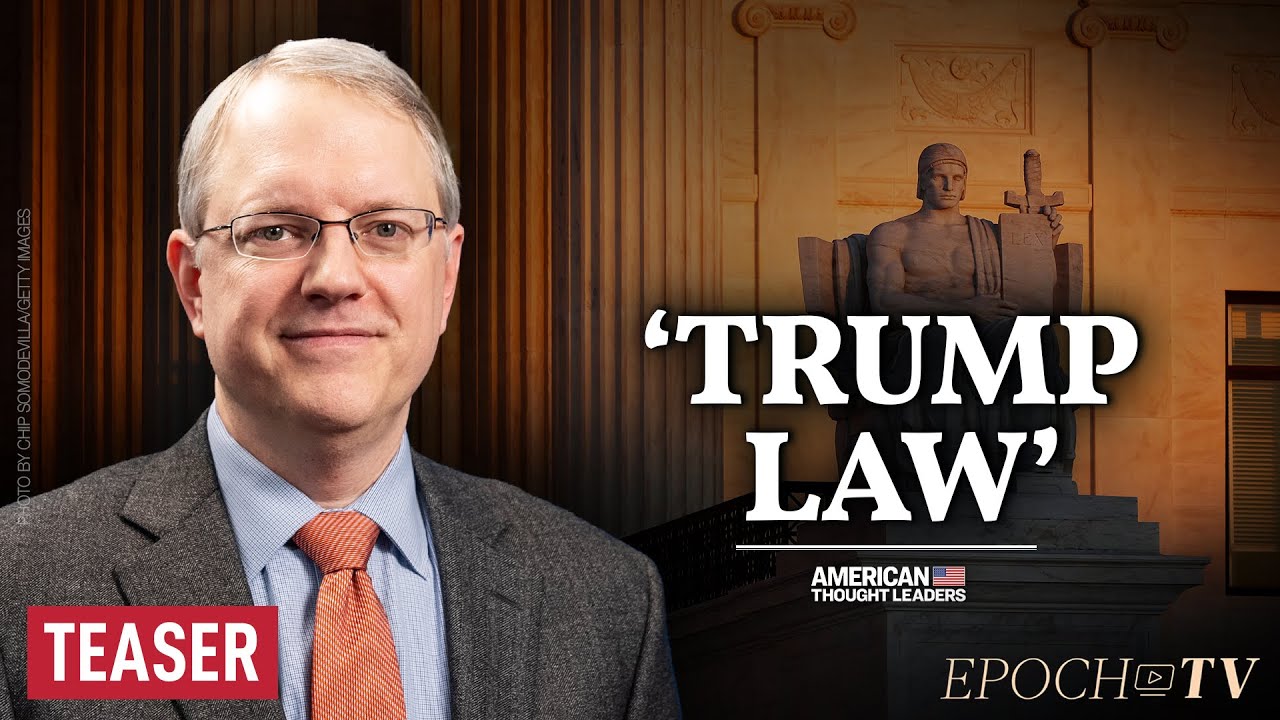
“Congress has to be the one that appropriates any funds from the treasury. That’s the power of the purse that Congress has. And if we lose that, then we’ll lose the country, because it has to be the elected representatives. If the executive is self-funding, then there’s just no ability to rein that in.” At the Conservative Political Action Conference, we sat down with Mark Chenoweth, President and General Counsel for the New Civil Liberties Alliance, which brings cases against the government when it violates constitutional freedoms. Today, we discuss three major lawsuits he is currently prosecuting. The first is The Cato Institute versus the Department of Education, which argues against Biden’s loan forgiveness plan on the basis of lacking statutory authority. “There just isn’t explicit language giving the Secretary of Education the ability to cancel the debt of 43 million people and at a cost of over half a trillion dollars,” says Chenoweth. The second case is Missouri versus Biden, which alleges that the Biden administration violated the First Amendment by directing social media companies to censor viewpoints that were in conflict with the government’s narrative on COVID-19. “There definitely seems to be a level of communication within the government about how to achieve this goal of censoring people that I think Americans are going to find disturbing,” says Chenoweth. And the third case is Hoeg versus Newsom, which claims that California Assembly Bill 2098 violates the First Amendment rights of medical professionals by intimidating and punishing doctors who dissent from mainstream views, thus interfering in the doctor-patient relationship. “I think of it as the Sovietization of science and medicine because this is the kind of thing you would expect in the Soviet Union under Lysenko, or something like that,” says Chenoweth. “This isn’t what you would expect in the United States of America, where we have freedom.” Interview trailer: Watch the full interview: https://www.theepochtimes.com/the-boot-of-the-state-mark-chenoweth-on-suing-federal-agencies-and-ensuring-the-separation-of-powers_5126951.html FULL TRANSCRIPT Jan Jekielek: Mark Chenoweth, such a pleasure to have you on American Thought Leaders. Mark Chenoweth: Good to be with you. Mr. Jekielek: You are involved, or your organization is involved in a number of incredibly high-profile cases, some of which are at the Supreme Court, as we speak. We’re looking at this case on the Biden student loan forgiveness program. This is a huge one that you’re doing. Another one, which I’ve talked about extensively on this show, is Missouri v. Biden. Looking into the discovery materials has shown us unbelievable cooperation between the government and Big Tech. Finally, you’ve got Hoeg v. Newsom. I didn’t even know the name of it until today. This is the case challenging the law that I call, “Prevent doctors from doctoring in California.” We’re going to talk about all of this today. Mr. Chenoweth: Fantastic. They’re all important topics. Mr. Jekielek: Absolutely. Let’s start with the loan forgiveness. The bottom line is I keep hearing from people that this rule, this approach, is just simply illegal. I think you’re the one who can actually tell me is that true and how true is it? Mr. Chenoweth: Right. It’s very true, and it’s illegal six ways from Sunday, or maybe even 12. This is such an illegal act by the administration that we could take as much time as you have to really detail all the various ways in which this is illegal. But maybe the clearest reason why it’s illegal is there’s just no statutory authority for the Secretary of Education to do what he has done. Federal departments and federal agencies don’t have any power to act unless Congress gives them that power. Here, Congress has not given the Secretary of Education the power to forgive or cancel student loan debt anywhere like this. In fact, Congress has only done minor debt cancellations in the past with very specific recipients in mind, and you have to qualify for that cancellation based on criteria that have limited it pretty significantly. What Congress has done more broadly, and they did this in the CARES Act right at the beginning of the pandemic in March of 2020, is they put into place a six-month moratorium, essentially a forbearance, where they said that students with federal student loan debt did not have to pay principle or interest payments on that for six months. That wasn’t a cancellation of debt; it was just a forbearance. The idea that you could take from that any ability to cancel debt is really just wrong from a legal standpoint. Mr. Jekielek: One of the big questions in people’s minds is that it feels like it’s just shifting the burden, because someone has to pay. One of the big complaints is this idea; it shifts the burden from the people that took the loans out to some other people, the taxpayers, broadly speaking. What is the legality around this? Mr. Chenoweth: It’s interesting you mentioned that fairness question because it came up in oral argument at the Supreme Court just this past week from Chief Justice Roberts, who I don’t necessarily think of as the person most likely to bring up a fairness argument, but he did. He said, “What about the kid who took out a loan for a lawn care company and then was devastated by the pandemic?” Or it might be other kinds of small business type situations that you could imagine. The answers that both the Solicitor General of the U.S. had and that other justices had was, “We don’t judge law by how it affects other people; we judge it by how it affects the people who are covered by it.” Because Congress has made that determination to give certain people relief and maybe not other people, is not an argument against that particular law. That would be fine if Congress had passed this, but Congress didn’t pass this. This is something that really has been created out of whole cloth by the Secretary of Education, and that creates a few different problems from a legal standpoint. One of them that got a lot of play in the oral argument was whether or not the lines that were drawn by the secretary in crafting this were arbitrary and capricious lines. That’s a bit of jargon under what’s called the Administrative Procedure Act. Pretty much any regulation that is passed by a federal department or agency has to satisfy the test of not being arbitrary or capricious. What it means is that when you’re drawing the lines of who qualifies and who doesn’t, the secretary has to provide sufficient justification for why he drew the lines where he did. He can’t just say, “We’re going to forgive all the debt of women, but not men, or all the debt of people of a certain race, but not another race, or Catholics, but not anybody else. Those would all be arbitrary distinctions. One of the concerns with the lines that were drawn is he said, “We’re going to give $10,000 of debt relief to certain folks, and 20,000 to other folks, and nothing to other folks.” Where did he come up with those lines? Congress would be allowed to draw lines like that, but it’s not clear that the secretary has the power to just arbitrarily decide who does and doesn’t get debt relief. In fact, I would say it’s clear that he does not have the authority to do that. Those who support what the secretary has done would say, “What about the Heroes Act of 2003 that was passed in the wake of 9/11 to give soldiers some debt relief?” The idea was you may be going off to war and you may be getting paid less as a soldier than you were getting paid in the private sector. If you’re getting called up for reserve duty, maybe you won’t be able to make your student loan payments. The idea was to give the Secretary of Education at that point some ability to help soldiers out in that situation. Even then, that was never used to forgive a single debt. It was used to postpone debt, to give some forbearance, but it was never used to cancel any student loan debt. But now, it has. Now, the Secretary of Education has used that law because there’s a provision in it that gives the secretary the ability to “waive or modify any provision of Title IV of the act,” which is the one that has to do with student loan debt. What the Solicitor General has essentially said is that waive or modify language that Congress used gave the secretary the keys to the kingdom, and he can do whatever he wants. Mr. Jekielek: He can modify this act to basically forgive anything. Is that what you’re saying? Mr. Chenoweth: Right. That’s basically what he has done. Mr. Jekielek: That sounds unbelievable. Mr. Chenoweth: It is unbelievable. He’s taken the provisions that had limitations on any sort of forgiveness or cancellation, and he’s just waived those provisions, and then he’s modified it by adding in people to qualify for debt who Congress didn’t have in there. This really bothered the Chief Justice, and he said, “Wait a minute. Waive or modify doesn’t mean anything.” There was a case with MCI [MCI Telecommunications Corp. v. American Telephone & Telegraph Co.] several years ago where Justice Scalia said, “Usually when we talk about modify, we mean that it has to be close to what was there originally.” I mean, you could say that the French Revolution modified the status of the nobility in France. Mr. Jekielek: That’s stretching the word a little bit. Mr. Chenoweth: Yes. And I think he said, “Only because the English language allows for understatement and sarcasm.” That’s not exactly what we mean when we use the word modify. The Solicitor General’s response to that was, “This is broader than that. It’s waive or modify.” The Chief Justice didn’t seem to be buying that. He seemed to think that it didn’t say you could waive debt; it said you could waive certain provisions. The other thing that individual states said, which I thought was a very good point, the secretary didn’t even waive these provisions because they still apply. People who have student loan debt can still treat the law as though those provisions are still there. It’s not as though he was really waiving provisions. Justice Amy Coney Barrett said, “He just red-penciled the whole thing. He just took out what he didn’t like and added in other things,” and the government admits that’s what the secretary did. It is not at all clear that you can do that. Mr. Jekielek: What does the term statutory authority actually mean, for the benefit of our audience? Mr. Chenoweth: It means that Congress has passed an explicit law giving a particular department or agency the ability to do something. No one doubts that the Secretary of Education is the right person who would be responsible for the student loan question, but that doesn’t mean he gets to do whatever he wants in that territory. He only has the power that Congress gives him. Mr. Jekielek: Okay, very simple. A big topic that has come up on this program is that Congress is essentially ceding its rights or basically its work to the bureaucracy or to the agency. Mr. Chenoweth: For maybe 20 years or so now, you could say that there’s a slow drip, and we see this happening. Certainly, this is something that the New Civil Liberties Alliance [NCLA] was created to stop. We’re trying to turn off the spigot. What we’ve seen in this administration in particular is that it’s a fire hose now. Practically everything this administration has done has really been treating the administrative agencies as though they’re empowered to do things that they just aren’t empowered to do. You can look at the nationwide eviction moratorium, which interestingly also started with the CARES Act. Congress had said, “For four months in federally subsidized housing, you can’t evict anyone.” That was what the CARES Act said. Originally, the Trump administration and then the Biden administration after many more months came in and said, “Okay, we’re going to extend this nationwide and we’re going to say that it’s for all housing, not just federally subsidized housing.” Eventually, that made it to the Supreme Court. When it did, in a case called Alabama Realtors [Alabama Assoc. of Realtors v. Dept. of Health & Human Services], the Supreme Court said, “Wait a minute. Congress said four months of federally subsidized housing, you can’t just change that language. The CDC quarantine power doesn’t give it the ability to stop evictions nationwide and shut down all of the landlord/tenant courts across the entire country,” which is what had happened. I think what the Supreme Court is going to do here is something similar. They’re going to say, “The CARES Act had this first four months, but it didn’t give the secretary the ability to do this indefinitely.” Mr. Jekielek: The ramifications of that decision are so massive. On a national scale, how many millions of people are deeply affected in both directions, with some not needing to pay, and some suddenly not having revenue to pay for their buildings? Mr. Chenoweth: Lots of people lost properties that they had lots of money invested in. Mr. Jekielek: Absolutely. The idea that the CDC could make a rule like this, but basically ignoring that reality, to me and perhaps some viewers, it seems unbelievable that could happen. Mr. Chenoweth: It was unbelievable. Folks had not planned for that possibility at all. They weren’t assuming that risk when they purchased these properties. It’s one of the reasons we need to have the rule of law in this country. The laws change slowly when Congress is involved. This was very deliberate on the part of our founders when they set up the Constitution. It’s bicameralism and presentment. You have to get something through the House of Representatives and the Senate. That’s very difficult to do. And then, you have to get the President’s signature. That’s called presentment. If something doesn’t go through all of those steps, then it’s not law. And yet, what we see from this administration time and time again is they want to use an executive order or some sort of shortcut or some sort of action where they have a secretary or a head of an agency go back, look at vague statutory language in some old law and pretend that old vague language gives them powers that no one had ever discovered before. You look back at student loans. When Nancy Pelosi was the Speaker of the House, she said Congress had to be involved, and that this wasn’t something the Secretary of Education could do on his own. Nancy Pelosi: People think that the President of the United States has the power for debt forgiveness. He does not. He can postpone, he can delay, but he does not have that power. That would have to be an act of Congress. Mr. Chenoweth: And yet, they somehow forgot that, once this action had taken place. We need to get back to that constitutional regime where it’s our elected officials in the House and the Senate that make these sort of momentous decisions you’re talking about. But certainly, at least four or five of those six justices seem to be very aware of the administrative state problem and the fact that too much power has slipped the grasp of Congress, and that it’s their job as the judicial branch to ensure that the separation of powers in the constitutional design is sustained. The particular way that they’re trying to go about that is a doctrine that they’ve come up with called the major questions doctrine. It has developed over about a 25-year period. If you go back to the late 90s, early 2000s, you can see antecedents of this idea going back to a case called Brown and Williamson [FDA v. Brown & Williamson Tobacco Corp.], where the FDA was trying to regulate tobacco. The Supreme Court said, “Congress has not given the FDA authority to do this. It has thought about it many times. It has always failed. You can’t just decide that you have this authority.” There have been a series of other cases, but it’s really happened within the last few years, including the Alabama Realtors case about nationwide eviction moratoriums, including the OSHA vaccine mandate case, and then finally in a case called West Virginia v. EPA, which had to do with EPA regulation. Now I’m suddenly blanking on whether it’s the Clean Air Act or Clean Water Act. But the particular outcome of that case was to say that essentially you can’t find elephants in mouseholes. You can’t take a particular vague or small piece of statutory language and blow out a huge new program from that small piece of statutory language. You can think of it as a clear statement principle if you want to. But the Supreme Court is going to look at the statutory language, and if an agency or department is reading that to give them vast power, then the court is going to expect the language to be much more explicit. What we see in all those cases that I mentioned, and then also in the student loan case, is there just isn’t explicit language giving the Secretary of Education the ability to cancel the debt of 43 million people, at a cost of over half-a-trillion dollars. There is just no explicit language to do that. The Chief Justice brought it up three times at oral argument. “Isn’t this a major question? These look like major questions. Doesn’t this fit very closely with our previous major question cases?” The Chief Justice, at least, and I suspect because he’s often the swing justice on the current court, I suspect that if that’s where he is, then you’re going to see a majority of the justices on the court decide that this is a violation of the major questions doctrine, and they’re going to set aside this rule on that basis. Mr. Jekielek: There is this attitude in government today where if you want to do something and the rules are an impediment, you get your best legal minds to go in and hunt for any excuse. Mr. Chenoweth: Rummage. Mr. Jekielek: Rummage is what it’s called. Mr. Chenoweth: Yes, for sure. That’s absolutely correct, and that makes me think of two things, Jan. First, it reminds me of how I got involved in this in the first place. I was an attorney at the Consumer Product Safety Commission. I was legal counsel to Commissioner Anne Northup, who was one of the minority Republican commissioners under President Obama at the agency. There had been a law passed in 2008, signed right at the tail end of the Bush administration, the Consumer Product Safety Improvement Act of 2008, trying to deal with lead on toys and things coming in from China. I joined about the time when the agency was implementing that law and putting rules into practice. I saw from the inside how the agency treated the statute that Congress had passed. It wasn’t this faithful effort to read the statute and try to implement it as best as possible and figure out, “What did Congress really mean by this?” No, far from it. It was about how we can expand our authority as an agency as much as possible to cover as much territory as possible? How can we re-litigate these things that we lost in the debates on Capitol Hill and pretend that we have this power that was never given to us? That wasn’t how I was taught administrative law in law school. I said, “Wait a minute. If this is how it’s really working in practice at this agency, we’ve got a major problem on our hands, because that means that Congress isn’t really in control anymore. Once it passes a law and turns things over to administrative agencies, Katie bar the door.” And I think that’s what we are. The second thing that this reminds me of is that the Office of Legal Counsel at the Department of Justice looked at this action by the administration to cancel student loan debt, and it had a couple of things to say about the debt. It said, “Even under the broadest interpretation of the Heroes Act, it still says that you can’t put students in a better position than they were before the emergency went into effect.” In this case, we would be talking about the pandemic. What the Secretary of Education has done has actually put people in a better position, because no one had $10,000 in debt canceled before the pandemic. That wasn’t the position they were in. In fact, Jan, I would argue that because of the forbearance, and we’ll put to one side whether the forbearance was legal. Because as I said, Congress approved it for a limited time, and it went beyond that. But putting that to the side, students weren’t making principal or interest payments. They’re still not, by the way, because it’s been extended until two months past the decision in this legal case, whenever that comes out. They’re not worse off. They haven’t had to make any payments. Their debt hasn’t been increasing. How can you argue that they need this debt cancellation to put them in the same position that they were before the pandemic or that they would have been in, but for the pandemic? Also, there has been inflation during that whole period of time. Economists will tell you that inflation helps the debtor because you’re now paying back the same amount of debt with inflated dollars. That’s what these students will be doing when they start making the repayments. The idea that they’re worse off than they would’ve been is very hard to justify. The Office of Legal Counsel looked at this. They didn’t say all the things I just said, but they did say that, “Look, you can only take people back to where they were. You can’t make them better off.” This regulation unquestionably makes students better off than they were, which is another reason why it’s illegal. Mr. Jekielek: As we finish up this topic of the student debt, it’s basically Congress that has appropriated the money. Congress is the funder here. Is that right? Mr. Chenoweth: Yes, that’s absolutely right. The Solicitor General was trying to say that because this is a benefits program and not a liberty at stake program the way that maybe the landlord interests were in the nationwide eviction moratorium case, that the rule would somehow be different and that the major questions doctrine wouldn’t apply. But the appropriations clause of Article 1 of the Constitution still applies. That says Congress has to be the one that appropriates any funds from the Treasury. That’s the power of the purse that Congress has. If we lose that, then we’ll lose the country, because it has to be the elected representatives. If the executive is self-funding, then there’s just no ability to reign that in. Justice Thomas brought this up at the oral argument and the response was disappointing from the government. They said, “This isn’t an appropriation from the Treasury because this is debt that’s being canceled.” There’s a couple of problems with that. First of all, the money was going to be going to the Treasury, so it’s really the flip side of the same coin. The other issue is that in the early days of the Republic, we only had debt. The idea that somehow debt doesn’t count as money being appropriated by Congress is just wrong historically as an understanding of what counts as an appropriation or what the founders had in mind in using that language. Typically, when Congress cancels debt, they do appropriate funds. They’ll say, “We’re no longer going to charge this up to a hundred million dollars,” or whatever, and they allow for a certain cap on what the spending is. The government wants to treat this as a new entitlement. They don’t even know how much it’s going to cost; $400 billion, $500 billion, $800 billion. They’re not sure. There’ve been estimates over a trillion dollars that this program might cost before it’s all said and done, with no appropriation from Congress whatsoever. That’s another reason that the Supreme Court is having not just second thoughts, but I think that they’re going to put a stop to this. They understand that the separation of powers can’t be protected if you have the executive spending a trillion dollars unauthorized. Mr. Jekielek: At the beginning of the Republic, it was all debt. That’s really interesting, isn’t it? Please explain that. Mr. Chenoweth: It was just the way the money worked back in those days, there were private banks like the Bank of New York that would issue different kinds of debt instruments. Currency wasn’t used as much. It was more debt instruments that were exchanged. If debt instruments aren’t treated as appropriations, then that would really blow a giant loophole into the appropriations clause and the power of Congress. At that point, I suppose the administration would say, “Any agency or any department of the government that issues debt would be able to cancel debt without the say so of Congress.” You can just think of what the cost of that would be. Mr. Jekielek: Exactly, what the raw cost of that would be. Mr. Chenoweth: Absolutely. Mr. Jekielek: Absolutely fascinating. Let’s switch gears. Let’s jump to the case that most people are familiar with, Missouri v. Biden. Some of the discovery materials you guys were able to procure were… Mr. Chenoweth: Eye-opening? Mr. Jekielek: Eye-opening is a good word. It seems like everyone is excited about it too. Please summarize the case for me just in case anyone isn’t familiar, and just let me know where we’re at with it. Mr. Chenoweth: Yes, sure. For those who aren’t familiar, it is a case where the Attorney General of Missouri and the Attorney General of Louisiana are representing those states in the lawsuit. The New Civil Liberties Alliance is representing four private plaintiffs in the same lawsuit. We’re all suing the administration, including Anthony Fauci, the Surgeon General, Vivek Murthy, and several other administration officials saying that those officials ordered Twitter and Facebook and other social media companies to censor certain things and even take people off of those platforms entirely. Because that was the action of the government and not just action of those private companies, the First Amendment is implicated and that conduct is illegal. That’s the claim in the case. We’re representing Jay Bhattacharya, Martin Kulldorff, Aaron Kheriaty, and also a small healthcare organization in Louisiana. Jill Hines is the head of that organization, so she’s the other plaintiff that we’re representing. What the discovery has shown in that case, as you were alluding to, Jan, is that there were quite extensive communications between the White House and many others. Rob Flaherty at the White House is the one who has been most often appearing in a lot of these emails. Not only was there a lot of communication, but a lot of it was quite explicit. Now that they’re under suit, the government wants to pretend that these were just suggestions. If you read these emails, and some of them are public and others will become public over the course of the lawsuit, this doesn’t read like a friendly suggestion from your neighborhood government. These read very much like, “Why the hell haven’t you acted on what I told you to do yet?” They were instructions that any reasonable juror would look at and say, “This is coercive on the part of the government. This is ordering a company to do something, not suggesting something that they might want to do.” The other thing that has come out is that there were private channels created, some at the behest of the government. Maybe others weren’t, but in any event, these private channels of communication and special portals were created where certain government agencies, including the FBI, could directly send information to these companies saying, “Check out this tweet, check out that tweet, check out this post, take down that post.” The third thing that has come out now is that some of these communications took place on a platform called Signal. To get your audience familiar with it, it’s a little bit like Snapchat in the sense that the communications disappear very quickly. Mr. Jekielek: They can be configured to do so. It doesn’t have to. Mr. Chenoweth: There’s a couple of problems with that. One is that under the National Archives and Records Act, typically government actions are supposed to be preserved, and there should be a record of any of those communications. The other thing is, if we don’t have a record of this, then there could be an exfoliation of evidence issue. Now, I suppose the government would say, “We had no reason to believe that we were going to be sued over this,” but a judge might not see it the same way. Mr. Jekielek: What is the exfoliation of evidence again? Mr. Chenoweth: If you know that you’re going to be sued and you have a bunch of evidence in your possession that shows that you’re guilty of what they’re going to sue you over and you destroy that—you burn the tapes, or you use BleachBit, on a server—you might be accused of exfoliation of evidence. You might be guilty of that. Mr. Jekielek: Okay, understood. In this case, they would be kind of doing it ahead of time, just sort of planning to make sure that nothing was available? Mr. Chenoweth: They say, “We won’t make any records.” Even if it’s not speculation, you might have a judge who would say, “Look, the fact that they deliberately set this up not to create an evidentiary trail of what they were saying or doing, we can use that as a reason to infer that the things that they were saying here might not have been fully lawful.” Mr. Jekielek: Fascinating. The Twitter Files release, subsequent to the beginning of your lawsuit, have really also been, I don’t know if vindication is the right word, but they’ve added to the evidence. Presumably you actually got from the Twitter Files more evidence that you can use. Is that right? Mr. Chenoweth: That’s absolutely right. The Twitter Files have been immensely helpful. There’s lots of information in there that confirms what we were already able to see from the discovery that we had obtained, which is that these were very extensive communications back and forth. Something that I believe came out of the Twitter Files that we didn’t know, if I remember correctly in terms of the sequencing of information here, is that the FBI was actually paying these companies for some of what they were doing. Now, there’s a federal statute that allows the government to pay for certain kinds of information. If the government is producing a search warrant, and it’s going to be very costly for a company to comply with that search warrant, then sometimes the government will subsidize the cost of that. There certainly isn’t a statute that subsidizes companies for violating the First Amendment rights of people at the government’s behest. To the extent that the payments were being made for this unlawful conduct that was being done, that is an additional level of illegality, because they were abusing the statute that would allow for paying companies in this other circumstance. Mr. Jekielek: Something that’s also really interesting is that with the Twitter Files, there was a huge focus on Twitter, just this one company. Whereas, when you add the discovery information that you found and you’ve published, you see that it’s not just one company, it’s many companies. Mr. Chenoweth: It’s a pattern. Absolutely. It’s a trend. It’s a pattern across multiple companies. Even more disturbing, Jan, it’s a pattern. It’s not just Rob Flaherty at the White House. It’s not just Elvis Chan at the FBI. It’s not just some of these nameless and faceless bureaucrats in other parts of the administration. There seems to have been a concerted effort across different offices in the administration. I don’t know if we know enough yet to be able to say, “Okay, you guys take care of Facebook, and you take care of Twitter, and you take care of LinkedIn.” But there definitely seems to be a level of communication within the government about how to achieve this goal of censoring people that Americans are going to find disturbing and that, fortunately, the First Amendment already protects them from. But it takes a lawsuit like the one that NCLA is bringing to get an injunction against the government to stop it from doing the illegal conduct that it’s been engaged in. Mr. Jekielek: I’m just thinking about juries. I attended a trial where John Durham was presenting evidence here in the DC Court. I felt the case was very strong. My guess is that the jury was just sympathetic to the actions of the plaintiff. I can understand why too. Based on the particular media reality that we’re in, I get it. Can we get juries in this day and age to actually consider the realities of law? Mr. Chenoweth: Absolutely. And can we get judges to do it as well? Jury nullification is a separate question. It doesn’t come up as often in some of the kinds of cases that we’re involved in at the New Civil Liberties Alliance, because you most often have juries in the criminal context. Not to say that we don’t have civil juries. Obviously, you do. But a lot of the kinds of cases that we bring against the government are decided at a summary judgment phase by the judge, because they’re legal questions rather than factual questions, and juries are really there for the factual questions in deciding the factual record. Mr. Jekielek: But of course, as you just said, this applies equally to judges? Mr. Chenoweth: Absolutely. Judges bring their priors to these things as well, and some of them are better at setting aside their biases than others. There was an expression, “Trump law.” What do people mean when they say Trump law? They mean, “Are the judges deciding this question the same way that they would have if a different president had done the exact same conduct?” If the answer is “No, they’re not,” well then you’ve come up with a special rule that applies only to this president that you wouldn’t apply elsewhere. That’s not the rule of law. That’s making decisions based on personalities and people, rather than on what the statute and the law and the words say. That’s not something that any judge should do. Mr. Jekielek: This is an actual term? Mr. Chenoweth: This is a term that people throw around. I don’t know that anyone’s done the definitive article on Trump law, but it wouldn’t surprise me. There may be a law review article out there. A lot of the articles are not widely read typically. But there may be one out there that tries to quantify this effect, because it’s certainly something folks are talking about in the profession. Mr. Jekielek: As we continue here, let’s jump to this third case, which is happening at the state level now. Mr. Chenoweth: AB2098 was a law passed by the California legislature last year. It was signed by Governor Newsom. It went into effect on January 1, 2023. What the law said is that if you’re a doctor, either an MD or a DO, governed by the Medical Board of California or the Osteopathic Board of California, if you say something to your patients that is inconsistent with the “contemporary scientific consensus about COVID,” then complaints can be made to the respective boards of medicine and your medical license is in jeopardy. They can take away your license if you say these things.This was something that frightened a lot of doctors. Unfortunately, the Medical Board of California was complicit in this legislation being passed. The problem is that when folks go to their doctor, the person they trust, they want that person to give their honest medical opinion specific to that individual and their circumstances. Your doctor knows you. They know all your other history, your medical history, and how you react to different sorts of medicines or vaccines. You want their honest opinion. You don’t want them to say, “The state of California has required that I tell you that this is perfectly safe,” or, “Everyone needs to get this regardless of their status.” You’re not supposed to be going to see a robot controlled by the state. You’re supposed to see a doctor who has been highly educated and went to school for many years. The government has been wrong so often during COVID about so many different things that if everyone was stuck obeying those rules, then there would’ve been a lot more deaths that occurred. Fortunately, there were people who broke out of that. I’ll give you two examples, Jan, that are really important for why this law is just wrong from a public policy perspective. One of the doctors that we represent is Tracy Hoeg. One of the other five doctors that we represent in this case, early on in the pandemic, was treating people in the hospital who were diagnosed with COVID. He said, “I don’t think intubating these patients with feeding tubes or respirators is the best way to get these people healthy.” At the time, the contemporary scientific consensus was to intubate. They wanted every patient that came to the hospital at a certain level of seriousness to be intubated. This doctor didn’t do that. He refused to do that. He fought back against that consensus. He didn’t intubate his patients. Lo-and-behold, Jan, his patients had much better outcomes than the people who were being intubated. Other doctors around the country were doing the same thing. Over time, the contemporary scientific consensus shifted, and now the best practice is to not intubate. If you don’t allow anyone to deviate from the norm and to test based on their hunches and their medical training, then you don’t ever get to that. We’d still be intubating people today, and we’d still be losing more people to COVID in the hospital setting than we would need to be losing. That’s one reason why this is really destructive. The other example I’ll give you has to do with natural immunity. There was a kind of wry joke on Capitol Hill from one of our clients, Dr. Kulldorff, this week, where he said, “Look, we learned about natural immunity after the Athenian Plague in 430 BC, and we knew about it up until 2020, and then we forgot about it for three years, and now we’ve remembered it again. The problem is that the government was telling people that they needed to get a vaccine, even if they already had COVID and they had antibodies in their system, provable from an antibody testing, that they already had antibodies. The whole point of a vaccine is to give you the antibodies. In fact, the way they test a vaccine and its efficacy is to test its antibody creation versus what natural antibody creation is. They knew this from day one. This was not something that they didn’t know. This was something that they deliberately lied about because they thought that it would enhance the number of people who would go and get vaccines. I find it very disturbing that that was taking place. But there were plenty of doctors out there that were telling people, “You don’t need this vaccine if you have natural immunity. You already had COVID.” If everyone had to tell their patients because of this law, “You need to go ahead and get the vaccine,” then you would be forcing doctors to violate the Hippocratic oath. You’d be forcing them to deny 2,500 years of medical knowledge. I think of it as the Sovietization of science and medicine, because this is the kind of thing you would expect in the Soviet Union under Lysenko. This isn’t what you would expect in the United States of America where we have freedom, where we have doctors who are supposed to give their best medical opinion, where there’s a First Amendment right for those doctors to share that opinion, and most importantly, a first Amendment for their patients to hear the doctor’s honest opinion about these things without having to fear for their medical licenses. Mr. Jekielek: Because how could you trust a doctor if this law is on the books to do anything related to COVID for you? Mr. Chenoweth: One of our clients said that their fear wasn’t so much from their current patients because they have a doctor/patient trust with their current patients. Part of their fear was that any new patient that came in could be a patient who was just there in order to try to get the doctor in trouble. You don’t want new patients seeing a doctor for their first time to have their doctor take that sort of skeptical approach to a new patient coming in the door. That’s not the way to build trust. It’s not the way to get an accurate medical history about that person. It’s really disturbing to see this happen. The other thing, Jan, about this law, they say that it’s contemporary scientific consensus. I should mention the fact that the New Civil Liberties Alliance won an injunction against this law in the Eastern District of California and the state of California is not appealing that decision. Now, unfortunately, there were a couple of other cases brought where the state of California prevailed, and those cases are now up on appeal to the U.S. Court of Appeals for the Ninth Circuit. But the injunction that NCLA won is still in effect in the eastern district of California, which covers Sacramento and points east. But what is the contemporary scientific consensus? What our judge, and I’ll give him credit here, Judge Shubb said is, “Well, whose consensus are you talking about? The Medical Board of California? It’s comprised of half doctors and half non-doctors. We’re going to go with what their view is? Are you talking about the consensus in Sacramento? Are you talking about the consensus in California? Are you talking about the consensus in the United States? Are you talking about the consensus among all doctors, among epidemiologists, among public health officials? By the way, how is any one individual treating physician supposed to know what the contemporary scientific consensus is at any one point in time” Are we polling people? Who are we going to poll? How do we determine this?” It’s really an impossible standard for any doctor to meet. There’s a vagueness to it that creates a First Amendment problem and a due process problem, because doctors are entitled to due process of law, knowing ahead of time, before they say anything, whether or not what they’re saying is going to get them in trouble. But there’s no way to know if something is squirrely, using contemporary scientific consensus as the standard. Mr. Jekielek: It allows the state to basically exercise power somewhat arbitrarily, which is always a terrible thing. At least it creates the possibility for that. Mr. Chenoweth: Can I just say, you hit the nail on the head there, Jan, because it’s pretty clear from the people who passed this law that they were interested in going after particular doctors. There were people who had said things that the government didn’t like about COVID, and this was the instrument that they wanted to be able to threaten those people with their medical licenses. You’re absolutely right about the intent of the law, I believe. Mr. Jekielek: When I look at all the official guidelines, a pattern emerged for me over time that they were much more concerned with, and you alluded to this a little bit earlier, with eliciting a particular kind of behavior, and that they were going to deny natural immunity because they wanted everyone to get jabbed. It was just the simplest way to make sure everybody gets jabbed, correct? Mr. Chenoweth: Administratively efficient. Mr. Jekielek: Right. I don’t know if someone’s sitting there thinking; “Sure, there may be a cost for that, but it’s worth it, and I’m just going to make that decision because I want this behavioral outcome. I’m not going to tell people I want this behavioral outcome explicitly. I’m going to basically create other incentives and disincentives as guidance to do that.” There’s so many things like this. We could play a game and you could name one, and I could tell you why I think it would be that way. Mr. Chenoweth: Sure. Mr. Jekielek: That’s my gut sense from watching a lot of just overtly really bad guidance that just ultimately hurt a lot of people. I want to know what you think here. Mr. Chenoweth: There’s been this theory going for maybe 20-ish years now of, “regulatory nudge.” I had a professor in law school, Cass Sunstein, who taught me administrative law among other things, a very good professor. He is one of the people who’s been an expository of this theory of nudge. The concern I have, and the problem I have with Cass’s theory is when you’re talking about that nudge coming from the state, it’s not really a nudge anymore. It’s the boot of the state. If you’re coercing people with state power, then individuals aren’t being nudged; they’re being shoved and shoved hard. And in this case, shoved hard into a needle. That’s not the proper role for the government. There is a terrible violation of individual rights that takes place there. Mr. Jekielek: The messaging not only created the sense that this is the right thing to do, but it also created this situation where there’s a large portion of the population which perceives the people not complying with this as somehow immoral or bad. Mr. Chenoweth: That’s right. Great point. This is another lie that was told by our government, unfortunately, that if you took the vaccine, then you wouldn’t be able to transmit the virus to anybody else. President Biden: You’re not going to get COVID if you have these vaccinations. Mr. Chenoweth: The theory is that somehow you need to do this, even if you’re not worried about dying because you’re young and healthy. You need to do this for grandma, and if you’re not willing to do this for grandma, then you’re an evil person and you’re morally wrong. The thing is that that might be true for something like a smallpox virus where it actually does prevent transmission of the virus to third parties. But these vaccines don’t have that property. It does not prevent transmission to third parties. Forcing someone to get the vaccine for the benefit of someone else never had a moral element to it, and yet they were pretending that it did. Go back to college, introduction to ethics. In this country, we don’t take a healthy person and divide them up and give their organs to five other sick people, because then we have five people who live and only one person dies, instead of five people dying. We consider that to be unethical behavior. But really, it’s the same logic chain that would lead you to say it’s just more administratively efficient for everyone to get the jab. They say, “We know that some young and healthy people are going to get myocarditis and die, and we know that some people are going to have strokes, but we think overall more people will live as a result of this, and therefore we’re going to use the power of the state to enforce this.” In other contexts, we would view that as unethical, and somehow we lost sight of that in this pandemic. Mr. Jekielek: We’ve covered a lot here. Any final thoughts as we finish? Mr. Chenoweth: I would encourage people to go to the website of the New Civil Liberties Alliance, nclalegal.org. They can find out about these cases and any of the 75 other cases that we’ve brought against the government. Many of them have been in the context of lockdowns or vaccine mandates, but many more of them have been in other contexts. We’ve probably sued some federal agencies that folks haven’t even heard of. It’s a trend that some of these cases, the ones we’ve talked about today, get to the Supreme Court. In fact, we have another case pending at the Supreme Court against the Securities and Exchange Commission right now. We argued it back in November, and we expect the decision by June. Folks can go learn more about those cases and pick their favorite federal agency and figure out what we might be doing to hold that one in check and really restore constitutional guardrails around the administrative state. Mr. Jekielek: Mark Chenoweth, it’s such a pleasure to have you on the show. Mr. Chenoweth: Thank you so much, Jan. Always good to be with you. Mr. Jekielek: Thank you all for joining Mark Chenoweth and me on this episode of American Thought Leaders. I’m your host, Jan Jekielek. To get notifications about new Kash's Corner and American Thought Leaders episodes, please sign up for our newsletter! Here 👉 Get Alerts - PRE-ORDER "The Shadow State" DVD: https://www.epochtv.shop/product-page/the-shadow-state-dvd The Real Story of January 6 | Documentary BUY Jan 6 DVD: https://www.epochtv.shop/product-page/dvd-the-real-story-of-january-6, Promo Code “Jan” for 20% off. - Follow American Thought Leaders on social media: Twitter: https://twitter.com/AmThoughtLeader Truth Social: https://truthsocial.com/@AmThoughtLeader Gettr: https://gettr.com/user/amthoughtleader Facebook: https://www.facebook.com/AmericanThoughtLeaders Gab: https://gab.com/AmThoughtLeader Telegram: https://t.me/AmThoughtLeader
- Why Is There No Age Limit for Puberty Blockers & Surgeries?—Dr. Miriam Grossman | PART 2
In part one of my interview with Dr. Miriam Grossman, a child and adolescent psychiatrist, we discussed the origins of gender ideology and how this ideology has spread across the fields of pediatric medicine, psychology, psychiatry, and education. Now in part two, we discuss the guidelines for treating gender dysphoria in the United States and how they are radically different from standards in other countries like the United Kingdom or Sweden. What should parents do if their child says their gender is different from their biological sex? And why are kids being taught about gender, sexuality, and genitalia at younger and younger ages? Interview trailer: Watch the full interview: https://www.theepochtimes.com/why-are-there-no-lower-age-limits-for-puberty-blockers-hormones-and-gender-transition-surgeries-dr-miriam-grossman-part-2_4858328.html Jan Jekielek: Previously on American Thought Leaders. Dr. Miriam Grossman: People are paying a massively high price for these medical experimentations. Jan Jekielek: In part one of my interview with Dr. Miriam Grossman, a child and adolescent psychiatrist, we discussed the origins of gender ideology and how this ideology has spread across the fields of pediatric medicine, psychology, psychiatry, and education. Now in part two, we discuss the guidelines for treating gender dysphoria in the United States and how they are radically different from the standards in other countries like the UK or Sweden. Dr. Miriam Grossman: Throughout the United States and Canada, there’s no lower age limit for these medical treatments. Jan Jekielek: What should parents do if their child says their gender is different from their biological sex? And why are kids being taught about gender, sexuality and genitalia at younger and younger ages? Dr. Miriam Grossman: By the time they’re reaching high school, they have already seen and heard so much, they’re molding the child to have certain attitude. Jan Jekielek: This is American Thought Leaders, and I’m Jan Jekielek. Mr. Jekielek: Tell me about Florida’s Parental Rights In Education bill. Dr. Grossman: In Florida, they passed a bill saying that kids up to third grade and including third grade would not be provided instruction on sexual orientation and gender identity issues. Our sex-ed organizations like SIECUS (Sexuality Information and Education Council of the United States) and Planned Parenthood have been campaigning and wanting and writing curricula for kindergartners and first graders for a long, long time, for 20 years or so, and that includes this material. Mr. Jekielek: Why? Dr. Grossman It’s a vision. It’s about changing the world. I think that there are many well-meaning people that are involved, and they don’t understand what’s really at the bottom of this. Again, it’s a worldview. That worldview is that children are sexual from cradle to grave. This idea was introduced by Kinsey, with the Kinsey model of human sexuality, which is the model of anything goes. We are human animals. It’s the model that says Judeo-Christian morality and sexual restraint is unhealthy. It’s going to harm people. We have to teach children that they are sexual, and that they have every right to explore and express their sexuality at every age. Therefore, why not go into kindergartners and let kids know that and teach them about their private parts and about masturbation and about sexual orientation, and so on and so forth. Because at the bottom of it all is this presumption that children and infants are sexual. Infants. If you look at the mission statement of the founder of SIECUS, which is the Sexuality Information and Educational Council of the U.S., the premier sex education organization in this country, and extremely powerful all over the Western world, and not only Western, the whole world, funded by our tax dollars. If you look at their original mission statement from decades ago, the founder of that organization, Mary Calderone, says that parents need to become aware of the erotic potential of their children and infants. This is what these people believe. A lot of them were pedophiles. So, this approach toward our children and our sexuality education comes from that philosophy. Now, of course, it’s very destructive philosophy because children are not sexual creatures. Children only become aware of any sexual attraction or eroticism or anything like that when they go into puberty, and there’s this release of sex hormones and it affects their brain and their bodies and they begin to change and become interested in sex. But when they’re in kindergarten, no. When they’re in second grade, fourth grade, normally, no. When kids are taught these things in kindergarten or first grade or second grade and they’re taught the medical terms for their genitalia, there’s an underlying message there. The message for the child is that it’s okay to talk about these things in school. Not only is it okay, but your teacher is the one who knows these things. You can turn to your teacher with your questions and concerns. It’s okay to talk about this in a classroom full of girls and boys. If you’re nervous about it or embarrassed, you need to get over that. There’s all kinds of underlying messages here when little kids are taught by their teachers the proper names for their genitalia. What we have, starting with Kinsey, and even before Kinsey is a new vision for human sexuality, for sexuality that is without any sort of restraint, without inhibition, and without judgment. Just celebrating practically any form of sexual expression. One thing that is important for you to know about and your listeners is something called SAR, which stands for Sexuality Attitude Reassessment or Restructuring. SAR. And SAR is basically a seminar that has existed since, and was developed in the late ’60s for any individual that is getting certification in any field related to human sexuality. They’re small groups, 10 or 12 people, and they are exposed over a number of hours to a multimedia program of explicit sexual behaviors. The point of the SAR is to desensitize these individuals. Because it was felt, and it’s still felt, that people who are going into the field of human sexuality might have their own anxiety, opinions, judgments, or negative reactions to certain forms of sexual expression, and that those opinions and reactions might interfere with their ability to help whoever is coming to them, or to educate their students. It’s a tool to desensitize individuals, so that after the seminar, they no longer will have any negative reaction, and they will be open and accepting of whatever it is that comes in front of them. Now, the way that I would describe this process is that it is an intentional breaking down or eroding of natural sensitivity, modesty, and healthy inhibitions that almost all of us are born with, and that we don’t necessarily want that to happen. In certain contexts maybe we do, but certainly not across the board, and certainly not in children. We have to look at this very closely, because as I said, these seminars still exist and attendance at these seminars are required in many of the programs that give certification to people who want to go into these fields. Mr. Jekielek: And just quickly, it isn’t children that are attending these, so how does this connect with children? Why did you mention that? Dr. Grossman: Okay. If I could, I want to just describe for one minute how one of these SAR seminars was described. There was an Esquire journalist in the ’70s who attended one of these seminars, and it’s just important for me to tell you what he said. The room was darkened and there were multiple large screens in front of the group. On those screens were projected very explicit sexual behavior. He basically felt bombarded with these high impact stimuli over and over again over the course of a few hours. He reported that after a while, he felt dizzy and nauseous. He was having a visceral reaction to it. He felt that after a while he just needed to surrender to the experience and not fight it, which was his initial reaction. He had to surrender to it. And then, by the end, nothing was shocking. Obviously, such a high impact, highly stimulating visual and auditory experience is going to have a permanent effect on the brain. It’s going to form memories that can’t be erased, and it’s changing a person. The way that children are relevant to this is, in my opinion, a similar approach is being used with children. In other words, in sex education, one of the goals is to have the children become open-minded and to accept every possibility of sexual expression. I can think of two examples. One I came across is on the Planned Parenthood website, and this was many years ago, actually, in 2007. They had at that time tools for teachers to use in the classroom. One thing that they suggested was a game for middle school and high school students in which the kids would pair up. You could have two girls, two boys, or a boy and a girl pair up. They wear sticky notes with a term related to sexuality. One of the kids puts the sticky note on their head without reading it, and the other person has to give clues or answer questions to help that person who has the sticky note on their head figure out what it says there. This is presented as a sort of icebreaker, as a way for the kids to get comfortable talking about sexuality. Obviously, if that one kid with the sticky note is trying to guess what it says there, they’re going to have to go into all sorts of perhaps uncomfortable questions and areas in their discussion, as they’re trying to figure out what it says on their forehead. Then, after that “game”, the kids will sit down and talk about what it was like, and they’ll process how it felt and did they feel embarrassed or not. It’s trying to work out what the sex educators would call inhibitions or anxieties, and trying to get through those to eliminate them, and to erode them. That is a process that’s similar to SAR, to Sexual Attitude Restructuring. I’ll tell you something else. The practice that we now have had for a long time of teaching little kids, five-year-olds, six-year-olds, the anatomically correct terms for their genitals is also a form of SAR. The justification of sex educators in bringing that material to little kids is that they say, “Look, they have to have the right words in order to report if they were molested, if they were touched in an inappropriate way, in an inappropriate place. The kid needs to have the vocabulary, so we need to tell them what these different areas are called.” I disagree. If we’re going to have any discussion of this whatsoever at school is a question in and of itself. Why can’t they get this at home? It could be presented to them in the form of, “Look, those parts of your body that are covered by your bathing suit are private. No one should be asking to see them or touching them. That is unsafe touching. That is not allowed. If anyone wants to do that or anyone tries to do that, you scream and run away and tell an adult.” That’s all. We don’t need them to know about testicles and vulva and clitoris and vagina. They don’t need that when they’re five-years-old. In presenting them with that kind of explicit material they must use diagrams. I still haven’t figured it out. How are you teaching five-year-olds these terms that they probably haven’t heard before without a diagram? I believe that it is eroding their natural sensitivity and embarrassment. Mr. Jekielek: I’ll share with you an experience I don’t think I’ve shared before, but it must have been in grade one or grade two in the early ’80s when I was in a class where we certainly talked about all this. In fact, I think we saw a pretty explicit film explaining how babies are made. And this is when you’re around six-years-old. So, that would’ve been in the early ’80s. What do you make of that? Dr. Grossman: It’s interesting that you still recall it pretty clearly so many years later. My first reaction to that is that it certainly made an impression on you. It sounds like a lifelong impression. Mr. Jekielek: It certainly did. Yes. Dr. Grossman: Do you remember the emotions that were connected to the experience? Mr. Jekielek: There was much laughter and rigamarole in the room. That’s what I remember. Dr. Grossman: Okay. That usually would mean a sense of embarrassment and probably a sense of anxiety. Laughing, awkward shifting around in your seat, making some noise, all probably due to some anxiety. It’s important to point out that I’m not at all surprised that you were exposed to this. But I also think it’s important to point out that to this day, the American Academy of Child and Adolescent Psychiatry states that children, in terms of learning about sexuality and reproduction, they should, at that age, grade one or two for sure, should only be provided with the information that they ask about. No more than that. It’s amazing, because this is really excellent. The information they have there is excellent. Too bad nobody follows it. The sex educators don’t follow it. Kids are not miniature adults. Kids are not able to process information the way an adult does. That’s why puberty is so important. Because the brain matures and we begin to process emotions and ideas differently. But when you’re in first or second grade, you’re a kid. Your thinking is very concrete. Many kids who find out about the sexual act think that it must be violent, or they can’t grasp what it might be like as an adult, because they’re kids. That first grade film that you saw was only the beginning of a long process. Each year there’s going to be more material that’s added. I would imagine that by the time these kids got to fourth, fifth grade, for sure, they’re learning about more explicit things. They’re putting condoms on bananas. They’re learning about the different types of birth control, oral sex, anal sex. This is being introduced at fairly young ages. Aside from the inappropriateness or the moral question of whether kids should be exposed to this material, I just want people to be aware of the process of desensitization that’s going on, so that by the time they’re reaching high school, they have already seen and heard so much in this area. It’s not just facts that they’re giving. They’re molding the child to have certain attitude. And that’s how you change the world. You change the attitude of the young kids. Mr. Jekielek: Let’s talk about this diagnosis of gender dysphoria. I understand that prior to this new diagnostic and statistical manual, DSM-5, the newest version, there was a different way of looking at this issue, and it’s just not generally known. Dr. Grossman: The bible of psychiatry is the DSM, the Diagnostic and Statistical Manual. We are now at DSM-5, and that came out in 2013, but the APA (American Psychological Association), was working on it for almost 10 years before it came out. The DSM-4 had a diagnosis of gender identity disorder, GID. It referred to kids and adults who have a deep sense of discomfort with their sexual bodies, or gender identity disorder. It was considered a psychiatric disorder. When time came to come up with a DSM-5, there was a decision to change it and to no longer call it a disorder, but to simply call it gender dysphoria. But let me first explain something. When the APA goes through this process of deciding what’s going to go into the DSM and how these psychiatric conditions are going to be described, what are the criteria, which by the way, is very, very important—this is where it’s decided what insurance is going to reimburse for. If you’re going to have a diagnosis and it has a code, that means you can put that code in the paperwork for the reimbursement from insurance. And that’s very important, to say nothing of the importance of something being considered a disorder or not. People should understand that that process of making these decisions around the DSM is restricted to a committee or a workforce of maybe 10, 12 or 15 people. The members on that workforce are chosen by the president of the American Psychiatric Association. Now, keep in mind that not every psychiatrist in the United States is a member of the American Psychiatric Association. And then, on top of that, when there’s an election in the APA for the president, not everyone votes. The point that I’m trying to make, is that these decisions that are made in terms of the DSM are not necessarily representing a majority of practitioners. It may, but we don’t know. We don’t know because there’s never been a referendum, and there’s never been a huge vote of thousands and thousands or tens of thousands of practitioners on these issues. The development of DSM-5, not only regarding gender, but regarding many other issues, was highly controversial. There were vastly differing opinions on many of the changes that were proposed. And people felt so strongly. Especially, there were two prominent psychiatrists at that time, and one of them, Robert Spitzer, had been the head of the development of the DSM-4. So, he really understood this whole process. Dr. Spitzer was very unhappy about the way that the DSM-5 was being developed, and another psychiatrist as well, a prominent psychiatrist, Allen Francis. Now, from what I understand, and again, I am an outsider in all of this, there was a work group. It was composed of people who have a special interest in this area. And so, there were quite a number of people that could be described as activists. For example, the doctor who was the head of the work group, Dr. Drescher is his name, he is very open in explaining the decision to drop gender identity disorder, and instead call it gender dysphoria, in which the focus is no longer on the disorder of feeling alienated from your body and feeling like you can’t accept your biology. It moved away from that. Instead, it focused on the dysphoria, which means the discomfort or the unhappiness or anxiety that comes from having to go out in the world and not being able to be perceived in the way that you want to be, not being able to live the way that you want to and pass as a woman or a man, and be treated in these stereotypical ways. So, that leads to a person feeling unhappy and uncomfortable. With gender dysphoria, the focus in terms of treatment and in terms of diagnosis is the dysphoria that comes with that. I was saying that Dr. Drescher talked about how that decision was largely based on the stigma that was attached to a gender identity disorder diagnosis. There was a wish to eliminate the stigma. So, why not eliminate it altogether? Why not just remove this whole subject from the DSM? Well, you can’t remove it, because then you don’t have a diagnosis for the insurance companies. If these people who are suffering in this way want to have some sort of a treatment, whether it’s psychological treatment or endocrine hormonal treatment or surgery, you need that diagnosis. You need that code to put on the form for reimbursement. Mr. Jekielek: If there is this diagnosis for a kid of gender dysphoria, if a kid identifies that they are experiencing gender dysphoria, parents will be told, “If you don’t deal with this, your kid might commit suicide.” Of course, nobody would ever wish that on anybody, hopefully. Is this a reasonable thing to say? How common is this? Dr. Grossman: Now, of course, everyone’s on the same page. Every suicide is a terrible loss and a terrible catastrophe. There’s so much misinformation out there about this. However, the data doesn’t support it. Let me point out, for example, that at the world’s largest gender identity disorder clinic, part of the Tavistock Clinic in London, they reported that out of 15,000 kids that were seen between 2010 and 2020, the suicide rate was under 1 per cent. And that not only included the kids seen, but also the kids on the waiting list who they were unable to see, those kids that didn’t get treatment. A suicide rate of under 1 per cent is really extraordinarily low. We see higher suicide per cents in the gay, lesbian and bisexual populations, which have an elevated suicide risk. Kids who are diagnosed with borderline personality, or who have other diagnoses of depression and anxiety, or who are on the autism spectrum, all those groups of kids have higher rates of suicide. The thing is, Jan, those are the very specific kids who are more likely to have gender identity issues. It’s such an oversimplification to the point of falsehood to tell parents that because of your child’s gender identity issue, and that because you’re not accepting their new identity, they’re at risk for suicide. It is so much more complex than that. To top it all off, we don’t have evidence that those kids who are treated, who are affirmed and who are put on hormones and might get surgery later on, we have no long-term data that their suicide rates and their levels of mental health are any better after all that treatment. The adults in the room have to be looking at the child in terms of their entire lifespan, not just how they’re going to feel in a few months, or even in a few years. If you’re sitting with a 14-year-old child, or let alone an eight-year-old child—some of these kids are eight or nine-years-old—one day this kid is going to be 20. One day this kid is going to be 30, and then 50. We want them to be healthy and thriving throughout their lifespan. We have to have a much bigger horizon than the child has. The child is only thinking about now. I have patients saying all the time, “This is what I want now.” I reply, “Well, what about in five years? Do you think that you might want something different?” They say, “Oh, I don’t know. I don’t think so. But this is what I want now.” You know what it’s like to be a teenager. Now is everything. What I am now, I’m an expert. I know what I want. I’m never going to change. I want it, and I want it now. But the adults have to be looking at it differently. Regarding suicide risk, and again, suicide is very, very different than suicidality. Suicidality is having thoughts of maybe wanting your life to be over, wanting to hurt yourself, but not actually acting on it. And then, there’s the people who have thoughts of just harming themselves. They may cut themselves, they may burn themselves, they have self-injurious behavior. That’s a different diagnosis. Suicide is a very complex issue. What we see happening with some of these providers, therapists and doctors and teachers, guidance counselors and politicians, they are simplifying things to the point of untruth. And we have to be very careful about that, because do you know why? We know that suicidal behavior can have an infectious, contagious nature to it. When there’s a suicide in a middle school or in a high school, there often follows a cluster of suicides, and this has been studied. Now, we certainly don’t want to be bringing up the possibility of suicide to parents with their child in the room, and making them the bad guys and saying, “If you don’t use your child’s new name and pronouns and you don’t go with this 100 per cent, your child right here may commit suicide.” That is wrong on so many levels. You’re placing a wedge between the child and their parents. The parents are in almost every instance, well meaning, loving, and devoted parents. These are parents that want the best for their child in the long term. Here you have this practitioner, this educator who is planting a seed in this child’s head that their parents are on the other side, and they are not safe to be with. That is a phrase that’s used over and over again. Is the home safe for you? Kids will say over and over again, “I feel safe in school. I don’t feel safe at home because my parents are not supportive.” Well, maybe the parent is just being really careful, just like they would want to be careful and ask questions about any medical process that their kid would go through. Getting back to the suicide point, the data that we do have, the best study that we have, which is long term of individuals that went through treatment comes out of Sweden, a 30-year study. It shows that even after going through the gender reassignment and living as the opposite sex, the rates of mental health disorders and suffering, and the rates of suicide are alarmingly high. You can look at the de-transitioners, and we have thousands of them now, these are kids who were affirmed and who got all the gender affirming treatment and whose parents did go along with it. They are talking about feeling suicidal because of where they are at now. They are recognizing that their original mental health issues were never addressed. They still have their depression and anxiety and trauma. They may have been molested or they may have had some terrible loss that they went through, or they may be on the autism spectrum. There are all these vast number of things; OCD, ADD, all kinds of things. They’re realizing that those things were not addressed. They were placed on an assembly line toward medicalization. Now, they don’t have their breasts any longer. They may not have the genitals that they were born with. They may have a whole slew of medical problems from the hormones that they’re on and from the surgeries that they went through. We can’t ignore that. These are the kids that are 10, 15 years out from those who are 12 and 15 and just starting on the process. Why are they being silenced? Why are they being canceled? If this was any other field in medicine that was doing experimental procedures on young people, we would be anxious to listen to them and want to know, “Hey, how are you doing? Let’s follow up with you from year to year. How are you with all that stuff, now that you’re 30-years-old?” Well, they’re not doing that. Mr. Jekielek: Aside from the DSM-5 gender dysphoria diagnosis, there’s some sort of guidelines that come from somewhere that explain how this should be done, presumably. Where’s that coming from? Dr. Grossman: The guidelines come from a few places, but I think the most important one to mention here is an organization called WPATH, which stands for World Professional Association for Transgender Health. WPATH. The practitioners, the doctors, the surgeons, the hospitals, the clinics where all this is going on will point to the WPATH guidelines and say, “These are the widely accepted guidelines.” The question is, should they be widely accepted? They are not accepted in various places in Europe. They have been rejected. But we here in the United States and in Canada are still following WPATH guidelines. In fact, at their annual meeting, which took place recently, our Assistant Deputy of Health and Human Services, Dr. Rachel Levine, gave the opening address, I think it was. So, it clearly has the very strong endorsement of the government. What is WPATH? What we could do here is look at the guidelines themselves, in order to answer that question. You can look at the WPATH guidelines, now called Standards of Care Version 8, which came out this year, 2022. First of all, what struck me is the language. I see, over and over again, gender affirming care. We’re using that word affirming, which normally sounds wonderful. You want to affirm people, right? That’s a good thing. But what are we affirming? We are affirming their perception of themselves or who they want to be, but in affirming that we’re also denying something. We’re denying their biology. We’re denying their genetics, their chromosomes, their natural state, and how they were born. We have to deny their biology. I would argue that their biology is actually their true reality. So, gender affirming care is an Orwellian manipulation of language, and it changes the way that we think about all this. I see the phrase top and bottom surgery. What is top surgery? It’s the removal of healthy breasts. It’s a bilateral mastectomy. That’s the surgery that we do for individuals with breast cancer. It’s a very serious surgery. It’s a permanent surgery. To use the term top surgery is a euphemism that makes it sound not so serious. The women who have gone through the bilateral mastectomies and then regret it, they speak in a very emotional, moving way about what that’s like for them and about the scars on their chest and how they may have gone through that surgery before they even had a chance to experience the sexual pleasure that they may have had one day from having breasts, and the pleasure of nursing. You may be aware that some people will rank that experience of nursing their child very high on the top of any wonderful, pleasurable, meaningful experience they’ve had in their lives. All that has been taken away from them and taken away at a time when they’re extremely vulnerable. They have comorbid psychiatric conditions, and they are led to believe that having their breasts removed is going to make them feel better. They’re going to like themselves better. They’re going to be perceived as being male by the world. They’re not going to have men staring at their chest which makes any woman uncomfortable, and that’s normal, by the way. But I’m just getting back to the ideological language that’s found in the standards of care of WPATH. WPATH is actually an advocacy organization. They advocate for transgender individuals. They have, in terms of their leadership, many people who are activists and who are transgender themselves. They have a certain mission in mind and they advocate and they lobby for the transgender community. Now, there’s nothing wrong with that. But there is something wrong when that organization passes itself off as if it was purely a medical organization that wanted to help practitioners and provide guidelines to make the most medically accurate, up-to-date research supported decisions to protect patients from harm. Now, WPATH eight is more radical than number seven. Because, for example, in the current Standards of Care version 8 that is used now throughout the United States and Canada by practitioners, by clinics, by hospitals, there’s no lower age limit for these medical treatments. They don’t want to specify a lower age limit such as 16, which, in my opinion, is already an outrageously low age limit to go through these life-changing permanent disfiguring and sterilizing treatments. But now with the current standards of care, it’s even lower than that. It’s a decision to be made by the child with the practitioner, with or without the parents. The current standards of care of WPATH say that practitioners should challenge parents that are hesitant—challenge them. This is really troubling. And our health and human services is holding up these standards of care as what all of us doctors and nurses and all the organizations are supposed to be following. That’s what we’re supposed to be doing. No. I’ve been working with families for almost 40 years. It’s very rare to come across parents who do not want the best for their kids. I’ve been in a position of having to call Child Protective Services, and I’ve been in a position of reporting parents and even recommending that a child be removed from the home. This is not those kinds of homes. Now, parents are losing their kids because of organizations like WPATH. Another phrase that I look for in order to determine how much or how little ideology there is, is the phrase, “sex assigned at birth.” Okay. Sex is not assigned at birth unless you’re one of a very rare case of about one in 5,000 individuals that is born with ambiguous genitalia, that we used to call a disorder of sexual development, in which it’s not immediately clear whether the child is male or female. In 99.98 per cent of individuals, male or female is clear, and it’s determined at conception, not at birth. So, with that phrase, sex assigned at birth, the goal of that phrase is for us to begin thinking that male or female is arbitrary. Male or female is a doctor or nurse’s opinion, and it can be changed. It’s not inborn. When I see that phrase, sex assigned at birth, I know that there’s already a lot of ideology there. Another thing I want to point out, WPATH has suggestions of reading material for kids. One of the books that they recommend is something that is strongly in favor of, and oiling the tracks toward gender affirmation care, toward transitioning to the other sex. While kids should certainly be respected and supported and helped through this difficult time, they need to be warned that the transgender path in life is a difficult one. And whereas, it is one option for them, and it may be one answer to their distress, this is what I tell people, “ I don’t believe it’s the best answer. I believe that there may be other answers for you.” And I certainly wouldn’t want a young person to be given material that looks very official from WPATH or from whoever it is celebrating this process that ends in medicalization. “This is how you’re going to find your true self. This is going to be the answer to your issues. You’re going to feel so good this way.” Furthermore, WPATH recommends a book that includes historical figures who they say were transgender and they give, as an example, Joan of Arc. They say that Joan of Arc was a transgender. I think that’s quite ridiculous. Some other things that WPATH is advising practitioners that is troublesome is that when a kid comes in and they’re going to start doing the social transition, they advise practitioners to teach the girls how to bind their breasts and boys, how to—you may not be aware of this term—tuck. Tuck. Let me explain to you what that is. Binding is when girls want to achieve an image of having a flatter chest, and so they wear these garments called binders. A binder is a very tight, elastic garment that is worn under the clothing, and they wear them for hours and hours. The instructions are to not wear for longer than eight hours, but many girls do. Now, this is not a benign thing. First of all, they can be painful. They can cause shortness of breath, because they hamper the full capacity of the lungs to inflate. They can hamper breathing and cause shortness of breath. That’s a big deal because you have to exercise and you have to go up and downstairs and you have to be in gym class. You don’t want your breathing to be hampered. They can cause rashes. There’s incidents of actual damage to ribs, like broken ribs. So, wearing a binder is not a benign thing. Tucking. This is going to be a little disturbing for your audience to hear. In male anatomy, the testicles are originally in the lower abdomen. Before a boy is born, that’s where they originate. Then, the testicles are supposed to travel down the inguinal canal and descend. They go down to where they’re supposed to be. That canal does not open up to the exterior of the body, but it’s a canal that’s still open to the testicles. The testicles can be pushed up back into that canal. And so, boys are taught this, and you can find this online. It’s pretty shocking, actually. You can find instructions on how to move those testicles back up into the inguinal canal, and how to move the penis back between the legs and tape the penis. If all this troubles you, it should. It’s dangerous, and it’s painful. You can harm your fertility. And again, instead of giving kids these techniques which deny who they are, and that are dangerous, we need to explore with the kid, “I recognize that you have this distress and I’m here for you. Together we’re going to figure out what is this about. Why do you want to become a different person? How will that help you? How will that improve your life and your relationships? How will it improve the way that you feel about yourself?” And a lot of the de-transitioners feel, “Yes, this process really was going to lead me into a life where I would be perceived as a boy. I would be a boy.” You know what’s also very shocking, Jan, is that some of them think that their breasts are going to grow back—so much for informed consent. Finally, WPATH says, the current standards of care say that the mental health issues that a person may have, or a child may have when they present and want gender affirming care, those mental health issues don’t necessarily need to be resolved. They don’t necessarily need to get mental health evaluation or treatment. They should have access to hormones and surgeries without anyone having to come in and saying, “Wait a minute. You have schizophrenia.” Yesterday, I was introduced to a case with a person with diagnosed schizophrenia. It’s a very, very serious disorder in which a person is disconnected from reality, might be having hallucinations, and might be having delusions. That person got gender affirming surgery. I remind you that our current government is supporting WPATH. Not only that, Dr. Levine stood up and said that we need to all be ambassadors of this message about gender affirming care and for hormonal and surgical treatments with no lower age limit. That’s how extreme it is in this country right now. Mr. Jekielek: I can’t help but think, given everything we’ve talked about today, that there’s almost a social contagion among our medical organizations and practitioners. Because I can’t fathom why everyone, given the preponderance of evidence suggesting not enough information, or even opposite indications, why so much of the medical establishment could be supporting this. Dr. Grossman: People have to understand that in medicine, there’s a chain of trust. You’re taught very early on in medical school, in residency, that you follow the guidelines from your professional organization. You can’t be sitting there all day and all night doing research into getting to the bottom of things. There’s no time for that. You go to your professional organization, and you trust that they’ve done the work and you trust that they have the priority of “do no harm.” The priority of the patient’s health and welfare comes first. Now, sadly, that chain of trust no longer exists. What I want parents to understand is that when they go to their pediatrician’s office, it’s more likely than not that their pediatrician is still trusting that chain of information from the authorities. Parents are not getting the information that they need. They’re being led to believe that the science is settled. And nothing could be further from the truth. Mr. Jekielek: I have to say, it reminds me of how we’ve approached Covid over the last few years. It almost feels like an analogous situation. Dr. Grossman: There are similarities, and just like with Covid, the price that is being paid and will be paid by young people and their families is enormous. It’s enormous. Mr. Jekielek: Why are there so few medical practitioners like yourself who are talking about this? Dr. Grossman: First of all, there are more than you might think, but it’s going on beneath the radar. They’re not writing articles and getting interviewed. They’re talking about it privately in emails over coffee. A lot of doctors are outraged and distressed and just can’t believe it. I get a lot of emails from medical students, people in their residencies, people who are considering going into mental health, social workers, psychologists, and they’re asking, “I’m not going to go along with all this stuff about affirming gender without doing the mental health part of it first.” But it seems like in order to enter the profession of medicine or psychology or psychiatry or social work, that you have to go with that. They ask me, “What should I do?” So, I encourage them. I say, “You’re the people that we need.” We need people that are not going to see this as a civil rights issue. They’re going to see it as a medical, mental health issue. We have to listen to the people who have been through this process, the de-transitioners. And the suffering is such that I can’t read it sometimes. To see what my colleagues have done to these kids and how they’re suffering, it’s just a nightmare. Mr. Jekielek: There’s an incredible body of knowledge that you’ve shared here today. You might be a parent, or you might be a grandparent watching, you might have friends. What do you recommend people who are concerned about this with family members or friends, and what do you recommend they do in this climate? Dr. Grossman: First of all, just in general about being a parent these days, it is very challenging and complex. You have to understand that your child needs a framework of understanding the world. They need some sort of system of being able to sort out what’s true, and what’s not true. “Who can I listen to, who should I not necessarily listen to?” Our kids are sponges. You need to give them that at home from an early age, a structure of how to know what’s true and not true. What I’m trying to say is that you have to reach your child first. There’s a reason why they target younger and younger children. People now are asking all the time, “But they’re so young. Why the drag shows for kindergartners? Can’t it wait a few years? Why?” Well, of course, they have to target the young kids because they need recruits, they need believers, they need soldiers that are going to go to battle for their cause. And so, you have to go to the youngest kids. That’s when they’re the most vulnerable. That’s when they’re the most naive and they’re the most gullible. And they’ll believe anything an adult tells them, practically. That’s just a general comment about being a parent or a grandparent. If you have a child that you notice is changing the way they present to the world and how they speak about themselves in terms of male and female, then you very much want to get educated about this topic. It’s not a difficult thing to do. You just have to know where to go. There are so many resources online and there’s so many groups of parents that are educated and that support one another. If your child comes to you with this announcement, this very shocking announcement, you want to try and remain calm. You want to say, “That’s very interesting. Tell me more about this. I don’t know exactly what you mean.” “I can see that it’s really important to you, and whatever’s important to you is important to me. I can promise you that I’m going to learn as much as I can. We’re going to learn as much as we can about this, and I’m going to get really educated and we’re going to start to have conversations. It’s not all going to happen in one conversation. It’s going to be an ongoing conversation.” That’s what I would say to parents. It’s not going to necessarily pass in a few weeks or a few months. Do not assume that your pediatrician knows everything they needs to know about this. Don’t assume that at all. Don’t assume that the therapist will know, or the guidance counselor, or the principals and teachers at school. More likely than not, they will have only heard the ideological side of this argument. They’ve been led to believe, for example, that puberty blockers are 100 per cent reversible. The research is very, very poor around these experimental therapies. On the other hand, all these people, the pediatrician and the guidance counselor and the people at your kid’s school are going to speak about it in a very definitive way as if this is done deal. This is known, this is established, there’s no argument. And if you do have an argument and you are questioning, then you have your own issues. You’re transphobic and so on and so forth. But if you ask the guidance counselor and the pediatrician, “Did you know that if we lived in Stockholm or in London, did you know that puberty blockers wouldn’t be available to my son or daughter? Did you know that in those countries, they’ve decided that there’s insufficient, inconclusive research around using puberty blockers on kids?” I would bet a large sum of money that the pediatrician and the guidance counselor and principal will not be aware of that. These kids, 10, 12-year-olds, even eight-year-olds, because some kids enter puberty that early, and so conceivably they could be given a rubber stamp of approval. If a girl that enters puberty when she’s eight or nine says, “I’m really a boy. I don’t want to enter girls puberty.” She could be approved for receiving puberty blockers and her eggs will not mature. Her eggs will never mature. Her eggs need estrogen to mature. Infertility is one of the most common causes of depression in our country. Infertility is a huge thing, as well as is having a biological child. We’re saying that this little girl has the right and the capacity to make informed consent about a decision like that. Now, is that crazy? That is crazy. We would not do this in any other field of medicine, but we are doing it when it comes to so-called gender affirming care. The goal of this movement is to erase the differences between male and female, to erase these fundamental truths, these biological truths that are eternal. They want to erase them. Now, I don’t have a question in my mind that in the end they will not prevail, and that the truth will prevail. Mother nature will prevail. She always does. The question is, how high is the body count? Mr. Jekielek: Dr. Miriam Grossman, it’s such a pleasure to have you on the show. Dr. Grossman: Thank you so much, Jan, for having me. Thank you. Mr. Jekielek: Thank you all for joining Dr. Miriam Grossman and me on this episode of American Thought Leaders. I’m your host, Jan Jekielek. To get notifications about new Kash's Corner and American Thought Leaders episodes, please sign up for our newsletter! Here 👉 Get Alerts - BUY "The Shadow State" DVD: https://www.epochtv.shop/product-page/the-shadow-state-dvd The Real Story of January 6 | Documentary BUY Jan 6 DVD: https://www.epochtv.shop/product-page/dvd-the-real-story-of-january-6, Promo Code “Jan” for 20% off. - Follow American Thought Leaders on social media: Twitter: https://twitter.com/AmThoughtLeader Truth Social: https://truthsocial.com/@AmThoughtLeader Gettr: https://gettr.com/user/amthoughtleader Facebook: https://www.facebook.com/AmericanThoughtLeaders Gab: https://gab.com/AmThoughtLeader Telegram: https://t.me/AmThoughtLeader
- Dr. Miriam Grossman: How One Doctor’s Lies Built the Gender Industry | PART 1
“They’re experimenting on the body, and people are paying a huge, massively high price for these medical experimentations,” says Dr. Miriam Grossman, a child and adolescent psychiatrist and author of “You’re Teaching My Child What?” In this two-part episode, we dive into the origins of gender ideology, why there is a growing push in America to teach even kindergarteners about gender and sexuality, and why many countries in Europe have started sounding alarm bells about “gender-affirming care.” “We really have to ask questions here. We are sterilizing these individuals. We are giving them medical treatments that cause a long list of medical problems—cardiovascular problems, blood clots, heart attacks, cancers, kidney failure. We’re putting girls into menopause,” Grossman says. “This is the so-called gender-affirming care that all the organizations and our Health and Human Services and President [Biden] are foisting on doctors like myself.” Interview trailer: Watch the full interview: https://www.theepochtimes.com/dr-miriam-grossman-how-one-doctors-lies-built-the-gender-industry-part-1_4852600.html FULL TRANSCRIPT Jan Jekielek: Miriam Grossman, such a pleasure to have you on American Thought Leaders. Dr. Miriam Grossman: So happy to be here, Jan. Thanks for having me. Mr. Jekielek: Many of our viewers might be familiar with you from this recent film, “What is a Woman?” You seem to have a different perspective than many of the other experts. To start, I want to find out who is Miriam Grossman? What makes you tick? How did you come to your expertise? Dr. Grossman: I’m a child, adolescent, and adult psychiatrist. I’ve been working in psychiatry for almost 40 years. I was a psychiatrist for students at UCLA for 12 years. I became aware that many of the students that were ending up in my office due to depression or anxiety or insomnia were there as a result of the sexual decisions that they had made. These were young people who were hooking up with strangers, with people that they hardly knew, and then dealing with their feelings about that later on, dealing with the possibility that they had a sexually transmitted infection or actually having been diagnosed with an STI, worrying about whether they may have HIV, worrying about being pregnant, or actually being pregnant and terminating the pregnancy either once or multiple times. Now, mind you, my patients were very bright, accomplished, ambitious young people. UCLA accepts the top 2 to 3 per cent of all high school seniors in the state—very smart kids, and very well informed about so many issues. But on this particular issue, they were not well informed. For example, they had the idea that one can go out and be sexually active with just about anybody, whether you know their history or not, as long as you use a condom. It’s okay, you’ll be safe. Just go ahead, have a great time. This is false information. Even with a condom, the protection against pregnancy and certain sexually transmitted infections is rather poor. And certainly there’s no protection against the emotional repercussions of engaging in intimate behavior with someone who you don’t know, and then you end up wanting to see them again, feeling some sort of attachment. That person doesn’t even care to know your name or your phone number. This is misinformation, the idea that all types of sexual behavior put you at equal risk for infection, the idea that terminating a pregnancy and having an abortion is like getting your wisdom teeth removed. I decided to dive into it and look at the history here. How did this all happen? I ended up writing two books. The first book was called, “Unprotected: A Campus Psychiatrist Reveals How Political Correctness in Her Profession Endangers Every Student.” I explained how certain aspects of my profession, especially sexual health, were really no longer about protecting health. They were about ideology. Then, I wrote a second book specifically about sex education and the history of sex education. That book is called, “You’re Teaching My Child What?” It’s mostly about the information that targets younger kids in the schools. That book was written in 2009. There’s a chapter there called Gender Land in which I went into the topic of what is gender, and what ideas are being promoted to young children about their gender identity. I warned parents at that time that parents need to have their eyes opened about the ideology that exists in sex education. It’s a dangerous ideology that their kids and their families are going to pay a high price for. Mr. Jekielek: In preparation for our interview, I read that chapter in your last book. The incredible thing about it was that a lot of what we’re talking about today, which in 2009 I had absolutely no idea about, was pretty much already baked in. Let’s start there. You say that there are dangerous ideas. What are these dangerous ideas? Dr. Grossman: You’re right, it was below the radar for nearly everybody. But there were a few people, brave, courageous individuals who brought a lot of this information to light. I do want to mention Dr. Judith Reisman, because she devoted her life to exposing Kinsey and the work of Kinsey. All of this started with Kinsey. She just passed away a year ago, and I want to acknowledge her work. Regarding gender ideology, the person who came up with the theory was Dr. John Money. He came up with this idea that a person’s biology, their body, and their chromosomes is completely separate from their feeling of whether they are male or female. John Money was a troubled individual. He grew up in a home where his father was an alcoholic who had aggressive outbursts and would beat John and his mother. And so, John Money’s image of masculinity was that of a monster. He wrote about how he was uncomfortable with his masculine identity and with his masculine genitals. He had what we would now call gender dysphoria. He came up with a theory in which he himself could feel better about being male. His theory was that, like I said, biology is completely separate from identity, and in fact, identity overrides biology. John Money had a prominent position at Johns Hopkins in the ‘50s and ‘60s, and he was part of a team that worked with what then used to be called kids who were hermaphrodites, now called intersex. These are very, very rare individuals that are born with disorders of sexual development due to a medical condition. They either have abnormal chromosomes or abnormal endocrine disorders. Because of that, when they’re born, their genitalia are not distinctly male or female. For John Money, this was his specialty. John Money set out to prove his theory of gender identity to the world. The perfect case showed up in his office in 1967, and it was a family from Canada. The parents were in their early ‘20s, a blue collar family, high school graduates. The mom had given birth to twin boys about a year-and-a-half earlier. Normal boys, no problem. These parents took the boys to be circumcised when they were about eight months old, and the boys names were Brian and Bruce. There was something wrong with the equipment that day, and there was a malfunction and Bruce’s penis was burnt off. It was just burned beyond recognition. The parents took Bruce home. What were they going to do now? What in the world were they going to do? They turned to different doctors who gave them various advice. But finally, one day they were watching television, and Dr. Money was on television explaining how a boy could actually be raised as a girl if you started early enough in the boy’s life. A boy who has normal chromosomes, XY chromosomes, who’s born with normal genitalia, could conceivably be raised as a girl. Remember, this was the time of stereotypes. Dr. Money was saying, “Dress the girl in pink dresses and give her dolls and give her a girl’s name. The boy will be perfectly fine as a girl.” And so, the parents were very excited about that. Let’s also remember that this was a relatively uneducated blue-collar family. In interviews that were done later with the parents, they explained how impressed they were with John Money. John Money was the quintessential professor, sophisticated, worldly, well-spoken, and very convincing. They went down to Johns Hopkins to see Dr. Money and have a consultation. They thought that Dr. Money was the answer to their prayers. But as it turned out, they were the answer to Dr. Money’s prayers, because he was obviously for years searching for a case like this in which he would have two kids who are essentially clones of each other—identical twins with identical genetic endowments, an identical prenatal environment, and then both twins being raised in the same environment. So, this was just perfect. Also, this was a time in which society was debating nature versus nurture. John Money’s hypothesis was that we are born with a blank slate in terms of gender. He told the parents that they must immediately change Bruce’s name to a girl’s name, put him in girls’ clothing, tell everybody that he’s a girl, and never, ever tell him the truth about his birth and what happened to him. Dr. Money said, “If you tell Brenda,” they ended up changing his name to Brenda, “if you tell her this whole thing, you’ll just sabotage this whole thing.” Otherwise, he promised she would grow up to be a normal, healthy woman. She would not be fertile, but otherwise she would be normal and healthy and well-adjusted as a woman. So, they did that. He did recommend that Bruce be castrated, have his testicles removed, have his penis removed, and have a kind of elementary female genitalia constructed. He went through that surgery at Johns Hopkins. What happened to the twins? What happened to his family? The family would travel down to see John Money once a year. During those visits, John Money would meet with the twins individually. He began to report in the literature that he was conducting this experiment. And he would report as the years went by, that the twins were doing great, and that Brenda was adjusting beautifully, that she never questioned anything about her identity, and that she was very feminine. She fit in with the rest of the girls. She was doing well at school and at home. When the twins were about 10 years old, he published a larger report. In response to all of these reports that he was putting out about how well Brenda was doing, he was getting a huge amount of attention from both the professional and lay press. He had proven that his gender theory was correct. He had proven that whether you’re male or female all boils down to the environment that you’re raised in. He was getting all kinds of awards. He got continuous funding from the NIH for 25 years, actually. His ideas about gender were institutionalized and immediately adopted within the entire field of medicine, mental health, and psychiatry, and outside of medicine as well, in child rearing and education and sociology and feminism. So, we didn’t hear anything else about the twins until 1999. In 1999, Brenda came out and started to speak about what had happened. Brenda was no longer Brenda. Brenda was now David. The entire thing was a hoax. It was a hoax. So-called Brenda had not adjusted to this female identity that had been foisted on her at all. She or he—I’m going to say he—had always been very masculine and very aggressive, actually, with his mannerisms, the way he walked, and the way he talked. Kids would make fun of him and call him cavewoman. He preferred his brother’s toys. He didn’t want to wear the dresses that his parents put him in. He would rip them off. He wanted rough and tumble play. He talked about wanting to be a car mechanic or a garbage man when he was in elementary school. So here, we’re being forced to return to these stereotypes. But in this case, in telling this story, it’s very important that even though the parents were following John Money’s instructions to the T, they were having huge problems with this kid. And the problems just continued to accumulate. He even wanted to pee standing up. He wanted to learn how to shave. He would stand by as his brother would be watching his dad shave. His mom would be saying, “Brenda, I’m making cookies. Come join me in the kitchen and let’s make cookies together.” And Brenda-David, would say, “No, no, I want to watch Dad shaving.” This is all documented in the book by John Colapinto called, “As Nature Made Him: The Boy that Was Raised as a Girl.” It’s out of print, but you can still get it. It’s an unbelievably important book by John Colapinto. What was going on with those yearly visits to Dr. Money was that the twins were very uncomfortable in John Money’s presence, because he was abusing them sexually by forcing them to undress, to get naked, and to act out different sexual positions. These were kids that he was doing this with. They were afraid to tell their parents. The parents had no idea this was going on. Eventually, the twins refused to go down anymore. That is why the family stopped going down when they were about 10 years old to see Dr. Money. The twins simply refused. They were being sexually abused. Eventually, the family began to take David to a psychiatrist and a psychologist, and they told these professionals what the true history was. As David entered puberty, he realized that he was romantically attracted to girls. And he had been told all his life that he is a girl. That seems to have really been the final straw for him and he became suicidal. His therapist told the parents, “You have to tell the twins the truth.” Because this was affecting the whole family, it wasn’t just affecting Brenda-David. It was affecting his brother as well in a very big way. In fact, it’s funny, as the twins later talked about it, it turned out that David-Brenda, was actually much more tough and assertive than his brother was. He would step in and beat kids up. Brenda, aka David, would beat kids up for beating up his brother. Anyway, the therapist told the parents, “You have to tell the kids.” So, one day the dad and the mom each took one of the twins and told them the truth. Years later, and you can see videos about this on YouTube about David recalling that moment in which he was told that he was born male. He says at that moment he felt such a sense of relief that he wasn’t crazy. He had always been a boy, despite what everyone had told him. I’ve told this story so many times, Jan. And every time I tell it, I do get chills, which is what I have right now. Immediately on the spot, he made the decision to go back and live as a boy. He got a boy’s wardrobe, cut his hair, and took the name David. Why the name David, and why not go back to Bruce, which was his given name? He took the name David, because he felt that until that point, he was fighting such a monster in his life, this monster of being led to believe that he’s something that he’s not by everyone around him, including Dr. Money. He identified with David fighting Goliath, and so he took the name David. He obviously stopped taking estrogen, and needed to have medical treatments and surgeries, which he went through, and needed to be put on male hormones. He eventually married a woman with two children. He was the janitor in a slaughterhouse, and he was father to these two adopted children. It sounds like it had a good ending, but it did not at all having a good ending. What happened was that his brother Brian ended up overdosing. He became an addict and overdosed. With the impact of what he had gone through in his childhood with Dr. Money and with all the terrible things that had happened within the family, he paid a high price for that. And then, two years later, David committed suicide. He shot himself. What can we take from this story? First of all, we have to acknowledge the unbelievable arrogance of a professional, high-standing academic, who was widely respected and accomplished. We have to acknowledge the arrogance that he had to exploit this family in order to hold them up as proof of his theory, and the immoral nature of obviously sexually abusing them, but also lying and creating this hoax in the psychological literature regarding the success of this experiment. John Money was a very bad man. And yet, the entire industry, the entire gender ideology, and all these clinics and hospitals and gender education and the flags and this whole movement which has become a civil rights movement, basically, is entirely based on a concept that was never proven. In fact, the opposite was proven. This whole concept of having an identity as male or female being completely separate from your biology has actually been proven incorrect by John Money’s experiment. But because he was so successful in publicizing and promoting his fake results, and because his fake results were institutionalized and became academic doctrine within mental health and within sociology and all these other fields, that’s how we got to where we are now. Mr. Jekielek: There have been a lot of studies that have been done in the realm of hormones, in the realm of behavior, and the intersection of these things that speak to the connection between biology and identity. I want to get you to briefly tell me what the scientific literature has to say about that, because we rarely hear about that. Dr. Grossman: At the time that John Money was promoting his gender theory, there was a belief that there was very little information on the Y chromosome. There was a belief that it was a genetic wasteland, that’s what it was called. The only information on the Y chromosome had to do with facial hair and genitalia and lower voice and things like that, and that otherwise it was empty. There was nothing there. Since that time, we have mapped out the human genome. The Y chromosome is packed with information that’s unique to males. It has an impact on every single system in the body. We’re not just talking about the reproductive system or growing a beard or having a lower voice. We’re talking about the heart, the kidneys, the GI system, the brain, the immune system, and the list goes on and on. We now know that whether a person has two X’s, or an X and a Y, in just about every cell that has a nucleus in the body, that has an impact on their physiology on a cellular level, on an organ level, and on a physiology level. There’s a new specialty within the field of medicine and it is called gender-specific medicine. It should be called sex-specific medicine, but that’s another issue. The word sex and gender have two completely different meanings, but they’re no being conflated. But anyway, this new specialty, gender-specific medicine, is focused on what I just explained, the importance of one’s chromosomes in terms of how every organ system works, and also in terms of pharmaceuticals, the development of new drugs, treatment for cancer, and treatment for women who have been badly burned that do worse than men. We know that certain cardiac arrhythmias are different in men and in women. There’s a textbook that’s about this thick, called “Principles of Gender-Specific Medicine.” So you see, this is very important, as this gender ideology has grown and become so prominent. It’s to the point where the New York Times came out with a poll a few days ago, [inaudible] and they asked as a concept, “Do you believe that gender is a completely different thing than biology, than sex?” In the 65 and over group, I think it was 18 per cent that agreed. But in the 18 to 29 age group, 61 per cent of people do believe that gender is separate than sex, meaning, John Money’s theory. And trust me, if we were to ask the younger kids, if we were to ask the 10 to 18-year-olds, it would be 90 per cent. So, John Money’s theory—which was proven incorrect and there has never been any other experiment that would uphold his theory—John Money’s theory is what a majority of young people now have been indoctrinated to believe, and I don’t use that word lightly. I use the word indoctrinated, because they’re being told these ideas, which are false, over and over and over again by people who are in positions of authority. And for a child to challenge their teacher, as if that’s really going to happen, right? Because little kids adore their teachers, and little kids trust their teachers, and they’re not going to challenge them. But let’s say there is that sort of odd child that’s coming from a family where they’ve heard something different and they might stand up and say, “Oh, I learned from the Bible that God said, ‘Male and female, I created them.’ Well, what about that?” That child is going to be made to feel like an outsider. They’re going to be ostracized. They’re going to be told that they are transphobic or racist, or any one of those things, those slurs. I don’t know of any child who wants to become an outcast at school. When I use the word indoctrinated, that’s what I’m speaking about—this idea of gender identity being separate from biology, and that one can choose one’s gender identity. And by the way, gender identity is not limited to male or female. It’s a spectrum. There are many different identities. This is all presented as truth, just the way kids might learn that the capital of California is Sacramento, and what is five squared. They’re taught that those are facts. They are facts. They are told that gender is between the ears, and that sex is between the legs, and they are not related to each other. You may choose to go on a wonderful gender journey of exploring which sex you are, and which gender you are. Should you decide that you are another gender, then these options are open to you in terms of medical care. And the only option with that care, which we will speak about, is gender-affirming care, only gender affirmation. Mr. Jekielek: This concept of gender-affirming care that you just mentioned is being presented as something there is scientific consensus around, and that this is the way to do things, because it has been determined scientifically. You’ve made the case that is absolutely not true. What is gender-affirming care? Please explain that briefly. And then, what is the consensus? Is there a consensus? Dr. Grossman: Gender-affirming care means that whatever the child comes up with in terms of their identity, no matter how old they are, or what other conditions they may suffer from, that is their identity, and we accept it. We affirm it, and we give them the treatment that they would like to get. If they’re feeling nervous about puberty starting, we give them blockers. If they would like to, after a few years of blockers, appear more as the opposite sex, we give them opposite sex hormones, and then the surgeries later on. Mr. Jekielek: Children change their minds about all sorts of things all the time. Frankly, adults do too, actually. But children do, especially as they’re discovering themselves. Dr. Grossman: Of course. Of course they do, and especially in adolescence. Adolescent development is, in large part, a search for identity. “Who am I? Where do I fit in? What do I want to do in my future? What career am I going to pursue? What ethnicity am I?” Those are the kids who might be of mixed ethnicity. “What religion am I?” There’s a search to determine identity. “Who am I?” That’s a very central part of adolescence and young adulthood. It’s healthy to undergo that search and to go through it. But this is an altogether different kind of thing when we talk about gender identity. Because with gender identity, we’re telling kids that they need to determine whether they’re male or female. We are proposing to young people that that’s actually something that can be dependent on feelings and inclinations and that it’s fluid. Our girls now are being led to believe that if they are not stereotypically female, they have to think about this. They might very well be boys, and they will fit in better with boys. Their life will be more consistent with their feelings and who they feel they are if they transition to being male, as if that’s even possible. You’ll have to note again the manipulation of language and the Orwellian use of language when the term gender-affirming is used. They are experimenting on the body, and people are paying a massively high price for these medical experimentations. All of this is just so upside down. I feel, Jan, like I’m living in a parallel universe. One universe is the whole gender industry, which includes Washington, DC, and includes the president coming out not a long time ago, as well as his assistant director of Health and Human Services, Dr. Levine, coming out and instructing parents that if they have a child who is questioning their gender, then it’s crucial that, as soon as possible, they get them gender-affirming care and basically put them on the path toward medical interventions. Almost all the professional organizations are on board with this—The American Academy of Pediatricians, the American Psychological Association, the American Association of Child and Adolescent Psychiatry, and the American Association of Endocrinology. All these organizations have been captured by this ideology. Mr. Jekielek: Let me jump in here. When I read the Gender Land chapter in your 2009 book, everything that we’re discussing here, including the biological basis for behavior and masculinity and femininity, as well as these medical interventions and gender-affirming care, all of that exists in 2009. But somehow it’s not a central thing in our society or in our social discourse. But today, it very much is. As you were saying, all these institutions, which are the key medical institutions in our country, are following this ostensibly false model. It’s hard to fathom how that’s even possible, given literature around the biology and those realities. Dr. Grossman: Okay. Until the ‘90s, we didn’t offer hormones and surgeries for transitioning into the other sex, unless you were an adult. This treatment was not at all available to kids, and typically it would be men in their 30s and 40s. When I went to medical school in the ’70s and ’80s, gender identity disorder or transsexualism was something that was considered to be very, very rare. It was something that we read about in the textbooks and didn’t really pay much attention to. And that includes my training in psychiatry and child psychiatry. I can’t recall one lecture ever on that subject. What happened is that these individuals, these men that would transition to living as women in the ’90s and before, their mental health did not improve as much as was expected, as much as what was wanted, because they didn’t pass easily as women. They had gone through male puberty as male adolescents, and that masculinizes them both internally and externally. But let’s just focus now on the external. Once a boy has gone through male puberty, his voice is permanently lowered. He has all the facial hair, body hair, bigger hands, taller, longer limbs, the muscle mass, and broader shoulders. All these things made it more difficult for individuals to then pass as women, even if they went on estrogen and went on anti-testosterone medication and had operations. So, they weren’t doing that well in terms of their mental health. They still had very high levels of depression, anxiety, suicidal ideation, and actual suicides. Doctors in Holland came up with the idea that if only these individuals could be identified at an early age before puberty, then they could be prevented from going through their puberty, and directed through female puberty instead, and then they would be able to pass much more easily when they were adults. Maybe their mental health would be better, and their risk of suicide would be better. That’s where all this came from. Those researchers in Holland came up with the following plan, which is now called the Dutch Protocol. Their plan was that you have to identify kids at an early age who have experienced unhappiness and discomfort with their sex for many years, and who, as they start their same sex puberty, they get worse. So they’re allowed certain signs of puberty at the beginning of their puberty, and that heightens their discomfort with themselves. So, you can identify those kids. They should not have mental health problems aside from their gender issues. They identified a small group, because it’s an unusual and a rare condition, or it was then, for a pre-pubescent child to suffer from their biological sex, and to insist that they are either the opposite sex or that they want to be the opposite sex and for that to persist over years. That was uncommon, and a rare condition. So clearly, it was difficult for them to assemble this group of kids, but they did do that. In the end, they got 55 subjects, which is a small number of subjects to have. They took those kids, and I want to underscore something here, because this is very important. These subjects in the Dutch studies that became known as the Dutch Protocol were kids who had gender dysphoria as small children in elementary school, and not developing it as teenagers or as early adolescents the way that the kids are currently. They did not have other significant mental health issues. Those are two really important criteria that you need to keep in mind as I’m talking about this. They took those kids and they put them on puberty blockers at age 12, and those puberty blockers had never been used before for that purpose. And to this day, puberty blockers are not licensed or FDA-approved in any country to be used with gender dysphoria. They are only approved for other uses. For example, there’s a condition called precocious puberty where kids who are five, six or seven years old begin to go through puberty, because they have abnormal hormonal levels and those are documented. It’s a medical condition, so it’s approved for that. The Dutch in the ’90s took this group of kids and gave them puberty blockers at age 12. At age 16, they gave them opposite sex hormone, testosterone for the girls, and estrogen for the boys. And then, at 18, they made surgery available, if they chose to go through surgery. There were a lot of problems with this study that I’m not going to go into, but it’s well documented that there were a lot of issues with the way that this study was designed and conducted. For example, there was no control group. They didn’t take another group of 50 kids who were presenting in the same way, and just allow them to go through normal adolescence and young adulthood and see how they turn out, and what happens to them. There are a lot of studies, there’s actually 11 studies on these type of kids in which we see that if we don’t give them medical and surgical options, and we simply allow them to go through regular puberty into young adulthood, the vast majority of them, around 80 per cent, that’s an average, some studies show around 90 per cent, their dysphoria with their bodies, and their unhappiness and discomfort with their bodies will resolve. It will resolve. They will reach a sense of acceptance and comfort with their biology. A lot of them are going to be gay and lesbian, not all, but a lot of them. They will go on; they will have their fertility and their sexual functioning is intact. We know this from 11 studies. But in this particular study, the Dutch study, they did this intervention with this group of kids, and they followed them for a year-and-a-half, which is not long at all. They found that after a year-and-a-half, their dysphoria was less. What happened was this Dutch Protocol was immediately adopted in other countries, including in the U.S., as the solution for these kids. By the way, let me give you some numbers here. The Tavistock Clinic in London was the largest clinic in the world, and it was the only clinic for gender dysphoric kids in all of the United Kingdom. When it opened in 1989, that first decade, ’89 to ’99, they had an average of 14 kids a year. If you look at the most recent data that’s available, which I think is 2019 to 2020, the Tavistock Clinic that year had 2,700 kids lined up for treatment for their gender dysphoria. Now, those kids that are presenting at the clinics now, and pretty much in the past decade or so, are not the same kids that the Dutch Protocol was focused on. They are kids that developed gender dysphoria as teenagers. They didn’t have a history early on in their life of having any discomfort with being boys or girls. So, it’s a different cohort just based on that. Number two, these are kids who have a whole long list of mental health issues. They’re on the autism spectrum, many of them. They have depression. They have anxiety. They have been through trauma. They’ve been sexually abused or molested. That also means that we’re working with a completely different type of patient. Those patients were explicitly excluded from the Dutch Protocol. And yet, we are using the Dutch protocol and their conclusions to go ahead and treat these kids medically with hormones and surgeries that in many cases are going to sterilize them, affect their sexual development, and affect their ability to develop a sexual arousal and sexual response. We’re creating a generation of sterilized, asexual people. Mr. Jekielek: Tavistock is being sued as we speak. And it’s not just the UK. This has been tried in numerous countries, in the Nordic countries. From what I understand, everybody is pulling back on this, because they saw some really bad results and negative outcomes for these children and people, if I understand it correctly. Dr. Grossman: This goes back to that parallel universe that I told you I feel like I’m living in. In this country, our professional organizations and our health and human services are coming out and saying, “We need to simply affirm these kids immediately and make available to them at an early age, hormones and surgeries.” You are correct that Tavistock is being sued and Tavistock is closing, because of deep concerns about the safety of the treatments that were being provided to kids there. That was the conclusion of the Cass Review. A pediatrician, Dr. Cass, was requested to review what was actually going on at Tavistock. Clinicians there at one point tried to speak up. They went to the administration and said, “This is not okay. I don’t feel comfortable with what’s going on here. We are basically railroading these families into medical treatments. We’re doing it too fast and we need to address all the mental health issues first.” They were ignored and they wrote articles, and there was a huge drama there. To their credit, the many people who brought this to light, they’re heroes. And also, what happened at Tavistock is that one of their previous patients, Keira Bell, was transitioned early on to identifying living as a male. She identified as a male, and then she went through the whole affirming process. Then, she realized that she regretted it. And she, along with one of the practitioners there, took their case to the High Court in England. This is what made it all blow up. Keira Bell was brave enough to say, “I went through this and I regret it. What I really needed was I help for my mental health issues. I was led to believe that all my distress was just because of my gender identity, and that if I were able to live as a man and pass as a man and have my breasts removed, I would be happier and my mental health issues would get better.” So, that’s Tavistock in England. But there are other countries that have also are making a turnaround in terms of affirmative care. They are waving red flags and saying, “Hold on a minute. We have to look at this closely. We need more data. The research that we have is inconclusive and insufficient.” We can’t be giving 10-year-olds or even 8-year-olds puberty blockers in the U.S. Places like Sweden, Finland, France, and Belgium are doing a 180 when it comes to so-called gender-affirming care. They are saying, “The number one treatment has to be mental health treatment for these kids, that has to be number one.” In Australia and New Zealand, there have also been groups of doctors that have published statements and recommendations along the same lines. Medical authorities in Sweden, Finland, Britain, Belgium, and France are all saying, “No, we can’t be doing this, because it’s not safe. We don’t have the data. We are harming our kids.” We don’t have evidence that these interventions are actually going to benefit the kids in the long term. I’m not talking about a year and a half. We need 10 years, 20 years down the line. Because the research that we have about these interventions with individuals who have gender dysphoria, the studies that we have that go 20, 30 years, we don’t have many. Basically, we only have one really good study from Sweden shows us that the mental health problems remain consistently high in this population. And most alarming is that the risk of suicide remains 19 times that in the general population. So, we really have to ask questions here. We are sterilizing these individuals. We are giving them medical treatments that cause a long list of medical problems, cardiovascular problems, blood clots, heart attacks, cancers, and kidney failure. We’re putting girls into menopause. There are girls, young women in their late teens and early 20s who are having to research, “How do I deal with hot flashes? How do I deal with insomnia, anxiety, and vaginal atrophy?” This is the so-called gender-affirming care that all the organizations and our health and human services and president are foisting on doctors like myself, that is the only acceptable care that we can provide to these young people. Mr. Jekielek: You said that this gender dysphoria is a rare condition. But now, as you explained with Tavistock, these numbers have gone through the roof. Based on everything you’ve told me right now, does the combination of ideology, indoctrination around the issue of identity, and peer pressure produce these results? Have there been studies done on this? Dr. Grossman: Yes, there are studies, most notably from Dr. Lisa Littman, a physician researcher at Brown University. She came out with a study in 2018, a very important study. She noted that at that point there were now these parent groups online, the parents of kids who suddenly, without any previous indication that they were uncomfortable with their sex—in fact, they might have been the most boyish of boys and the most girly girls—suddenly making an announcement that they are either the opposite sex or they’re non-binary, non-binary meaning that they are neither male nor female. And these parents were just blindsided. They just didn’t know what the heck this was about. They would take their kids to gender therapists. The gender therapists would say, “Yes. This is a thing, and we are going to affirm this. You don’t have a daughter, now you have a son.” When these parents would say, “Well, just hold everything. This is my child. I know my child. I know that my child was on the spectrum, or was having trouble in school, or my child was molested a few years ago. I know my child.” The gender therapist would say, “If you are not going to accept your daughter as your son, you’re the problem.” And they would often say this after one or two meetings with the family, and they would say it in front of the child. These parents would grab their child and run, but they didn’t know where to go. Then, they began to find one another online. They were anonymous online, because a lot of them were scared to put their name on this and admit that they were questioning the process. Because wherever they turned, whether it was their gender therapist, or their guidance counselor at school, or their pediatrician, they were told that their reaction was transphobic. Only their daughter knows who she is. If they continue to reject their son, and they don’t go along with their child’s new identity, they are going to increase the chance of their child committing suicide. I’ve talked to a lot of these parents, and I continue talking to them. This has been, for most of them, the most difficult thing they’ve ever gone through in their lives. This destroys families and destroys marriages. The child is so indoctrinated that the child is led to believe that if their family and their parents don’t get on board with this, then their home isn’t safe, their parents are toxic, and they really may want to think about leaving. With Lisa Littman’s study in 2018, she surveyed 126 parents, and asked them a bunch of questions. This was a certain demographic. First of all, this was unlike the earlier group of kids that were studied in the Dutch Protocol who were mostly boys. These kids were mostly girls. They were mostly girls who identified as transgender or non-binary along with, or somewhat after, a number of their friends did so. They were in friend groups with friends of theirs who had also identified as being transgender. And a large number of them had spent enormous amounts of time online. This is where transgenderism and the COVID lockdowns start to intersect. With the COVID lockdowns and kids not going to school and being online 24/7, either with friends or watching YouTube videos and being on other platforms, they were being exposed to these ideas about transgenderism. There are hundreds of influencers on YouTube and on other platforms that are describing their journeys and their transition from male to female, or female to male. “Oh, I went on estrogen today. I’m so excited. My breasts are growing.” Or, “I’m growing facial hair. I can’t believe it. This is the best thing that ever happened to me.” In Lisa Littman’s study, the kids were also found to have spent large amount of time on social media. There were other things as well. But the main things that I want to focus on right now is that a large number of them were females, and that was the opposite of what we’ve always seen in the history of transgenderism. It has always been a ratio of six males to one female. Based on that study, Dr. Littman proposed that these new kids that we’re now seeing who are identifying as transgender are a result of a type of social contagion. Now, in mental health, we already we know about social contagions. We know that certain behaviors and beliefs can spread among friend groups. We know this regarding eating disorders, anorexia, and suicide. Dr. Littman proposed that these current kids that we are seeing that are filling the clinics, that are lining up for puberty blockers and opposite sex hormones and surgeries, she suggested that this is part of a social contagion. Mr. Jekielek: What happened with the use of the Dutch Protocol in the end? Dr. Grossman: In many countries, it became the standard of care, except that the Dutch themselves not long ago, actually stood up and asked clinicians in the U.S. and other places, “Why are you using our research findings as a basis for what you’re now doing with this new population of kids?” And mind you, they only followed those kids for a year-and-a-half. And it seems to take 8 to 10 years on average to develop regret, or to come out and express that regret. It takes years. The Dutch themselves are saying, “We need more data. You can’t be using our conclusions from our research to apply to this current group of kids.” Jan Jekielek: Coming up next on American Thought Leaders. What are the current guidelines for treating gender dysphoria in the United States? How are they radically different from standards in other countries like the UK and Sweden? Dr. Miriam Grossman: Throughout the United States and Canada, there’s no lower age limit for these medical treatments. Jan Jekielek: What should parents do if their child says their gender is different from their biological sex? And why are kids being taught about gender, sexuality, and genitalia at younger and younger ages? Dr. Miriam Grossman: By the time they’re reaching high school, they have already seen and heard so much. They’re molding the child to have certain attitude. To get notifications about new Kash's Corner and American Thought Leaders episodes, please sign up for our newsletter! Here 👉 Get Alerts - PRE-ORDER "The Shadow State" DVD: https://www.epochtv.shop/product-page/the-shadow-state-dvd The Real Story of January 6 | Documentary BUY Jan 6 DVD: https://www.epochtv.shop/product-page/dvd-the-real-story-of-january-6, Promo Code “Jan” for 20% off. - Follow American Thought Leaders on social media: Twitter: https://twitter.com/AmThoughtLeader Truth Social: https://truthsocial.com/@AmThoughtLeader Gettr: https://gettr.com/user/amthoughtleader Facebook: https://www.facebook.com/AmericanThoughtLeaders Gab: https://gab.com/AmThoughtLeader Telegram: https://t.me/AmThoughtLeader
- Leaked Videos Show Israeli Authorities Hiding Information About Side Effects of the Vaccines
“The Ministry of Health in Israel is actively hiding critical information about side effects of the vaccines from the Israeli public,” says Retsef Levi, an expert in risk management and health systems and a professor at the MIT Sloan School of Management. He co-authored a paper that found a 25 percent rise in heart attack emergency calls among young Israelis after the country’s rollout of the COVID genetic vaccine. We take a look at a series of leaked videos that shows authorities in Israel, one of the most vaccinated countries in the world, knew much more than they let on about the vaccine’s side effects. “Why is that important beyond Israel? … Because Israel was essentially the first country to launch [a] national vaccination campaign, and it did that under a very unique agreement with Pfizer that essentially made Israel a worldwide lab for the rest of the world. And indeed, if you follow all the approval stages of the FDA of the vaccine, in each one of them, Pfizer is quoting and relying on data from Israel.” Interview trailer: Watch the full interview: https://www.theepochtimes.com/retsef-levi-leaked-videos-show-how-israeli-authorities-are-actively-hiding-critical-information-about-side-effects-of-the-vaccines_4864651.html Jan Jekielek: Dr. Retsef Levi, such a pleasure to have you on American Thought Leaders. Retsef Levi: Thank you, Jan. It’s a pleasure to be here and thank you for the opportunity to talk to you. Mr. Jekielek: You have been deeply involved in analyzing all sorts of things related to the COVID pandemic over the last few years. Notably, in Nature Scientific Reports, you were a co-author of a paper. I’ll get you to explain exactly what it is that you found. It had to do with an increase in cardiac events, but also, you were one of the investigators looking at this Israeli leaked video about possible vaccine side effects. We’re going to talk about all this, but before we do that, briefly tell us your background, because it’s really fascinating how it fits into all different aspects of what’s been happening over the last few years. Mr. Levi: Yes. My background is maybe a little bit unique. I was born in Israel and spent almost 12 years in the military as an intelligence officer and developed intelligence skill sets. Then I shifted careers and came to the U.S. to do a PhD and ended up as a faculty member at MIT. My work over the years has been at the intersection of analytics and modeling with issues like risk management, and a lot of work with healthcare systems and other health-related systems where I’ve been looking at a lot of data, and often trying to analyze what the data is telling us about quality, safety, and risk. Clearly, when the COVID 19 pandemic started, I shifted a lot of my attention to what was happening. Coming to that specific paper in Nature Scientific Reports that you mentioned, in a nutshell what this paper found is that when you analyze the national emergency calls of the national EMS service in Israel, you find that in the first five months of 2021, you see an increase of 25 per cent in calls for cardiac arrest and heart attacks among young individuals between the ages of 16 to 39. This is compared to the previous years of 2019 and 2020. This is a period of time when you can actually control for a period where you had only a pandemic, and then a period when you had a pandemic and vaccines. When we analyzed this increase, we actually found that there is a temporal correlation between this increase starting in early 2021 and the launch of the vaccination campaign in Israel. Specifically, we saw a temporal correlation between the number of doses that were given to this specific age group, 16 to 39, and the number of EMS calls with cardiac arrest and heart attack diagnosis. Interestingly enough, we did not see, nor did we find the same statistical correlation with the number of COVID 19 infections within the same age group. Where does this leave us? It leaves us with a concern that first there is an unexplained increase of some pretty serious healthcare events among young individuals. This is not something that is supposed to happen, and with some even more concerning signal that there is some temporal correlation with the vaccination campaign. Now, just to put this in context, the paper does not have enough data or the right data to conclude that there is a causal relation between the vaccine and the increase that we see, but it definitely calls for a very thorough investigation to understand, with more refined individual data, what is happening. Unfortunately, one would expect that the Ministry of Health in Israel would embrace this as something that would cause them to initiate an investigation. But the reality was that they basically launched an attack on us both in the public domain, as well as even actively trying to approach the journal and ask the journal to retract the paper. This is very unfortunate, because the only thing that the paper is doing is highlighting a few facts that are concerning, and then asks that things will be investigated. And in fact, the paper explicitly says that potentially there could be multiple causes for this increase, including perhaps some role of that could be related or associated with infections of COVID-19. But this temporal correlation that we see with the vaccines seems very concerning, particularly because there is some plausible mechanism of why we would see that. Now, what is that mechanism? Mr. Jekielek: Right, exactly. Mr. Levi: We know already, and that’s a fact, and everybody agrees on that fact, and there is no debate about that fact that these vaccines, the COVID-19 vaccines of Pfizer—this is the primary vaccine and almost all Israeli citizens were vaccinated with the Pfizer vaccine—there is absolutely agreement that these vaccines can cause a condition that is called myocarditis or another condition that is called pericarditis, and these are basically situations where your heart is being inflamed. In fact, the rates are highest among young individuals, specifically males. But we also know that with this condition, beyond the clinical cases that you can really diagnose because there are symptoms, there are in fact many cases that are very vague, or even subclinical cases where there are no symptoms. And this is not the concern that I thought about. This is actually a concern that the FDA thought about. The FDA, when they approved the Pfizer vaccine, asked Pfizer to investigate and do a post-marketing study exactly on subclinical myocarditis among young individuals. Now, here’s another fact that we know. Often subclinical myocarditis can be a primary cause of sudden death because of cardiac arrest among young individuals. When you take this known clinical mechanism, and again, this is not something I thought about, this is a known mechanism based on many years of literature and you connect that with the data that we see in Israel, and not only in Israel. We actually see the same trends in other countries like the UK. When you connect all of this, you must ask yourself at the very least, “What is going on?” You must agree that at the very least you have to thoroughly investigate what is happening. Unfortunately, that’s not what is happening in Israel, and unfortunately not happening in other countries like the U.S. and the UK. Mr. Jekielek: This is incredibly important, because on this show we’ve covered all sorts of scenarios. We’ve covered the mechanism around myocarditis and its potential relationships with the spike protein and all sorts of things. But we’ve rarely covered this by just looking at the various pieces of data and just thinking, “All of this seems to fit together.” We should be studying all of this and asking the question, “Why is this happening?” Mr. Levi: Yes. Just to underscore what you just said, I want to relate to an historical event that is relevant to another vaccine that also caused myocarditis. This is the smallpox vaccine that was also known to cause myocarditis. In 2015, the American military conducted a pretty large study, and the results were published in an academic journal called Plus. That study was basically checking people that got the smallpox vaccine and the influenza vaccine, before and after they received the vaccine, and checking cardiovascular biomarkers to see if you could identify subclinical cases of myocarditis. What they found was quite striking. They found that for the smallpox vaccine for which you knew there was a risk of myocarditis, the rate of subclinical cases was 60-fold higher than what was the known clinical rate. At the same time, they didn’t see almost any cases in the flu vaccine. What is the conclusion? The conclusion is that some vaccines can cause clinical myocarditis, and it’s very likely that those vaccines caused, beyond the cases that we diagnosed, they caused many more cases. In fact, we already have some initial studies about the Pfizer and the mRNA vaccines that suggest that we see the same issue here. There’s a study from Thailand that did something similar to what the American military did, and found seven cases among 201 boys, which again brings us to a rate of one to 31 to 50 young males that receive this vaccine that may have some sort of cardiac injury. Now, do we know what is the long-term implications of that? No, we don’t. But like the American military did at the time in 2015, we are obliged to check these things. In fact, the decision with respect to the smallpox vaccine was to immediately take it out of the vaccination program of the American military. Here we see something very different, as you pointed out. You ask yourself, “What is different?” These vaccines were approved in an unprecedented, speedy process that essentially did not follow the mainstream approach and methodology that we got used to for decades. Once you deviate from what is known, from what is established, you put yourself in a very problematic situation as a regulator, right? Because if something happens, you have nothing to refer to. Because with any vaccine that you deploy after clinical trials, you take into account there’s going to be the possibility of harms that you didn’t detect in the prior stages in the clinical trial stages. But at the very least, you feel comfortable that you followed the acceptable methodology about how to check this vaccine. But if you didn’t do that, and you gave it to millions and billions of people, including young individuals that have very, very tiny risk from COVID 19, then you put yourself in a situation where you essentially cannot admit any wrong anymore, because that will imply that you did something very, very disastrous. That state of mind has affected the behavior of regulatory agencies across the world. It all goes back to the origin of how we approve this vaccine, and for whom we approve this vaccine. We approved it in a very expedited way, and we approved for everybody regardless of the risk. That was basically the fundamental mistake that we made. And everything else can be explained by that. Mr. Jekielek: That is fascinating. We now have a paper where I’ve been amazed by new analysis by John Ioannidis that shows the actual risks across age stratification, and how really for the vast majority of people it was very, very low. And given the types of information we’re getting about vaccines, including this subclinical myocarditis study from Thailand, that’s almost unimaginable to me. That’s a much greater rate than you ever see with vaccines of any sort, right? Mr. Levi: Yes. The paper you refer to is fundamental, but just to be honest, this is not news. This data, these numbers were known in March 2020, right? We knew these facts in the early stages of the pandemic. In fact, the risk-benefit analysis of the vaccine was also known from the clinical trials that were conducted. There is a recent analysis or reanalysis of the clinical trials of Pfizer and Moderna by a group of very serious scientists that essentially show us that when you look at total medical harm, including deaths and serious hospitalizations and serious adverse events versus deaths from COVID and hospitalizations for COVID, there’s far much higher harm among the vaccine harm, versus the placebo harm. That should have already been a red flag that at the very least we should not use this vaccine among young individuals that are at a very, very, very low risk, especially if they’re healthy. Essentially, they have no risk from COVID 19 if they’re healthy. You’re now putting them in a situation where they take an unknown risk, that now we know is actually in some cases pretty substantial, and could really compromise the future of young people, including causing their death. Mr. Jekielek: There’s a relatively new study in which the Surgeon General of Florida, Dr. Joseph Ladapo, found an 84 per cent increase among a similar age group of young men in cardiac death. Mr. Levi: Here’s one way to understand the study that came out of Florida. It’s a very intuitive explanation on the nature of the result. Let’s assume that the vaccine has no impact on cardiac death, right? Then, when we look at when you were vaccinated, and if unfortunately you died after vaccination from some sudden cardiac event, then the distance, the temporal distance from the vaccine should basically be completely random. So, the chances to get it two weeks after the vaccine should be the same as getting it between week eight and week 10 after the vaccine. What this study shows is that’s actually not the case. In fact, it’s more likely that you’re going to have such an unfortunate event in the weeks following the vaccine. That’s basically contradicting the initial hypothesis, that wishful hypothesis that there is no relationship between, or there is no impact between the vaccine and cardiac deaths. Now is that going to show us a causal relationship? Again, no, but that’s not the point here. What is the point? The point is first, the onus is to show that the vaccine is safe, not to show that the vaccine is not safe. This is a fundamental principle that has been accepted for decades when we thought about the risk benefits of therapeutics, drugs and vaccines. But secondly, again, you cannot just look at this as an isolated result. You have to look at the overall evidence, as I just described it. You have to look at the plausible clinical mechanism that we already know exists. And at the very least, this should just raise your concerns that something really, really disturbing is happening here. I’ve been in the minority camp in many arguments around this pandemic, but I always tell people that I feel that I’m the main narrative. The people that kept talking about risk-benefits, and about taking the time to really investigate any signal, they represent what would be considered the mainstream, up to two-and-a-half years ago. The regulatory agencies, with the support of some scientists and the media, are essentially representing a very extreme approach and a very dangerous approach, if I may say. Because again, they are undermining the fundamentals of proper scientific and medical work. Once this goes away and once the trust goes away, you are in a very, very, very dangerous situation. I’m very, very concerned about the future trust in science and medicine. Mr. Jekielek: Just briefly, before we continue, did you look closely at this study that was done in Florida? Mr. Levi: Yes, I read it. Mr. Jekielek: It has been attacked as being poorly done and shoddy. You know something about looking at these sorts of data sets and studies. What do you think of it? Mr. Levi: The first thing is, as I said, there is no perfect study, and you shouldn’t just look at one single study when you want to investigate an issue like this. But again, this study just builds on a tremendous amount of additional evidence that something very problematic is happening here. The technique that they used is a known technique. The data that they used is good data, reasonably good data, and the conclusions that they made are appropriate to the method that they used. If anything, by the way, you could argue that their risk estimates are potentially underestimates. The reason is that they essentially compare vaccinated people in the first 28 after they got vaccinated, and then after 28 days. The underlying assumption is that there is a really high risk in the first 28 days to die from cardiovascular outcome, and there is much less of that after that. Let’s assume for a second that maybe the risk is continuing beyond 28 days, then the results that they showed in their study might be actually biased downward. Now, I don’t know which is what, but frankly speaking, I don’t think that that’s the main question here. We need to ask ourselves if we have enough evidence from this study and many other studies to say, “Halt. We are going to stop these vaccines definitely for young individuals, but maybe overall. We are going to take the time to really look very, very carefully and scrutinize every piece of data and bring together every possible piece of data to understand what is the answer.” That’s something we have to do. Now everybody can speculate what will be the ultimate answer of a process like that, but what is disturbing is that we don’t agree that we need to check it. That’s what Dr. Ladapo was saying. He was saying, “I don’t feel comfortable continuing to give these vaccines to young individuals, given the evidence that I have.” Because the most basic fundamental principle in medicine is to first do no harm. And clearly, they are at a very low risk of harm from COVID-19. There is no reason whatsoever to take any risk, especially not when you have such mounting evidence that something potentially is very, very wrong going on here. Mr. Jekielek: Something you said earlier, I was thinking about. At the beginning of the pandemic, there was an incredible amount of fear. There’s some evidence. Laura Dodsworth, for example, in the UK, found that there were actually behavioral units nudging people towards more fear. So, there was this incredible amount of fear, perhaps even among the bureaucrats that were making the decisions. Now, there’s a different kind of fear, this is what I’m hearing from you. This is the fear of being found out that you did something terribly wrong, at the very least. Maybe there’s other things going on, but fear has definitely figured very, very importantly in all of this. It has completely changed my thinking about human motivation, and what people are capable of in these kinds of situations. Mr. Levi: If there is a lesson I learned during the last two-and-a-half years is how powerful fear is as a mechanism to impact individuals. What I realized is that in many cases it shuts down intellect, rationale, and ethics. Scared people can do very, very bad things to each other and even to themselves. Being anchored in one specific source of fear is even worse. Let’s just look at all the scare and the fear that was used to drive lockdowns. If you would speak to parents and explain to them what are the implications of their kids not going to school for two years, or these grandparents not being able to hug their grandkids or to see them and be isolated, if you would be able to objectively explain this to them, I think that they would be able to make a much more thoughtful choice of how to balance the different risks. But you anchor and you create fear for a one dimensional risk—getting infected with COVID. Again, this is not to say that COVID cannot be a dangerous illness for some people. It can. I want to make sure that’s clear. But there are other risks in life, and health consists of so many other dimensions. We just forgot about many of them, or health authorities and policy makers forgot about all of them, and they really acted driven by fear. That fear was fueled often by scientists and medical professionals that elevated, and sometimes, if I may say, manipulated data. Coming back to the paper you mentioned by John Ioannidis, that basically tells us the story very clearly. COVID-19 is very, very risky for older people and people with serious comorbidities, but it’s not risky for young people. It’s absolutely not risky for children. That fundamental insight should have guided everything that we’ve been doing, but unfortunately, it didn’t. Mr. Jekielek: You’ve been teaching in the field of risk management? Mr. Levi: Among other things. Analytics, data, risk management, healthcare, many things. Mr. Jekielek: Right, but specifically you have been interested in looking at all these different dimensions that you just described to actually figure out how to make good decisions about them. You’re the perfect person to look at this and say, “My goodness, these people have a monomania about COVID, and there’s all these other things they’re completely forgetting about.” You were actually asked to advise on this in a professional capacity, right? Please tell me a bit about that and how your advice was met. Mr. Levi: I’ve been interacting early on during the pandemic, both here in the U.S. with different states’ administrations and also in Israel with ministers. I’m going to tell you two anecdotes that maybe will tell you the story. Early on in the pandemic, I met with the governor of a state in the U.S. and the health secretary of that state, and that was in early March. That’s March of 2020. A team that I worked with prepared a map with all the nursing homes in the state. We basically told them, “You have to protect these people, because they are the most vulnerable high-risk population, and if you don’t protect them appropriately, you’re going to have pretty much a disaster.” Unfortunately, it took two to three months, and 2 to 3000 casualties among nursing homes from COVID for them to come back and work with us to develop some protocols of how to better protect nursing homes. The other story is from Israel. A team that I was involved with, we were essentially the first to present the government in Israel with an analysis of the health damage, and the health consequences of lockdowns. I’m not talking about the economic impacts, I’m talking about the health implications. We used a very common methodology that is called lost years of life, which essentially is exactly the common methodology where you want to compare two potential approaches, and you want to see which one of them has more favorable long term health impact. What we’ve been able to show is that lockdowns would cause in the next coming decades more than a factor of 10,000, more lost years of life than all the deaths that Israel would experience from COVID-19. The reason is, and again, every person that dies is a tragedy, but most of the people that died from COVID were people over 70 with life expectancy of around three years. With lockdowns, and especially the way they were implemented, and the fact that kids were kept from school, we can already see the health implications of those lockdowns with tremendous rates of mental health issues among kids, eating disorders, sleeping disorders, kids that lost school time. Increased inequity is another factor. The lockdowns that we implemented in so many countries around the world and the impact that they had on young individuals and children’s health, based on what we know, based on the science that we have had for years, are going to cause many young people to live shorter lives and many lost years of life, with a number that is 10,000 times higher than the lost years of life because of COVID. This is not going to be something that is happening in a week. It’s going to happen over the next five decades, the next three to five decades. We already see kids with major mental health and eating disorders. We know that a child that is falling into that level of problems is supposed to live a shorter life. This is known literature. This is not my research, I’m just summarizing the research. Mr. Jekielek: There are these astounding outcomes where young people gained on the average, tens of pounds. Mr. Levi: Absolutely. Mr. Jekielek: Morbid obesity. Mr. Levi: You’re right. We know there are studies that show that any kilogram, any pound that you gain as a child stays with you and is going to shorten your life. There are studies that show that. Unfortunately, we weren’t able to listen to those voices when we were trying to show this study or to speak about this study to the Israeli government. We were just basically dismissed. The reason was that we didn’t ask the right questions. We didn’t present the right policy objectives that we needed to manage. If you just want to manage the number of infections of COVID-19, then you might be convinced that lockdowns are a very rational policy. But that’s a very wrong objective. You should have a multitude of objectives that really capture the holistic definition of health. That has to do with mental health, and that has to do with older people not being isolated. We know that it shortened their life. You need to think about all of these aspects when you devise and implement policies. But unfortunately we adapted, based on fear, a one dimensional objective. And even that objective we didn’t manage very well, because we now know that lockdowns did not slow the pandemic. We know that as well, so we didn’t manage to get any progress on the one objective that we focused on. We actually sacrificed many other extremely important objectives that really have to do with the health of the younger people in our society and children. And to me, that is not only a scientific flaw, that is an ethical flaw. This is an ethical failure that as a society, we didn’t put the young and the children as a top priority. To me, that’s what a society is supposed to do. Mr. Jekielek: Scott Atlas has said a number of times, and is known for saying this, that as a society we used children as shields for adults, and that it’s unconscionable. What you’ve just explained to me allows me to understand that at a deeper level than I did before. Mr. Levi: And just to underscore what Scott Atlas said, it didn’t even help. In fact, in many ways it potentially enhanced the spread of the pandemic. We know that the most powerful mechanism of spreading infections like COVID-19 is multi-generational households. So, what did we do? We kept all the students or university students out of school, and we kept them at home. We kept all the children at home. We exactly created multi-generational households. What is striking is that the insights that I share with you now are not new. They were known. This is why I’m saying that this would have been the mainstream response two-and-a-half years ago. It seems that out of fear, we took the book and we threw it away, and we adopted something that is not science. We adopted something else. Mr. Jekielek: We adopted the Chinese communist totalitarian model. Mr. Levi: The initial response of China and the lockdowns that they conducted and the scare that came out of China definitely fueled the scare in the West. We now see in China that this lockdown and zero-COVID policy is failing miserably. It’s potentially going to bring China down, economically speaking. Not to mention that in China there were many people locked in their house for a month-and-a-half and not being able to even buy food or buy medical drugs. This has definitely impacted the response from the West, unfortunately. To just expand on what you just said, we tend to relate human rights to the Left or Right. What I found is that human rights are something that can be supported or dismissed by both the Left side and the Right side of the political map. I’m a very apolitical person. I’m a scientist. What is striking to me is that freedom is a fundamental value of democratic societies, but it’s also a fundamental value of science. When I say that fear often shuts down values and ethics, there is no better example of how fear really caused people—who on regular days you would expect them to be voicing and leading with human rights promotion and with freedom—to be the most front line supporters of some of the most draconian policies that took away human rights from people, the very basic human right of deciding what kind of medical treatment you want or don’t want to take. But also in the scientific world, we are essentially imposing censorship mechanisms that I’ve never seen in my over 16 years as a scientist. I’ve never seen something close to that. I tend to say that we have new instances of a scientific inquisition. It’s to that level that science has deviated from some of the basic principles of scientific freedom. Mr. Jekielek: At this point, it’s the perfect time to jump into this leaked video talking about vaccine harms. Of course, it’s in Hebrew. We’ve independently verified that everything is accurate. In fact, we’ve written a number of pieces with your help, so thank you for that. Let’s roll the first one. Video: [foreign language] Mr. Levi: Let me just give some background on what we see here. I’m going to start with a summary, a one line summary. Like other regulatory health agencies in the world, and regulatory agencies in the world, the Ministry of Health in Israel is actively hiding critical information about side effects of the vaccines from the Israeli public. Moreover, the Ministry of Health for the longest time did not really monitor side effects in a very appropriate way, and had a very dysfunctional system to monitor side effects of the vaccine. It’s important beyond Israel, because Israel was essentially the first country to launch the vaccination campaign, the national vaccination campaign. It did that under a very unique agreement with Pfizer that essentially made Israel a worldwide lab for the rest of the world. Indeed, if you follow all the approval stages of the FDA for the vaccine, in each one of them, Pfizer is quoting and relying on data from Israel. In fact, some of the Israeli officials are presenting to the FDA about the booster outcomes, for example. Now what we see here is an internal discussion that was recorded between some senior officials from the Ministry of Health in Israel and a research team that the Ministry of Health itself hired to analyze side effects. Why did they hire the special team? Because only at the end of 2021, a year after vaccination started in Israel, was the Ministry of Health finally able to launch an appropriate system to surveille side effects and collect reports of side effects from patients. This is in contrast to what the Ministry of Health was saying publicly, including to the FDA, that they had a very robust system to monitor side effects. After a year, they were finally able to launch the system and they basically hired this research team to investigate and study the reports that were received. What we just heard was part of multiple messages that this research team gave to the Ministry of Health. Here, what they told them is that they were surprised to find out that unlike what was told to the public and maybe against the existing narrative, many of the side effects are in fact not short term, but actually last weeks, months and sometimes over a year. When I say side effects, I talk about menses irregularities, and I talk about serious neurological side effects, and so forth. We just heard the head of the research team essentially advising the Ministry of Health officials to think medical legal, because they had a serious problem with potential lawsuits by patients, because they communicated to the public in Israel and to the world that the side effects are rare, and if they happen, they don’t last for a long period of time. They go away, but that’s not what the data is saying. The data is suggesting that in a substantial number of cases, these side effects actually last for many, many weeks, months and over a year. So, he is advising them how to communicate and think carefully. How do they communicate this to the Israeli public? It seems that the Ministry of Health in Israel took this to their attention, because when you look at the actual report that they post in the public domain, they essentially took out a lot of the messages, a lot of the findings that were found by the research team that they hired. And moreover, they misrepresented the data and misrepresented the reporting rates of the different side effects, and made them look like very, very rare side effects. Whereas, the fact of the matter is, the reporting rates were much higher. How did they do that? They did that by doing two things. They basically ignored the fact that the system was only launched at the end of 2021, a year after the vaccination started. When they considered the number of reports, they took this number and divided it by the total number of doses of vaccine that were given in Israel throughout the entire period of time. That’s clearly manipulative. The irony is that when they took the number of reports on menses irregularities, they divided it by the number of doses of men and women. I think that everybody could tell you that you don’t need to be a scientist to know that’s wrong. Mr. Jekielek: I was going to say it’s either manipulative or a really, really bad error. Mr. Levi: I don’t think it’s a bad error, because even after that was pointed out to them, they never really admitted that there was an error. They are also hiding from the Israeli public that these reports represent only 15, maybe 17 per cent of the population in Israel. The reason is, the data was collected, theoretically speaking, from four large HMOs, healthcare maintenance organizations. That’s how the healthcare system in Israel is set up. It’s very different than the U.S. The fact is, only one HMO was primarily reporting, and essentially these reports are only representing six months out of a year-and-a-half, and only 15 to 17 per cent of the population in Israel, rather than the entire population and all the doses that were given in Israel. When you actually look at these true reporting rates, you actually become very concerned that these are actually quite high reporting rates.That was another thing that the Ministry of Health manipulated. Lastly, the research team was essentially talking about clear evidence that these reports in many cases demonstrate causal relationship to the vaccine. How did they infer that? They inferred that based on a phenomenon that is called re-challenge. What does this mean? It means that when I took one dose of the vaccine and had a neurological reaction, and then when I took the second dose of the vaccine, this neurological reaction either came back or became worse. Now, I have a situation when every time that I take the vaccine, I see the same response. That is called re-challenge, because the vaccine, every dose of the vaccine is re-challenging the appearance of the side effect. In which case, it’s a common kind of methodology, and we’re going to see a video where the head of the research team is explaining that. It’s a common methodology to basically conclude there is a causal relationship with the vaccine. Now, this is a system where they actually know the individuals. The Ministry of Health currently knows that there are people that have clear evidence that they were harmed by the vaccine. Not only that, they did not expose the fact that there is evidence of a causal relationship to the public in Israel. They also did not reach out to these individuals to try and compensate them and take care of them. There are many, many failures. As much as I want to give them the benefit of the doubt that these are maybe innocent errors, it’s very hard to believe given the mounting evidence of so many things that were hidden here, and that this is something innocent. Video: [foreign language] Mr. Jekielek: Let me see if I’ve got this straight. This is saying that 90 per cent of the reports that talked about menstrual irregularities were actually of long term nature. Mr. Levi: 90 per cent of the ones that mention the duration of the phenomena. Some did not have any reference to that topic, but it’s a substantial number. This story is really illustrative of what we’ve seen around this vaccine. If you think back about the very first reports from women about menses irregularities, they were immediately dismissed by saying, “This is fake news, this is just misinformation.” We see at the beginning of the video, Dr. Sharon Alroy-Preis, who is the number two healthcare official in the Ministry of Health interviewing on Israeli TV, and basically saying something along the lines, “Okay, maybe there is a phenomenon like that, but it’s just short term. Nothing to worry about, go vaccinate.” Now what this research team has found, and you see that in the conversation and how they report, the fact of the matter is that this is not a short term phenomenon. In fact, there are women that suffer for weeks and months and over a year sometimes from irregular menstrual cycle, and different types of irregularities. Again, there is evidence that this is directly caused by the vaccine because of the re-challenge. Every time that they take the vaccine or another dose of the vaccine, and we all know that now we need to take another booster, every time that they take another dose of the vaccine, the phenomena, or the side effect, or the irregularity is coming back, or becoming worse. There is no acknowledgement from anybody in the Ministry of Health. There is no acknowledgement that I am aware of from any health authority or health agency in the world that says, “Hey, there is a problem here.” Even now people kind of dismiss it, “Oh, it’s the short term. It doesn’t have any impact, because we don’t know the mechanism. There is no plausible mechanism that can make this happen in a way that has some serious implications.” So, people say, “Oh, this cannot impact fertility.” Frankly speaking, I don’t understand how someone can say that when they don’t have an explanation of how it is happening. People don’t know, but they assume that nothing is wrong. The worst thing is that they ignore the voice of the patient. I worked with healthcare systems for over 16 years. Patient-centric medicine is one of the things that is being promoted as a fundamental principle of how we should be thinking about medicine. What is more patient-centric? Basically, patient-centric is to listen to what women are saying. So you see, the mental mindset of, “I cannot admit that anything is wrong,” is so powerful at the moment that it makes us pretty much cruel. So many women are experiencing this and some studies and some surveys talk about even 40 per cent of women. I don’t know the exact number, but the numbers are substantial, and for such a long period of time. How can you not pay attention, investigate, understand the mechanisms, and see what are the implications? Remember, we are giving this vaccine to 17 year-old-old, 16 year-old girls. Are we going to say to ourselves that everything is okay, and nothing is wrong, when young women are experiencing adverse events like that? It’s beyond me to understand why we are taking that approach, other than if we are very much in the mindset that we have to deny any harm. Mr. Jekielek: From what I’ve understood, at least from what I’ve read, this type of information has been coming from multiple different sources, including from the actual Pfizer data sets themselves. Mr. Levi: Absolutely. Unfortunately, we see a trend across many countries, the U.S., Israel and to some degree other countries, where health agencies are holding back critical information that one would expect should have been released long ago and analyzed, not only released. But the FDA here in the U.S. and the Ministry of Health in Israel, you have to take them to court to make them release data. We’ve seen that with the documents of the clinical trials of Pfizer. It took a federal court of law to force them to release it against their initial intention to keep it for 75 years. Why don’t you think that’s relevant now? You see that with the Israeli Ministry of Health that very recently there was a court order basically that forces the Ministry of Health to release to the public data on all causal mortality across different age groups. Again, these are things that you would expect are health outcomes that health agencies across the world would not only reveal publicly and let scientists analyze, but would analyze the data themselves and allow the public to understand what are the risk-benefit of these vaccines. What are the impact of these vaccines on all causal mortality and other health outcomes, in a way that is informative so that people can make their risk-benefit decision based on their age, health, background, and beliefs? But it is unheard of that health agencies behave in a way that you need to take them to court to release data. Mr. Jekielek: You actually would think if you truly believe that these vaccines are “safe and effective”, you would do the studies to prove it, right? Mr. Levi: Of course. Mr. Jekielek: In fact, it would help allay all these fears which have been created through what you call this so-called misinformation, right? How weird? Mr. Levi: Yes. It’s hard to explain. Think about what makes public health policies successful. What are the principles that we all believed to be fundamental to the success of public health policies? Transparency, trust, and empathy are the three fundamental principles. We lost transparency, as we can see. As a result, we lost trust. And the problem is that we also lost empathy. There is no better illustration of how much we lost empathy than the way we treat vaccine injured people. The commitment to take care of people that get injured from vaccines is fundamental to the success of vaccine programs. In fact, the more pro-vaccine you are, you should be promoting that more strongly, because even the best vaccines are very important vaccines that are extremely important for public health. But no vaccine is 100 per cent safe. There is always harm or risk of harm. If we as a society are not committed to take care and acknowledge and compensate the people that are injured by any vaccine, we are essentially undermining the ability to have successful vaccine programs going forward. The data from Israel is very, very powerful about this. Israel traditionally has 98 per cent adherence to all traditional vaccines. Essentially, everybody in Israel gets vaccinated. When you look at the first two doses of the Pfizer vaccine, we’ve seen above 80 per cent, close to 90 per cent depending on the age group adherence. When it came to the third booster, we already saw less than 50 per cent adherence. Now, when we talk about the bivalent booster, we are talking about 2, 3 per cent. That illustrates to you what is happening. This is in an environment when the Ministry of Health has full control in the media, and full control to do whatever they want. The only explanation is that they lost the trust of people. Unfortunately, that’s true for other countries, including the U.S. They lost it because they did not maintain transparency, because they did not maintain trust, and because they themselves were caught spreading misinformation, like saying, for example, “Menses irregularities is short term,” without really knowing that it’s short term. And above all they don’t show empathy. They don’t show empathy to people that took the vaccine and got injured. What can make someone call these people anti-vaxxers or misinformation spreaders? Again, I hate the term anti-vaxxers, because it’s a diminishing term that should not be used against anybody, but definitely it’s insane to use that against someone that got injured from the vaccine that they actually took. We need to go back to the basics and restore trust and we will be able to do that only with transparency and empathy. We are missing both at the moment, unfortunately. Mr. Jekielek: One of the things that I find paradoxical here is that I was inclined early in the pandemic to really trust the Israeli data. The reason is for Israel the health of the population is kind of an existential question. That’s how I see it. I figure if anyone’s going to get it right, Israel is going to get it right. You’re telling me a very different story. Mr. Levi: You probably were right to have that assumption for other reasons as well, because Israel also has an amazing healthcare system. We have amazing doctors and we also have a national health systems that unlike the U.S. In the U.S., you don’t really have a health system. You have separated hospital systems that are not really connecting to each other. In Israel, you have a national healthcare system, and you have data on every patient for decades. You have a great small countries’ best logistics. Unfortunately what happened is, and again, maybe driven by fear, Israel signed an agreement with Pfizer. When you read that agreement, most of that agreement is not exposed to the public, but part of it is exposed. And that agreement basically has a goal. When you read the goal, you have to be puzzled. The goal says, “The goal of the collaboration is to see what will be the needed vaccination rates to achieve vaccine-induced herd immunity.” When you read that, you essentially understand that at this moment, Israel basically took the boundaries that should exist between the regulator and the vendor, Pfizer and the Ministry of Health, and completely took them out and created a very blurry situation where suddenly, the Ministry of Health in Israel is adopting an agenda that is not necessarily aligned with the interests of the people of Israel. What is more striking is that in this agreement, there is a lot of discussion about collecting a lot of data about infection rates, vaccination rates, and severe illness from COVID, but there is no mentioning of side effects. If you understand this context, you essentially have to conclude that willingly or unwillingly, consciously or subconsciously, I don’t think the Israeli officials, the leaders of the Ministry of Health in Israel could be objective about this vaccine. Moreover, they actually wrote together with Pfizer people articles about the vaccine in the academic literature. This is a completely distorted situation, and that might explain the aggressive vaccination policies that Israel has launched. There are many boosters in Israel, we have four boosters in Israel. Our green passports were actually conditioned on receiving a third booster. Unfortunately, they also promoted this idea of boosters and the idea of vaccination in the U.S. It was a known fact, everybody that knew the healthcare system in Israel knew that the system that we had until the end of 2021 for the first year of the vaccination campaign to monitor side effects was completely dysfunctional. Medical doctors would have told you this privately. Patients basically had a form that allowed them 20 characters to report on the side effects, or 20 words. This was a completely dysfunctional system. Nevertheless, when they presented to the FDA expert committee, they wanted to give the impression that everything is under control, “We monitor the data.” Unfortunately, that was not the case. As we know, only at the end of 2021, did they even have a system. Even after that, they did not analyze all the data. In fact, this research team that I mentioned before, at the end of May 2022, their contract was basically terminated, in spite of the fact that we know that a lot of the data had not been analyzed yet. So, no collection until the end of 2021, and even beyond that, no real analysis and definitely no transparency in exposing the data to the Israeli public. Mr. Jekielek: And then potentially spurious analysis because of these gaps in the data. Mr. Levi: Absolutely. In the next video we can actually see, it’s taken partially from the discussion that the FDA had with its expert committee on the approval of the third booster. Speaker 6: I have to say that I was pretty surprised with Retsef Levi’s comment that Israel doesn’t follow adverse events. It’s our data, I’m in charge of it. So, I know exactly what is being reported to us. Speaker 7: If Dr. Alroy-Preis is the one in charge of the adverse events reporting system, why then, even though she has been aware since March of the findings from the study commissioned by the Ministry of Health itself, and even though the research team prepared a detailed presentation intended for the public, why then has this presentation not been published to this very day? Speaker 5: [foreign language] Mr. Jekielek: In fact, we did, as you know, reach out to the Ministry of Health and ask them about the veracity of these videos, whether they were real and accurate. We didn’t get a response. But later, Reuters reached out and they basically said, “Yes, this was true, but that perhaps they were somehow taken out of context.” What’s your response? Mr. Levi: By the way, I want to take the opportunity and really acknowledge Dr. Yaffa Shir-Raz, who is a prominent Israeli journalist that exposed this story to the public and worked also with the Epoch Times. She reached out to the Ministry of Health multiple times and also to the research team to get a response. The story with the fact checkers of Reuters is quite striking. In fact, I reached out to their fact checkers at some point and I showed them the parts of the videos. Some of them we just watched here. I told them, “Hey, there is a story here. Why don’t you validate this?” So, they reached out to the Ministry of Health, and they still refused to respond. Then, they came back to me and they basically told me, “We are not going to write about this because the Ministry of Health does not respond.” When I asked them, “The fact that they don’t respond cannot protect them, right? Why would that protect them?” They said, “These are our rules.” So, I moved on. Then, one day I open my email, and I get a link to a fact checker from Reuters who essentially somehow got a response from the Ministry of Health, and then wrote a complete piece on this, not asking for our response, that basically presents this as taken out of context and misinformation. That tells you something about their ethics and how they work. Maybe it connects to the fact that until recently the CEO of Reuters, who is now the chair of their foundation is on the board of Pfizer. Maybe it has something to do with that. Nevertheless, just to get the facts straight, anybody that watches this leaked video as a whole during the discussion can see that some of the researchers are actually expressing concern that these findings are not known to the public. They even say that their conscience bothers them. We are going to hopefully very soon expose the entire video, and the entire discussion to the public. It’s going to be very, very clear that nothing was taken out of context. These are the facts. And I suggest, my friendly advice to the Ministry of Health in Israel, is to at least to start addressing the facts, because I think they owe some explanations to not only the Israeli public, but also to the medical professionals in Israel, and to the scientists in Israel. But I think most of them, their heart is in a good place, and they want to actually know the truth. We all want to know the truth, that’s the only thing that we need to aspire to. We just want to know the truth, the facts, and we are going to do that by exposing the data and analyzing it in a scientific manner, in a very cautious manner. But we need to know the truth. Mr. Jekielek: Retsef, as we finish up here, you’ve given me examples of basically very bad responses from the press. You’ve given me examples of healthcare authorities not listening to your advice even after asking for it, or at least not for a while. But professionally, what has been the impact of you taking this what you would call the mainstream approach that no one else seems to be taking? Mr. Levi: First, I don’t think it’s no one else. There are many, many serious scientists that I’m proud to interact with that take the same approach that I take, very similar. Mr. Jekielek: Okay, let’s call it a very, very small minority though. Mr. Levi: I would even push back on that. I don’t know to what extent they’re minority. They’re not being heard, because there is a very powerful censorship mechanisms in social media, in the media, and in some of the academic journals. But they do exist, and numbers are going up all the time as we speak. I think that’s a misconception, the narrative that there’s only a minority that doesn’t agree with the narrative is false. If you look at the Great Barrington Declaration, there were actually more people signing on than the alternative that supported lockdowns, right? That might be part of the problem, that there was an attempt to basically say, “We need to have public policy that is not hesitant and we are representing the science.” Whereas, it was a perceived consensus that never existed. And I don’t think it exists now. In fact, more and more people realize that something is wrong here. To me personally, this has been a journey. I’ve been exposed to things that I’ve never been exposed to in terms of some dynamics that I didn’t think that exist or could exist. Luckily, in my direct community, COVID is not such a major issue. But when I interacted with the medical community, with whom I’ve worked for many years now, and with other communities, I’ve seen some quite powerful mechanisms of censorship that were very disturbing. The paper that we talked about at the beginning of the conversation today, a week after it was published, by the way, it was invited by the journal to be submitted. It went through a rigorous review process like any academic publication, got published, and then a week later it was attacked in social media, but also multiple groups actively and still actively are trying to retract this paper. Where the only thing that the paper is claiming, “We have to check. There is a potential concerning signal, please check. We are using the most reliable data from the national EMS in Israel based on the diagnosis of the EMS teams in the field.” And then you suddenly see, and I joke, they throw the kitchen sink at you with the hope that something will stick and the paper will be retracted. That was disturbing. But at the same time, I never felt more comfortable that what I and many others are doing is the right thing to do. I’m a father of six children. I don’t see any other way. The ability to trust science, the ability to trust the medical authorities, the medical systems and medicine—I’m a great believer in medicine and science, that’s my life—if this is not going to sustain, if we are going to also compromise fundamental values like human rights and the ability of someone to decide for themselves, if we are not going to put young people and children at the top of our value system, then if I didn’t do anything that I could do to make it right, I’m not a good father. That’s the way I see that. So, it’s clear to me what I need to do. It’s not easy all the time, but in some ways it’s easy, because you just don’t have any other choice. Mr. Jekielek: Dr. Retsef Levi, such a pleasure to have you on the show. Mr. Levi: It was a pleasure talking to you tonight. Mr. Jekielek: Thank you all for joining Dr. Retsef Levi and me on this episode of American Thought Leaders. I’m your host, Jan Jekielek. Israel’s Ministry of Health did not immediately respond to our request for comment. To get notifications about new Kash's Corner and American Thought Leaders episodes, please sign up for our newsletter! Here 👉 Get Alerts - BUY "The Shadow State" DVD: https://www.epochtv.shop/product-page/the-shadow-state-dvd The Real Story of January 6 | Documentary BUY Jan 6 DVD: https://www.epochtv.shop/product-page/dvd-the-real-story-of-january-6, Promo Code “Jan” for 20% off. - Follow American Thought Leaders on social media: Twitter: https://twitter.com/AmThoughtLeader Truth Social: https://truthsocial.com/@AmThoughtLeader Gettr: https://gettr.com/user/amthoughtleader Facebook: https://www.facebook.com/AmericanThoughtLeaders Gab: https://gab.com/AmThoughtLeader Telegram: https://t.me/AmThoughtLeader
- Vivek Ramaswamy Exposes the ‘Greatest Form of Institutionalized Racism in the United States Today’
“We have this victimhood metastasis where everyone wants to think of themselves as a victim,” says entrepreneur Vivek Ramaswamy. “We have to recognize there is no winner in America’s oppression Olympics.” Ramaswamy is the author of the 2021 bestselling book, “Woke, Inc.: Inside Corporate America’s Social Justice Scam.” “Affirmative action is the systemic racism that’s still here in America today,” he says. “And I’m sorry to say, it will then create the new kind of anti-black racism that we had spent so many decades moving on from.” Ramaswamy’s new book, “Nation of Victims,” looks at America’s culture of grievance—on both the left and the right—and how Americans have lost a sense of purpose and identity. This, he says, has paved the way for the politicization of business and the rise of woke capitalism. “I think a culture committed to excellence demands inequality of results—demands inequity of results. I’ll say the quiet part out loud,” says Ramaswamy. Interview trailer: Watch the full interview: https://www.theepochtimes.com/vivek-ramaswamy-exposes-the-greatest-form-of-institutionalized-racism-in-the-united-states-today_4868346.html FULL TRANSCRIPT Jan Jekielek: Vivek Ramaswamy, such a pleasure to have you back on American Thought Leaders. Vivek Ramaswamy: It’s good to be back. Thanks for having me, Jan. Mr. Jekielek: Vivek, I’ve finally managed to finish your book Nation of Victims. I had you on about a month ago talking about it a little bit. It’s an absolutely fascinating piece. You’re looking at the other side of Woke, Inc., which you argue is even the more important side, and we’re going to get into that in a moment. I want to get your opinion on something right now. Mr. Ramaswamy: Sure. Mr. Jekielek: There is an investor letter that Elliott Management, one of the larger hedge funds in the world, sent around. It’s basically talking about how the global economy is on a path to hyperinflation. It might almost lead to societal collapse. This is something in an actual letter. This is not theoretical. This is not sci-fi. What do you make of that? Mr. Ramaswamy: I write about this extensively in Nation of Victims as well. It’s deeply related to even some of these themes of excess, followed by victimhood. But in a nutshell, we are in a period of inflation. We might be entering hyperinflation very soon. The Federal Reserve has been late to raise rates. But at a very high level, what’s going on right now is more scary than the last cycle of hyperinflation in the United States, because now you have to raise interest rates, not against the backdrop of Ronald Reagan’s deregulatory policies and Ronald Reagan’s tax cuts that otherwise stimulate the economy to balance out the effects of rising interest rates to curb inflation, but now you’re doing it against the backdrop of Joe Biden’s economic policies, which are not particularly favorable to private commerce or business—and his war on fossil fuels, which in turn is contributing to an energy crisis, a supply-demand imbalance for global energy that in turn contributes to inflation. That in turn, requires a greater raising of interest rates, which cools down the economy against the backdrop of those commercially unfavorable regulatory policies, and then you have a double whammy. That’s what is unique right now, relative to the 1970s to early 1980s in the earlier years of Paul Volcker raising rates under Ronald Reagan. It was at least a yin for yang, but now instead you actually have a one-two punch. And so, I tend to agree. I’m very cautious about where we’re going as an economy for the next several years. I think we’re in for hardship. We have an era of hardship that’s waiting for us. We have been skiing on artificial snow for the last decade-and-a-half with free money raining like manna from heaven on high with the Federal Reserve printing it. By the way, central banks around the world are doing the same thing. At some point, when that artificial snow machine turns off, as we’re starting to see in the United States, we realize that we forgot how to actually ski on the real thing. In some ways, that’s the bad news. The good news is, in the long run, and I’m an optimist because I actually think that could be an opportunity for us. We can build the muscle memory that we have lost after a decade-and-a-half of losing it, which allows us to understand how to create things through actual ingenuity, actual productivity, and actual—a notion we forgot in our economy—hard work. In some ways, that has been covered up by the excesses of monetary policy over the last decade-and-a-half. Mr. Jekielek: By excesses of monetary policy, do you basically mean just printing insane amounts of money? Mr. Ramaswamy: That is correct. Mr. Jekielek: Okay. Mr. Ramaswamy: That’s correct. Yes. Exactly. It’s true in the United States. It’s true in much of the modern West. It’s true in most democratic societies around the world. Following the 2008 financial crisis, we had chronically easy money, and chronic low interest rates. You could look at the bright side. It fostered risk-taking behavior that resulted in innovation in sectors ranging from tech to biotech. The net cultural effect is that it has actually created a time of artificial ease, and we’re going to pay for a lot of those sins of excess in the next couple of years ahead of us. Whether that’s going to be a financial Armageddon, that’s not necessarily my view. Let’s just put it this way. Very few people have been consistently good at predicting financial Armageddon. Financial Armageddon been predicted many more times than it has actually materialized. There are all of those forgotten predictions by people who predicted financial Armageddon when it didn’t play out. We don’t remember those. I’m not saying that that’s exactly what we’re in for, like a 2008-style crisis or worse. We’re in for an era of some economic hardship, but that could actually end up being good for our culture if we learn from it. Mr. Jekielek: You argue in both Woke, Inc., your first book, and in the second book as well, that this situation that you just described allows for a situation where people in the corporate world focus on things that are very different than the creation of actual value. Mr. Ramaswamy: That’s right. Mr. Jekielek: Yes. Mr. Ramaswamy: That’s right. The case I made in Woke, Inc. was that the politicization of business is bad both for business and for our body politic. It’s bad for business because every business has a unique and worthy purpose. Usually, that’s true, because if you don’t have a worthy purpose, people aren’t going to pay you for the service that you provide. They’re not going to pay you more than it costs you to provide it. Almost by definition, there’s a presumption in favor of most businesses having a worthy purpose when they serve their customers. But when we impose these top-down political and social agendas on those businesses, they’re less good at making the widgets that people can buy from them, which in turn creates less valuable businesses, which in turn creates a less prosperous society that holds everyone back. That was my critique, but it also was Milton Friedman’s critique, so that part wasn’t original. If I may say so myself, the part that was a different spin, a different moment of progress in the conversation that I aimed to add in Woke, Inc., was that it wasn’t just a threat to capitalism, it was also a threat to democracy. The reason why is because in a democratic society, citizens are supposed to decide how we settle our political differences through free speech and open debate in the public square, where everyone’s voice and vote counts equally. When we delegate the authority to make those political decisions, social decisions, or whether and how to fight climate change or systemic racism, what we’re really saying is that those guys get to make those decisions behind closed doors. Those are the business elites in corporate boardrooms, according to a one-dollar-one-vote system, not a one-person-one-vote system, but a one-dollar-one-vote system, which sucks the air and the lifeblood out of a democracy, where every citizen’s voice and vote ought to account equally on the political, normative, social questions that a citizenry ought to decide, rather than a corporatocratic class in the boardrooms of corporate America. That was where I was with Woke, Inc., but the thing that compelled me to write the second book that you just finished reading is that it really does take two to tango. And so, in Woke, Inc., I take a look at the top-down phenomenon, the merger between government and private enterprise doing together what neither one could do on its own. I even trace the ways in which government is using private companies to do through the back door what government couldn’t do through the front door and the Constitution. I look at things like Big Tech censorship, and things like the climate agenda that major financial institutions are pushing through their banking arms, and through their asset management arms. But at the same time, the question I ask in the second book is, “What is it about our culture right now and our national psyche that still creates an entire generation that’s buying up this nonsense?” Mr. Jekielek: Yes. Mr. Ramaswamy: What about the demand side of this? In some ways, Woke, Inc. was about the supply side, the supply of the BS. And the second book, Nation of Victims, is all about the demand side. What is it about a culture that actually eats up these one-sided narratives? In a way, why is it that corporate America is dancing to that tune? So, they go together. Mr. Jekielek: This is very interesting. Let’s stick to Woke, Inc. just for one more moment. Mr. Ramaswamy: Sure. Mr. Jekielek: The supply side, so to speak. Mr. Ramaswamy: Yes. Mr. Jekielek: It’s not obvious. It’s not obvious, and this is very powerful, and your book is making this case. It’s not obvious that corporate America with their fiduciary responsibilities to their shareholders would take this path. Mr. Ramaswamy: It’s far from obvious. Mr. Jekielek: Right. Mr. Ramaswamy: It’s counterintuitive. Yes. Mr. Jekielek: Completely counterintuitive. And you make the case that it has to do with these very loose monetary policies. That’s part of it. Mr. Ramaswamy: That’s part of it. Mr. Jekielek: Please give me the whole picture. Mr. Ramaswamy: Yes. The whole picture takes the whole book to read, but I can give you a couple of underappreciated elements of it. All right? One of the stories I do trace in Woke, Inc. is the story that goes back to the 2008 financial crisis. We’re here in New York City. I actually was working in New York City starting in the fall of 2007 on the eve of the ’08 crisis. I was working at a hedge fund here in New York, so I had a front-row seat to what happened then. What happened was, in the aftermath of the ’08 crisis, you had large government bailouts to the big banks here in New York and on Wall Street. I was an opponent of those bailouts. As a side note, I remain an opponent of those bailouts. That was a bad mistake. We continue to pay for those sins to this day in ways that are not just economic, but also cultural. I’ll come back to that. But anyway, in the aftermath of the ’08 crisis, what happened was that the guys on Wall Street went from being the heroes that you were supposed to emulate if you were a young guy coming out of business school to becoming the bad guys. Occupy Wall Street was literally occupying Wall Street. It was at Wall Street’s doorstep. And the capitalist class in this country, they were on their back heels. What they recognized was, “Look, Occupy Wall Street, that is a tough pill to swallow. They want to take our money and redistribute it to poor people to help poor people reform and reorder the system of who controls the keys to power over the market. That’s a tough pill to swallow.” But it turns out that there was a birth of a new wing of the Left right around the same time that had a slightly different theory of the case than the Occupy Wall Street Left. What the new Left said was that it really wasn’t about economics, but it was about racism, misogyny, bigotry, and climate change. That’s what actually presented the opportunity for big business in this country to bail itself out culturally. It wasn’t just the government bailouts. They bailed themselves out culturally a second time over when they said, “Look, here’s what we’re going to do. We will embrace those demands of the new Left. We will talk about systemic racism all you want, just as long as you don’t talk about systemic financial risk. All right?” “We will muse about diversity and inclusion. We’ll appoint some token minorities to your boards. We will pontificate about the racially disparate impact of climate change, after flying in a private jet to Davos. We will do all of those things.” But privately they said, “But we won’t do it for free. We effectively expect that the new wing of the Left looks the other way when it comes to leaving our corporate power structure intact.” And that is how you get it. It was kind of the joke of the last book. You have a bunch of big banks that got in bed with a bunch of woke millennials. Together, they birthed woke capitalism, and they used that to put Occupy Wall Street up for adoption. All right? That was the trade they made. It worked so well for the capitalist class here downtown, in New York City, that Silicon Valley then got into the act. What they realized was, “Okay. It worked for the Wall Street guys. The threat to our monopoly power right now if we’re sitting in Silicon Valley comes from the Left, even the Obama Left.” Right? They wanted to break it up. Big Tech was cool on the Left, before it was cool on the Right. What they realized was, “Look, we can defang that threat to our power structure if we agree to lend some of that monopoly power to advance your substantive ends. We’ll censor speech you don’t want to see online. We’ll take down misinformation as you define it.” But privately they said, “We won’t do it for free. We effectively expect that the new Democratic Party look the other way when it comes to leaving our monopoly power intact.” And so, that’s how the game was played. The rest of corporate America starts copying the act. Coca-Cola gets to make statements about new voting laws in Georgia, so-called systemically racist voting laws like requiring voter IDs, and muse about how to teach their employee base to be “less white.” That was the word they used, how to be, “less white,” to get off the hook on their own products’ impact on the nationwide epidemic of diabetes and obesity, including in the black community that they profess to care so much about. Nike condemned slavery 250 years ago in the United States. But don’t say a peep about actual slavery in China today in Xinjiang province, or using labor abroad to generate $250 sneakers that you sell to black kids in the inner city who can’t afford to buy books for school. This is great. It works out for all parties, but it was a cynical, arranged marriage. The reason it was counterintuitive was neither side really had too much respect for the other. It was a marriage in which each partner had secret scorn for its bed partner. It was closer to mutual prostitution, but it worked as long as each side got something out of the trade. That was the story of the birth of this illegitimate child, the woke industrial complex, that I argued was far more powerful than either big government or big business, because it was this chimeric, almost monstrous hybrid of the two that was, in many ways, crushing the will of the everyday citizen and diluting the voice of the everyday American and the economy as well. Mr. Jekielek: Many people of this ideology started to populate the HR departments of these big corporations. Mr. Ramaswamy: Sure. Mr. Jekielek: They started hiring people that were similarly inclined, because they knew the right code words and so forth. Mr. Ramaswamy: The way I look at it is, it is when wokeness met capitalism that it got supercharged with the full force of green pieces of paper behind it. Before that time, wokeness in America was basically a fringe philosophy in the halls of some academy somewhere at some liberal arts college. It was supposed to be a challenge to the system. If you ask the question about when did this go from being about being a challenge to the system to becoming the new system, it’s when wokeness met capitalism that it became supercharged with the potency of market power that effectively made it ubiquitous. Mr. Jekielek: This is the case you make in the new book, Nation of Victims, that we’re in the midst of a national identity crisis, and it’s not just among the Left. Mr. Ramaswamy: That’s right. This is where I get to the bridge, to the second part of what I was talking about, which is it takes two to tango. On the flip side, this corporate trick wouldn’t have worked if there weren’t a consumer base and an employee base that effectively demanded that same behavior of the companies. I didn’t treat that issue enough in Woke, Inc., because it’s a separate and complicated question. Yes, there’s this cynical top-down institutional marriage between government and big business, but what about the millennial generation, my generation, and younger? In fact, increasingly, most people, even under the age of 40 in the United States are demanding this sort of virtue-signaling behavior, and even encouraging it through their consumer buying behaviors and their employment work patterns. It’s a cultural question, and less to do with corporate America and big government, but more to do with our culture as we know it. My net diagnosis, and this bled from the end of Woke, Inc. into the beginning of Nation of Victims, is that we live in a moment in our country where our entire generation, Jan, is hungry for a cause. We are so hungry for purpose and meaning and identity at this point in our national history. The kinds of things that used to fulfill that purpose, things like patriotism, hard work, family, faith, national identity, whatever it might be, the kinds of things that used to fulfill that purpose have slowly receded, if not disappeared, from modern life. That leaves a black hole of identity in its wake. When you have a vacuum that runs that deep, that is when poison begins to fill the void. That is what allows wokeism to find its home in the heart of the American soul. That is what allows for scientism, as distinct from science. The scientism, and the different secular religions, one at a time, are preying on that soul. What causes it? It’s the vacuum that actually creates the attraction to that poison. I looked in the mirror after I wrote Woke, Inc., and went on a national tour across the country. Before this, I was a biotech CEO. But this is when I became much more vocal on these issues, pointing out what I quickly came to find was an infinite list of the hypocrisies of business, of universities, of government’s relationship with business, and of this new woke cancer infiltrating nearly every major institution. The hypocrisies were endless. It was almost too easy by the end. But I looked myself in the mirror and I asked myself, “Okay. How are we solving the problem?” There’s some value, sure, in shining a spotlight on the problem and educating people on it to the extent that you know how. But we’re not really moving the needle unless we fill that black hole, that vacuum for purpose, with something more rich, something more meaningful that dilutes the poison to irrelevance. That’s the project I took up in this second book, “Okay. We’ve got this void of purpose. Where do we go from here?” If we don’t fill that void for purpose with affirmative values, like excellence—that’s the case I make in the book, a vision of American identity centered on the unapologetic pursuit of excellence, individual self-actualization, the destiny of realizing your journey as an individual, which is part of what it means to live the American dream, and part of what it means to be American—if we don’t fill the void with something more affirming, that’s when you get the victimhood that fills the void instead. The case I make in the first half of the book is that victimhood has become our new national identity. The call to action I make in the second half of the book is that we need to fill that identity vacuum with something else, based on the shared pursuit of excellence as part of what it means to be American. But the path from getting from A to B is a complicated one that runs through some uncomfortable terrain. Mr. Jekielek: I want to touch on something that I thought was really interesting in Nation of Victims. It’s related to exactly what you’re talking about now. You point out that some surveys were done on the people objecting to inequality, something very reasonable for people to object to. But it’s really unearned inequality that people have the big issue with. They don’t mind so much if they feel like someone has done the hard work, or has demonstrated the excellence to get higher status. Please tell me about this. Mr. Ramaswamy: All right. There’s a couple of dimensions to this, Jan. One is from Woke, Inc., and the other is what you were talking about with respect to Nation of Victims. One of the first things that we can do in the debate about material inequality is to just lower the stakes in the debate. The green pieces of paper that you and I have, or someone else has or doesn’t have, are really just green pieces of paper that buy things. In the scheme of things, if you have a nicer car than I do, or I have a nicer watch than you do, I probably want the nicer watch, or you probably want the nicer car. But in the scheme of things, that’s one category that matters. If it’s just, “Okay. You’ve got more green pieces of paper in your bank account. Maybe your tie is more of a name brand than mine.” But who cares? They’re just things. It’s just materialist, superficial stuff in the context of what the human experience really is, and in the context of what it means to be a coequal member of a society. We can each be coequal citizens in society, even if your tie is more of a name brand than mine. Part of the problem with this new trend of so-called stakeholder capitalism or ESG-informed capitalism is that it’s not just the fact that you have more green pieces of paper than I do, and it’s not even the fact that you have a luxury car, when I only have a mid-tier sedan. It is also the fact that your voice counts more than my voice in our body politic, because your say on how we fight climate change if you have a seat in a corporate boardroom is more impactful than my seat at the ballot box, because that’s all I get. It’s all about your view on how we should fight systemic racism or racial equity or racial injustice through implementing quota systems in who gets promoted. The company where I work imposes that agenda on me, that political agenda on me, when all I have for my voice is the voice of the ballot box, because I don’t have the same dollars that you do.” This is the first step in this debate, and this terrain is all covered in Woke, Inc.. We skip to the inequality debate, talking about inequality in dollars, without first asking ourselves whether we’ve already just made a mistake by even over-fetishizing the green pieces of paper, by allowing them to be too important in terms of what they represent. So, we’re already in a smaller, lower temperature zone of this discussion, but let’s get to the bottom of it even further. People would have a less begrudging attitude towards successful capitalists if they knew and had faith in a system that the person was rewarded for the value that they uniquely and individually created, rather than many who happen to get that head start for the mere act of being born. This is a conversation I tease in the book a little bit. Forget about whether you favor high taxes or low taxes. I’m more in the low tax camp. I don’t trust the government to manage money, as much as I do through the decentralized allocation of resources, but put that to one side. That’s not the debate I’m touching on here. Let’s say you want high taxes, or you want low taxes. Whichever it is, do you prefer to get more of those tax dollars into the system through taxing income as you earn it, which actually makes it harder for someone who’s starting from the ground floor to work their way up, or do you want to take a closer look at how one generation transfers wealth to the next generation, if you had to pick between the two? Let’s say the government only needs a tiny amount of revenue to run, or let’s say the government needs a ton of revenue to run. I prefer the tiny model. But whatever it is, there’s a conversation to be had about weighting it much more heavily towards picking it up on intergenerational wealth transfers, than on picking it up on income that you tax every year along the way. More importantly, it would have the effect of making good on the promise of true equality of opportunity, while completely shedding our collective insecurities about the inequality of results. A culture committed to excellence demands inequality of results. It demands inequity of results. I’ll say the quiet part out loud, because I think we need to. Not everyone is going to reach the finish line at the same time. Not even everyone is going to get to the same finish line, whether that’s on the basketball court, whether that is in the classroom, or whether it’s in the system of free-market capitalism. We’re not going to have a system where everyone wins and loses equally if we have a true culture of excellence. They don’t go together. But against the backdrop of at least starting on or around the same line, and also against the backdrop of saying that even if somebody does get to that destination, it’s just a question of things. It’s just a question of materialistic differences, but not normative, moral differences, and citizen self-worth differences. In that sense, we’re still all equal. That’s the way to weave our way through what is the otherwise thorny thicket of the debates that we’ve had for over 100 years in this country about inequality. Mr. Jekielek: I’m thinking about this idea of unearned inequality, and we have so many examples, especially over the last few years. I’ll give one example. I was just looking at a thread written by Vinay Prasad, professor of epidemiology at UCSF, looking at all the ways in which the CDC, which provides the public health guidance for the nation from the most elite of the public health officials, has utterly failed. It’s quite the list to read. You might think to yourself, “My goodness, these people are in charge. They’re essentially setting the tone for everything that we have to do, because everyone says, “We have to follow these guidelines,'” but they’re themselves are not demonstrating excellence, and that’s unfair, and I’m angry. Mr. Ramaswamy: Yes. Mr. Jekielek: I agree with you there is this narrative of victimhood, but there’s also this narrative coming from this anger at the fact that many really incompetent people are in charge, and you’re forced to live by their edicts. What do you think? Mr. Ramaswamy: Yes. That’s a broader discussion than just the unearned rewards. There’s a separate issue relating to the mistrust and earned mistrust of institutional leaders in our country. That builds on the theme that we were just having about unearned status in the context of inheritance, but more broadly it builds on the theme in terms of people who ascend and occupy positions of authority in institutions, who are increasingly put into those positions in ways that are decoupled from this idea of merit. Merit is defined as a system of allocating rewards exclusively according to principles of excellence. Excellence, in turn, is an internal system for self-actualization of purpose in any institution. From institutional purpose follows excellence, and from excellence follows merit as a system of distributing those rewards. Increasingly, the people who are in charge of those institutions are not only behaving in ways that dilute the purpose of those institutions, but are also put into those positions in ways that betray the principles of merit. That’s a different situation where the public correctly senses that there’s an unearned status, an unearned reward. It’s not even financial in nature, but there is a certain reward of status that was unearned. Does the diversity, equity, inclusion cancer in this country play a role in creating that unearned status? Of course, it does. Many people are put in those positions for reasons that have little to do with their job qualifications. It’s not just that it was a racial or sexual minority that wasn’t as competitive as the person who otherwise would’ve gotten that job in a color-blind system. It’s the idea that when you do it for that reason it opens up the possibility that, “If we weren’t going to do it for merit, we can do it for DEI reasons. But if we’ve thrown out merit, it can be somebody else’s self-interested reason too.” It could be, “I’ll just put someone there because they’re going to be less of a threat to me. If I’m a coequal, or if I’m on the board, I’ll put someone there who isn’t going to threaten my power structure in the organization.” There could be other unmeritocratic reasons for doing the same thing too. So, it’s a double whammy. You’re getting unqualified people from certain underrepresented groups, and that itself undermines the entire justification for merit at all. And there’s all other kinds of self-interested corrupting forces that then fill that void too. That’s a big part of what has sown the seeds for this public mistrust in the idea of merit, because they’re right. It doesn’t really exist in the way many institutions practice their behaviors. Mr. Jekielek: At this point, I have to ask you, the Supreme Court is looking at affirmative action as we speak. What do you think should happen based on your thinking here? Mr. Ramaswamy: The Supreme Court should strike down affirmative action, and finally put a nail in that coffin. This was a mistake that was made decades ago. Let’s recognize the mistake for what it was, and at least move on to a better way of rectifying alleged racial inequities in outcomes. There are racial inequities in outcomes, but what accounts for that starts at a very young age in the family, and in broken public schools starting as early as kindergarten or preschool. Go upstream and fix those problems, instead of using this cosmetic band-aid on the back end of the process. Because if affirmative action worked, then you wouldn’t have the same racial minority groups who needed it to get into boarding school, who then need it to get into college, who are then the exact same racial minority groups that then need it to get into graduate school, who are then the exact same racial minority groups who need it to get into the workforce—if it was working, you wouldn’t need to double-count or quintuple-count at every step of the cascade. I was at Harvard for college. I was at Yale Law School. I saw it firsthand. It’s the same groups, the same people that require the same affirmative action programs every time through. That means it’s not working. It’s a pretty good sign that it’s not working. It’s also a disservice even to qualified members of those minority groups who do get those positions because of merit, because no one can tell the difference. At the end of the day, if they’re going to reward people of certain races, even if somebody scored highly or was excellent in their performance, they’re going to be judged in an unfair way by their non-favored peers. In the first instance, it is this form of anti-white and anti-Asian racism. One of the things that I talk about in Nation of Victims was the last rigorous study that was conducted on this. It was by Thomas Espenshade, who found that when you looked the top 10 elite colleges, or 10 of the elite colleges, there was an over 400-point gap between SAT scores that an average Asian applicant would have to score, versus the average black applicant. Let’s keep in mind, this is a 1600-scale test, where I believe you can’t score less than a 400 literally. 400 is the lowest score you can get. The difference between the Asians who apply to those colleges, and the black people who apply to those colleges is an over 400-point delta. Now, nobody talks about affirmative action for the NBA or the NFL, but if you were to apply this to the NBA or NFL, it would be the equivalent of asking someone who’s black to make a half-court shot, but someone who’s Asian gets a stair step right up to the hoop to go do a slam dunk. It’s something that would ruin basketball, and nobody would want to watch basketball or watch football if it was informed by principles of affirmative action. We shouldn’t think it’s anything different in science or engineering classrooms either. It’s an assault on merit. It’s an assault on excellence. I’ve said this before, I said in the book, and I’ll say it again. An assault on merit and assault on excellence is an assault on the American soul. Part of the essence of what it means to be American is to be able to pursue excellence unapologetically. Affirmative action, I can confidently say, is the single greatest form of institutionalized racism in the United States today, it’s anti-white, anti-Asian racism, which then creates a backlash wave of a new anti-black racism that we otherwise would not have had, the grievance that affirmative action creates amongst the people who were penalized by it. So, that’s what I say. Mr. Jekielek: Do you ever think the creation of the grievance is intentional? Mr. Ramaswamy: There’s a lot that happens behind closed doors that is explained by cynical motivations. I just don’t think this is the one case that fits that description. I don’t think the creation of the grievance was intentional. The creation of the white savior complex that is indulged by creating a system that gives back to black people who supposedly couldn’t hack it on their own, that’s an indulgence of a white savior complex, but I don’t think that they intended to foster grievance. They intended to foster gratitude. Instead, what happened is that they created new grievances in other members of the disfavored races in this game we’re talking about, the whites and Asians, that then created new forms of racial animus towards the people who were perceived to have taken their spots. You get on an airplane, and you see a black pilot and you say, “I know that they just eliminated testing requirements because of a mandate to achieve racial equity.” Many people won’t say it out loud, but they will think twice when they see the black pilot in the cockpit, wondering if they’re in the hands of a slightly less-qualified pilot than there otherwise would have been in a world without affirmative action. That is no one’s fault other than the people who created the system that allowed one to make that inference even possible. That is what I call true systemic racism. Affirmative action is the systemic racism that’s still here in America today. I’m sorry to say it will then create this new kind of anti-black racism that we had spent so many decades moving on from. Mr. Jekielek: I want to shift gears. Essentially, you make the argument that it’s not just the Left that is basically thinking of themselves as victims. It’s also the conservatives very much so. You have a whole chapter dedicated to this, and then, you end up in this arms race of victimhood. Please talk about this. You also issue a challenge, and the challenge is that we have to lay down our arms. But then, there’s a lot of people that might not think it has been a fair game, a fair battle. So, please tell me about this. Mr. Ramaswamy: Yes. The chapter is entitled Conservative Victimhood, and this is one of my reflections. One of my concerns is that this culture war that we are in ends not with a bang, but with a whimper, where both sides are infected with the same cancer, yet still continuing to fight each other not knowing that they’re actually members of the same victimhood tribe. One of the points I make in this chapter is that there are legitimate reasons for conservative victimhood. We could spend hours talking about them. Some of them I even lay out in Woke, Inc., by the way. Others of them I didn’t lay out in Woke, Inc., but are more economic in nature. Let’s take the policy decision that we made in this country for the dollar to be the reserve currency of the world. By the way, that is a good thing for the United States for the dollar to be the reserve currency of the world. It gives us control of the global financial system. It is what allows us to freeze the terrorists’ assets on demand. It is what lowers borrowing costs for the United States. But if the dollar is the reserve currency of the world, that means that there’s a little bit of artificial extra demand for the dollar above and beyond what would’ve existed under market conditions where the dollar was not the reserve currency. What does that mean? That’s an artificial buying pressure that pushes up the average price of the dollar, so we then have a strong dollar. But a strong dollar is actually bad for exporters, because that means their goods are incrementally more expensive, and artificially more expensive on the global stage. It’s great for importers in the United States, but it’s bad for exporters, and bad for manufacturers. They’re left holding the bag. It’s a great policy that grows the size of the pie for everyone in the United States overall, but leaves this one group of people, the people who live in today’s Rust Belt, holding the bag. Then, go to the next policy. Think about student loan forgiveness. That’s recently in the news. Again, somebody who borrowed money to go buy a truck and build a career as a trucker in that industrial Rust Belt didn’t get their loans forgiven for buying that truck, even though somebody who went to Bryn Mawr College did for being a humanities major. We can question the merits of that policy. I personally think that policy was a boneheaded policy, but put that to one side. It’s the same group of people then left holding the bag. Look at where military enrollment is coming from. It turns out that we do need a military to defend this country. We don’t get to live the free lives that you and I live without having people who are willing to defend it. Again, it’s same group of people holding the bag. Then, you look at the intellectual property system. The intellectual property system is effectively a government-created subsidy to knowledge-based industries, and no subsidy is free. It effectively comes at the cost of the manufacturing industries, the same manufacturing industries and people who worked in them who were penalized by the dollar-as-reserve-currency policy framework that created the strong dollar. Anyway, I could go on and on in as rigorous a way as one could want, hopefully, and paint the case for conservative victimhood, Trumpian victimhood. They are justified reasons for victimhood that resulted in the election of Trump in 2016 as the expression of that frustration. Got it. But you know what else we could do? Go to the Left-leaning version of this conversation. We’re here in New York City. I’m sure there are a lot of them happening. There’ll be the same sob story told by somebody else about the black victimhood narratives, about redlining in this country, and how literally there were laws written that prevented black people from living in a certain neighborhood. Take the war on drugs. Again, it’s trite because everyone has talked about this stuff ad nauseam, but there is a difference in arrest rates for crack cocaine versus non-crack cocaine. One is more disproportionate and prevalent in the black community. They’ll say, “You blame us for having unstable family structures. Well, you’re the guys who took the father figures and put them in jail.” The black victimhood epidemic is now creating a new epidemic of white victimhood culture in our country. Second-generation Asian kids are now grown up in this country trying to describe themselves as persons of color, inventing hardships for themselves that they didn’t actually go through, but their parents or their grandparents actually did in coming to this country. We have this victimhood metastasis where everyone wants to think of themselves as a victim. At some point, we must recognize there is no winner in America’s oppression Olympics. There is no gold medalist. If there was a gold medalist, maybe it’s China. China may be the gold medalist of America’s victimhood Olympics, our assault on merit over here. But it is America as a nation is who loses in the end. At some point, we’re going to have to get past the grievance tug of war and say, “You know what? You have a grievance? You think you were oppressed? Guess what, I was oppressed by even more.” Right? That’s the white victimhood complex in response to black victimhood. At some point, we’ve got to stop, guys. We’re done. That’s the part where I say, “Lay down arms. Okay?” Everyone might have real valid reasons for their claims of victimhood, but start to forget about your claim on victimhood and reclaim your claim on excellence. That is what we need to revive in our culture or else we’re not going to have a nation, and certainly not a competitive one, in the end. We’ll just have a hollowed-out husk of America as a geographic space. What are we? A bunch of higher mammals roaming around a common geographic space? We’re not animals. We’re human beings, free agents who came together to found a nation built on principles of excellence. We’re going to have to return to reviving that national spirit if we were to have a chance of passing the torch onto that next generation, which is why I even bothered to write this book. Mr. Jekielek: Each side needs to forgive the other. This is what you argue. The response to that is in my ears because I hear almost it every day. For example, there was this recent article in The Atlantic calling for pandemic amnesty for everyone that did poor things or vilified others in the pandemic. People are saying, “Well, okay, but there needs to be accountability for these terrible behaviors. Oh sure, maybe we can even do forgiveness.” Mr. Ramaswamy: Yes. Mr. Jekielek: But what about accountability? Mr. Ramaswamy: Forgiveness and accountability are two separate conversations, and one is not a substitute for the other. What I actually worry about is we might be in the worst of all worlds where we wallow in grievance without accountability. In a certain sense, I worry that we’re in that worst-case scenario where everyone experiences grievance, but we’re not actually doing the things to hold the people who erred to be accountable. I argue for the exact opposite of that, where we should have forgiving attitudes to one another as fellow coequal citizens. But that doesn’t mean if you commit a crime, you don’t do your time. That doesn’t mean that if you fail as a leader, that you aren’t put out of a job so that somebody else is put in that spot in return. It’s a very different balance we need to strike, not the double whammy combo of both grievance without accountability, but a forgiving view of human nature as coequal citizens, as coequal partners in building a nation, while still recognizing the fact that if you were put in a leadership position and you failed, you deserve to be held accountable. If you broke a law, we would rehabilitate you through our criminal justice system and through our rehabilitation system. But that doesn’t mean that you’re not held accountable for bashing in a storefront in the summer of 2020. Forgiveness doesn’t mean that you don’t bear some level of punishment and go through a rectification system, but we can do both of those things at once. Not only can we do both those things at once, but they’re also actually even synchronous with one another. Part of respecting someone’s humanity is to recognize that they deserve a level of being held accountable for failing to act in the way that we would expect them to comport themselves. This is the stuff of Russian literature, Crime and Punishment. Okay? This is the essence of actually respecting someone’s humanity. Mr. Jekielek: Vivek, I could speak with you for hours. Any final thoughts as we finish? Mr. Ramaswamy: The path from victimhood to excellence runs through a lot of complicated terrain, and that’s probably the most important part of the book. The path from victimhood to excellence runs through forgiveness. It runs through hardship. I also think that there are good reasons to be optimistic. There’s a lot of analogies that people draw today between the rise and fall of the American experiment and the rise and fall of Rome. That’s why I spent a couple chapters in this book detailing the history of Rome. I had to brush up on some of my Roman history. Actually, I had studied Latin in seventh and eighth grade. Most of the Roman history I learned came from those years in middle school. One of the things I reminded myself of is that here was no one rise and fall of Rome, as it turns out. There were many rises, and there were many falls. And you know what? There are many rises and many falls of the American experiment too. And yes, we may be at a low point. We may be at a nadir, but we’re not done with this one yet. We have many generations yet left to go. If we can take the hardship that we’re going to encounter in the next couple of years, and remind ourselves that hardship is not the same thing as victimhood, this hardship can be what reminds us of who we are both as individuals and as a people. Then, we will be stronger for it as individuals and as a nation on the other side of it. I’m optimistic that that’s exactly what’s going to happen. It’s just that we’re going through a rough patch in getting there. Mr. Jekielek: I’m like you. I’m very bullish on the U.S. and I think the U.S. can handle a lot and people can figure things out. But what if we get so weak that this nefarious power, the Chinese Communist Party, can really take advantage and take over? Mr. Ramaswamy: That is one of the risks we need to guard against, which is why I have been as vocal as I possibly can on this issue. It is the single greatest threat to the future of America, to the future of free Western civilization, free countries, and democratic freedom around the world as we know it. They’re deeply aware of some of the kinks in our armor. I talk about this extensively in Woke, Inc., about the relationship between stakeholder capitalism and ESG applying asymmetric standards in the West that they don’t apply in China, that are actually in service of China’s own agenda. There are kinks in their armor too. As long as we educate ourselves to become more aware of it, we might be able to come out on the winning side of this. Because history teaches us that it is the ego, the hubris of dictators and autocrats that eventually proves to be their Achilles heel. I have no reason to believe that it will not be the same for Xi Jinping. He’s just taken over that third term. We just need to prepare ourselves to be as excellent as we possibly can. Rome fought that Punic War with Carthage over the small island of Sicily. I asked the question of whether Taiwan might be the Sicily of our time. But the real question is, “Are we Rome or are we Carthage?” That’s a question for America to answer through decisions we make in our culture, through decisions we make in our economy, and even decisions we make in our military. As I point out in the book, we’re in the middle of this divest-to-invest program, an ill-thought, ill-conceived military policy where we are decommissioning ships precisely during the window where China might make its move on Taiwan. This is a complete rethink of institutions ranging from government to military, to our economy, and to our culture. If we can revive our path back to excellence in each of them, then my bet is still on America leading that way, not only for you and I, but for our children and for the free world as we know it. It’s going to take real work, and it’s a big part of why I wrote these books. It’s a big part of why I hope we can educate our fellow citizens to do what needs to be done to take that hardship that we’re about to go through, that we’re already going through right now, and to be strengthened by it, rather than to be defined by it. Mr. Jekielek: Vivek Ramaswamy, it’s such a pleasure to have you on again. Mr. Ramaswamy: Thank you, Jan. It’s a pleasure. To get notifications about new Kash's Corner and American Thought Leaders episodes, please sign up for our newsletter! Here 👉 Get Alerts - PRE-ORDER "The Shadow State" DVD: https://www.epochtv.shop/product-page/the-shadow-state-dvd The Real Story of January 6 | Documentary BUY Jan 6 DVD: https://www.epochtv.shop/product-page/dvd-the-real-story-of-january-6, Promo Code “Jan” for 20% off. - Follow American Thought Leaders on social media: Twitter: https://twitter.com/AmThoughtLeader Truth Social: https://truthsocial.com/@AmThoughtLeader Gettr: https://gettr.com/user/amthoughtleader Facebook: https://www.facebook.com/AmericanThoughtLeaders Gab: https://gab.com/AmThoughtLeader Telegram: https://t.me/AmThoughtLeader
- Raymond Ibrahim: Why Christians Are Disappearing From the Middle East
“Dozens of Christians are massacred … macheted to death, locked in their churches and burned alive.” Raymond Ibrahim, author of the new book “Defenders of the West,” has been tracking persecution of Christians in Muslim-majority countries for decades—from Nigeria to Iran. He says this pattern has become so routine, widespread, and violent that it constitutes what he calls a “drip genocide.” Ibrahim discusses the history of Christians in the Middle East, growing anti-Christian sentiment in the West, and the false narratives perpetuated by much of the media, academia, Hollywood, and international organizations, such as the United Nations. “Christian women who fled from Muslim countries and went to some European nation and they were granted asylum … and now at work, they get fired because their little cross, for example, shows,” says Ibrahim. “Whether it’s Islamic radicalization, or extremism, or whether it’s, you know, this militant leftism … Christians have quickly fallen out of favor.” Interview trailer: Watch the full interview: https://www.theepochtimes.com/raymond-ibrahim-why-christians-are-disappearing-from-the-middle-east_4873634.html Jan Jekielek: Raymond Ibrahim, such a pleasure to have you on American Thought Leaders. Raymond Ibrahim: Thank you for having me, Jan. Good to be with you. Mr. Jekielek: We’re going to talk about Christian persecution in the Middle East and beyond. You’re an expert on such things. I want to congratulate you on your new book, Defenders of the West. Frankly, I was surprised to find one defender of the West, John Sobieski III, was very strangely absent, given that he led the Polish and Lithuanian forces at the Battle of Vienna in 1683, which was certainly a very massive defense of the West. I’ll get you to start there, because that’s a bit of my Polish history. Mr. Ibrahim: Sure, Jan. No, that makes perfect sense. He completely and totally fits into and has a place in that book. He should have a place in Defenders of the West: The Christian Heroes Who Stood Against Islam. That’s the subtitle, and you could understand why he definitely belongs in there. I do explain this in the introduction. I did not include him, because in the predecessor book that I wrote, Sword and Scimitar: Fourteen Centuries of War Between Islam and the West, which circulates around eight of the most decisive battles between Islam and the West, the first from the year 636, the last, 1683 and even beyond, to the Barbary Wars in the United States— chapter eight, the longest chapter, is dedicated to Jan Sobieski. He gets his place, just not in the new book. In the previous book, he gets it. Mr. Jekielek: It looks like I have some more reading to do. Mr. Ibrahim: Now you have to read both books. Mr. Jekielek: Please tell me about how you came to be an expert on this topic that generally isn’t covered very much. Mr. Ibrahim: A lot of it has to do with my own personal upbringing, and background, and also my professional academic training. My family hails from Egypt. We’re Coptic Christians, basically the indigenous inhabitants of Egypt. Technically, we’re the descendants of the pharaohs, because the Coptic language is still the pharaonic language with a different alphabet, the Greek alphabet. At any rate, the Islamic conquest is a whole long story we can get into. Of course, Egypt is a Muslim-majority nation now, and the Christians, the Copts, are a minority, but they’re also the largest Christians minority in the entire Middle East. My parents left Egypt in part because of the entrenched discrimination. It’s gotten so much worse now. It’s not just discrimination. It’s violence, outright murder, burning churches, and other long lists we can discuss. I was born in the United States. Growing up here, I was aware of what was happening in Egypt to the Copts. I developed a natural interest, obviously, because it is personally related to me and my family. I went to college, and I studied history. I focused on the medieval era, and also the classics. Victor Davis Hanson was my professor. We’re talking now about a quarter of a century ago. I’m happy to say we’re still friends, and I still see him as a mentor. He wrote a foreword. Mr. Jekielek: He wrote the foreword to your book, yes. Mr. Ibrahim: Yes, he wrote the foreword to my last book. That was great. He was a great professor to have at the time. As you probably know, one of his fields was military history. I also gravitated towards that in my master’s degree, and he was the chair of my thesis committee. It was about the first battle between Muslims and Christians, the Battle of Yarmuk in the year 636. I also did it for linguistic reasons, because I was studying Greek and Arabic. Those were the main sources that you needed to understand Byzantine Greek and the classics of Arabic. I was able to put together a thesis. Everything seemed very academic for me. In the same month my thesis was published it was 9/11, September 11, 2001. Immediately, what I noticed and what caught my attention when I started reading contemporary sources about Osama Bin Laden, and Al-Qaeda, these groups, which I had never really focused on, I was focused on history—what immediately caught my eye was the immense continuity in their own words and their worldview with what I was writing about from the 14th century. Then, to make a long story short, I decided to stay in this field, and Victor encouraged me. I came out to D.C., and went to Georgetown University, and studied there a little bit. I was young then. I didn’t realize how politically charged things like the Center for Contemporary Arab Studies in Georgetown were. I actually got A’s, but I also ruffled some feathers amongst my professors who didn’t like my viewpoints, which to me were just objective. At any rate, I decided to leave Georgetown. I was going to, but then I got an internship at the Library of Congress in the Middle Eastern Division. The Library of Congress is a great place, because it’s the largest repository of books from all around the world. While I was there, I got Arabic writings from Al-Qaeda that would pass through my hands, and I started reading them, by Osama Bin Laden, and Ayman Zawahri. At the time, the narrative that the Western media was sharing with us was that Al Qaeda was angry. When they covered 9/11, they would give you a whole list of grievances, from supporting Israel to mocking Muḥammad. It was always a grievance.They would say, “We’re attacking you because you attacked us.” These were all relayed by CNN and all the big media. They would interview people like Peter Bergen, and then give you the whole grievance mantra. Then, I came across the Arabic writings that were written by Al-Qaeda to fellow Muslims, which most Westerners are not, obviously, privy to, or that were not accessible, and they said the exact opposite. Now, they basically sounded like ISIS, the Islamic State. They basically said, “Yes, we tell them about grievances, but we hate them because they’re infidels. It’s our law. It’s our religion to wage jihad until the whole world is subjugated.” That’s a whole other thing we can discuss about doctrine. I took those Arabic writings and put them together, and it was my first book. It came out in 2007, called The Al Qaeda Reader. Actually, that helped change the narrative and the discussion about what Islamic groups wanted. Because before then, like I said, we had to rely on CNN telling us why they’re angry. Back to my original interest, which was my own family and Christians in the Middle East, I fused all that together, and I started focusing on writing about and trying to shed light on the plight of Christian minorities. Really, the rise of Christian persecution is now in many countries, but still the lion’s share is the Islamic world. It’s probably 80 per cent. If you look at the statistics that come from think tanks, like Open Doors and World Watch List, they rank the 50 worst nations in which to be a Christian. Habitually, of the top 10, 8 or 9 are Muslim nations. I started writing about that, and I still do. I wrote a book in 2013, Crucified Again: Exposing Islam’s New War on Christians. What is also interesting, at that time, in 2011, I started writing a report for the Gatestone Institute monthly report where I collate and I go through, never major media sources, but Arabic sources or alternate media. I check my sources, and I collate every month all the violence or discrimination that Muslims commit against Christians. I said, “I’m going to create it and write one report a month.” When I did that at the time, I thought, “Maybe one day I’m going to come to a month where there’s just nothing to report.” It has been 11 years, and that has never happened. The report gets longer and longer. It’s one to two dozen anecdotes of violence and murder in the name of Islam vis-a-vis Christians. With all of them, if this was the opposite, if it was a Christian or a Westerner doing that to a Muslim, this would be all over the news. In the seventh century, when Islam was born, if you looked at the Christian world, three quarters of it was actually conquered and Islamized until today. When we hear about Egypt, Syria, Libya, North Africa, Morocco, Iraq, and Turkey, we forget that in the seventh century that is where Christianity was centered. There were five C’s, and Rome was only one of them. You had Alexandria, Antioch, Jerusalem, Constantinople. All of those were swallowed up by Islam. What we’re seeing today happening to Christians, I believe, is just the continuation of that. St. Augustine comes from Carthage, Tunisia. That was a bastion of Christianity. Christianity has been completely snuffed out there. In Egypt, you had the Christians, the Copts. They were a very large and powerful population. Now, they’ve been reduced to about 10 or 15 per cent of the population. We’re still seeing the same kind of shrinkage. I call it the drip-drip genocide because it doesn’t happen overnight. Mr. Jekielek: You’ve started telling me what my next question is. Can you give me a general overview of the state of Christian persecution? Again, it’s just something that most people aren’t generally aware of. Mr. Ibrahim: Yes. I’ll just begin again, because we won’t understand the modern idea unless we go to the historical aspects, briefly. As I was saying, in the seventh century, that’s where Christianity was located, in what we call MENA, the Middle East and North Africa. The seventh century conquest, we know that as the Arab conquest. They come, and sweep in. From the death of the prophet Muhammad in 632, to one century later in 732, which is the Battle of Tours, Islam had essentially swept through all of North Africa, from Egypt to Morocco, all of the Middle East proper; Syria, Iraq, Iran, and had conquered Spain. People forget about that, and it was now midway into Europe, into France, by Tours. That’s the conquest. You can look at what happened to Christians. Islamic law, or sharia, as it is known, is very detailed. It tells you everything, and how to treat different people. It’s important. Again, this is why I go to history, because sometimes with what I’m going to tell you, people will say, “Well, these are doctrinal, abstract, old, musty, scriptural books. People can interpret them in any way.” That’s actually what happened, historically. Basically, “the people of the book,” as Christians and Jews were called specifically, including in the Quran, had three choices during the conquest: to convert and become an equal citizen, or to become a dhimmi, which is a technical term, which basically means you’re a second-class citizen. You pay tribute, and there’s a host of discriminatory measures that are leveled against you. You can’t build a church, for example, or a synagogue. You can’t proselytize. You can’t show your cross in public. If a Muslim wants your seat, you have to get up and give it to him. Those were all historical things that happened. Now, fast forward to today. Believe it or not, many of those elements are still enshrined in various Islamic countries. Take Egypt, for example. In their Constitution, its second article says that the Constitution traces back and makes use of sharia, Islamic law. You have this situation. I was at a conference, Coptic Solidarity, which is based in D.C. It’s a humanitarian organization which exists to shed light on the plight of the Copts. We’ve been meeting with various senators. Even they get surprised to hear how bad it is, because it’s so entrenched, the discrimination and the persecution. It just permeates all of Egyptian society and other Muslim nations in general. Mr. Jekielek: Because, essentially, you’re saying it’s doctrinal in many cases. Mr. Ibrahim: It’s doctrinal. It gets codified, and it becomes part of the Constitution. I’ll give you one example: churches. According to Islamic teaching, you’re not supposed to build churches. That’s against Islamic teaching. If a church exists, you can let it stay there until it completely crumbles. In a nation like Egypt, it is like pulling teeth for the Copts to try to build one church. I just got statistics recently from an Arabic source. In Egypt, the Coptic minority population is anywhere from 10 to 15 per cent, and then the rest are mostly Sunni Muslims. There’s something like half a million mosques and prayer halls for Muslims. The Copts have 3,000 churches. They should have 50,000 churches, not 3,000. Because of that, the churches are often in someone’s home. It becomes a fire hazard. Last month, 11 churches caught fire in Egypt, and the government claims that it was just faulty wiring. In one of them, 40 people were killed, women and children, and the priest as well. It’s rather telling and curious that Egypt is also the one nation that’s probably had more churches bombed and burned in the modern era than any nation in the world. The Muslim Brotherhood, in 2012, attacked almost a hundred churches in one week after the ousting of Mursi. Then, when there’s some moderate element in Egypt or another country who does allow the building of a church, then the mob acts up. They will bomb the church with Molotov cocktails and things of that nature. Then, of course, you have the terrorist element. In Egypt, I did the math, and something like maybe 10 churches have been bombed by professional terrorists with hundreds of Christians killed. Does that mean every Egyptian is a terrorist? Of course not. Even the government will combat a terrorist. But because it goes back to Islamic law, the infidel, or the kafir in Arabic, is a second-class citizen. They should just be grateful that they’re alive. Don’t rock the boat. Don’t try to build churches. Because of that, from top to bottom, all this is ignored. Like I said, it permeates every aspect and every rung of society. Mr. Jekielek: It’s very interesting to me, because it creates a complex situation. On one hand, the authorities do deal with it to some extent. Mr. Ibrahim: Right. Mr. Jekielek: But you’re saying on the other hand, culturally and doctrinally, there is resistance to that. Mr. Ibrahim: Right. Mr. Jekielek: It’s going to push and pull from both sides. Mr. Ibrahim: Right. For example, with the curriculum, in Egypt, Pakistan, Turkey, and Iran, it comes out in reports from think tanks and NGOs in the West, because they do surveys of their curriculum and what they teach their children—they’ll teach them things not unlike what ISIS says, that the non-Muslim is our innate enemy, and you can never really befriend them. If you do, it’s for some ulterior motive. Basically, it is radical teaching. Children are indoctrinated by it in these Islamic nations, including ones that you would think are moderate, like Indonesia. The same thing happens there. Then, they grow up. In that climate, it’s very hard when that child becomes an adult. It’s ingrained in their head. I’ll leave you with one last example that’s very pertinent, just to show you how ingrained this sort of thing is, again, from Egypt. A child was born, and he was found in the Coptic church, a day old. The theory was some Coptic mom had him out of wedlock. Out of shame, she just left him in a church hoping someone would find him. The church entrusted the child to a barren couple, an older couple. I think they were at the time 40 or 50. They gave him a name. They baptized him. They raised him. He was their pride and joy for four years. Then, the state got wind of it. They actually seized the child from them, gave him a Muslim name, and sent him to an orphanage. You ask why? Because when it’s all said and done, Islam teaches what is called fitra. Every human, when you’re born, you’re actually a Muslim by nature, unless your parents change you. If they’re your biological parents, that’s fine. In this case, they have to assume he was born a Muslim, so we can’t give him to this family who are Copts. That’s just one little heartbreaking example, because if you know what orphanages in Egypt are like, it’s not somewhere you want to be. He had a loving family taking care of him. That’s how ingrained these sorts of things are in the entire society, and in the government, as in this case. Mr. Jekielek: There’s typically a distinction made between Islamism, which is radical Islam that leads to terrorism, and Islam. How do you see that distinction? Mr. Ibrahim: I believe it’s important to make a distinction. It’s true, look around you. There is obviously what you would call moderate Muslims. I, for one, don’t think every single Muslim is screaming, “jihad,” or anything like that. I do believe there is a distinction. The dishonesty in that paradigm is that it presupposes that true Islam is problem-free. When you dig into the sources as I did, it’s the Tatars, the Mongols, the Turks, the Arabs, and the Berbers. All of them rationalize what they were doing according to these jihadist principles that say, “You’re the infidel. You are, by nature, my enemy. I have to fight you. I have to subjugate you.” Now does that mean every single Muslim today thinks that way and wants to do this, or is it Muslims who just interpret the religion any way they want, which you have in all religions? Mr. Jekielek: Reformers. Mr. Ibrahim: Reformers. Sure, they’re out there. Yes, there’s room for reform. There’s definitely room for moderate Muslims. Mr. Jekielek: I can’t help but think of the Crusades, and I’m sure you get this question a lot, that maybe not every religion, including Christianity, isn’t problem-free when it comes to the general realm of this kind of behavior. Mr. Ibrahim: Yes. Bernard Lewis, the great historian once said, “It was a belated response to the jihad.” Sside from what I mentioned, in the 600s, that’s when that massive jihad takes over most of Christendom. The Crusades began in 1095, which is almost 350, 400 years later. At any rate, right before the Crusades, the Seljuk Turks were running amok in Asia Minor, which is today’s Turkey. Asia Minor, of course, was one of the oldest Christian regions. It’s where St. Paul sent most of his apostles. Right before the first Crusade, according to the primary contemporary sources, including Muslim sources, you had anywhere between tens, and possibly hundreds of thousands of Christians that were either butchered outright, or enslaved in really gruesome ways. In Armenia alone, around 1070, you had a thousand churches destroyed in one city, in Ani. One Muslim source says, “I tried to walk after the conquest, and I couldn’t walk because for miles, there were just dead bodies of Christians slaughtered everywhere. That was going on right before the first Crusade. The emperor of Constantinople, the Eastern Roman emperor, Alexios, because the Muslims had reached his country, called and begged the Western Christians to come. Of course, today, if you mention historic hostilities between Muslims and Christians, virtually everyone will remember the Crusades, and they’ll bring it out in a vacuum. If you don’t know what happened in the preceding 400 years or the preceding decades under the Seljuks, it will just seem like a bunch of European xenophobes trying to colonize the Middle East. I discuss a lot of these men in my book, Defenders of the West. They actually sacrificed so much, because a lot of them were nobles, kings, emperors. They would fund this. Some of them would die and lose their kingdoms. Now did they fight cruelly? Were there atrocities? Of course, but it was tit for tat. Mr. Jekielek: What you’re hoping to do is to provide the entire context for this, the reality of these terrible times. Mr. Ibrahim: Yes. I think this is by design. What I’m saying now really transcends my particular topic and field of Islam, for example, like trying to insist and prove that America’s very racist. Then, they’ll talk about the slave trade, which is true. But they won’t tell you that 10 to 15 million Europeans were actually enslaved by Muslims, many of them from Africa. They don’t want you to know that something like slavery was done by everyone. If anything, probably white slavery of non-whites was the least, when it came to numbers. They won’t tell you that it was white Christians and missionaries who actually abolished slavery. Whereas, it was still going on in the Islamic world. History is a potent tool. Much is being done to just suppress it, make people ignorant of it, and then present a false history. Mr. Jekielek: Let’s go to the present now. What do things look like in the Middle East? Mr. Ibrahim: For Christians? Mr. Jekielek: For Christians. Mr. Ibrahim: They don’t look good at all. There’s actually been a rise in persecution around the world. Even nations that before were not engaged in this before are now, such as India. A lot of it is tied up with religious nationalism, like Hindu nationalism in India. Apparently some Buddhists in Myanmar or Burma also are engaged in this. Like I said, the lion’s share of it comes from the Islamic world. If you look at the top 50 nations, as various human rights organizations have categorized them, and I’ve counted the numbers, something like 38 to 40 will be Muslim nations, out of the 50. Right now, in certain nations in Nigeria, you have what has been categorized or defined as a genocide against Christians. I follow that. As I was mentioning, I write that Gatestone report every month. Every month in Nigeria, dozens of Christians are massacred, and not killed hygienically with a bullet. They’re just macheted to death, locked in their churches, and burned alive. That’s just one nation in Nigeria, and that’s not considered the worst. With other nations, it’s the government. In Iran, for example, it’s not so much the people, the Shia Muslim population, that is extreme. It’s the Islamic Republic of Iran itself. If they find Christians and they arrest them. They throw them in jail. Sometimes they disappear. They get killed in jail. My point is you have it from the terrorists. You have it from the governments. You have it from the populations, the masses. When they hear that a church is being built for whatever reason or even renovated, they go. They riot. They attack. They burn the church. They kill. One of the sadder things that I’ve been noticing is that Western elements not only don’t acknowledge this, but almost aid and abet it. I’ll just give you one example. We know about the migrant crisis which really picked up in 2015. You had millions of Muslims just go around Western nations, especially in Europe. Supposedly, the crisis was started by the Islamic State, which is a Sunni organization, so it’s not going to attack or kill Sunni Muslims. What happened is something like 99 per cent of the Muslims that went into Europe and that were accepted without even being vetted were Sunni Muslims who were portrayed as persecuted victims, including in the United States. Christians who actually were Yazidis and even Shias who were being attacked were virtually 0.01 per cent of the people that Europe would take in in America. A lot of people thought, “Well, maybe that’s just a coincidence or whatever.” More and more cases have been coming out where Germany will take in 1.5 million Muslims. Most recently, they took in 10,000 Afghanis. Afghan is the number-one ranked, most violent nation towards Christians, and they take them in unvetted. Very recently, an Iranian man who’s been in Germany for asylum because he converted to Christianity is being sent back to Iran to certainly punishment, and possibly death. That’s not a singular anecdote. In the UK, the United Kingdom’s Home Office, which deals with migration, habitually, they’ll take in Muslims who are on record expressing their radicalization, and they’ll allow them entry. Then they will involve themselves in terror crimes and kill people in England. Then, with the Christians who are one in, I don’t know, every how many thousand, that’s when they will say, “No, you can’t come in,” because of whatever reason. Mr. Jekielek: We’ve done quite a bit of coverage of this, including the Christian persecution in Nigeria, for example. I’m aware of this situation. In general, even among human rights organizations, this topic usually isn’t really front and center. Mr. Ibrahim: No, it’s not. To the Left or to the liberals, in as much as they like to talk about how they care about the human rights of others, it almost seems like they want to protect any and everyone except a Christian, because a Christian seems too close to them. They want to show you that, “Oh, I’m not being tribalistic. I would much prefer to go help a Hindu, or a Buddhist, or anyone else.” With a Christian it just seems like, “Oh, I’m picking my religion, and I’m helping them.” That, ironically, puts Christians at the end of the barrel in many ways. I’ve sensed that. It is this need to show, “I’m progressive. I’ll help someone of a different background.” That’s definitely one of the reasons. You hear about the war on Christians in America, the war on Christmas and all that sort of thing. That, of course, is nothing compared to what I’m discussing, which is out and out violence, and prison terms, and just terrorism. It seems to me that it’s a slippery slope here in the West and in America. I was reading about some women, Christian women, who fled from Muslim countries and went to some European nation, and they were granted asylum. Now at work, they get fired because of their little cross. And they just can’t believe it. They’re like, “We fled from something, and we thought we were going to a country that can appreciate this.” It’s not. It’s almost like being in an Islamic country. Whether it’s Islamic radicalization or extremism or whether it’s this militant Leftism, Christians have quickly fallen out of favor, to put it mildly. You have to admit, there’s a hatred for Christianity that’s growing in the West, an animosity. There is this insistence on portraying it as the root of all evil, because it’s the white man’s religion, and he exploited it to do whatever. These tropes are very popular and embedded, not least of all because of Hollywood, but also because of academia. This is the sort of thing that’s being taught. Mr. Jekielek: This is a very, very troubling picture that you’re painting. In the Middle East, in speaking with folks on the U.S. Commission on International Religious Freedom, I’ve been told there’s places like Bahrain or South Sudan, maybe a year-and-a-half ago, where religious tolerance is on the rise for Christians, as well as others. Where is this the case? Mr. Ibrahim: I don’t really know of any Muslim country where the indigenous Christians can boast of anything like that. This is usually afforded to Westerners. With Bahrain, as you mentioned, yes. Rarely does this country come into any kind of scrutiny as a Christian-persecuting nation, but it’s also a very popular resort for Westerners. Some of the nations that aren’t that bad but, again, they are listed, would be Uzbekistan, and Central Asian nations, but they are still considered violators of human rights. They do persecute Christians, but nothing like other nations. Mr. Jekielek: There are a few organizations that are working to help the persecuted Christians. One is called Help the Persecuted. What about some of these multilateral organizations that are out there? What are they doing? Mr. Ibrahim: The greater, the bigger, and the larger ones are actually, I would argue, part of the problem. We were discussing how little known this issue is in the West. I’ll give you one example of how the United Nations, for example, and other political, large European entities have dealt with this issue. We’re all familiar with the attack on March 15th, 2019, where an Australian man in New Zealand shot up a mosque and killed 51 Muslims. Now, of course, that’s a horrific thing, and everyone condemned it. Then, just this last March, the UN decided, on the anniversary of this atrocity, to create a Combat Islamophobia Day. They got up and talked about how Islamophobia is entrenched, and looked at what happened on that day, and et cetera, et cetera. Okay. I actually did a study. Just in the last 10 years, I looked at how many times Muslims had entered churches and killed Christians? Now, this is above and beyond just regular Muslim terrorism like 9/11, and killing people in that sense. It was just exclusively analogous situations where Muslims burned a church, bombed the church, or went in and shot up a church, much like this Australian fellow did. I counted how many Christians were killed in their churches, and it came out to at least over 1,000. So, compare 1,000 to 50. That’s 1 to 20. All right. Has the UN ever said, “Let’s have a Let’s Combat Christian Phobia Day?” No. With the UN and all those groups, and the European Parliament as well, which I’ve been following, they’re looking at actual patterns of violence. Because in these attacks on Christians and churches, they happened in various countries. It was in Pakistan. It was in Indonesia and Sri Lanka—all Muslims attacking Christians—Egypt, Nigeria, and of course, Syria, Iraq, Turkey. But they won’t acknowledge the cause of each one of these attacks. If they even talk about it, they will say, “No, this has nothing to do with Islam. This is not hate.” Whereas, of course, with the Australian man, “He’s a racist. He’s a hater.” They won’t say, “This is Islamic supremacy.” They’ve gone as far as to say now that climate change is what’s forcing Muslims to kill Christians. In other words, where there is a real pattern of Muslims persecuting Christians, these large powerful international organizations, like the UN, try everything to just scrub that out of your worldview. They’re trying to just dominate and control the narrative. Now, it’s the Christians who are violent, because they attack the Muslims. There’s other examples I can give you as well. One other quick one is the European Parliament. Perhaps you’re familiar with a young woman named Deborah Emmanuel in Nigeria. She was actually stoned to death and then burned, possibly alive, because she said something that was misconstrued. Apparently, a Muslim man wanted to date her, and she didn’t, so he accused her of blasphemy. Everyone in that college of higher education stoned her and burned her. At the European Parliament, the Right wing wanted to vote just to talk about religious persecution in the context of what happened to this young lady, and what’s happening in Nigeria. The Left, basically the Leftist-type parties in the European Parliament, voted it down. They didn’t want to talk about it. They don’t want to acknowledge it’s happening. It’s very telling. Mr. Jekielek: Raymond Ibrahim, it’s such a pleasure to have you on the show. Mr. Ibrahim: Thanks for having me on. Mr. Jekielek: Thank you all for joining Raymond Ibrahim and me on this episode of American Thought Leaders. I’m your host, Jan Jekielek. The Real Story of January 6 | Documentary BUY Jan 6 DVD: https://www.epochtv.shop/product-page/dvd-the-real-story-of-january-6, Promo Code “Jan” for 20% off. - Follow American Thought Leaders on social media: Twitter: https://twitter.com/AmThoughtLeader Truth Social: https://truthsocial.com/@AmThoughtLeader Gettr: https://gettr.com/user/amthoughtleader Facebook: https://www.facebook.com/AmericanThoughtLeaders Gab: https://gab.com/AmThoughtLeader Telegram: https://t.me/AmThoughtLeader
- Ben Cort: The Truth About the Marijuana Industry and the Terrifying Effects of High-Potency THC
“Ten years ago … the idea of physical addiction to cannabis was absolutely laughable. That people would be having psychotic episodes, and then psychotic breaks, just from THC? It was unfathomable.” Ben Cort is the CEO of the Foundry Treatment Center and author of “Weed, Inc.: The Truth About the Pot Lobby, THC, and the Commercial Marijuana Industry.” “If one pictures their body as the cannabis plant, originally THC was about the size of our big toe,” says Cort. “By the mid-2000s, [it] was about up to our knee, and now we have THC-available products that are past our eyes.” Cort is now fighting back against a multi-billion-dollar industry that he says turned a once natural, relatively harmless plant into a highly addictive, psychosis-inducing narcotic. “There are pesticides that we find regularly inside of cannabis plants that are not safe for topical animal use, and this is being inhaled by human beings,” says Cort. Interview trailer: Watch the full interview: https://www.theepochtimes.com/ben-cort-the-truth-about-the-marijuana-industry-and-the-terrifying-effects-of-high-potency-thc_4878149.html FULL TRANSCRIPT Jan Jekielek: Ben Cort, such a pleasure to have you on American Thought Leaders. Ben Cort: Thanks so much for having me. I’m glad to be here. Mr. Jekielek: Ben, weed or marijuana or pot is not something you typically associate with psychosis. Okay. And I’ve been reading a number of magazine articles. We’ve actually had reports in The Epoch Times as well that there is this growing link, bizarrely. So, tell me what’s going on. Mr. Cort: 10 years ago, we really didn’t see psychosis and cannabis use together. But recently, I’ll bet you we see 30 cases of THC-induced psychosis for every amphetamine case. Let me break that down a little. THC is the language I’ll use for marijuana probably from here on out, because it’s more accurate. It’s the chemical that gets you high inside of the cannabis plant. Traditionally, drug-induced psychosis was always associated with amphetamines, cocaine, and methamphetamine until the last five or six years where THC has really taken that over, because of how strong the THC has gotten today. Mr. Jekielek: What is the difference between what was being used 20 or 30 years ago or whenever this whole process started and today? How is that different? Mr. Cort: For your viewers who want to see these data, the University of Mississippi has kept a fantastic data table for us. It’s readily available. What we see beginning in 1960 was that cannabis has always had about a half-of-a-per cent of THC in it. And starting in 1960, we see a slow but steady rise in cannabis until 2010, 2011, where it’s topping out at about 12 per cent THC, so considerably more than what naturally occurs inside of the cannabis plant, but still not nearly enough to cause big problems. If one pictures their body as the cannabis plant, originally THC was about the size of our big toe. And interestingly, the other chemical we really care about, CBD, was the same size, but by the mid-2000s it was about up to our knee. And now we have THC available products that are past our eyes. Mr. Jekielek: And even the marijuana itself? Mr. Cort: The cannabis plant itself can’t get much more than low 40 per cent THC in it. But it’s the products, the refined byproducts of the cannabis plant. Mr. Jekielek: Psychosis and marijuana are not something that you typically think of together. I want to dig into that a little bit more. Before I go there, addiction and marijuana are something that you don’t typically think of together. In fact, I remember years ago looking at studies that showed that it wasn’t particularly physically addictive. But is that still the case? I think you’re making the case that it has become addictive. Mr. Cort: My case is simply to read to the data. The best study that we have for this is we had a big publication of it in 2012 that showed that addiction rates to THC were about 10 per cent. And to your point, that’s not worth anything, because 10 per cent of the population is genetically predisposed to begin with. That same study was reported on again in October of 2020, and the addiction rates had gone from 10 per cent to 30 per cent. And with the authors of a study, anytime you have something crazy like that happen in a longitudinal study, they’re going to address it. The author said, “It’s our belief that this is just THC potency.” 10 years ago, 15, 20 years ago, the idea of physical addiction to cannabis was absolutely laughable. It was not a thing. Five years ago, the DSM, the Diagnostic and Statistical Manual where we have all of the mental health diagnostic criteria, gave us objective diagnostic criteria for physical withdrawal from cannabis. Not only can you get physically dependent on it, but the withdrawal from cannabis is a really big deal, and something I see every single day working in treatment. Mr. Jekielek: How does this manifest? Maybe give me some examples. Maybe we can look at psychosis, and then also other symptoms that come with this use of potency THC. Mr. Cort: Psychosis is the separation where one separates from reality. My reality differs from yours, and it can look like a lot of different things. There are two ways to get to psychosis. Let’s just picture psychosis as a town, and there’s two ways to get there. The first is organic. You lost the genetic lotto. You had a lot of mental illness inside of your family like I did. You ended up developing it early in life like I did. You end up there organically. The other way is chemically. You get to psychosis town, because of chemicals that you introduced into your body. Traditionally, the chemicals that brought everybody there via this route were just amphetamines. Now, it’s cannabis, again, at rates that are probably 30 to 1. This high potency THC is bringing people to this place, which is a detachment from reality at a rate never conceived of before.. The idea that people would be having psychotic episodes and then psychotic breaks just from THC was unfathomable 15 years ago. In its most extreme forms, it looks like schizophrenia, which is seeing things and hearing things that aren’t there—audio and visual hallucinations, and the anxiety can be intense. If you’ve ever seen or had experience with or a loved one who has used amphetamines, there’s this idea that we have of the person using cocaine like Scarface, where at the end he’s just using cocaine and he’s terrified and he’s paranoid and he’s got the gun and everybody’s coming to get him. They really are paranoid in that film. It’s this paranoia that, “Everyone’s out to get me.” I will not go through a week when I don’t hear this story of a young person who has dismantled every electronic device in the house, who has smashed their phone, taken all the light bulbs out of it to double check for the listening devices, because they are so paranoid that they’re being spied on, behavior consistent with amphetamine use, but it’s only the THC. One of my biggest desires would be if I could just ask people to watch what a psychotic episode looks like, all the funny and all the laughing would go out of it. You certainly can on YouTube, just watch people consuming concentrates. Once you’ve had one psychotic episode, you’re twice as likely to have another. It is causing these psychotic episodes in multiple cases, not just adding to them. People who never would have gone to psychosis, about a quarter of them who end up there, are ending up there just because of the THC. Mental illness, speaking as somebody who struggled with plenty of it in his life, is absolutely not a joke and not something to take lightly. I do a monthly group inside of our program called THC in Recovery. The story you hear again and again is, “Yeah, it used to be fun, when I was a kid, I did it. Now it’s just paranoid. I was hearing voices, and I thought I was going crazy. I thought I couldn’t breathe.” Yes, we’ve totally bred all of the fun out of cannabis. Mr. Jekielek: I want to explore all the nuance of this, because this is something that’s obviously a very contentious issue today for many folks. But why don’t you give me a picture of how you came into this in the first place. Mr. Cort: I’m somebody who’s in long-term recovery myself, and certainly used my fair share of that drug, as well as quite a few others. But I never had any interest in having my recovery be any part of my vocation. After leaving a nonprofit that was very near and dear to my heart, I took this issue on simply because I read the proposed legislation in Colorado. Mr. Jekielek: Okay. Mr. Cort: We passed Amendment 64 in 2012 and it was 3,666 words of protection of the establishment of an industry. I didn’t see what I wanted for my generation, as somebody who is 43. I had always loved the idea of decriminalization and legalization, if you will. I thought it was about social justice and freedom— more of a libertarian mindset. It would turn out that it was about the creation of another vice industry and another opportunity to tax. To decriminalize cannabis is very easy, and has been done in most states in this country. In fact, in Colorado it was done about 10 years before we passed Amendment 64, where possession of anything less than an ounce of cannabis was a parking ticket. You didn’t even need to show up, if they even wrote out anything. In most of this country, small amounts of cannabis possession are absolutely not criminalized, which I’m a fan of. I like the idea. Amendment 64 didn’t have anything to do with decriminalization. What it said was, “Here are the standards that the industry will be allowed. Here are the maximum fines that you can ever give them. Here’s how quickly you have to approve licenses. If you haven’t approved it by January, everybody who’s got their licenses in is automatically approved. You can’t fine over X.” It really was just about the creation of a new business. Decriminalization is easy. Simply remove penalties for it. Commercialization takes real effort. And commercialization, make no mistake, is the path that this country has been on, and continues to run down. Mr. Jekielek: So, explain this to me. I live in New York City. In the past few years, a whole lot of these marijuana-focused shops have popped up. There’s many, even between where I live and where I work, which is not a huge distance. Are these mom-and-pop operations? How is it that this is somehow a new thing that I wasn’t aware of? Mr. Cort: They started as mom and pop operations, certainly, but the vertical integration has been going on for quite some time now in the massive corporate takeover. In fact, two days ago, the largest company in the world called Canopy just announced their ascension onto the Canadian Stock Exchange in a hope to then be brought onto the U.S. Stock Exchange. This is a multi-billion dollar industry that simply won’t tolerate small players anymore. The license itself, a lot of the time is worth much more than the storefront of the dispensary. For example, probably, and I’m not up to date to it since COVID, but pre-COVID, to simply buy a license to sell cannabis in California was going to cost you $5 to 7 million, with not even a storefront, and nothing to go with it. You had a lot of small business owners end up originally with licenses, and they kind of hit the lotto. They could sell them to the much larger corporation. The larger corporation could come in and make money off of it. As far as the storefronts opening in your neighborhood, if you don’t mind me making an assumption or two about you, I would assume that you live in a nice neighborhood in New York and work in a nice area in New York. There are certainly dispensaries there. But there will be a much higher concentration of dispensaries the poorer the neighborhoods are, and the more ethnic minorities the neighborhoods are made up of. A fascinating piece was done by the Denver Post called, “Why Most Dispensaries are Located in Poor Minority Neighborhoods.” That’s an exact quote. There was one in a paper from out here, “The Marijuana Industries War on the Poor.” I wrote a chapter about it, about the incredible racial injustice of where these dispensaries end up. I think that why really comes mostly from real estate zoning and cheap prices. It’s why you have more liquor stores, check cashing facilities, and convenience stores in poor minority neighborhoods, because it’s easier to open storefronts there. If somebody wanted to open a liquor store in my neighborhood, which is the upper middle-class neighborhood, we would fight to keep it out. When people are living paycheck to paycheck, and they just don’t have that sort of time on their hands, and those resources, a lot of the time stuff just gets pushed on them, more than anything else. Mr. Jekielek: Before I continue now, I want you to tell me more about where you ended up. Because you’re here, and you’re clearly doing this advocacy, but you’re actually working on helping people. So, tell me about that. Mr. Cort: My full-time job is in a little treatment program in the mountains of Colorado in Steamboat Springs called the Foundry. We treat men with substance use disorder, alcoholism, drug addictions, et cetera. Of course, we treat quite a few people for cannabis use disorder. I do multiple other things professionally. I help inside of collegiate and professional athletics, as well inside of labor unions, building policies, doing crisis intervention, and helping them really protect the people who are part of those organizations with their mental health and wellbeing, and help when addiction shows itself. Mr. Jekielek: You see a number of different serious addictions by people who check into the Foundry, presumably. How does this THC addiction, which I really never thought about, and I can’t even imagine, until I started reading these pieces this year that it was a thing, how does it manifest, and how is it different from some of these other drugs that you see? Mr. Cort: Substance use disorder is substance use disorder. It doesn’t matter the substance or the process. There are people who can get addicted to a process like gambling. Addiction destroys lives. Addiction guts families. It rots communities from the inside, because addiction is, to quote a friend, “A radical commitment to escape reality.” Addiction is taking a good thing, an ancillary thing, and making it an ultimate thing. Addiction is the forsaking of all else to seek that one thing. It doesn’t matter what the addiction is to. One of the things that is really hard for me, frankly, is when I go out in the world and I’ll hear people say, “Well, it’s just weed. They’re just addicted to weed.” I wish they could see what we see every day. Addiction is ugly and devastating, and if you can’t stop something, I don’t care what it is, it hurts every bit as much and it’s lonely and it really rots us from the inside. Addiction to THC, I think in a lot of the ways can be more challenging for the individual. Because if you said to me, “Ben, I’ve got to stop drinking so much. Ben, I’ve got to stop shooting heroin. I have to stop smoking meth.” I and everybody around me would say, “Oh my goodness, of course. Yes, I’m so glad that you’ve come around and asked for help.” If you said, “I think I’m smoking too much weed,” a lot of the people in your life are going to laugh and say, “That’s not a thing. Smoking too much weed? What are you talking about? You can’t even get addicted to that.” So, it doesn’t enjoy the same sort of societal acceptance towards sobriety that these other things do, which makes it very challenging for the cannabis dependent patient. Mr. Jekielek: How is it possible there’s a huge distance between public perception and this reality that you’re seeing every day? Mr. Cort: I am trying my best to address that in the follow up book that I’m working on right now. I think it’s multifaceted. I think one of the things that happened was a very true injustice that happened in this country around drug policy, especially around cannabis. It was made illegal for some very wrong reasons in the late ‘30s. That led to pushback and activism. These activists genuinely believed in what they were doing—racial justice, getting rid of the inequalities inside of that system, and more of a libertarian approach to life, “Don’t bother me, I won’t bother you.” That movement was hijacked about 20 years ago by organized business, under the guise of the Drug Policy Alliance, the Marijuana Policy Project, and NORML (National Organization for the Reform of Marijuana Laws), who really used to be in this for the good of the people. They believed and decided that there was more money to be made in being a part of selling this stuff, rather than advocating for people to get out of jail. Speaker 3: We reached out to NORML, the National Organization for the Reform of Marijuana Laws. Paul Armentano, NORML’s deputy director, said that the organization advocates for consumers, does not advocate on behalf of commercial interests, and has previously taken positions that are adversarial to those taken by the commercial industry. However, we found a specific advertising request on NORML’s website, encouraging marijuana businesses to advertise with them. We also found a call-to-action on their website opposing HB 1317 to regulate marijuana concentrates for safe consumption. Mr. Cort: You had a movement get hijacked by an industry, and then 20 years of messaging that I think is pretty profound. Because when you ask a young person today, the last thing they’re going to associate with marijuana is any sort of harm. They have been indoctrinated. Mr. Jekielek: How big is this industry and how concentrated is it? Mr. Cort: The industry itself in North America is $30 billion this year. The estimates are that by 2030, it will be worth mid-$70 billion, or they’ll do mid-$70 billion in commerce. To contextualize that, if we sell $30 billion worth of cannabis this year in North America, we will sell $24 billion worth of books in this country. So, we’re buying more weed than we are books. We are talking about tens of billions, if not ultimately hundreds of billions. Then, the international market is certainly controlled by several big players. But I can tell you that almost 85 per cent of the dispensaries in Colorado are owned by 14 men. Mr. Jekielek: Wow. Ultimately, is it just this legalization or decriminalization, coupled with these commercialized bills such as the one in Colorado that essentially created the reality or incentive structures for this? Is that what you’re seeing? Mr. Cort: Absolutely. The numbers for THC potency are steadily rising, steadily rising, and then we open retail. And they do this, because there’s nobody looking over their shoulder, and making sure that what they’re presenting to the public is safe. There are no limitations on what they can put out there. They can put any potency they want, things that five years ago we thought were absolutely impossible to produce. Five years ago, the idea of getting more than 30 per cent THC in a plant was laughable, and now we’re in the mid-40s. Where we are right now with these products that we’re consuming, if your viewers want to see something interesting, Google something called distillate, which is making up a huge portion of the market in recreational states. This is THC separated at the sub-molecular level, just to isolate the Delta-9 THC from it. One protein spike is isolated to pull this stuff out. We gave this industry absolute free reign with no guardrails at all. Science takes time, and certainly science around cannabis takes real time. And so, we gave them unrestricted access. The more you can sell, the more money you’re going to make. The stronger it is, the higher the rates of addiction. And boy did they take advantage of that. The thing that’s always made me laugh on my good days, and cry on my bad days is why we thought this would be different than every other vice substance we have tried this with in this country. With alcohol, 80 per cent of the booze in this country is consumed by 20 per cent of the consumers, the problem users. With tobacco, it wasn’t until we started adding eight times the nicotine to tobacco that we really started bumping into the problems that we have with it. The opiate crisis we are in today was caused by huge pharmaceutical companies pushing their products on us in order to make more money. Never in this country have we appropriately regulated a vice substance, and the idea that we would do it on this one with less infrastructure and no FDA involvement always made me scratch my head. Mr. Jekielek: It’s fascinating. because one of the themes common on this show over the last few years has been regulatory capture. Essentially, it’s how big industry has huge influence in agencies such as the CDC and FDA, to shocking levels that many of us weren’t aware of at all. But here you’re saying that there actually is no regulation. Is there any at all? Mr. Cort: There’s certainly regulation on the books. For enforcement, there is absolutely none. There was an open records request that demonstrates the difference between how many checks the Marijuana Enforcement did versus the Alcohol Division did in Colorado. It’s like 80 to 1, even though the Marijuana Enforcement Division has twice the employees. The idea is that in Colorado, we are the thought leaders. Everybody will say, “You guys are the best. You’ve built this regulatory infrastructure.” Colorado hasn’t independently verified a single test for potency or purity since 2015. Speaker 3: We reached out to Colorado’s Marijuana Enforcement Division, the MED, to verify this. We are currently in communication and have not yet received a definitive response. Mr. Cort: The whistleblower’s name was Sarah Urfer, who has become a dear friend and I hope someone gives her a lab again, because she did amazing work. But she decided to tell the truth and the state shut her down. With the things that we find in these plants, the growth accelerators that they use, the pesticides that they use, no one is making sure this is safe. There are pesticides that we find regularly inside of cannabis plants that are not safe for topical animal use. And this is being inhaled by human beings. I’ve written about it. There are a lot of other people who’ve written extensively about it, but we just don’t have the infrastructure to test for potency or purity, because that’s done at a federal level, that’s FDA. States are not equipped to do that. If we want to get them there, we need to make a very serious investment in infrastructure. Mr. Jekielek: But you just said that it’s double the infrastructure in Colorado, than with the alcohol enforcement. So, what are these people doing? Mr. Cort: They’re learning on the job, so that they can go to work for the cannabis industry. Colorado’s first cannabis czar held the job for a year-and-a-half, and then started a huge consulting firm teaching people how to take cannabis companies into different states, Andrew Freedman. The amount of nepotism that has gone from the Marijuana Enforcement Division into the industry is enough to make absolutely anybody shake their heads. The marijuana enforcement division is well funded. The marijuana enforcement division sits on their hands, because they want to make friends with the people inside of the industry. And thanks to my friend Dawn Reinfeld at Blue Rising in Colorado, a great deal of this has been publicly published. Speaker 3: Shannon Gray, the MED’s marijuana communications specialist, told us that any state licensing authority and any MED employee is prohibited from working for or getting money from the marijuana industry for six months following their employment with MED. Ms. Gray also noted that Andrew Freedman and other cannabis czars technically work for the governor’s office, not the MED. However, a quick search on LinkedIn revealed a surprising number of former MED employees who currently work for private marijuana-related business. Mr. Jekielek: What has been the response of the industry to your work? Mr. Cort: I once got offered a significant contract by a company that said that they’d like me to consult with them on how to do things the right way, which I interpreted as to stop talking. I didn’t take that contract. The marijuana industry in Colorado and nationwide is playing a very simple and predictable game. The slippery slope argument is something I’ve always thought was pretty silly. “Any threat to what we do now, ultimately will lead to taking away all access to this again.” They won’t be checked. They won’t allow any sort of rational law making. For example, House Bill 1317 in Colorado, which passed last year, was an attempt to put any kind of potency cap on THC in Colorado. We would have taken 80 per cent, we would’ve taken 95 per cent, just because it was a cap. The lower the potency, the fewer the problems we have. Conversely, the lower the potency, the lower the addiction rates. They had no interest in that. With House Bill 1317, in the end what we were able to do, was to get the School of Medicine in Colorado to do a review of all the data that’s out there, and then suggest what could be a cap down the road. There was no cap associated with it. They even fought back tooth and nail. They fought back on the warnings that went on the concentrate packages. Here’s an interesting one for you. There are warnings that come with every purchase of concentrate, which was what I was talking about before, those distillates, those intense forms of THC. An easy way to think about it; concentrates are to cannabis, what crack is to coca. It’s a highly refined byproduct. These brochures that you have to get whenever you purchase a concentrate, have a visual identification of what a serving is, which is half the size of a rice grain. They have that printed on the sheet, that’s how you’re supposed to tell. And they also have number for the National Suicide Hotline, as well as the poison control in Colorado. How many other products do we have out there that have the suicide hotline and the poison control listed on them? And when you speak about the dispensaries, the owners, and the lobbyists, there were about 50 lobbyists who showed up on the Colorado Hill when we were trying to pass this bill. And the thing that they would consistently say was, “You can’t prove that it’s unsafe.” We would say, “Well, actually, of course we can, systematically.” And they would say, “Well, there’s no science.” And there isn’t, because humankind has never studied anything more than about a 20 per cent THC potency, because this is just three years old. Think about the ridiculousness of that proposal, though. Why should the burden of proof of safety be on the consumer? Shouldn’t it be on the supplier? Mr. Jekielek: What is the law around that? The burden is on the side of the consumer here? Mr. Cort: Yes, because of how cannabis was defined, words really matter. This was another big thing I latched onto in Amendment 64, the actual definition of cannabis. Cannabis isn’t defined as the plant in the genus. Cannabis is defined as, and I quote “Every salt, derivative, extract and concentrate from the cannabis plant.” So, it’s not cannabis. It’s anything you can extract from cannabis, and then anything you can make with those extractions, becomes legally defined as cannabis. So that means that the crystal-clear rock, that you smoke in a glass pipe or a superheated needle—just put this stuff into YouTube—is considered cannabis in Colorado, even though it comes in rock form. Mr. Jekielek: Why does that create a situation where the onus on proving lack of safety is on the side of the consumer or the advocates? Mr. Cort: Because we said cannabis is legal, there’s no way to say that you can’t sell a thing if it’s so defined. Mr. Jekielek: You say that Colorado is the thought leader in this. There are legalization initiatives in five more states in just a few days, or even as we show this episode, that may have been voted on. I don’t know how it’s going to play out. What does that look like? Are these commercialization initiatives actually? Mr. Cort: Every single one of them? You bet. Even the medical ones are. We have to remember that someone who’s still very involved in this, Keith Stroup, the original founder of NORML, was directly quoted as saying, “We will use medical marijuana as a red herring to usher in recreational marijuana.” That’s always been the plan. So, when med is on the ballot, the idea is to get to rec. And when it’s limited, the idea is always recreational for sure. Mr. Jekielek: Okay, please explain that to me. Mr. Cort: Anytime we are asked to consider or vote on any form of medicinal marijuana, the end goal for the people putting this together is recreational marijuana, because there’s just not enough money to be made in medical marijuana. If there was, we would have ended quite some time ago. I’m really glad that there are people, and it’s a small section of people, who are really benefiting. I’m very glad that people are benefiting, and that they’re getting access to cannabis-derived medications. But the idea is to always use medical, then desensitize us a little bit, and then bring in recreational. For example, it’s happening in Georgia right now. In one of the states that’s looking at medical, the main proponents behind that bill in Georgia are multi-state operators out of Florida. Those multi-state operators out of Florida started with just medical in Florida. All of the messaging was medical, medical, medical. Then, as soon as medical passed, the emphasis went towards recreational, because there’s 20 times the market. Mr. Jekielek: In what states has this Colorado model, which was the beginning, been replicated already? Mr. Cort: Well, quite a few of them have followed something similar. The big issue is the definition of cannabis and everybody’s used to the same one. There’s nobody who’s really deviated from this definition of cannabis, which includes concentrated cannabis. Exceptions to it are probably easier to note. Vermont has tried it a little bit differently, and I appreciate the approach too. It’s more of a co-op, less commercialized exchange, and they capped the potency of the plant. Unfortunately, until you cap the potency of the products, that’s just window dressing. Oregon has done it a little bit differently and a little bit better. Again, it’s more of a co-op style and with very limited licenses. Pretty much everybody else has followed suit with similar laws. The laws are written by the same people. The laws are written by the Drug Policy Alliance lobbyists. The laws are written by Mason Tvert in the Marijuana Policy Project. They’re all written by the same people. Mr. Jekielek: You’re painting this picture for me of a wild west where you can do anything, but it’s a kind of a corporatized wild west where the corporations can do anything. What are the restrictions on kids accessing this stuff that we’re talking about? Mr. Cort: You can only purchase 21 and over. The House bill that I mentioned before, 1317, makes it quite a bit harder for kids between the ages of 18 and 20 to get medical cards. Because what we found was most of the young people who were developing problems and ending up in treatment and ending up in the hospitals were getting their THC from people with medical cards. The 18-year-old who was still in high school could get a card, didn’t need any parental involvement, and could purchase quite a bit and then come back and resell it. So technically, access is restricted to everybody under 21 recreationally. Mr. Jekielek: And how does that translate to the cases that are actually seen of addiction? Mr. Cort: The idea that fewer kids will use something if it’s sanctioned by society and readily available in 2000 storefronts in the state doesn’t pass the giggle test. When I started smoking cigarettes at 13, I couldn’t buy cigarettes legally. Come on. You get stuff in a commercial market, and with things that are that easy, you’re going to get it. Mr. Jekielek: You mentioned earlier in the interview that there’s actually a suicide hotline number that comes with some of these products. How did that happen if suicide is apparently not an issue, officially? Mr. Cort: I don’t think anybody would be willing to say it’s not, except for the industry. This has affected lawmakers lives. I’ve spoken to lots of them in Colorado whose kids develop an addiction to high potency THC who have lost friends, loved ones, and family members to suicide. But so long as there are billions of dollars being made, you’re going to have a huge incentive for people to push back on anything that would look like the tying of those two together. But the correlation can’t be denied. Mr. Jekielek: How many people are there like you nationwide? You’re in Colorado, and you’ve got a small network of people, but how does that look across the country? Mr. Cort: There are more and more of us. There’s an organization here in Washington DC, where I sit on the board of directors called SAM, Smart Approaches to Marijuana. It’s extremely bipartisan. It was founded by David Frum and Patrick Kennedy, with Kevin Sabet, an advisor to three white houses, who is running it now. There are lots of people who are starting to come up and speak about this. Unfortunately, we didn’t heed the warnings of the professionals at the beginning who said, “If you do this, then this will happen.” But now that this is happening, there are so many more people who are willing to step up and push back and fight. With the group of Coloradans who pushed through House Bill 1317, the lawmakers who did it, it was completely bipartisan. It was both Republican and Democrat, and it did my heart good to see it. But the reason why they got there was because their lives had been so dramatically affected by it. Remember the old adage that a smart man learns from his mistakes, and a wise man from the mistakes of others? I wish more people would look at some of the mistakes we’ve made on this issue and say, “Maybe we’ll try another way. Maybe the ultra-liberalization of drug laws is not the way to go, allowing for the use of everything and writing off addiction again, and treating it like a nothing issue, becoming Portland, becoming Seattle, becoming San Francisco as a nation, hobbling our drug courts, and making it impossible for law enforcement to do their jobs in a lot of ways.” “Maybe that’s not the best way. Maybe the war on drugs certainly wasn’t. But this pendulum swing in the other direction to where all things are permissible, and now all things are being driven by corporate interests, that’s not the solution either.” Mr. Jekielek: What legislation needs to happen? Mr. Cort: I was sitting in an office in the Colorado capitol building, and you always know it’s going to get spicy when the lawmaker kicks everybody out of the room and closes the door. This lawmaker said, when everybody left, “What’s the science actually going to come back at? Where are we going to be able to say cannabis is safe?” The simple answer to that is, there’s no safe amount that’s easy. But anything below 8 per cent is going to have very minimal negative effects on the human brain and body, especially if it’s got CBD in it. So, if you want to never develop an issue with cannabis, just keep it under 8 per cent. As soon as we hit double digits, we start to get into trouble, and that’s very simply put in the summary of a lot of science. I would take a potency cap at 95 per cent, because 95 per cent is less harmful than 99. I would take a potency cap at 80. So, let’s kick the industry lobbyists out of the rulemaking committees. Let’s stop letting Philip Morris sit at the table trying to determine how to regulate tobacco, so to speak. And let’s put a common sense, potency limit on everything that’s going on in this country until all of the research soundly tells us what’s safe and isn’t safe. Mr. Jekielek: And what does the industry say in response to this? Mr. Cort: When they’re done complaining that we can’t prove that it’s unsafe, which again, we systematically can, we just can’t prove that 99 per cent is safe. What we can show you is how much worse 16 per cent is than 12, and how much worse 20 is than 16. So, it’s a pretty simple logic to continue to follow here. What they say is you will simply drive that into the black market. The demand exists, so if you don’t let us do it, you’ll drive it into the unregulated black market. My answer to that is simple. Your market is unregulated. You have chemicals, growth accelerators, pesticides, butane, propane, and isopropanol that’s being found in your products every day of every week. Your product is not safe. Would I rather it be in the black market? You better believe I would. Because I’ve never seen a drug dealer run a two-for-one special or have coupons. I get coupons in the mail to my house. I have books of coupons that I pick up in Boulder with my buy one, get one free offer, and apps that track my purchases and give me points. So, after X amount, I can get free concentrates. Would I rather have it in the black market? Oh, yes. Give me a drug dealer to a corporate executive with an MBA any day. Mr. Jekielek: The thing that is stunning to me is that in this black market of drug dealing with the many drugs out there, there’s all sorts of stuff that’s laced with fentanyl. People would say, I can imagine, “Yes, okay, maybe it’s not the best, but at least it’s not going to be laced with fentanyl and kill someone.” How do you respond to that? Mr. Cort: Correct. I agree. Mr. Jekielek: Okay. But you still take the unregulated back market over this? Mr. Cort: Absolutely, any day. It’s either all or nothing. Let’s bring it all into the light and truly regulate it and put forth quality controls. I’ve written a chapter in the new book on exactly how to do this. It’s a multi-billion dollar infrastructure investment, but it could be done. We bring it all into the daylight and we take real responsibility for making sure that it’s safe. Mr. Jekielek: What would be the sort of the key elements of this plan that you’re outlining? Mr. Cort: Testing facilities. That’s the most important thing, because testing cannabis is a little bit involved, and you need some real lab. The applied science is not minor, and you need precursors, et cetera. To test the plant and the products in any sort of timely manner, you would have to have testing facilities all over the country. They couldn’t just be regionally. You’d have to have them in some places in two states. I went to New Zealand a couple years ago to advise them on how to do this, and I said that they would probably need four on each island. If you have enough testing facilities, then what will happen is you determine what a representative sample is, and everybody sends that in, probably about 5 per cent. So, 5 per cent of the product is lost off the bat, because it’s tested. But the reason why you have to have so many facilities, is you have to be able to get back to the manufacturer quickly to say that product is good, or that product is not good. You can’t have a backlog of two years like we’ve got in Colorado right now, where when we get back to them, we say, “Oh, hey, that had pesticides in it.” And they say, “Yes, that’s been off the shelf for a year-and-a-half. We sold it a year-and-a-half ago. It’s not even in anybody’s stash boxes anymore.” So, the testing facilities really are the key. The next thing after that is the tax structure. A much greater mind than my own, a gentleman named Mark Kleiman, a professor who unfortunately passed away a couple of years ago, was a staunch advocate for legalization. He spent his career trying to determine what an appropriate tax rate would be for cannabis to pay for the problems that it caused, without driving it back into the black market. We would have to determine what nationwide tax would be, and it’s probably going to be about 40 per cent, which is to cover everything that we need to do with it. Then, we need a governing regulatory agency, be that FDA, ATF, or an additional part of the federal government that’s created. Mr. Jekielek: Viewers of this show will ask the question, “How does this agency prevent itself from being captured by industry, as many other agencies have been?” Mr. Cort: You ask a very deep question. And I think my answer for that is that’s a much larger question than cannabis. How do we prevent corruption to begin with? Well, I don’t know that the human experience will allow for that at this point in our growth, but I’ve often argued that good should not be the enemy of perfect. I will take a move in the right direction. It doesn’t have to be sewn up for me. Mr. Jekielek: Ben Cort, it’s such a pleasure to have you on the show. Mr. Cort: Thank you very much. Pleasure to be here. Mr. Jekielek: Thank you all for joining Ben Cort and me on this episode of American Thought Leaders. I’m your host, Jan Jekielek. To get notifications about new Kash's Corner and American Thought Leaders episodes, please sign up for our newsletter! Here 👉 Get Alerts - PRE-ORDER "The Shadow State" DVD: https://www.epochtv.shop/product-page/the-shadow-state-dvd The Real Story of January 6 | Documentary BUY Jan 6 DVD: https://www.epochtv.shop/product-page/dvd-the-real-story-of-january-6, Promo Code “Jan” for 20% off. - Follow American Thought Leaders on social media: Twitter: https://twitter.com/AmThoughtLeader Truth Social: https://truthsocial.com/@AmThoughtLeader Gettr: https://gettr.com/user/amthoughtleader Facebook: https://www.facebook.com/AmericanThoughtLeaders Gab: https://gab.com/AmThoughtLeader Telegram: https://t.me/AmThoughtLeader
- ‘This Has Cost Millions of Lives’: Steve Kirsch on Suppression of Repurposed Drugs
“The clue was the embalmers. The clue was the insurance companies. The embalmers never saw anything until midway in 2021. And then they started seeing these massive clots … It only started six months into the vaccination program,” says Steve Kirsch, the executive director of the Vaccine Safety Research Foundation. Kirsch argues there are two peaks of vaccine-related mortality: one is within weeks of vaccination, and one is about five or six months after vaccination. A successful entrepreneur and philanthropist, Kirsch has started a number of high-tech companies, including one of the first Internet search engines, Infoseek, and he is also one of two people who independently invented the optical mouse. During the COVID-19 pandemic, he founded the COVID-19 Early Treatment Fund and raised millions of dollars to fund outpatient clinical trials for repurposed drugs. “When I started speaking out against the vaccine, within a week, all 14 members of [my] scientific advisory board quit,” Kirsch says. We discuss the suppression of repurposed drugs like fluvoxamine, perverse hospital incentives, and the bewildering lack of institutional interest in looking at data on vaccine-related injuries and deaths. “Everybody’s drinking the Kool-Aid, and these vaccine-injured people are paying the price,” Kirsch says. Interview trailer: Watch the full interview: https://www.theepochtimes.com/this-has-cost-millions-of-lives-steve-kirsch-on-suppression-of-repurposed-drugs-and-a-spike-in-deaths-5-months-after-vaccine-rollout_4882569.html Jan Jekielek: Steve Kirsch, such a pleasure to have you on American Thought Leaders. Steve Kirsch: It’s great to be here. Thank you. Mr. Jekielek: Steve, we’re here at the FLCCC Conference focusing on treatment of spike-related disease. I couldn’t help but notice you don’t have an advanced degree like many of the very, very illustrious doctors here do, yet a lot of people seem to have a lot of respect for the work you’ve done and your particular attention to looking at data. And I want to talk about that before we get there. Very early in the pandemic, you were involved in this COVID Early Treatment Fund. You started this COVID Early Treatment Fund and that early treatment was something that frankly officially didn’t exist. Mr. Kirsch: Well, it always existed but nobody was pursuing it for this disease because everyone was told that the vaccine was the only way out that we had this pandemic and that there’s one exit door and it’s labeled the COVID vaccine. And when I talk to doctors who I had funded over the past 20 years, all of them said that the fastest, cheapest and safest way to end the pandemic was to use repurposed drugs and supplements and see which ones would work against the virus. And so, that’s what I did. I put in $1 million from my own money. I raised $5 million from other people. I recruited a Scientific Advisory Board of 14 people. And we started advertising that we wanted to fund people who were working on outpatient clinical trials to test repurposed drug treatments so that we could prove to the medical community that this was a viable way to treat COVID. You couldn’t not do this. That’s the weird thing, right? Because it’s like if there’s a fire in front of you, you could say, “Oh, we need to build a fire station. And then we need to buy the fire trucks. And then we need to train people to do that.” Or you could go to your faucet, take a bucket of water and see if you could put the fire out yourself. Why wouldn’t you try the simple thing first before going to the time and billions of dollars expense that would take at least a year, if not more, to solve this problem when you could try the quick and easy, “Let’s test this. Let’s test this.” Let’s take what’s on the shelf right now and let us apply that to this virus and see if we can make a difference with the stuff that’s already there. And in fact, what we discovered was that many of these drugs were remarkably effective. In fact, there’s one study that shows just rinsing your nose with a saline solution can reduce your chance of hospitalization by a factor of eight. No vaccine can do that today. Now, the nasal rinse is virtually free. You just have to buy the water, the distilled water and salt and you mix it together. And you rinse your nose twice a day as soon as you know you have COVID. And there’s no risk. Nobody has ever died that I have heard of doing a nasal rinse on their nose. Nobody has been disabled. Safety profile is extreme and the efficacy is amazing. Why isn’t there a trial on that? So, we had other drugs that looked promising. We funded the Fluvoxamine research. It was featured on “60 Minutes.” And “60 Minutes” wasn’t allowed to say that this could cure COVID. It could say, “Oh, well, they’re studying it.” And what we showed was that in the original Phase 2 trial which is a relatively small trial, you had 80 people or so on each side, one getting the placebo, one getting the drug. And there would be zero hospitalization on one side and 8.2 percent hospitalization rate for people who didn’t take the drug. Now, 100 percent effective. So, I was on a webinar with a doctor who happened to be the track doctor at Golden Gate Fields. And it turned out that days after my interview, they had an outbreak at Golden Gate Fields—big outbreak of COVID. And so, the doctor was persuaded by this Phase 2 study and he did what the medical journal said not to do. He offered this drug fluvoxamine to people and if they wanted to take the drug, they could. And if they didn’t want to take the drug, they didn’t have to take the drug. And what happened was that the people who felt really sick said, “I think I’m going to need some help. I’ll take the drug.” The people who felt really well said, “I don’t need a drug. Why should I take the risk of a drug when I don’t feel bad?” 12.5 percent of the people who didn’t feel bad ended up hospitalized. And one of them died. And these are relatively small numbers so this is a significant amount. The people who took the drug, and three days later, typically sometimes it was two days, sometimes three days, sometimes four days, they recovered almost instantly. And their biggest complaint was, “How come I can’t get back to work? I feel fine.” And when people saw this, it was only like 30 percent of the people that opted for the drug when they got COVID because they were unsure. This is untested. But it’s a tight knit community. And so, people who were on the drug told other people. And so, when the other people came down with COVID at the track, they went to the doctor and they said, “I want the drug.” And even the track management who didn’t have COVID said, “I want a prescription for this in case I get COVID.” And also, there was no long haul COVID. If you got the drug early, 15 milligrams of fluvoxamine twice a day for 14 days, if you got the drug early, and pretty much everyone did because the track doctor was there, nobody had any long haul COVID symptoms. Zero. Out of 77 people, nobody had a long haul COVID. In the group that didn’t get the fluvoxamine, 40 percent had long haul COVID symptoms. That’s not luck. That could only be explained by the drug working. And there were no long-term side effects. There were no downsides. There was nothing in terms of the side effects that would indicate any kind of safety signal. Fluvoxamine has been around for 30 years. So, what happened? We applied to the FDA for an EUA [Emergency Use Authorization]. The FDA said, “Insufficient evidence, we’re not convinced. It was not a randomized trial because the people who were the sickest wanted the drug.” And I’m saying, “Whoa, wait a minute. This is better than randomized. You weren’t getting the crippled people, the sick people and were making them well. And so it’s not even a fair test. It’s like playing tennis with two hands tied behind your back and winning.” FDA said, “Hey, it wasn’t a randomized trial.” And it took them six weeks to come back and say, “Well, insufficient evidence where we can’t approve your EUA application.” It was six weeks. This is something that is killing people that is a world emergency. And it took the FDA six weeks to act on data which could be reviewed in an hour. The fix is in. They’re not going to prove anything. Even after a Phase 3 trial done in Brazil that was approved by the WHO, even after that came back positive, the NIH still has a neutral recommendation on fluvoxamine and there is no EUA. In fact, they tried again to get an EUA after that trial finished and proved again that it worked. And the FDA again said, “We’re not going to give you an EUA.” But we get an EUA on a drug that is tested in eight mice. All eight mice who got the drug, this is the new bivalent vaccine, were challenged with the Omicron virus. All eight mice were infected by the virus, by Omicron. This is the Omicron variant, the bivalent booster. They’ve already had their primary series and they get boosted with a specific Omicron-specific booster and all eight mice get Omicron. That is approved by the FDA for use in hundred million people, however many people take the bivalent booster. Explain to me how you can grant an EUA which the benefits outweigh the risks. Where is the benefit? There’s no evidence of a benefit, yet they approved it for that. But for fluvoxamine which had a stellar track record and an incredible safety record for 30 years, they said, “No, insufficient evidence.” Mr. Jekielek: Before we continue, I want to talk to you a little bit about how you got here. Because you said you had been funding doctors for example, right? Before all this happened, you had a serious disease that you funded doctors to try to help you figure out how to heal from that. So, maybe give me a little sense of your background and also your professional background. Mr. Kirsch: Sure. So, I’m a computer geek. Went to MIT, got bachelor’s and master’s there. Well, I worked for a company and then I ended up starting companies. I ended up doing startup companies. So, I did a mouse company, an optical mouse company. I invented the optical mouse. I did my Infoseek, one of the first search engines on the internet. I did Frame Technology. It’s a sort of desktop publishing. And I used to have this resume in LinkedIn of all of the things and companies I did and deep descriptions of each of my startups. And a couple of them were billion-dollar startups. But LinkedIn basically removed all of my accounts, all of my connections, removed my accounts and permanently banned me because I made two posts that the vaccines were unsafe. For that, my career was wiped off of LinkedIn and Wikipedia. Then I got a National Caring Award. It was presented to me by Hillary Clinton. There are only a few people every year that get a National Caring Award. It’s a big honor. It’s a big event held in Washington D.C. And Senator Clinton was the person presenting my award to me. And they had different people present to different people. And it’s a high honor. That used to be part of my Wikipedia profile. As soon as I wrote my article saying these vaccines are not safe, my National Caring Award disappeared from my Wikipedia profile. There are no words to describe how unethical that is. Medium banned me because I said that fluvoxamine was 100 percent effective in all the trials which it was at the time. And so, when you tell the truth on social media, if you speak against what the government narrative is, you end up being banned and you end up being demonized. And when I started speaking out against the vaccine, within a week, all 14 members of the Scientific Advisory Board quit. They said they never wanted to talk to me again. Mr. Jekielek: Of your Scientific Advisory Board? Mr. Kirsch: Yes. That I had recruited for the COVID-19 Early Treatment Fund. All 14 of those people said, “Take me off your website. Remove me from your videos. We don’t want to be associated with you at all. Never contact us again.” And I said, “I don’t want to be a misinformation spreader. If I got it wrong, please tell me how I got it wrong because I’m just looking at the data and it seemed very straightforward to me that this is the most dangerous vaccine in human history. The data is clear. Did I make a mistake?” And they said, “Don’t ever contact us again. What you’re doing is wrong. It’s evil. You are costing lives. We never want to speak to you again and we won’t tell you anything about what you said is wrong.” Mr. Jekielek: Tell me a little bit about the research that you were involved with before all of this, before COVID, before we jump in because I absolutely want to talk about the data by the way. That’s part of- Mr. Kirsch: So, I made a lot of money for my startups and I put that into a charitable fund. And what I wanted to do was good work. So, I had an ambition to cure all diseases. How many diseases could I cure with the money that I had? There wasn’t a lot of money at the time. It grew to about $100 million dollars. And so, I hired a staff and the directive was, fund projects where we can make a difference in diseases. And so, one of the projects was glaucoma for example because there hadn’t been any progress in glaucoma. And I said, “Sure.” And I didn’t have glaucoma. It’s just like, “Hey, let’s look for opportunities where we can make a difference with the money and sort of doing things a little bit differently to try to get a better result. And so, for example, we partnered with the Glaucoma Research Foundation and funded this program called Catalyst for a Cure. I’m still writing the checks. I recently made a $1.5 million commitment to fund Glaucoma Research. And we did that because we thought it could make a difference. And so, we recruited a Scientific Advisory Board in our foundation to go and advise us on where to park the money, who should we fund? We funded a lot of top scientists. One in fact ended up winning the Nobel Prize. So, that gave me a background in terms of funding medical research and understanding medical research. And then 10 years later, I developed glaucoma. And hey, fortuitous, I had no idea at the time but isn’t that remarkable that a disease that I started funding a cure on was a disease that I later in life then found myself a victim of. Mr. Jekielek: So, this presumably helped for sitting care. Mr. Kirsch: Yes. Basically I had a background then in talking to scientists and understanding clinical trials and reading scientific studies and so forth because that was part of the job to responsibly deploy funds to fund these researchers. And I also developed Waldenstrom’s macroglobulinemia which is a blood cancer that’s incurable and again reached out to find the researchers. And I helped to fund research that could lead to a cure. So, things like having a cell line for Waldenstrom’s that was reliable, that was human-based and was stable and so forth is one of the projects that we funded so that we could try to move the research forward. Mr. Jekielek: So, it strikes me as incredibly odd and I keep bringing up this question with people I interview. And I didn’t fully grasp it myself because I didn’t have nearly the experience you did. But as you said earlier, why not get some water and try to douse the fire instead of building the whole infrastructure beforehand, right? It’s just- Mr. Kirsch: Right. Why not try easy before you try hard? Mr. Jekielek: I didn’t fully grasp early on that basically, people were told only come to get treatment once you’re really sick. And it- Mr. Kirsch: That’s what they were told. They were told that there was no cure. Fauci told them there’s no cure. And I actually went to the Gates Foundation because I had limited funds, so I went to the Gates Foundation. I said, “Hey, would you help me fund early treatment because that’s the fastest, safest, cheapest way. Let’s try what’s on the shelf.” They said, “No, we’re out of money.” This is the Gates Foundation saying, “We won’t give you a dime because we’re out of money.” The fix is in. They’re out of money because they’re deploying every dime for the vaccine program. The vaccine program, the vaccine program. We had very promising drugs on the shelf that looked promising that should have been tested. Mr. Jekielek: And as I’ve learned, some were tested against SARS-1, against MERS. There are papers. There are NIH-funded papers that had tested, I think it was hydroxychloroquine against MERS if I recall correctly. So, let me mention this. So, there’s something, I just read Dr. Joe Ladapo’s new book. And one of the things, the most fascinating thing in there for me was he mentions how doctors are taught about vaccines. And he talks about how it’s really different than the way they’re taught about essentially all other medications. There’s a certain kind of reverence that doctors are basically taught that these things have transformed the world. And it’s almost he likened to a kind of indoctrination. Mr. Kirsch: Yes. Mr. Jekielek: I wonder if this … Aside from there being an edict around this about how this could be treated or not, that there’s just this kind of inherent sense in the medical community that this always is going to be the answer. Mr. Kirsch: Yes. This is the big myth. And, hey, I believe the myth, I bought the Kool-Aid. Doctors believe the Kool-Aid because they’re taught this. And doctors don’t have time to research everything. Nobody has time to research everything. So, you have to trust people. And everybody’s saying, “Oh, vaccines are safe and effective. Oh, the vaccines ended polio. The vaccines ended smallpox.” And you have all these stories that you hear. And when you’re only hearing one side of the narrative, you tend to believe it, right? There’s nobody there to challenge it. It’s like with these vaccines. On CNN, you only hear one side of the narrative. It’s as if the other side doesn’t exist. It’s almost like, “Oh yeah, we’re CNN. We try to get somebody on the other side of the narrative but, man, there’s nobody opposing it. All the doctors are saying it’s safe and effective and everybody should take it. And that is what you should do because everybody’s saying it.” Fundamentally, the news media is supposed to say, “Well, this side said this, this side said this, you decide.” But what they’ve turned into is an advocacy organization for the government narrative. And it’s not that they are fans of the government but the government narrative of course is the mainstream medical thinking that is influenced by Tony Fauci. It was Tony that funded the gain of function research that he wasn’t supposed to fund that led to the creation of the COVID virus. And it was U.S. biotechnology that was involved in this. And we know that because there is a Moderna patent application that had a very interesting 19-nucleotide sequence that is not found in a natural virus. Now, it is found in nature but it is never found in a virus, and it can’t get into a virus if somebody didn’t put it there. And everybody knows that the first outbreak happened at that Wuhan wet market. Do you know how far it is from the Wuhan Institute of Technology and the wet market? They’re right across the river. Why is it that when the investigators who are looking into this went to the Wuhan Institute of Virology, they didn’t open their doors and say, “Hey, no problem. We’ve got nothing to hide here. The sequence of our virus that we’ve been working on doesn’t match at all the sequence of what broke out at the Wuhan wet market.” No, you weren’t allowed to see anything at the Wuhan Institute of Virology. And in fact, Jeffrey Sachs, who was put in charge of an independent investigation committee by the “Lancet,” recruited a committee. They started looking at the data. And he came back two years later and he said, “This is a man-made virus.” So, what happened when the news broke about this virus? Tony sends off a message to his friends, Kristian Andersen and some other people saying, “Hey, what do you think?” And they come back and say, “Definitely manmade, couldn’t have come out of nature because of the unique sequences.” And then we see redacted emails on the FOIA requests. And then magically a week later, it came out of nature with no new evidence. Why were those emails redacted? Do you know that any committee chairman in Congress, meaning any Democrat who is a committee chairman, can go to the NIH and request Tony Fauci’s unredacted emails and we would know the truth? Why wouldn’t they do that? Don’t we want to know where the virus came from? In fact, when Jeffrey Sachs started getting close and said, “Hey, it came out of U.S. biotechnology,” what happened? He was shut down. All of a sudden, nobody wanted to know where this virus came from. Now, the CEO of Moderna was asked the question, “This 19-nucleotide sequence that’s found in SARS-CoV-2, it matches the sequence in your patent. How does that happen?” He said, “I will look into that.” We still don’t have an answer. It’s been a year later. How’s it going? Why isn’t the press asking him that question? How it’s going? If we don’t want to repeat the same mistake, how could we not know? It’s like if somebody goes and shoots a million people, do you want to know who’s responsible? Or when you start getting close to finding the source, do you say, “Hey, let’s cut the funding. I’m not interested in finding out who killed those million Americans, who’s responsible for killing the million Americans,” other than maybe Rand Paul and Senator Ron Johnson who’s interested in challenging Tony Fauci and how magically every single early treatment protocol for COVID is deemed to be not acceptable to the NIH. Wow. All these early treatment protocols that work, the Fareed and Tyson protocol used on over 10,000 people with no hospitalizations and no deaths. Why is the NIH not even interested in looking at their data? This has cost millions of lives. And not only that, they compounded the problem by not just withholding drugs but when you went into the hospital, they gave you a treatment protocol that was almost certain to kill you. This is why we have so many COVID deaths because the hospitals basically follow a very bad protocol for treating COVID, but it’s approved by the NIH. And if you stick with the NIH and the CDC-approved protocols, you get compensated and there’s no liability. Your Honor, I did what the authorities told me to do. We treated them by the book. I’m sorry he died but we’re not liable because we followed the directive of the government. Now, if we really want to end COVID in this country, we should be incentivizing hospitals based on their cure rate. Why? If you’ve got 100 patients coming in and nobody dies, we’re going to pay you $50,000 a patient. And if people die, we’re only going to pay you $2,000. You should be incentivizing the outcome that you want. And, of course, the incentives aren’t transparent. Mr. Jekielek: There seems to be a terrible lack of transparency throughout. I mean, even just this sort of gathering data, I was just looking at one of your recent posts actually, you responded to Surgeon General of Florida, Joe Ladapo’s new guidance basically saying that under 39, males shouldn’t touch the vaccine because the cost outweighs the benefits. Essentially he’s got a whole study around that. You wrote a piece to support him but you also showed some very troubling data most of which you got from a whistleblower I think. Mr. Kirsch: Yes. So, Joe’s study basically showed that it was 1.96 times. So, it’s almost a doubling, effectively a doubling of the rate of death, cardiac death following in the 28 days following vaccination. It’s elevated by a factor of two versus the remaining period of the study. And so, that higher rate in that 28-day period he associates with, 28 days right after the vaccine, if the vaccine was like a saline shot, the rate should be the same over the time period of the study. It shouldn’t be elevated at all. And what he should have done was he should have looked at the rate over a six-month period from when you got your last shot and looked at the rates of death. How did they go? Did they go up and down or whatever? But he made an assumption that if the vaccine kills people … And it’s a perfectly reasonable assumption. If the vaccine kills people, it would probably be in the first 28 days, right? Because you see the VAERS numbers and the VAERS numbers go up and then they go down and they taper off after 28 days. So, it looks like, “Hey, if it kills people, the VAERS number shows that it’s going to kill people within the first 28 days.” But you see that’s a mirage because if it kills people after 28 days, it’s not going to get reported in the VAERS system because nobody’s going to associate it with the vaccine. If it kills people six months after the vaccine, it’s not going to get reported into the VAERS system. Nobody’s going to make the connection. How could you make a connection? Six months nothing happened and then you suddenly die? Come on, it can’t be the vaccine or can it? So, Joe basically said, “Let’s look at the rate in first 28 days and then let’s look at the rate for the next four months after that and compare them.” And if the rate is higher then we know it must be the drug because it shouldn’t have changed. It’s completely random. So, he found a 2x elevation for a cohort which is 18 to 39 males that took the drug and it could be limited to the mRNA. And he started eliminating. He said, “Oh gee, it’s only affecting the mRNA vaccines.” And so, he may need some calculations. And it turned out to be a statistically significant elevation. So, clearly there was an elevation of cardiac death. But he found also that, “Hey gee, it looks like these vaccines are actually life-saving for people—that it lowered mortality versus baseline,” because he found fewer deaths in the 2018 period. Well- Mr. Jekielek: And so, one of the older cohorts. Mr. Kirsch: Yes, in the older cohorts and if you were younger than 18 and so forth. So depending on what he looked at and whether he is looking at all-cause mortality versus cardiac mortality. And so it looked like, “Wow, this vaccine looks like it’s saving lives.” There’s one little problem with that conclusion. And he never concluded it because it wasn’t statistically significant. The problem with that conclusion of course is that I know that these vaccines are nothing but deadly. There’s a peak of mortality five months out from the vaccine. There are two-time constants. The vaccine will either kill you very quickly within weeks because of inflammation or it will cause clogging in your arteries that will show up about five months later. And so, there are two different mechanisms going on and they have two different time constants. And it turns out that the five-month death is actually larger. There are more people that died five months later than there are that happened within the first 28 days. So, he’s now comparing this higher death rate versus the lower death rate, but it’s still elevated from baseline. When you look at the first 28 days compared to the numbers here, it looks like, “Wow, this is one-third the deaths of baseline but it’s not baseline.” That’s the problem. Because in his study, he only looked at people who were vaccinated and died, he never compared with the unvaccinated. So, rising tide lifts all boats and it lifts the death and after 28 days, it starts raising those numbers so that when you do a comparison of the first 28 days versus the other period, you say, “Wow, the drug looks like it’s reducing it from the baseline rate because you never thought that the baseline rate was actually excess deaths due to the vaccine.” And so then when you see this all-cause data that of course doesn’t look at that but just says, “Wow, there’s a big spike in vaccination in April and there’s a big spike in death on September 9th,” five months difference. And guess what? It’s in multiple countries. There are at least five different analyses that show this five-month delay, this five months, 5.5 months. It’s somewhere between five and six months. And so, I’m getting these independent analyses done in other countries where you’re seeing the exact same delay. And it’s not a, “Oh, well, that’s because they gave the booster shots then.” No, because the people who are dying, the death records show, “Oh, they died five months after their last vaccine.” So, you have to again look at the people who died and you look at when did they get shot last? The clue was the embalmers. The clue was the insurance companies. The embalmers never saw anything until midway in 2021. And then they started seeing these massive clots that were white and they’re solid and they don’t look like blood clots. In fact, they’re not blood. These things are massive clots. Some of them are six feet long. Embalmers have never seen anything like it. And it only started six months into the vaccination program. Was it because the vaccine suddenly changed? No, it’s because it took six months to clog up your arteries. It’s like how do people die? When their arteries get clogged up. You think from birth they do that? No, it takes decades to clog your arteries with plaques and so forth. In this case, it takes months for this spike protein to essentially accelerate this process of creating these amyloid proteins that are clogging up your blood vessels. So, the embalmers were a clue. It only started happening half a year into it, that’s when they started seeing it. So, that kind of makes sense because some people were vaccinated in January. So, it takes six months from January. Okay. There you are in the middle of the year which is when the embalmers started seeing the uptick. And then you said that you saw the same thing with the insurance companies, Q3, Q4, massive excess deaths in young people. Nothing in Q1 and Q2. How come we didn’t see the deaths in April? Nobody could figure that out. Once you open your mind to considering the possibility that maybe there’s a six-month delay, then all of a sudden all the data fits. I presented this today at this FLCCC Conference. And then I talked to Meryl Nass who’s one of the speakers. And she’s been in this field for a long, long time. And I said, “Did you disagree with anything I said?” She said, “No.” I said, “Did you know about the five-month period?” And she said, “Yeah, yeah, I knew about that.” Since that article appeared, other people did independent analyses to confirm that this was happening in other countries. So, it’s not just me, it’s not just me looking at the data in a strange way. Mr. Jekielek: Yes. And I think you mentioned that there were basically five datasets from different places that show a similar picture of this sort of increase in all-cause mortality, five odd months out. Now, this is the point at which you would think that there would be some very in-depth research that would be being done to actually figure out what’s going on, right? Mr. Kirsch: Yes. Mr. Jekielek: But we’re not seeing that. Mr. Kirsch: No, of course not. We’re looking the other way. The Israeli government wasn’t collecting much safety data at all in the first year after they rolled out the vaccines. They said to the population, “You get vaccinated. You get double vaccinated. You get boosted.” They were collecting no safety data. It was very difficult to report safety data. So, a year after Israel started vaccinating people, they said, “Hey, we should get serious about the safety data because people are asking questions.” So, they recruited a top notch team of Israeli scientists to design the collection system to collect the data and see how safe it was. So, they started doing that and about two months into it, they report, “HEY, we’ve got a problem here. This vaccine is not safe. We’re seeing these safety signals. It’s not the final report. We’ll have that in.” It was June of 2022 because it started in basically early 2022. And so, they reported that and the Israeli government said, “Hey, thanks very much, we’ll let people know.” And then when they met in June with the final report on the first five most frequent adverse events, they asked, “Hey, how come you didn’t tell the Israeli people what was going on? We told you this thing is throwing out safety signals and these side effects are serious and they’re caused by the vaccine. How come you never say anything?” So, what did they do? They sat on it for two months and then issued a report saying there’s nothing to see here. So, that would be the end of it except for one little problem. One of the people on the meeting recorded the call and it shows that the Ministry of Health was informed that these vaccines are not safe and effective. And it showed that the vaccine is actually causing harm in lots of different areas that have not been reported or recognized by the drug companies or the FDA or anybody else. So, super troubling result. And so, the reporter gets her hands on it and she asked the media, “Hey, anybody want to see the tapes?” And nobody is interested in seeing the tapes. There’s no investigation on the Israeli Ministry of Health for burying that information. The only place that takes it, that wants to take the story is “GB News,” Neil Oliver at “GB News.” These guys are the only ones that want to promote the story. And then the Epoch Times says, “We want to see the data, too.” So, we arranged to have a private briefing for the Epoch Times. They come in with someone who speaks Hebrew so they can verify everything that was said and they write up four stories on it. The Epoch Times and GB News, that’s it. Total news blackout everywhere else. How can you have a safety study on a vaccine which people are being mandated to take showing significant adverse events that nobody wants to see the data? So, I thought, “Oh, let’s give them the benefit of the doubt.” So, I emailed all the members of the outside committees of the FDA and CDC saying, “Hey, would you like to see the data? I’m good friends with the journalist that has the tapes and we can arrange a private briefing for you.” No response at all. So, I make a phone call. I send text messages to the chair of the ACIP Committee. This is the final stop. When you get a vaccine like the final buck stops here is that ACIP committee, the outside committee of the CDC to pass on a recommendation to say, “Yes, you should do this.” So before the CDC does something, they’re supposed to go to the ACIP committee and get independent approval. So, the chief guard on this committee, the head of the committee is Professor Grace Lee at Stanford University. Grace Lee has never responded to any email communication or anything I have ever sent her in my entire life. I wasn’t expecting anything on this one either but I said, “Grace, hey, I got the Israeli data. Surely you want to see it.” She doesn’t respond to anything. There is absolutely no reason in the world for not wanting to see the data unless you have willful blindness. And that’s what it’s all about. There are thousands of safety signals of symptoms in VAERS, thousands that are elevated by 10 times or more versus a normal vaccine. How is that possible that they don’t even see a safety signaling for menstrual issues? Menstrual issues popped up in the Israeli data as the number one most significant signal in their safety studies. It was menstrual issues. You’ll never guess what the number one symptoms in the VAERS database that were elevated from the COVID vaccines. Menstrual problems, what do you know? The VAERS system is actually accurately reflecting the same information that the Israelis collected. But even though these menstrual problems are elevated by close to 10,000 times normal, the CDC has never recognized menstrual problems as a side effect of the COVID vaccines. How is that possible? In fact, the NIH has never recognized that vaccine injuries could be caused by the COVID vaccines. Dr. Nath at this NIH spent a year studying people who are vaccine-injured. And he said, “We can’t make a causal connection between you getting the vaccine and all these symptoms that you’re having.” That is inexplicable because I did a survey. I got a thousand people to report into me their symptoms after they got the vaccine. These are people who are vaccine-injured. These people go from having no symptoms at all or perfectly normal to having up to 86 symptoms that are unique to people who have vaccine injury and that most people would have zero of, stuff like bleeding behind your eyes. This stuff never happens to normal people. Or inability to speak or I had to crawl to the bathroom in order to get to the bathroom. These people have … 10 percent of them have 30 or more of these symptoms. I have zero. How can you go from zero to 30 to 86 out of about 120 different symptoms that were on the list right after you get vaccinated? It’s not the day after but these people very quickly develop and go from perfectly normal to my life is ruined. Marsha Gee, perfectly healthy nurse, top nurse at UC-San Diego. And they think so highly of her that she’s one of the first to get the vaccine. She gets vaccine-injured within 24 hours of her shot. And what do they do? They throw her under the bus. They don’t support her at all. And so, they basically pretend that these … They knew at the very beginning of the vaccine program, they knew there was trouble but they basically looked the other way. She described it. I said, “What? So, they basically threw you under the bus?” She said, “No, it’s worse than that. They threw me under the bus and then they took the bus and they ran over me and then they backed up the bus and ran over me again and then moved it forward.” It’s like that. That’s how she described it. So, this is what happens to people who get injured. They get marginalized. They don’t get any help. People say, “Oh, no, you’re crazy. It’s not related to the vaccine.” And people are applying the safe and effective narrative where everybody’s drinking the Kool-Aid. And these vaccine-injured people are paying the price. And there is a group called Died Suddenly on Facebook. Facebook took it down. It grew to over 300,000 people. At the end, it was growing at the rate of over 20,000 people joining a day. There’s a thing called a precautionary principle of medicine which says that, “Hey, if you don’t have an alternate explanation for this, you should assume that it’s the vaccine that caused these injuries because that’s the conservative thing to do unless you have a better explanation. You’ve got a better explanation?” “Oh, it’s global warming or maybe there was smoking pot or something or it’s a fentanyl overdose or whatever.” But unless you have an explanation for how somebody can go from perfectly healthy to having 30 or more serious symptoms, you have to believe that it is the vaccine that causes that. That is the obvious thing. Mr. Jekielek: And at the very least, there should be great interest and a lot of work being done to actually understand what’s really happening. Mr. Kirsch: There should be. Mr. Jekielek: Yes. Mr. Kirsch: There should be. But you see, I’ve tried to reach out to Dr. Nath and I said, “Hey Dr. Nath, I’ve got this great database, a thousand people. I have their names. I have their addresses. I have their phone numbers. You can contact anyone. And I’ve got the stories and I’ve mapped out all the symptoms, all 120 for each of the people and so forth. You can dice it and slice it. You can do any kind of analysis on it that you want. Would you like to see the data?” No. I got a response from his assistant saying that Dr. Nath is no longer treating the vaccine-injured. It was never really part of his research studies. It’s being done by other people. That’s not true. That’s a lie. That’s a lie. And so in VAERS, they have a program where the CDC says, “We use this formula to monitor for safety signals.” And the formula consists of this thing called PRR, the proportional reporting ratio. And they look at chi-squared. And they looked at the number of events. And if all three of those are triggered then it’s declared that there’s a safety signal. Now, look, if they were really interested in safety, it’d be an OR. If the guy sprouts horns, that would be a safety signal. If his legs get cut off or he loses both of his limbs, that would be safety. It’s like you do an OR condition. You don’t want to say, “Oh, if he loses his legs and he uses his arms and he has a stroke, then that would be a safety signal.” You never have AND condition for a safety signal. It should be an OR condition. So, these guys make it really tough. And the other thing about this PRR formula is that if you’ve got a very unsafe vaccine which has thousands of adverse events, then any event gets drowned out because it’s the number of times that this event occurred versus the total number of events. Mr. Jekielek: Right. Mr. Kirsch: So, if you only have three distinct events, you can get a very high signal because if one of them is double, it’s going to be compared to the other two. But if you have let’s say, and a ridiculous case, you have a million adverse event types, then- Mr. Jekielek: They’re all tiny. Mr. Kirsch: Yes. And then the ratio is always close to zero because the denominator is so large. And you have to get a PRR value of greater than two, you have a chi-square, a two-by-two chi-squared of greater than four. And then you have to have a certain number of events. So, all three have to be triggered. And I’m thinking … When I do this, I criticize this and I say to the committee and I write and it’s in the public record that I told them that this safety signal, if you have a vaccine which is very dangerous, it’s never going to fire on anything because of the PRR condition. And I tried to contact the committee directly and they say, “No, no, you have to submit it through the official channels.” So, I submitted through the official channels and I have a record of it. I have a record that I told them this a year ago. So, of course, nothing happens. They never changed the safety signal. So, I’m curious. I wonder how close we ever got. And so I calculated for death. Death is over the threshold. It’s like three-point something. It’s over the two threshold. I’m going like, “Wow.” So, death is so dramatic. It’s so huge a safety signal that it even overcomes the flawed PRR formula for a dangerous vaccine which would normally bury all safety signals. This one was so huge that it broke through on both PRR. Chi-squared was off the charts. I think the number was like 10,000 compared to four. The threshold is at four and the chi-squared number is over 10,000. And then, of course, the number of events, it’s a small number of events and this is like, yeah, it’s like 30,000 versus a threshold of 20 or something. I don’t remember the number. So, we’re not even close here. And I have two independent statisticians who I ask, “Hey, could you independently verify that I didn’t get it wrong because I’m calling up the CDC people saying, ‘Hey, we got an emergency here. You got a safety signal of death and you’re not letting anybody know about it and you’re not investigating it.'” And I know that because we did a Freedom of Information Act request and there is nothing in that Freedom of Information Act request which said, “What kind of safety monitoring you’re doing and let me see the reports.” There is nothing that says that the death safety signal in VAERS is triggered. So, you get the independent validation from two different statisticians. And there’s no response from the CDC. They won’t even return your phone call. You talk to the press people there which are the gatekeepers because you’re not allowed to talk to the scientists at the CDC. You’re not allowed to call them and ask them questions. As a reporter, you have to go through the press people. The press people don’t return your calls. This is a vaccine which is mandated which is throwing a death safety signal and I can’t get a call back from Martha Sharon at the CDC. I even sent emails to Rochelle Walensky. I never get a response. And so, it is so unambiguous and everybody who’s doing this calculation is getting the same answer that I got. Mr. Jekielek: This is obviously stunning information that this VAERS safety signal was triggered and really nothing’s been done about it officially. I’m not surprised that it was triggered because it seems again even anecdotally that they’re serious that there’s a volume of harms out there that’s very significant, it seems, right? So again, you would be expecting there’d be incredible amounts of work being done to try to figure out the- Mr. Kirsch: Yes. You don’t have 20,000 people a day joining Died Suddenly group if there wasn’t something going on. Mr. Jekielek: So, why this unbelievable disinterest? I refuse to believe that it’s all industry capture although I’ve been convinced that there’s a lot of industry capture, right? Mr. Kirsch: It’s not. No, clearly it’s not, because our friends basically don’t want to talk to me because I’m an evil anti-vaxxer. And I had an insider at the CDC and I asked him, “Hey, what’s going on here?” Surely there must be a couple people that know what’s going on and everybody else is fool. He said, “No, it’s all groupthink.” It’s all groupthink. They all are trained to believe that vaccines are safe and effective. They are all mentally conditioned when they see this rise in VAERS, they say, “Oh, it must be over-reporting because these vaccines have to be safe.” Their reasoning is simple. They look at the clinical trials and they presume that the drug companies are telling the truth. Everybody is conditioned from birth that vaccines are safe and effective. Your pediatrician says, “Hey, make sure your kids get all the vaccines and all the required vaccines your schools require in California. The schools require you to get 10 vaccines.” And you’re led to believe from the time that you pop out of the womb and you can’t understand what’s going on at that point. But you’re led to believe that the vaccines are safe and effective. All the doctors are led to believe the vaccines are safe and effective. And nobody has any interest in going and looking at the studies and so forth because they got more important things to do than to rehash that the earth is not … If the earth is round and it rotates around the sun, who’s going to go back and check out that calculation to make sure the data was right? Nobody. So, it’s like that. It’s like who’s going to check that global warming really exists? Well nobody, they’re going to trust the scientists. They’ll trust what is the scientific consensus on global warming? Same thing for vaccines. They’ll trust the scientific consensus because if there was something wrong with vaccines, surely there’d be people that would be speaking out about it. So, everybody makes the assumption that these vaccines are safe and effective. And then when the FDA comes out and the FDA has this track record of, “Oh, we’re really tough, we only let one percent of the drugs in and pass them and give them an EUA. We’re really strict.” And so, they have this track record. So they believe, just like I did, that the FDA, because of their long track record of not approving lots of drugs, meant that they had a very high standard. And so when something goes through FDA approval, you immediately assume that it has to be safe. And therefore anybody who says anything differently has to be a misinformation spreader because this is the FDA. They have no conflicts of interest. They’re out there to protect the public. This is why Paul Merrick got the vaccine. So, you have a really smart guy like Paul Merrick. And I asked Paul, “Why’d you get the vaccine?” He said, “Well, I trusted my peers. They were saying that the vaccine was safe.” Those peers trusted other peers. Those peers trusted other peers. There’s only one guy looking at the data saying, “Huh, whoa.” And he’s either incompetent or corrupt. But once that guy says it’s okay then it just trickles down and everybody believes it’s safe. And so, if the guy looking at the VAERS data is not doing his job, we only got the one VAERS expert really at the CDC. If he screws up, man, he’s got a ripple effect that’s worldwide. Everybody thinks it’s safe. So, everybody’s conditioned to think it’s safe. So you get a side effect, you die a week after you get the vaccine. Oh, bad luck. And everybody is seeing, in their own silo, they’re seeing these deaths but they think, “Ah, it’s just bad luck for me.” Because nobody’s allowed to go on social media and say, “Hey, we got death from the vaccine it looks like.” And because they’re going to have their account removed by Facebook, by Instagram, by LinkedIn, by Medium, whatever. All these people will have their accounts removed if they tell the truth. So, everybody’s looking at their own silo of data thinking like, “Hey, wow, this bad stuff is happening to me, but fortunately nobody else is reporting it.” And so then, all the doctors are basically saying nothing. Everybody’s saying, “Get the vaccine. Get the vaccine. Get the vaccine.” In fact, if they don’t do that, they will be fired because they’ll be considered misinformation spreaders and we don’t have misinformation spreaders on our hospital payroll. So, that’s the reason all the doctors are saying, “Take the vax, it’s safe.” All the doctors are saying it, everybody believes it. So, when I come out as an engineer, “You’re not a doctor. Oh my gosh, you don’t have medical credentials. You’re looking at the data but you really don’t understand science.” No, I had the luxury. I lost my job because I spoke out. I founded a high-tech company in the digital money business and I lost my job because one of our customers basically said, “Hey, we’re not going to do business with a company where the CEO is anti-science. And so, if you want our business, something’s going to have to change. Otherwise we’re going to go elsewhere.” They said to me, “Look, your views are causing a problem for the business. Either you silence yourself or you’re going to have to leave.” And I said, “That’s perfectly reasonable because the Board of Directors have a fiduciary responsibility to the shareholders.” So, I didn’t have a problem with that. So, I left because that was the right thing to do. So, I left millions of dollars on the table because that was the right thing to do because people’s lives were at stake and somebody has to speak out. And I had the means to be able to quit my job and still be able to provide for my family. And I’ve never had any regrets that I made that decision. Now, we lost a lot of friends. Most of our friends don’t talk to us anymore. But I made hundreds of thousands of new friends and people are so grateful. I mean, it is such a difference versus before. I would never get that in my entire professional career. And if there aren’t people like me that are doing this, what has happened here will go on and on and on for decades and millions of people will lose their life or be injured by these vaccines. And I’ve seen multiple analyses of data, whether it’s from San Diego or Ontario, that show there is no hospitalization benefit, that there is no infection benefit and there is no death benefit. So, we are doing all this. We are turning the country upside down and mandating a vaccine which is killing people. And that’s why I’m doing this because if I can help stop that and I can say, “Hey, I was part of that. I was there. I showed up as a human being and I did the right thing and I paid a price but I did the right thing.” Mr. Jekielek: It recently dawned on me, everything you’re describing doesn’t look very good but there are people like yourself trying to figure things out. There’s actually quite a few … Every day, there’s more people that realize that something’s amiss that in the future will maybe act to change the system. Because if anything, these last few years have really exposed fundamental problems that need to be resolved. So, I keep thinking about that. This is fascinating … It is a very significant silver lining because the problem isn’t just now, the problem is something that’s been stewing for a long time. Mr. Kirsch: It’s been stewing for a long time. Yes, this just exposes it and it makes it obvious because what happens is people starting to get impacted by people that they know or people in their family who are killed by the vaccine. Mr. Jekielek: The scale of the harms is just so significant that it can’t be ignored. Mr. Kirsch: Right, that it can’t be ignored. Exactly. It cannot be ignored. And that’s what makes this an opportunity to create change because it’s affecting people’s lives and people are becoming aware of this when something happens. Like Dr. Aseem Malhotra, father died of cardiac issues. His father didn’t have any cardiac issues at all. He’s perfectly healthy. How could he have died from cardiac issues? It didn’t make sense to Aseem. So, he said, “Maybe what they were telling me about the vaccine wasn’t true. Let’s just check the data.” And so, he took a look under the hood and he looked at the data. He is appalled. He can’t believe it. So, he changes from being a promoter of the vaccine on TV and now he is telling the world that this is the biggest medical disaster in our lifetime and that the vaccine should be immediately stopped. And he writes two papers which are published in peer-reviewed medical journals. And this is happening over and over. Paul Merrick, same thing. He believed in the vaccine, took the vaccine because his peers told him it’s safe and effective. And then he started meeting vaccine-injured. And then he started looking at the data and he said, “Wow, all this data is negative. Oh, I was lied to.” And he is appalled at what has gone on in the medical community and what is not going on. If you write a paper that shows the myocarditis rates like Peter McCullough did along with Jessica Rose, they wrote a paper published in a medical journal, peer-reviewed medical journal, sells best pass peer review, gets published in the journal. And the publisher unilaterally decides to withdraw the paper for no reason. There is no stated reason that’s legitimate for withdrawing the paper. I mean, that is corruption. But the medical community is silent about all of this because the ends justify the means. So, we have censorship in scientific journals. We have censorship in social media. We have government-directed censorship which is unconstitutional where they’re collaborating with social media companies to censor people like me and Robert Malone and Peter McCullough and Alex Berenson and other people. That’s what we have today. We have a government which believes that it can govern by censoring people who disagree with it. We’ve had some regimes in history where that has happened and it never ends well. It’s just like we did with autism-causing vaccines. When there was data showing that vaccines cause autism, what the CDC did is they directed the documents to be destroyed that linked the vaccines with autism so that there would be no paper trail. And that was exposed on a recording that was made. And it was a legal recording but the person didn’t know, the CDC person didn’t know that he was being recorded. And so, he spoke honestly. He said, “Yeah, they required me to destroy any documents linking the vaccines and autism.” And so, you can bury this up. It’s like the VAERS data shows that these vaccines are outrageously dangerous. And people say, “Oh, that’s just over-reporting.” There’s always an excuse. There’s always a story. Gardasil. When Gardasil came out, they did the investigation in Gardasil. Gardasil came out in 2016 … 2006, sorry. In 2009, there were so many complaints coming and the CDC was forced to do an investigation. So, they wrote a report saying, “Hey, even though there are three times as many VAERS reports for Gardasil versus all vaccines combined in history at the time.” And they said, “Oh, it’s just a normal vaccine. It was just over-reporting because Gardasil was getting just a lot of press because people were so upset about the side effects.” Of course, people were so upset about the side effects and reporting so much because the drug was so dangerous. And that’s 2009. By 2011, 120 countries had approved Gardasil and Gardasil is still approved today. It has a safety profile that’s like … It’s not nearly as bad as the COVID vaccines but it’s a super dangerous drug. It should be taken off the market. The cost-benefit isn’t there. And it’s true for all of these vaccines that are on the market. There is no cost-benefit analysis that is done where you compare the drug versus a true placebo and you look at all-cause mortality and morbidity across like a year or two-year or three-year timeframe. Never been done. Why? Because it would be negative and so they don’t do the studies. Look, if it was a safe vaccine, of course they would do the studies. It would prove to the world that this vaccine is super safe. Look, we have the data. And what they do is they don’t do the study at all. They just focus on the benefits and they don’t try to assess what the downsides are. So, this has been done for vaccines since the beginning of time and since the beginning of … starting with polio vaccine. And it’s all documented in the “Turtles All The Way Down” vaccine safety book. It’s now in plain sight. It’s now accessible. That book is a milestone. That “Turtles All The Way Down” book is a milestone because it’s a readable book. It explains it all in layman’s terms and anyone can read it and understand the kinds of games that they play in order for the drug companies to make money and in order to create this perception that the government is protecting you and the government is funding these vaccines and doing all this stuff to protect you when that’s not the case. If they really wanted to protect us, they would remove the liability protection for the vaccine manufacturers. Mr. Jekielek: Well, Steve Kirsch, it’s such a pleasure to have you on the show. Mr. Kirsch: Thank you. It’s been a pleasure. Mr. Jekielek: Thank you all for joining Steve Kirsch and me on this episode of American Thought Leaders. I’m your host Jan Jekielek. To get notifications about new Kash's Corner and American Thought Leaders episodes, please sign up for our newsletter! Here 👉 Get Alerts - BUY "The Shadow State" DVD: https://www.epochtv.shop/product-page/the-shadow-state-dvd The Real Story of January 6 | Documentary BUY Jan 6 DVD: https://www.epochtv.shop/product-page/dvd-the-real-story-of-january-6, Promo Code “Jan” for 20% off. - Follow American Thought Leaders on social media: Twitter: https://twitter.com/AmThoughtLeader Truth Social: https://truthsocial.com/@AmThoughtLeader Gettr: https://gettr.com/user/amthoughtleader Facebook: https://www.facebook.com/AmericanThoughtLeaders Gab: https://gab.com/AmThoughtLeader Telegram: https://t.me/AmThoughtLeader
- Jennifer Sey: Wokeism Is a Costume Elites Wear to Pretend They Care About Social Justice
“I was a traitor to what has become almost like a religion … which maniacally upheld these ideals that COVID restrictions were for the good of the masses, when in fact, they were doing such great harm.” We sit down with Jennifer Sey, who was on track to become CEO of Levi Strauss & Co. after becoming chief marketing officer and brand president. Her advocacy against COVID restrictions, especially school closures, changed all that. She’s the author of “Levi’s Unbuttoned: The Woke Mob Took My Job but Gave Me My Voice.” Wokeism is a “costume that the left, liberal elite wraps around themselves to say I care about social justice. I care about all these causes. I am a good person. If you threaten to expose that you need to be banished.” Interview trailer: Watch the full interview: https://www.theepochtimes.com/jennifer-sey-wokeism-is-a-costume-elites-wear-to-pretend-they-care-about-social-justice_4886578.html FULL TRANSCRIPT Jan Jekielek: Jennifer Sey, such a pleasure to have you on American thought Leaders. Jennifer Sey: Thanks for having me on. I’m really happy to be here. Mr. Jekielek: Let’s start with your story. Give us the background of how we got here. Ms. Sey: Yes. I’ll give you the short version. I worked at Levi’s for almost 23 years, a brand and a company that people around the world love. I love the product. I’m wearing it now. But in 2020, I pushed back on the school closures in my city of San Francisco. This went against the woke ideology and the Democratic leadership, both in my city, state, and at the national level. And this was considered unacceptable. I pushed back, and back, and back for two years. Ultimately, I was pushed out of the company because of woke capitalism, essentially because I was foolish enough or perhaps courageous enough to say, “This is a lie. This is a lie. This is benefiting no one, and in fact is harming many, many people, and many children.” But I was a traitor to what has become almost a religion. And certainly, I was a trait to my class, which maniacally upheld these ideals that COVID restrictions were for the good of the masses, when in fact, they were doing such great harm. Mr. Jekielek: There’s something about you that was already different. There were many things. That’s why you’re laughing. You were sending your kids to public school, which was atypical of your peer group. Ms. Sey: Yes, it was really atypical, not just of my side-to-side peers. I think probably in two, three employee levels below me in the corporate hierarchy, you couldn’t find a single soul who sent their kids to public school, not in San Francisco. They perhaps moved to a wealthier neighborhood across the bay where they might feel comfortable sending their kids to public school. But by and large, I was in the vast minority. And so, over the course of my two years of kicking and screaming about how wrong this was and how children were being harmed, my peers all sent their kids back to school, because their kids went to private school. That’s when I thought the light bulb would go off, and people would see the hypocrisy if I just made it clear in a calm, nice way, but they didn’t, because the hypocrisy, in a sense, is the point. This pose of wokeness is a cloak they wrap themselves in to signal virtue to hide greed, corruption, and keeping all the good stuff for themselves. It’s this costume that the Left liberal elite wraps around itself to say, “I care about social justice. I care about all these causes. I am a good person. If you threaten to expose that, you need to be banished.” My pushing back on this one very simple thing, which now seems so obviously not that crazy of a thing to have done, “Let’s open schools for public school students,” that risked exposing the entire fraudulent operation. As we’ve seen of late Sam Bankman-Fried, the now notorious founder and CEO of FTX, he said it in a DM exchange with a Vox reporter. He said, “It’s a game we woke Westerner’s play, so that people like us.” I couldn’t say it any better than that. He said it himself. Mr. Jekielek: Now that was fascinating when I came across it, because you don’t see it verbalized very often. Ms. Sey: It’s interesting, though, because he thought he was talking to someone that was in his cohort. Why would she expose it? She’s in the press. They’re buddies. They’re both up to the same game. He didn’t think she would release that. Add to that, he doesn’t really think there’s anything wrong with it. They don’t think there’s anything wrong with it. Because if you only ever talk to people who agree with you and think the same thing, it’s very hard to think that there’s anything wrong with that. That becomes your morality, that becomes your religion, that becomes the way you think. You don’t let anything pierce that. So, he shared it with her as a fellow member of this woke tribe. Why would she expose it? She would risk exposing herself. But she saw the hypocrisy and exposed it. Mr. Jekielek: That’s a fascinating take. There’s so many areas to cover here. I want to start with when you first noticed something was off. Ms. Sey: March 13th, 2020, the day that everything locked down in San Francisco. It was off from day one. I could say it was even before that, because we felt it coming in San Francisco. We knew this was coming. The fear and the panic was already being generated. But I was obsessively reading the data, along with my husband, that was coming out of Italy, in which the median age of death was over 80. Nobody was bothering to look at actual data or adhere to the pre-pandemic playbook, which said you never shut schools down for more than a couple of weeks. And so, my alarm bells went off from the very beginning. It was from day one that me and my husband, we both said, “Hell no, this is wrong. People are going to be harmed.” I had kept my advocacy to children in schools. It wasn’t because I wasn’t opposed to other things like lockdowns and business closures and keeping old folks in retirement homes from their loved ones and sick people in hospitals from the comfort—I was opposed to all of this. And then the upcoming vaccine mandates for a vaccine that we now know does not even work. People were fired. I was opposed to all of this, but I did try to manage my outspokenness to children, and schools, and restrictions on kids. I thought that would be something we could all reach some agreement on, that we should not harm children, but I was wrong. It was all of a piece. Mr. Jekielek: But it took quite a while for your exit from Levi’s. Ms. Sey: Yes, it did. It actually took quite a while, because I was outspoken from the very beginning. Like I said, March 13th. It wasn’t until September of that year, a full six months later, that somebody raised it with me at work. It was our head of corporate communications, and she said, “You might want to maybe think about maybe not doing this. When you speak, you speak on behalf of the company.” The implication being there would be reputational harm caused to the company. I would argue their bigger concern was reputational harm to them, my peers themselves, who had adopted this virtuous pose to say, “I stay home all the time, because I care about people.” Meanwhile, in September or October of that year, they all began to send their kids back to private schools. I really believed at that point the fever would break and people would see the hypocrisy and there would be an uprising of people saying, “We need to open the schools. We need to open businesses.” At this point, playgrounds in San Francisco were closed. I thought, people are going to definitely argue and they’re going to say, “We need to open the playgrounds,” but they didn’t. It was so oppressive in San Francisco. It’s like the further Left leaning a city, state, or town was, the more oppressive and the more intense the restrictions were. And by December, when I started to lead rallies with my husband and a few friends, they were sparsely populated. People were afraid to push back against this religion. They were afraid, because you experienced tremendous reputational harm if you did. You were called everything from a teacher killer, to a racist, to a eugenicist. Nobody wants to hire a person or give a person like that a job. Who would? So, from the first time that I got talked to in September, it was just constant for the next year-and-a-half. And I was so angry. A sane person might say to me, “Well, why didn’t you just stop?” I couldn’t because the hypocrisy, it was so great and I was so angry that these people would dare to say to me, while sending their own kids to in-person school, “You can’t advocate for poor children to be in school.” I don’t understand what is wrong with anyone that would not advocate for the same. I don’t understand it. It lacks empathy. It lacks any imagination that these children might be suffering. It’s cowardly. And so, despite the fact that I am not someone that likes to be hated, I don’t like fighting with people, and I like to be liked, I couldn’t stop, because the hypocrisy was just so enraging to me. Mr. Jekielek: Before we continue, I want to mention, and you highlight this in the book too, you were a very long-standing CMO. You kept that job a lot longer than others, because you were quite successful at your job. That would suggest to me that you got along with a lot of people, because that is a very important part of the job. Ms. Sey: Yes, it’s a prerequisite, especially for women in corporate America. I think some men can get away with sharper elbows. But I was good at my job. I was well liked in the company. It sounds a little obnoxious to say that, but I was. I was well liked. I’d been there for a long time. I had friends across many years and generations and iterations of the company. My own boss, the CEO, he called it a culture carrier. What he meant by that was I embodied the ethos of the company and the brand. I was a CMO for eight years, very unusual. The average tenure is about two years. It’s a slippery seat. People don’t deliver on the expectations. There’s a lot of, I would say, fancy talkers and non-doers in the role, but you got to get the work done and you got to drive the business. That, in a sense is what’s alarming about this. There are those that would say, “Well, you’re this corporate executive. You’re not just any employee. You’re not just any person. You have an obligation.” What, to keep my mouth shut? If I can’t speak up, somebody well-liked, beloved, with 22 years under my belt at the company, in line to be CEO, who can? That should scare us all. It’s actually really dangerous when you create a culture, both in a company and more broadly, that is not open to debate and dissent. Again, I’m going to use Sam Bankman-Fried. Nobody who saw the weakness in this company, the fraudulence, the corruption felt that they could say anything because he was beloved. That was the story. He’s a good guy. He supports the right causes, best to not say anything. And we’ve heard this. It wasn’t just people in the company. People outside the company, journalists didn’t question or provide any scrutiny. Look how many people now have been harmed, and how many people have lost their life savings. Not just really rich people, regular people who put their life savings in this exchange. That’s what happens when we don’t question and challenge, and we see that something is wrong. Mr. Jekielek: What struck me about this situation was SPF basically spent pretty lavishly across all sorts of very Left wing causes. And when I saw this it almost feels like protection. Look, he’s paying off all these media. He’s the number two contributor to the Democratic party. He’s basically everywhere where scrutiny might come from the establishment. They’ve all been covered. It almost seemed very deliberate. And that’s when I saw that exchange with the Vox reporter. I thought to myself, “Wow, he really was looking at this cynically the whole time. That’s amazing.” Ms. Sey: Yes, he admits it. He writes it down, right out loud, because he doesn’t really think there’s anything wrong with it. It just fell apart. It functions on two levels, because I think you’re right. He’s paying off, without calling it that. It’s a wink, wink, nudge, nudge. Paying off those who might seek to expose him or apply any scrutiny. But then, broadly, for the rest of us, whether it’s the everyday investor or the everyday employee or just the general public, it provides a cover. “Oh, look, he’s doing all these nice things. He is a nice guy. I won’t question it.” So, it works on two levels. He buys himself cover from any degree of scrutiny whatsoever, and we can see how dangerous and problematic this is. Now, even for those I would say that perhaps didn’t so overtly pay for that cover, I’m reminded of Elizabeth Holmes, a favorite subject of mine for many years, because she seemed so unconvincing to me the whole time. She seemed just a little crazy, honestly, in terms of her self presentation, but it was a similar adoption of a pose, without perhaps all the payoffs. Although, when you look at who was on her board, she still bolstered support in that way. When they go beyond selling the product, her product was this thing that never worked, that was supposed to draw blood with a finger prick. It never worked. That was beside the point. All she talked about was changing the world, changing healthcare, changing the way you get, receive, and understand healthcare and you understand your own health. This always sets off alarm bells for me. Sell the product. If you’re doing any more than that, there’s a game being played. Mr. Jekielek: You have a ton of fascinating observations about woke capitalism from someone who frankly played the game. And you also talk about that too. I definitely want to get into that. What I want to talk about now is this time period towards the end of that six months that we discussed earlier, when you were outspoken, people started to notice, people started coming and saying, “Hey, I don’t know if you want to be talking about what you’re talking about.” And then, your plan was to ultimately exit with fanfare, with a splash. Please tell me about that and why. Ms. Sey: Yes, it went on for two years, my advocacy, and them pushing back saying, “You can’t do this.” By December of ’21/January of ’22, that is when I was told, “There’s no longer a place for you. You can’t be the CEO because of the things you’ve been saying and doing. Therefore, you can’t sit in your current chair, because that is the role that ultimately becomes the CEO. So you need to leave.” I was offered severance. I decided that I would not take that, because that inevitably comes with the signing of a nondisclosure agreement. What the nondisclosure agreement would require is that I never speak about the terms of my ousting. I was not okay with that, because I was increasingly alarmed over the course of the two, two-and-a-half years, however long it was, at the illiberalism that had taken hold of this institution and other institutions like it, corporate entities across the country. It had traveled from college campuses and oozed into companies. And I found it and still find it to be incredibly dangerous, because if you insist on a culture where free speech is not tolerated, not only is it non-inclusive, which is problematic in and of itself, but I actually think it’s fraught and rife with the potential for corruption and fraud like we’ve seen with Theranos and FTX, and Enron, and WeWork. Should I go on? There were people in those companies who knew what was going on, but they didn’t feel they could say anything. And there are plenty of examples, which I cite in my book, that are less overtly criminal, but problematic. Because if you cannot have a conversation in the company about what is working and what is not working, what is true and what is not, you can’t innovate. You can’t move forward. It stands in the way of progress when we can’t have these conversations, because we’re all just adhering to propaganda. Mr. Jekielek: Why did you decide that you’re going to go out with a bang with this op-ed and common sense? Ms. Sey: Sorry. Yes, I didn’t finish answering the question. Because I felt that it was too important. It was absolutely imperative to expose this culture that was epitomized by my last two years at Levi’s, this woke capitalism as a pose, a fraudulent corrosive pose that corporate executives adopt to hide what is really going on underneath the covers, which is anything but progressive, or values-driven, or inclusive. Essentially, it’s a cover for, at its best, business as it’s always been, profit for shareholders and executives. At its worst, there’s real corruption underneath it and criminality. One can easily lead to the other. It was too important to me to expose that, because it’s un-American. It’s dangerous. It is a violation of the spirit of the First Amendment. It stands in the way of truth-seeking, ultimately. So, I went out with a bang. Mr. Jekielek: You put your money where your mouth was too, because you would have gotten probably at least a million dollars or something like that if you had played along. Ms. Sey: I would’ve gotten a million dollars if I had signed the non-disclosure and never spoken of any of this again. Mr. Jekielek: But didn’t they know at this point that this wasn’t your style? Ms. Sey: You would think. But I I’ll go back to the example of Sam Bankman-Fried and saying what he said to this reporter. It’s beyond their imagination that anybody would give up. This is the culture. They can’t fathom a world in which one of their own would give up a million dollars to speak the truth. It’s like it’s beyond their wildest imagination, because they wouldn’t give up anything. They would give up nothing. Money is always first. Mr. Jekielek: That’s fascinating. It paints a more disturbing picture than I was aware of when you put it that way. You have a lot of great observations from being in the thick of this over a couple of years. For starters, this woke ideology, a lot of people have only really become aware of it in the last few years. When it comes to school, countless people I’ve spoken with told me the silver lining of this virtual learning was, “I actually heard what the teachers were teaching my kids. And I cut it off very quickly.” But tell me what you’ve learned. You have thought very deeply about this. Ms. Sey: Yes, it’s important to look historically at what woke meant in the beginning. In the ’40s, and the ’50s, and even into the ’60s, it was really just a very simple thing that was being awake or alert to the fact that there was racial inequality, and being part of the movement to change that. It’s admirable, I have no issue with that. The issue I have is what’s happened in the last 10, 15 years, but that has accelerated in the last three to five, which is the corruption and the commoditization of those beliefs into an ideology which can never be questioned, ever, about gender ideology, race ideology, or body positivity. We’ll use a specific example of trans people. I had trans people on my team at work. I’m very supportive. I would never want a person to be discriminated against for anything, including being unvaccinated, but that’s a separate point. But if you question whether or not an 11 year old should be on puberty blockers, which we have no research on about the mid to long-term impacts, then you are violating this ideology. Therefore, you are evil and you must be banished. It has become religious in nature. The capitalism is really just an attempt to profit off of this ideology and the passion behind this ideology amongst primarily Gen Z and millennial consumers. It’s really corrupted at this point, because they’re really just co-opting it to make money. Mr. Jekielek: Something just struck me here. You became even more outspoken subsequent to leaving Levi’s, and obviously writing a book and so forth. Along the way, what has happened to your friends or your peer group, or how has that changed or not? Ms. Sey: Oh, no, it’s changed significantly. I would say there’s several groups. There were my friends and colleagues at Levi’s. None stood by me during the course of the two years at Levi’s. I’ve heard from a few since to say, “I’m probably not supposed to talk to you, but I hope you’re well.” So that’s nice. Makes me feel good. These are people I knew and worked side by side with for 20 years. My friends from outside of work. It’s more like, “Well, we’re really confused by the things you say and do, but I guess we won’t banish you completely, but we find you upsetting and confusing.” And then, there’s family members that I have no contact with because what I said was so problematic as to be deemed evil and dangerous, which is what I will never truly understand in my heart of hearts about any of this. Why couldn’t we all just disagree on perhaps what the best path forward was? Why did I have to be positioned as literally the incarnation of all things evil by people even in my own family? I will never fully grasp why that happened. Mr. Jekielek: I know. You talk about your brother. That must have been very difficult. Ms. Sey: Yes, that’s been the most painful part of all of it. I really wrestled with whether or not to put anything in the book about it at all, because it really does expose a wound. You asked about friends. I also have made so many new friends, lots of moms from across the country who pushed back on the restrictions and this unfairness directed at children. We come from all walks of life. We come from all sides of the political aisle. Some are religious, some are not. I’ve never really had a group of friends so diverse in their upbringing. And they have been a tremendous support to me. But what I’ve found is some of them have also had these family fractures, and it’s the thing we bond over the most, because it is the most painful thing. I find for myself, when reading memoir, which is my favorite thing to read, it’s those moments of vulnerability and of pain when the writer is really truly honest, where I find the most connection and inspiration. So I felt, for that reason, it was important to include some of it. I have really only included what’s publicly available, meaning social media exchanges. I have not included any private communication. Mr. Jekielek: Has your view of humanity changed at all through this? Ms. Sey: It has. I’m trying to be optimistic, but I feel sad mostly. People seem more interested in fitting in and being in with the group than doing the right thing. I did not believe that about my friends. I didn’t believe it before. I thought they were critical thinkers. I thought they believed in questioning authority, and challenging the narrative. But when it came down to it, it seems sure to me like 90 per cent of people went with the story they were being told, and were willing to ostracize and demonize their own friends and family members. There’s something really upsetting about that. In a sense, I should’ve known. I study history. There are so many examples. I cite the Milgram experiment in my book. Two thirds of people continued to register shocks on these fake research study participants. They didn’t realize they were the ones being studied, the ones administering the shocks. If you know anything about that study, you realize that it’s been replicated many times. And those are always the results. Somewhere between 60 and 75 per cent of people just obey authority. That’s consistent across geographies, across cultures, and across decades. That’s what we saw here. So, it’s disheartening and it’s very different to learn it from a book, versus to go through it in your own life. That really drives the point home, when you go through it in your own life. Mr. Jekielek: What do you think about this authority? How do you think this authority could have been so wrong on so many things consistently? Actually, I find that quite stunning. Ms. Sey: You mean the COVID industrial complex? Mr. Jekielek: Yes. The lockdowns, implementing policy that was known to not be a good idea in the literature previously, throwing out the book, doing a type of vaccination that is untried and untested, and impossible to test in a short period of time. And then, specifically around children, that’s also been a question. It seemed like, in all cases, the children, our society’s most vulnerable, were the least vulnerable to the virus, and we knew that in March of 2020. Ms. Sey: Yes. They somehow, some way, became the locus of all of our anxiety. All of the greatest restrictions were put on children. Even now, close to three years later, the debates are about masking in schools. Do we bring them back? Nobody’s debating do we mask in bars, and do we mask in clubs, and do we mask at sports arenas? It’s always children. That’s the locus of our anxiety. I don’t understand it. I don’t know how to explain it. Honestly, I don’t. It was like a mass psychosis, or a global social contagion. There are those that think, and I adhere to this somewhat, in the U.S., we have to think of the United States as a global leader. Others followed our lead in a sense. Anything Trump said was bad. So, we had to do the opposite. I really did believe in my heart of hearts that the Democratic party would use this to defeat Trump. They’ll position themselves as the good people fighting disease and keeping people safe, but once they win the presidency, they’ll stop. But it didn’t stop. You can’t stop it once it’s a social contagion. I don’t know if they meant to or they tried to, but it never stopped. But it was in the ether. It was among the people at this point. And it was unstoppable. Mr. Jekielek: I read something in the book, which struck me in a different way. You were actually talking about how to sell jeans. I’ll read what you wrote. You said, “The trick in fashion, is to get people to all want to look the same and buy the same stuff with only slight variations, while telling them they are being themselves. It’s a remarkable sleight of hand if you think about it.” When I read that, I said, “Is she talking about selling jeans, or she’s talking about wokeism?” Ms. Sey: I was actually talking about selling jeans, but I think you’re right, it is analogous, isn’t it? Yes, in fashion, at least in mass marketed fashion and certainly at Levi’s, where our whole reason for being, our vision for the brand was to enable your authentic self-expression, you don’t have to look like everybody else, but we sold that idea to everyone, and they’re all wearing the same jeans in the end. But marketing individuality, that is what all fashion brands do at this point. They market individuality. They commoditize your authenticity. Mr. Jekielek: What strikes me about wokeism, and this is the passage really made me think about this, is that the people that really believe in it, which I know there are many people that really truly believe in it, and aren’t these looking at it cynically like SPF was. They believe they’re changing the world through their individual, thoughtful, strong, moral positions. But the reality feels more to me like everybody actually has the exact same position and the moment a different position is taken, the mob descents and destroys that person. Ms. Sey: There’s nothing just or kind about it. I always laugh before this all this happened to me, that the people on my side, which was the woke side, would always talk about themselves and label themselves as good trouble. They would use that John Lewis phrase, good trouble. I would laugh and say to myself, “You’re no trouble at all. Everyone agrees with you. Who are these people you’re waging war against, that you’re fighting against? You’ve never met one. You don’t know anyone in Silver Lake or Brooklyn that thinks any differently than you. You’re not good trouble.” That’s what’s so astonishing about all of this is, and you’re right, although I didn’t think about it when I wrote that. Wokeism allows them to adopt this, “I’m a fighter for all things good.” I don’t know what they’re fighting. Everyone they’ve ever met agrees with them. They’re not fighters. They will never stand apart. They will never stand up for anyone that goes against this ideology even slightly. I would agree with you, that most of these folks think they are fighting for the right thing, and that somehow that justifies horrific treatment of other human beings. This is why I couldn’t understand. They justified locking poor children at home with no schooling for 18 months without an adult to supervise as righteous and just. They’re true believers. But they stopped analyzing and thinking about what was happening. Because there is no universe where that was right and just. There is no universe where old people being forced to die scared and alone is just. But they believed in this bigger cause and in themselves as righteous, and they could not allow that stuff, the facts, to creep in. It justified discrimination against the unvaccinated. My company fired people that wouldn’t get vaccinated with a vaccine that does not prevent infection or transmission. And they have still not rescinded the requirement. Mr. Jekielek: One of the things I found very interesting about reading your book is that, intuitively, it was very obvious to me that whatever the logic that was driving this COVID policy somehow was very much like woke logic. But what I found very interesting is that you make that connection explicitly throughout. Ms. Sey: It is connected, although I think the start point was different. With most woke causes, and I’ll just use one that’s a little less fraught, “body positivity.” It’s still pretty fraught, to be clear. Body positivity touts healthy at any size. False. That’s not true. It doesn’t matter. You can’t question that ideology. It’s debatable where it started. One could argue it started as a movement by women and it was adopted by medicine, pharma, companies, corporations, and ultimately the government. We couldn’t say during COVID that it was dangerous to be overweight. I said it and that made me a fat phobe.My point here is that usually it starts over here in the woke world and gets adopted by the party. With COVID, it went the opposite direction. It started being touted by the party, the Democratic party. This is what good people did. Good governors locked down, and good mayors locked down and closed schools. Public health gave them the cover for that with the public health bureaucrats saying, “If you don’t want to do this, you don’t care about people and everyone will die.” It started in the party, but was adopted as a woke cause. So, it went the opposite direction with COVID versus what we’ve typically seen. But the way it functioned and operated, I agree with you, became similar. The truth didn’t matter. It was ideological. It didn’t matter what harms were being caused. Children were being harmed. People were being fired. Old folks were dying alone. It didn’t matter. None of that mattered. What mattered was belief in this ideology. I’ll use body positivity. It doesn’t matter that people are actually being harmed by being morbidly obese and they are being harmed. Their lives are being shortened. They are less healthy. They are less mobile. They’re sicker. We can’t say that, because the mantra is healthy at any size. It’s ideological. And you have to be pure in the belief of that ideology or you are evil and must be shunned. Mr. Jekielek: You’ve said that your biggest mistake was not understanding, and this is my shorthand, not understanding the woke side taking logic. Please explain that to me. Ms. Sey: Perhaps what makes me foolish is I thought I could be convincing. I thought I could make it make sense. I could state it all very clearly. I’m going to be nice about it. I’m not going to yell at people. I’m going to do it in my nice lady voice, my nice lady executive voice. I can make it make sense. But there wasn’t any making it make sense. People had bought in with religious fervor to this belief system and anything that strayed or veered from that was heresy. And I misunderstood the intensity of the fervor. That was my mistake. I thought I could pierce that with logic. Mr. Jekielek: Early on, and you document this, you implemented some very woke policy yourself at the company before COVID. So tell me about that, and tell me what you think about it now. Ms. Sey: Yes. First up, I have thought a lot about the line. What is the line in terms of what companies should and can do? I lay out the line pretty clearly in the book. You can agree or disagree. I actually think companies adopting policies that further fairness and better working conditions for employees, I support that. I’ll use an example from Levi’s past. Levi’s was the first Fortune 500 company to offer same sex partner health benefits. I support that. Most people would support that now. It was very controversial at the time, but we extended greater equality to all employees. In fact, we actually extended that same benefit to unmarried heterosexual couples in the company as well. When you keep it in the four walls of the company and you improve and enhance the working conditions for employees, that’s a good thing. When you start signaling that outside the company as a marketing strategy for the company to drive revenues, that is problematic in many ways. One, it makes many employees feel unwelcome. Two, it alienates some potential customers. Three, it’s dishonest. It’s a lie. It’s a marketing strategy. That’s my line in terms of what I think is okay. I don’t know if you would argue that giving same sex couples, partners, giving them health benefits was a woke policy back in 1992. I don’t think so. It was about fairness and equality, just like integrating factories was in the ’50s, which Levi’s did before the law required it. The policies that you’re referring to, that I was a part of, are about the employee resource groups. I’m still thinking through some of this, so you’ll bear with me. Employee resource groups are all the rage in corporate America. Essentially, it’s cohorts of various subsets of employees, sometimes race-based. I was the executive sponsor of the black employee resource group at the request of some employee friends in my group. Some were not race-based. There was a veterans ERG. There was a parents ERG. There was a disabilities employee resource group. They’re not always race-based. The intentions are well meaning, in that it’s an attempt to create a sense of community within the community. The story I tell is I was a young woman coming up in this company. There weren’t a lot of female executives. It was very easy to not feel part of the broader culture. For the women in the company that were coming up, we had our own little shadow group. We created that sense of community ourselves. It was not at odds with the goals of the company. It was completely in sync. But we would get together and talk about our experience, many of us had young children, and we were up half the night. It was really just a way to create connection and community, and actually enhanced my connection to the place. It didn’t make me feel separate, it made me feel more a part of it. But I think the problem is how these things get executed. When certain groups in these company-supported ERGs are perceived to have more benefits than other employees, then that creates discord within the company, and it’s problematic. When some groups have goals that are different or outside of the company’s larger mission, that’s also a problem. Ultimately, it comes down to how they’re executed. I’ve seen such poor execution over the last few years, that I’m beginning to wonder if it can work. Mr. Jekielek: What I’m thinking about is, in woke ideology, there is the idea is that if you’re in one group, if it’s race-based, if you’re white, you can’t ever understand what it would be like. You can’t empathize, really, at all because you have no idea. And don’t even try. And if you suggest you could, that’s terrible. Ms. Sey: That’s evidence of how racist you really are. Mr. Jekielek: Right. What I’m saying is that you’ve thought a bit, and I’ve thought about this stuff as well, is how, essentially, having a veteran’s group because these people have a common history gets weaponized into this ideology. And then, actually, when it’s implemented, it becomes used to further that ideology and create divisions where they might not exist. Ms. Sey: Yes, that can happen. In my heart of hearts, I don’t believe it has to happen. Look, I was the white sponsor of the black ERG. Anyone could join. There were white folks in the black ERG that considered themselves friends and allies. There were Latino folks. So, they weren’t exclusive in that sense, which I think is different than some companies. In some companies, there is no joining if you aren’t a member of the group. For the first two years when I was a part of it, it really did create this greater sense of community and belonging to the larger organization. It really did. I stand by that, but I do think things got a little crazy in the summer of 2020. Things just accelerated, and there was an expectation of a different kind of treatment. And in fact, it’s funny, I haven’t told this story, but I’ll tell it here. I think there were 11 or 12 ERGs at Levi’s. There was a lot of anger and jealousy because the black ERG got more attention and they got more of a floor with the executives. They got more visibility, and that just accelerated. Now, part of the reason was because I was leading it, and I was really bullish, and I felt I had some really talented employees that had perhaps not gotten the visibility that they deserved. But after the ascendancy of BLM and the murder of George Floyd, the black ERG really got all the fanfare in the organization. There was a lot of infighting and bickering, because the others didn’t feel they were getting the visibility and attention they deserved. Mr. Jekielek: Something else that struck me as I was reading was you observing how corporate CEOs or people high up in the corporate ladder are actually quite influenced by their kids, who very often have been going to schools where they’ve been extensively indoctrinated with this woke ideology. And this helps precipitate that. I thought about it more. It’s like I can imagine that could actually play a very significant role in changing the direction of companies. That’s something I’d never occurred to me before. Ms. Sey: Yes. It’s part of this whole movement and trend towards I’m your friend, not your parent. Parents want to be in good with their kids. They don’t want to tell them what to do. It’s also part of this, “I feel a little guilty that I have so much money. I acknowledge my privilege.” And the kids feel even more guilty. These kids have had every advantage under the sun since forever. They have unimaginable wealth. They have trust funds. They feel very guilty about it and they want to overcome that guilt. They do it through the presentation of themselves as social justice warriors. They have learned this in their very woke elementary schools. They went on to woke colleges. Every space is a safe space. Every sideways glance is a grave social injustice that they must battle with every ounce of their being. They come home and they tell their parents about this, and their parents lean in because they’re the friend, not the parents. I told my parents that they were wrong about everything too, but they didn’t believe me because they knew better. Now, there’s just all this guilt. And so, the parent adopts the same pose that the child adopts so that the child will be proud of them, I believe. Mr. Jekielek: That makes perfect sense, because that’s how this works. If you are not anointed with the moral veneer, so to speak, then you’re going to get shunned. So, the parents are going to lose their kids. The kids are going to lose their friends. And in fact, the work often is actually ostracizing the people. Ms. Sey: Yes, that’s a lot of hard work. It’s crazy. If you’re not presenting this stance as a social justice warrior, even as a very wealthy CEO, then you’re just a greedy capitalist. Then greed is good. They want to distance themselves from all of that past. The banking tycoons and the Wall Street traders of the past, oh no, that’s not who they are. They just happened to be rich. They didn’t elbow people and cheat. They didn’t do any of that. They just happen to be really good at what they do and they’re super nice and they care about making the world a better place. Does that sound familiar? Sounds like what Sam Bankman-Fried said with his effective altruism stance. But it is really not that different than the CEOs at more established companies. It’s the same mechanics are at play. The relationships, and I say this as a Gen Xer with two gen Zs, the relationships that I observe across my cohort, they’re different than they were in years and decades gone by. The parents really do want to be friends with their kids and they take guidance from their children. They take fashion advice from their children, as well as moral and ethical advice. They want to appear like good people in the eyes of their kids because, in essence, their kids have been told through the woke ideology they learn in school that they are bad because not only are they white, but they’re rich. They’re really bad. And so, this is their attempt to push back on that. Mr. Jekielek: And one of the things that I’ve been thinking about a lot lately, especially as I’ve been doing interviews about related to gender ideology, is this very concerted effort to remove the parents’ authority, the children’s sense that the parents are the ones who have their authority, and shift that over to the school. This inversion almost of how parents and children relate to each other actually also puts the power in the hands of the school, because they’re teaching it and now the kids are teaching the parents what the correct moral position is. Ms. Sey: Yes, it’s insane. It is as if the parents have been sidelined a bit, whether it’s by the schools or by the children themselves. But I think we’re going to have a rude awakening, honestly, because when the parents give up that responsibility of parenting, the accountability, I don’t think it goes well. I’ll give you a very different example. You read the book. You know I was an elite athlete as a child. And in this world, parents did give up their parenting responsibility. They sent their kids off to training camps. They sent their kids to live at gyms run by [inaudible], or my coaches, the Strauses, where children were not well cared for. They were abused. They were forced to train on injuries. But parents gave the ownership of raising their children to these coaches who did not have their children’s best interest at heart. The parents allowed themselves to be convinced that this was best for their child. That didn’t go well. That’s how we got Larry Nasser, who’s the most prolific pedophile, certainly in the history of American sport. He’s sexually abused over 500 athletes. He often did it with parents in the room. But the parents trusted him and they gave over the ownership and accountability to these other people who were running USA gymnastics to this doctor, to the coaches in the gym that their child attended. I say it in this context, because it takes away some of the current energy conflict. Everyone can see that wasn’t a good thing. And in fact, when these stories broke, you know what people said, “Where were the parents? Where were the parents? Why weren’t they parenting?” That’s what people said when they read my first book. “Where were the parents?” And yet, now, the parents are wrong. They’re supposed to back up, and they’re supposed to not be participating in their child’s education and their rearing. They’re supposed to, if a child comes home at 11 and says, “I’m the opposite gender,” they’re supposed to affirm that. They’re not supposed to parent. Mr. Jekielek: We started talking a little bit about woke capitalism. You describe it as a scam. What is the scam? Ms. Sey: Woke capitalism is corporate America’s successful attempt to commoditize the mostly well-meaning activism of Gen Zs and millennials in an attempt to make money off their activism. Mr. Jekielek: When Vivek Ramaswamy talks about woke capitalism, he basically describes the shift from—and this is essentially what ESG allows—the shift from shareholder capitalism to stakeholder capitalism. Now the CEO can exercise his power and say, “Well, it’s not about fiduciary responsibility anymore. It’s about the stakeholders, whoever that may be.” As Vivek has said, “Typically the stakeholder is the Chinese Communist Party.” Different story, different interview. But the bottom line is, do you see that as part of the scam? Ms. Sey: It’s part of this scam, and I said the first part. The second part is it’s this co-opting of this youthful generation’s activism to appear good and well-meaning, so that they can still make tons of money for the executives and the shareholders. It still benefits the same people it always benefited. It’s pretend. ESG is just this good housekeeping seal of approval. Look at the list of high ranking ESG companies. It’s a joke. FTX was a high ranking ESG company. It’s a joke. It’s a marketing strategy. It’s a seal of approval that says these people are good and they’re doing good in the world. They have this scam of a P&L, and they take all the money for themselves. It’s just the same as it’s always been. In fact, more so. The ratio of CEO compensation to average employee compensation has gone up, and up, and up, and up every year for the last 25 years. The average CEO makes over 350 times more than the average employee. Mr. Jekielek: To go back to COVID here, we’ve witnessed, unequivocally, the largest wealth transfer in history over a very short period of time, from poor people to extremely rich people, to your point. Ms. Sey: But they all said they were doing good and cared about people and cared about saving lives, and that was enough. In the meantime, companies like my own were laying off employees in record numbers. 25 million people lost their jobs due to lockdowns. They said they were doing it with empathy. They said they cared about employee health, and welfare, and wellbeing. And so, we can’t open our stores. And nobody cared. Where was the outrage of that 25 million people lost their jobs? I don’t remember much outrage. There was a little bit of, “Hey, send them checks. Send them $1,000.” How long do you think that lasts? Not very long. The just thing would’ve been to find a way for these folks to keep their jobs. The only way that was going to be possible was for the companies to advocate for opening up. That’s the only way that would’ve been possible. And they weren’t going to do that. That went against the party and the ideology. Mr. Jekielek: You can have a society, or a whole ideology, or as John Mcwhorter calls it, a religion. And then, I can’t help but think there’s this whole social constructivist, powerful element in it where people that are believers literally believe that whatever they think of, whatever the postulates of the ideology, that is reality, and that’s what’s going to be reality. It creates a very, very troubling situation for society, doesn’t it? Ms. Sey: It really does. I’ve thought about why. Why are so many willing to give themselves over to this? Why are they willing to believe? Look, inherently, most of us want to believe we’re good guys and that we’re doing the right thing. Most people want some framework for how to behave and do the right thing. And in a world where religion is less and less relevant, we still look for those constructs and frameworks elsewhere. We still have this human impulse of religiosity. We have this religion sized hole in our hearts collectively. And so, we buy into it in other ways. And I think woke ideology is the most popular way right now. We buy into it with second-rate religions like Scientology. I’m obsessed with Scientology. There is no difference between David Miscavige, the guy that runs that, and Sam Bankman-Fried. They’re the same. They both sold a framework for how to be a good person. They got people to turn over their money. And it’s a big fraudulent scheme, but it’s our desire to believe in something and want to be part of something bigger than ourselves and have this framework for how to make good decisions to be a good person. That’s what I think the impetus is. Mr. Jekielek: One of the things I’ve been thinking a lot about is moving forward after what’s happened. You’ve lost friends, as we’ve discussed. There’s all sorts of people, you’ll never look at the same. There’s all sorts of people that have made bad decisions that might have cost even loved ones their lives. It’s going to be very difficult for them to admit that to themselves. They did that as we become more aware, which I believe we have to, of the reality of what happened, and the costs of these lockdown measures, these quickly adopted genetic vaccines. There’s going to be a large social reckoning that needs to happen. It can be very difficult. In an environment where there isn’t a shared value system as you described, there’s less and less of one, it makes it extra difficult. What do you see as the way forward? Ms. Sey: Goodness, I don’t know. I don’t really know what the way forward is. It’s all too fresh for me. I can’t unsee what I’ve seen; so much cruelty from people I respected, people cheering for others to lose their jobs if they refuse vaccination, people cheering for others to be demonized and ostracized, people I thought were good people. I can’t unsee that. So, I’m not feeling all that forgiving. And certainly, no apology has been offered. In fact, some of the most horrific policies are being doubled down upon. There’s still debates about masking very young children in schools. There are still booster mandate policies at universities. We know this does nothing. There are still vaccine and booster mandates for employment in certain private companies. Mr. Jekielek: Well, I’ll just jump in. For the young people, it’s a lot worse than nothing, isn’t it? Ms. Sey: Yes. That’s right. That’s especially egregious, because we know they are the most likely to be harmed from vaccination, young men in particular. It’s particularly egregious and we continue to double down on the worst of the policies. There has been this plea for amnesty for those who perhaps were wrong but did it for the right reasons, or that’s what we’re supposed to think. People like Fauci, and the Teachers’ Unions, and public health bureaucrats. But these were not benign decisions. Long after we knew that they were useless and ineffective and dangerous, these folks continue to push and double down. There needs to be some shared understanding of how harmful these policies were. There’s a real attitude in the air of let’s just move along. Let’s just never look back. But if we do that, we don’t wrestle with the harms done to children and the catastrophic learning loss, which we need to wrestle with so we can help them. If we don’t acknowledge an understanding and create a joint understanding of how horrible these policies were in terms of the damage cost, how cruel they were, then we can do it again. So, until we get to that shared understanding, I won’t stop talking about how horrible it all was. I may be very unsuccessful, but I won’t stop. Mr. Jekielek: As we’re finishing here, tell me what you hope people can get out of your book, which, frankly, covers a lot of bases. Ms. Sey: Yes. What I really hope they get is that you can do it. Screw up your courage, say the thing, call out the lies, push back against injustice. Stand up and say it. And you’ve got to do it now. And chances are more people agree with you than you think. Yes, it’s scary, but you’ve got to do it. And I give a lot of background on my life, which was unusual. There was a really intense amount of obedience that was instilled in me as a child. It is very hard for me to find the courage to do this, but you have to do it. It’s dangerous, what is happening. Harms are caused when good people fail to speak up. And so, it’s my fondest hope that it gives people a little nudge and a little dose of courage to stand up and do the right thing and say what they really think. It’s really the only way to pierce this bubble, this hypnotic bubble we seem to be in of wokeism where we all have to uphold its tenets as the only way to be a good person. You may agree with 80 per cent of it, but if you question 20 per cent, you have to say it, because you’re going to be on the wrong side of something at some point. Stand up for your friends and neighbors who use their voice, and use your own. It’s the only way, and it’s the only way we can pierce this mass hypnosis, what appears to be mass hypnosis. Mr. Jekielek: Jennifer Sey, it’s such a pleasure to have you on the show. Ms. Sey: Thank you. Thanks for having me. Mr. Jekielek: Thank you all for joining Jennifer Sey and me on this episode of American Thought Leaders. I’m your host, Jan Jekielek. To get notifications about new Kash's Corner and American Thought Leaders episodes, please sign up for our newsletter! Here 👉 Get Alerts - PRE-ORDER "The Shadow State" DVD: https://www.epochtv.shop/product-page/the-shadow-state-dvd The Real Story of January 6 | Documentary BUY Jan 6 DVD: https://www.epochtv.shop/product-page/dvd-the-real-story-of-january-6, Promo Code “Jan” for 20% off. - Follow American Thought Leaders on social media: Twitter: https://twitter.com/AmThoughtLeader Truth Social: https://truthsocial.com/@AmThoughtLeader Gettr: https://gettr.com/user/amthoughtleader Facebook: https://www.facebook.com/AmericanThoughtLeaders Gab: https://gab.com/AmThoughtLeader Telegram: https://t.me/AmThoughtLeader
- Dr. James Thorp: What Pfizer’s Internal Data Reveals About Vaccines and Pregnancy
“Of the 270 pregnant women, 238 were not followed up. And of the data that they did present with a miscarriage … it was 80 percent miscarriage rate,” says Dr. James Thorp. The calculation that Pfizer documents revealed an 80 percent miscarriage rate was first reported by Daily Clout/War Room researchers in the spring of 2022. “The federal government, the CDC, and the FDA—they’re corrupt. They sat on that data,” Thorp says. Thorp is an OBGYN and fetal medicine specialist who sees upwards of 8,000 patients a year. He says his extensive reading of available data convinced him that pressuring pregnant women to get the COVID-19 genetic vaccines is “unconscionable.” “They fraudulently deleted horrible outcomes of the vaccine in the reproductive toxicology studies,” claims Thorp. “The official UK government … specifically recommends that the vaccines not be used in pregnancy … and not to be used in breastfeeding.” Interview trailer: Watch the full interview: https://www.theepochtimes.com/dr-james-thorp-what-pfizers-internal-data-reveals-about-vaccines-and-pregnancy_4886318.html FULL TRANSCRIPT Jan Jekielek: Dr. James Thorp, such a pleasure to have you on American Thought Leaders. Dr. James Thorp: Jan, thank you so much for your time, and thank you so much for all you do on this amazing platform. Mr. Jekielek: You are an OBGYN doctor, and you’re a maternal fetal medicine specialist. I want to make sure I get that right. You just recently published a paper, “COVID-19 Vaccines.” This is in preprint, “The Impact on Pregnancy Outcomes and Menstrual Function.” You’re also on track to see 9,000 patients this year, which I find almost unfathomable. Why don’t you tell me a little bit about your background? Dr. Thorp: Sure. I’m 69 years old, and I’ve been doing high-risk obstetrics, which is my passion. I’ve been doing it for over 43 years. Went to medical school at Wayne State University School of Medicine and did an OBGYN residency for four years at University of Colorado in Denver. Served with the Air Force, active duty for three years, and went back to University of Texas Houston to do a fellowship in maternal fetal medicine. And so, spent the first half of my career in Kansas City, second half of my career down in Florida where I currently reside with my beautiful bride, Maggie. I do full-time telemedicine, and I work through a company in the Midwest. It primarily has about eight offices in both suburban and urban and rural areas, about eight different locations in Missouri and Illinois. And I love what I do. Mr. Jekielek: You don’t typically connect obstetrics with telemedicine, or at least I don’t. How does that work exactly? Dr. Thorp: You mean delivering a baby through a computer screen? Mr. Jekielek: Yes. Dr. Thorp: Right. Mr. Jekielek: That’s what I’m asking. Dr. Thorp: All right. That’s a brilliant question, Jan, and technology has developed—No, I’m just kidding. I’ve gone to fellowship training and done maternal fetal medicine. What we do is many of us now oversee the OBGYN docs or the nurse midwives, and then we focus on the very high-risk obstetrical patients. The important things, of course, like catching a baby is very important, but really, it’s pretty routine. We use our expertise for the more important things in obstetrics, like for example, how to keep a baby in the womb safely until it’s safe to deliver, how to prevent premature labor, when do you induce somebody, and at what time do you induce somebody? How do you manage diabetes, hypertension, preeclampsia, and all the other obstetrical complications that we have in the United States of America right now? Many of us don’t actually catch the babies, but telemedicine renders our specialty very well, because we do high-definition ultrasound, 2D and 3D ultrasound, and so a lot of the way we examine our patients is through the ultrasound. We have the ability to do that. And then, of course, I can examine the patient or talk to a patient if there’s a need to do that. My hands and eyes and brains on the ground can do the physical examination in front of me. There’s a lot that I can see on the telemedicine computer screen as well. It’s very, very effective for me. I’m actually seeing about three times as many patients as I did before I retired, and that’s because I’m able to devote all of my time to all of my patients and not drive all the way around the geography of two or three states. My mother was a labor and delivery nurse. I went to a Catholic high school in Lakewood, Ohio. And during that time, we had books that we had to read for summer vacation. One of the books that I read was on Ignaz Philipp Semmelweis, and it was by Morton Thompson, The Cry and the Covenant. It had a really huge impact on me as a high schooler. And I knew what I wanted to do after I read that book. There are several parts of that story that are really historically intriguing to me. Number one, in the mid-19th century and mid-1850s or so, Ignaz Philipp Semmelweis was an attending obstetrician at Vienna Lying-in Hospital. Unfortunately, at that time, obviously that was a pre-antibiotic era, but Jan, if you can fathom this, almost one in two beautiful, young, healthy pregnant women that went into Vienna Lying-in Hospital to have a baby died. Mom died, went out of the hospital into the morgue, never to see her baby again that she delivered. It so happened that Vienna Lying-in Hospital, all the attending physicians and all the physicians in training were going down to the morgue to do their vivisections, their autopsies. There was nothing known of bacteria or viruses or infection or health. The safety of washing hands wasn’t known. But Ignaz Philipp Semmelweis figured it out. They had all of these contorted theories of how the women were dying. It’s so analogous to what’s going on today on so many different levels, Jan. The American Board of OBGYN authorities of his day did the exact same thing as the American OBGYN, the Board of OBGYN, our American College of OBGYN, and the Society for Maternal Fetal Medicine are doing today. There’s nothing new under the sun as it says in the good book of Ecclesiastes, “What has been done will be done again.” Mr. Jekielek: We have to mention a little bit about the story. Semmelweis had this brilliant idea that people should wash their hands. And then what happened? Dr. Thorp: It turned out that he did an internal study. And what he did was one floor would wash their hands and another floor did not. So he performed really, the first randomized prospective trial in medicine. He performed it, and he figured it out in what he called contagion. They had all these other goofy theories of miasma and things floating around in the air. It made no sense. Why did it not make any sense? Because he was an observant physician. I love that about him. And number two, and I’ve tried to model myself after him. I do not follow the crowds. Never have, never will. I don’t do well when authority is calling illegal and unethical, immoral orders, and when I’m put in a position where I’m expected to dishonor and disrespect my physician-patient relationship. Mr. Jekielek: How was the situation then and what happened to Semmelweis analogous to what’s happening now exactly? Dr. Thorp: They isolated him. Sound familiar? They mocked him. They scourged him. They punished him. They gaslit him, exactly what they’re doing to us right now. Ignaz Philipp Semmelweis knew that he was right. He knew that he was right. He performed the study. He showed incredible results, prevented the disease, and they ignored him. They persecuted him. And literally, he was driven crazy. I can relate to that, Jan, because I have so much ethical and moral trauma from what I’ve seen in the last two years. Some nights I can’t sleep, and I cry. It’s very painful for me to see my beautiful young moms and my beautiful pre-born babies and my beautiful newborn babies die or be permanently damaged from something, when I know what caused it. I’ve seen it with my own eyes, Jan. And I think that Ignaz Philipp Semmelweis felt the same way. I had no idea when I was reading this book in 1973 that I would be in such an analogous position in a time such as this. Mr. Jekielek: What is it that you started to see as these vaccines started to get rolled out? As we knew, they were recommended for pregnant women. Dr. Thorp: Of course, the vaccines really didn’t roll out full force until 2021, but I became very concerned. Actually in 2018, 2019, there was all this talk about a looming pandemic that was definitely coming. There was talk about SARS-CoV-1. And so, I’m always inquisitive. I like to make sure I’m catching all bases and not going to miss anything. So, I went back and read a lot about SARS-CoV-1. I read on hydroxychloroquine and how successful it was. Dr. Tony Fauci’s article that he actually published, I don’t think his name is on it, but he funded it, I think that was published in 2004, and at that time it said that it was highly effective, highly effective against SARS-CoV-1. There were a lot of other therapies. I used ozone a lot, not in my obstetrical practice, although I have, but with myself personally and with some family and friends. Ozone was extraordinarily effective as was Vitamin D3 and many others. So, in 2020, “Oh, the pandemic is coming.” They even had this mock meeting, if you will, of authorities. They were actors planning out how they would manage a pandemic that was going to come, we were told. So, it came, and then I noticed that the doctors weren’t really doctors, they were fake doctors. And the authorities and the powers were saying, “Well, you can’t treat this early.” “What do you mean you can’t treat it early?” “There’s no treatment. You just stay at home until your lips turn blue and then come in the emergency room.” I was dumbfounded by that response because I’m a historian, and I know the history of medicine. There’s never been a disease in the history of medicine where we’ve said, “No, there’s no treatment.” It’s always been agreed by experts and historians that the earlier you treat a disease, the better the outcome is going to be. What’s this business about staying home? How do you know there’s no therapy for it that’s effective? That’s not my understanding. So, with my research background, and with my medical background, and never having taken funding for any of my hundreds of projects that I publish, I haven’t taken any funding from any of the pharmaceutical companies. I never wanted to take the money, because we all know that with 90 per cent of grantors that give money for research, 90 per cent of the investigators will always follow the fiduciary leanings of their funder. That’s a fact of life, and I didn’t want to be tied to that. So, I designed a randomized, double-blinded clinical trial in the summer of 2020 saying, “This is how it has to be done.” I wrote it up, I published it on social media, and I sent it to everybody I knew. Mr. Jekielek: Basically, you said, “If you’re going to roll out this warp speed vaccine, this is what you need to do in order to test it properly to be able to assess it.” Dr. Thorp: Yes. Mr. Jekielek: But no one seemed to be interested in your methodology. Dr. Thorp: I got laughed at. Mr. Jekielek: Okay. Dr. Thorp: I got laughed at. Of course, it’s going to work. The rest is history, it was rolled out. Now, six months into the rollout, and this is really important, when I looked at the various data, Jan, I was dead wrong. I was dead wrong. I hypothesized a fivefold increase in death in 10 years. Are you kidding me? There was a 20 or 25-fold increase of death in six months out compared to the other vaccines. I was then really upset and rather depressed, because had we done that randomized controlled prospective trial and started it by the summer or by September 2021, we could have had a committee around the world to look at that data and say, “This vaccine is killing people, take it off the market.” That’s what would’ve happened if they did the randomized, double-blinded placebo control trial. They didn’t do it, and I think they purposely didn’t do it. So, that’s my story leading up to the rollout of the vaccine, which was December 1st, 2020. That’s when they shipped it out worldwide. And by mid-December 2020, then the injections were starting around the world. Mr. Jekielek: Okay. Then, you started seeing some impact among your patients. Is that what happened? Dr. Thorp: Yes. I saw horrible outcomes. I will say this, and I personally didn’t see death and destruction from COVID-19 disease itself, really nothing more than what I’ve seen over the last 20 years with flu. I really didn’t. I didn’t see a lot of pregnant women dying. I didn’t see a lot of sick pregnant women. There were some, but it was on par with my prior experience with the influenza. And what I also noticed was that part of the lure to push this vaccine in pregnancy was based upon some really flawed assumptions, in my opinion. Mr. Jekielek: For example? Dr. Thorp: For example, I think that the powers that be would always say, “Well, pregnant women, you have to use a vaccine in them. They’re at more risk for dying from viral pneumonia.” I would ask, “Why is that?” “Well, because pregnant women’s immune systems are compromised, and that’s the only way they can carry a baby.” Because of course, a baby is a totally different human being than the mother carrying it. In essence they’re right, a pregnancy is a natural, the most successful transplant case that we could ever have, because that fetus inside the womb is not of the mother’s origin, it’s a completely unique human being by mixture and exchange of genetic material between the father and the mother. So yes, they’re right in a way, but their conclusion is dead wrong, in my opinion. In my experience, pregnant women are less vulnerable to an infection or a viral pneumonia than a non-pregnant woman. I think that, truth be told, the current literature would bear my opinion out. There’s an article that was published by Beth Pineles, actually from my alma mater, from a fellowship at University of Texas Houston. Beth Pineles published an article that was published last year. She did a very large study showing pretty dramatically that, interestingly, pregnant women had much lower mortality from viral pneumonia than their non-pregnant colleagues. Isn’t that interesting? And now there was just another study published in Journal Nature, I believe the lead author is John MacArthur, et al, showing very similar results. In fact, the immunity of the immune system of a mother and fetus are integrally related to each other and dependent upon each other, and that the baby does fine, and mother does fine during pregnancy with cellular immunity, cellular immunity being much more important than humeral immunity. Let’s look at the cell-mediated immunity as a right hand of the immune system, humeral or the antibody creation by the B cell. The lymphocyte B cells are the left hand, they’re not as important. And it’s my opinion that they’re not a good marker of immunity, whatsoever. And that’s everything that the pharmaceutical industry bases their tests on. In my opinion, it’s a false surrogate. If an antibody is absent, it doesn’t tell you anything. If it’s present, it really doesn’t tell you anything. And the literature has borne that out. So, I don’t believe that the antibody testing that the pharmaceutical companies do are anything better than a charade, using a false surrogate to make themselves look good and make large amounts of profit. Mr. Jekielek: At what point did you start seeing some impact in your patients? Dr. Thorp: In 2021 as the vaccines were rolled out, about March of that year, I started seeing problems. It was my observation. Now I want to be really transparent. I want to make it real clear to our audience that I’m not allowed to do clinical research on this topic. In fact, doctors have been fired for doing that. It’s a pretty covert closed mouth operation. You can’t do something that your employers don’t allow you to do, or your colleagues won’t allow you to do, but I can keep track. Seeing 7,000, 8,000, 9,000 patients a year, I’ve got my fingertips on the pulse of obstetrical outcomes. I saw many more miscarriage, I saw more malformations, I saw more cardiac defects. There was much more preeclampsia and preterm labor. I saw many more second trimester abnormalities, abnormal testing results, abnormal appearing placentas, and dead fetuses. I saw stillbirths, too many. Mr. Jekielek: You’re saying this was quite different in the year that the vaccine rollout happened, versus the first year of COVID. So, you could see that it wasn’t just COVID that was happening. Dr. Thorp: That’s correct. Mr. Jekielek: Okay. I want to ask this. You were already expecting the vaccine to have some negative outcomes. Did you ever worry that that might have influenced what you were seeing somehow? Dr. Thorp: It’s a great question. That’s a very legitimate question. I don’t think that it did, because I was hoping and praying that I wouldn’t see that. And of course, there was the VAERS [Vaccine Adverse Event Reporting System] data. I was keeping my fingertips on the pulse of the VAERS data, and fetal deaths were up. And then, of course, when I saw Pfizer’s own internal documents, those got me even more upset. And now keep in mind, specifically for your audience, I’m speaking of the Pfizer 5.3.6 post-marketing survey data. That’s the official data of Pfizer. That was 90 days, the first 90 days of the rollout. Like I said, they shipped it out December 1st, 2020. They carried out this study for about 90 days, February 28th, 2021. And then nothing was said. Now, about a month later, I got a copy of internal whistleblower documents. I saw this data. Jan, that was horrible, but there’s nothing that I could do about it, because what am I to do with this? I said, “Okay, this is consistent with what I’m seeing, but I can’t show this to anybody.” I didn’t get it legally. It’s not given to me by formally by the company, but I studied it and I looked at it very carefully. And Jan, it wasn’t until 14 months later that the federal judge made a FOIA request for that. Pfizer wanted to hold it up for 75 years, which I would have been long gone to heaven dancing with Ignaz Philipp Semmelweis or something. But I think that it was very, very disturbing, because why would they want to block something for 75 years? Doesn’t every world’s citizen deserved to know what that was? Because by that time, there were billions of injections given all over the world. What is this? Why is this not on CNN? Why is it not on Fox News? Why is it that we’re just talking about this now, and nobody else is talking about it? It really upset me, because when that came out on April 1st, the first thing I did was I compared every single page, even the copy artifacts were the same on my PDF copy. Every dot, title, coma, from page zero, page one was identical to the copy that I had. And then it was, “Boom.” Then, I continued to follow that, and I would keep following avalanches of data after data, after data drop, actually showing worse outcomes then VAERS. Mr. Jekielek: Maybe summarize for me what you saw in that data that was the most concerning, for those of us not familiar with it. Dr. Thorp: Just for our viewers, if you go to a search engine, now you can’t use Google, but use DuckDuckGo. Google will block you. It will never get you. And just type in Pfizer, P-F-I-Z-E-R 5.3.6, hit search, and you’ll come up with a website. There’s many different sites that it’s published on, they’re all the same. But the one that’s easiest that I find going to is phmpt.org. That’s public health and medical practitioners for transparency, P-H-M-P-T.org. Pull that document up, click on it, go to page seven. On page seven, there’s table one. In table one, fatal outcomes, 1,223 fatal outcomes. That’s in less than 90 days, Jan. I told you my experience as a medical student when I was 24 and Wayne State University had just 26 deaths, [the vaccine] was ripped off the market. What was the difference in those 47 years? It’s hard to extrapolate and figure out, because it was so unprofessionally done. If you go down to page 12 on that same document, it’s got the obstetrical outcome, which we talked about. And if you look at that carefully, it’s very poorly done, very poorly written on Pfizer’s part, horrible, bad language. It’s not professional language, not the appropriate language, but their miscarriage rate was north of 75 per cent, 80 per cent. Mr. Jekielek: Their miscarriage rate was 80 per cent? Dr. Thorp: Yes. Mr. Jekielek: Okay, explain that in another way. Dr. Thorp: In the data that they presented on page 12, and I’ve read it and I’ve studied it for a year, it’s very disjointed, and it’s not well written. But as of the 270 pregnant women, 238 were not followed up. And of the data that they did present with a miscarriage of those that they did follow up, it was an 80 per cent miscarriage rate, 80 per cent. And I want to bring it to your attention, Jan, that the federal government, the CDC and the FDA, they’re corrupt. They’re corrupt. They sat on that data. I’m not an anti-vaxxer. In fact, I didn’t really believe what they were saying at Children’s Health Defense. It wasn’t until 2020 when I really took RFK Jr and Dr. Andy Wakefield seriously, and I looked at the data that they accumulated in Africa. Jan, it is bloody disturbing. Basically, what they did was they covalently bonded the pregnancy hormone HCG to the vaccine antigen. They purposefully distributed it throughout the entire continent of Africa to sterilize young, beautiful daughters of our most high God. That’s not an allegation, that’s proven. And they proved it with patents. They proved it with publications, and they got caught with their pants down, as much as they wanted to deny it. Now I found it really interesting. I’ve gone back and I’ve studied all the African doctors. I spent some time over there in Africa, not enough. But I really realized that what they did was a purposeful heinous crime to take the fertility away from one of my patients. I don’t care what country they live in. That is not okay with me. And God bless Dr. Andy Wakefield. He’s been so persecuted for pointing that out, as has RFK. And I apologized to them because it took me till 2010 to wake myself up. I was dead wrong. I made a mistake. I did an academic metanoia if you will, and I apologized to the people that I might have insulted or might have made feel bad, because I thought the vaccines were indicated. I was brainwashed. But I think that it’s crucial to understand that what they’ve done with this vaccine, is much of the same with what they did there. I know there are different vaccines. It’s an mRNA vaccine, and it’s different. But some of the proteins that are coded for by this manmade mRNA code for a molecule that’s very similar to the molecule that holds the baby in the womb syncytin. So, just like the HCG covalently bonded, they spent millions doing that in the lab for that sole purpose. When the young girls in Africa, 10, 11, 12 years old, when they got those vaccines, their body developed an immune reaction, an autoimmune reaction to the pregnancy hormone HCG. So, when they get pregnant and the HCG levels go up, their antibodies made by the T cells would drive up dramatically, bind to the HCG, neutralize it, leading to failed pregnancy, dead baby, or no baby. I have no idea exactly what is causing the miscarriage or what’s causing the rampant bleeding in women of reproductive age who are not pregnant. We don’t know that. There’s so many things we don’t know because nobody will fund it. But that syncytin-like protein that is coded for by the mRNA does the same thing. The body makes it into a protein, what happens? The body’s immune system develops an antibody, and then that antibody goes to the womb and makes a hostile environment. So, if there is fertilization that occurs, it’s miscarried. Or if the pregnancy does continue and there’s not enough antibody, the pregnancy will go on for a time such that it’s lost. Mr. Jekielek: I want to jump to your paper because I think you did some really, really valuable work there. Dr. Thorp: Thank you, Jan. Mr. Jekielek: Again, “COVID-19 Vaccines: The Impact on Pregnancy Outcomes and Menstrual Function.” And you summarized this to me. Of course, you’re one of a number of researchers that worked on this. Dr. Thorp: And I was going to point that out to you. It wasn’t me, there’s seven of us and the least of whom is me. We have Ms. Claire Rogers. I’m her wing man, I like to say. And then we have, let’s see, Michael Deskevich PhD, who’s a brilliant PhD mathematical modeling expert. We have Stewart Tankersley, who’s an incredible colleague and whistleblower, military whistleblower. He’s a physician and a friend. And then we also have Megan Redshaw, who is an attorney. She’s lead counsel with RFK’s Group, Children’s Health Defense, and also with TrialSiteNews. Brilliant attorney, brilliant writer. We also have Dr. Peter McCullough, who I know that everybody knows. I also have Albert Benavides. Albert Benavides is the expert in the world on VAERS, and he travels all over the world. He’s developed dashboards. He’s not a physician. He has been in the medical billing profession. He’s sharp. Mr. Jekielek: Maybe you can summarize for me what you found. Dr. Thorp: To set the stage, I wanted to compare the vaccine influenza since we started using that in 1998 in pregnancy, and then compare it to the outcomes of the COVID-19 vaccines that have been used. So, understand, we’re looking at about 288 months of usage for the influenza vaccine in pregnancy. We’ve got about 18 months or so of the data from the COVID-19 vaccine and pregnancy. What I did was I simply interrogated the various databases, and I looked for pregnancy complications that I’ve seen in my experience. Mostly I looked for things that were highly related to inflammatory nature. It’s been known in my field for 50 years that anything that causes inflammation in pregnancy is deathly and dangerous and injuring to the developing embryo fetus. I looked at all of those causes. I picked out first, before pregnancy, the miscarriage, and the explosion of abnormal menstruation in women of reproductive age, to the tune of 1200-fold. I’m not talking about 1200 per cent, I’m talking about a 120000 per cent increase in abnormal menstruation. Something’s going on there. And then we also noted a substantial increase in miscarriage. Now this is comparing the COVID-19 vaccine to the influenza vaccine, the same database. I saw a substantial increase in cystic hygroma, which is an abnormality in the developing fetus embryo along about 10, 12, 14 weeks where there’s an abnormal development of the lymphatic system, the lymphatic channels that drain into the venous system. Saw a dramatic increase in cardiac arrhythmia, irregular heartbeat in the fetal heart. Saw a dramatic increase in fetal cardiac abnormalities and malformations, saw a substantial increase in fetal cardiac arrest. Absent fetal heart, saw a substantial increase in abnormal placentas where the placenta doesn’t serve the baby well. Dramatic reduction in birth weights, what we call intrauterine growth restriction. A dramatic increase in preterm labor. Saw a dramatic increase in abnormal blood flow to certain various organs in the fetus. We looked at sophisticated doppler velocimetry measuring the blood flow velocity and certain blood vessels in the umbilical artery, in the ductus venosus, in the umbilical vein sometimes, and in the ductus arteriosus in the middle cerebral artery, all doing surveillance. We did the non-stress test where we would monitor the fetus for 30 minutes with a continuous heart rate monitor. Those testings were dramatically abnormal. And then of course, stillbirth. Mr. Jekielek: It’s hard to fathom what studies need to be done to confirm all of this, that this is actually caused by the vaccines. Dr. Thorp: It’s hard to undo it, because I believe probably purposefully they’ve lost a follow-up and they’ve crossed over, they did a crossover. So, some of the patients in their phase one, phase two and phase three that got the placebo were crossed over. So we’ll never have that data. It was permanently, permanently deleted. Mr. Jekielek: Explain what that means. Dr. Thorp: The part of doing a randomized controlled prospective trial, you have pristine, you don’t have bias. So you’re randomizing a patient to either getting the real treatment, the vaccines, or getting a placebo which is fake. And when you do that, you eliminate bias, if it’s done appropriately and if you include a large enough number. So, what they never did was they never—and I believe purposefully, they’re not dumb—they wanted this to be concealed, so they never kept a pristine placebo group. They ended up crossing it over and treating those patients that got the placebo group with the real vaccine. Mr. Jekielek: They said that they did it because for humanitarian reasons, right? Dr. Thorp: Yes. For humanitarian reasons to get their 80 billion profit margin. People will want to discredit VAERS data, which is a governmental database saying, “Oh, it’s passed. And no, it doesn’t prove causation.” No pharmacovigilance tools ever proven. It wasn’t proven back in 1976. That’s not the function of a pharmacovigilance tool. The function is to pick up safety signals. The safety signals that the CDC recommended that needed to be acted on is an odds ratio of two. Listen, our odds ratios are so far off the graph that I had to make the X axis log rhythmic. Instead of going 1, 2, 3, 4, I had to go 1 10, 100, 10,000, a 100,000. Otherwise, if it were on a linear X line, a linear graph, the data point would be a mile out to the right hand of my screen. It wouldn’t be visible. And if you look at the yellow card, the UK Yellow Card, it’s same thing. It’s worse than VAERS. The European Union, the European Medicines Agency database, EudraVigilance, is worse than VAERS. At the World Health Organization, VigiAccess is what they call it. It’s worse than VAERS. Here’s what I found just six weeks ago, which just floored me. The official UK government for two years put language at the bottom, very concealed. It’s very hard to find. I can’t believe I missed it. They specifically recommend that the vaccines not be used in pregnancy. COVID-19 vaccines are not to be used in pregnancy and not to be used in breastfeeding, specifically on their website right now, as we speak. As a very intelligent move for the UK government, because the governments all over the world now are waking up. And many of them, who do you think they’re blaming, Jan? They’re pointing their fingers at the physicians. And rightfully so, because it’s not the bureaucrats or the politicians or the board that have a physician patient relationship that they have to honor. Where does the rubber meet the road? The rubber meets the road when a physician does his or her own due diligence and they counsel their patients. The UK data has always been there. They’ve always put it in there, but they have plausible deniability, you see? The government in the United States, they don’t have that hidden anywhere that I can find it. The U.S. government doesn’t have that excuse, but the UK government does. They have plausible deniability. I have assembled large numbers north of 30 independent verifiable sources showing that the various data that we have in our study is absolutely accurate, except it may be underestimated the adverse effect, because it’s being throttled. Mr. Jekielek: And what does throttle mean again? Dr. Thorp: Throttling is like a governor on an engine. If you have a Corvette and you’re sitting there and you try to take the RPMs up, it’ll keep it suppressed so it won’t hurt the engine. Same thing as what the FDA and CDC has done. And Albert Benavides has convinced me, I’ve spent hours with him going through just unbelievable data clearly showing that they’ve hidden, they’ve taken deaths out. They will take data out from, for example, the age. If the age is taken out and there’s a death from the vaccine, it doesn’t get counted. Mr. Jekielek: Oh, that’s right. Dr. Thorp: Yes. Mr. Jekielek: Because you need all the data points. Dr. Thorp: What Albert Benavides has done was he’s gone back, and the age was in there in other areas of the report. So he just put it in there, and that’s going to be our next paper. Mr. Jekielek: I see. You’re basically de-throttling. Dr. Thorp: Well, we didn’t do it for this study, because I wanted virgin data. This is straight data from VAERS. Our next study after this we’re going to start working on is we’re going to use de-throttled data. Now we can’t de-throttle at all, because they’ve done a lot of sneaky things, but he can de-throttle a lot of it. Mr. Jekielek: Just from pulling from different parts of the database, right? Dr. Thorp: That’s right. That’s absolutely right. Mr. Jekielek: And you mentioned breast milk. I think this was in the UK information. So, there have been reports of this mRNA appearing in breast milk from what I recall. Dr. Thorp: There’s two reports that I’m aware of. Two reports, one published this year and one published last year. And what they’re finding is that there is intact, I call it PU mRNA. That PU is pseudo urinated mRNA intact in the breast milk. And I have to tell a little story of why that’s so deeply disturbing to me. First understand, the first lie that we were told was that the vaccine stays in the arm. That was nonsense, they knew that. The vaccine doesn’t stand the arm. It’s in the bloodstream within hours and it breaks every God made barrier to protect the human being from dangerous substances. Now, in order for it to go from here, it’s in a lipid nanoparticle, then it goes into a cell, pick any cell in the body. But here’s the bizarre thing, and what’s really scary to me about this study is that the mRNA is reprocessed within the cytoplasm of the cell, and it’s made into another lipid package. It’s by pinocytosis, a fat layer, kind of like the lipid nanoparticle, except it’s not that, it’s really a natural fatty layer like a lysosomal membrane or exosome. It covers the mRNA, it protects it, and then by pinocytosis it’s transported out the cell, then it goes to the memory gland and then the reverse process occurs. It gets intact into the acequin cell of the milk duct gland that’s making it and it’s excreted intact. So, think about that. This mRNA, PU mRNA is being sent to possibly every acequin gland in the body; your sweat glands, your salivary glands, nasal secretions, eye drops, vaginal secretions, cervical secretions, semen, it could be in all of those. Normal mRNA only lasts about 20 minutes, a half-life of 20 minutes in our blood, because it’s immediately taken out by the metabolic enzyme machinery. Not so with DNA. DNA is very stable. It stays in the blood for a long time. In fact, we use fetal DNA that is excreted in mom’s blood to do genetics on a fetus. We’ve been doing that for 15, 20 years now. DNA is very easy. It’s very stable. RNA is not, but pseudo-manmade RNA lasts a long time and that’s scary. So is it coming out in our sweat, in our spit, in our breath, in our saliva, in our semen, in our cervical secretions, we don’t know. This is all stuff that was incumbent upon the government and the pharmaceutical companies to study before it was rolled out. This is an event that could potentially severely adversely affect generations to come. I’m not saying that’s what’s happening. What I’m saying is that it’s possible. We now have two studies, two very clear studies, the study by Aiden and colleagues earlier this year, and the study from Zang and colleagues last year that clearly show that the mRNA, the pseudouridine mRNA is reverse-transcribed. That means it’s an enzyme. Reverse transcriptase takes it from mRNA to DNA, and it gets incorporated into the DNA genome, possibly permanently. Mr. Jekielek: Now I think those were in vitro, right? Dr. Thorp: Those were in vitro. Mr. Jekielek: Right. Dr. Thorp: Very good, Jan. Mr. Jekielek: Again, it’s something else that needs to be studied in vitro in the body. Dr. Thorp: You’re spot on. That’s correct. Mr. Jekielek: What kinds of studies would typically be done to understand the impact on pregnant women, both short term and long term? Dr. Thorp: That’s a brilliant question. Thank you for asking that. As we speak, I’m working with Dr. Ryan Cole and we have a team. We’ve assembled a team of folks, one from Europe, Aga Wilson, Tiffany Parrotto, she’s from Florida, Brook Jackson and myself. And we’ve designed some studies to move forward and to gain more understanding of what’s in the placenta and also what’s in the endometrium of these women. They’re causing severe adverse menstrual irregularities. Understand that your question is so good and nobody’s funding it. So we have to fund ourselves and we’re moving forward with ourselves as best we can study this for our patients to give some hope. How do we treat these things? We don’t know how to treat them until we know what the exact cause. I do believe that the vaccine damage and injury and death is mediated by multiple different mechanisms, including inflammation, at least in the fetus. The study by Palmer and Bhakdi pretty much showed that that spike protein vasculopathy or endotheliitis is what’s killing the people that get the vaccine and die. They’ve shown that pretty conclusively. I think the same thing. Mr. Jekielek: Can you say that in layman’s terms? Dr. Thorp: Dr. Palmer and Dr. Bhakdi are brilliant investigators. So the spike protein, which is made by the pseudouridine mRNA is stealing all the energy from the usual household energy requirements of the molecules and the cells. It’s stealing that energy and diverting it to creation of spike protein. The spike protein is severely damaging to the lining of cells, causes severe inflammation, necrosis and damage. You just probably saw that recent article this past week where there’s vaccine injury due to severe damaging of the brain tissue. Mr. Jekielek: What does it typically look like for a product or a drug or a vaccine to be tested for use in pregnant women? What does that typically look like? Dr. Thorp: You’re a great questioner because that’s a topic we should visit. Before you ever introduce any drug in pregnancy, you have to do a couple of things. Everybody knows you don’t have to be a doctor or a nurse or a mechanical engineer or have any education, realize that you don’t ever use a foreign substance in pregnancy. You don’t ever do that. We’ve been burned very badly; Thalidomide, Diethylstilbestrol, the Dalkon Shield. In obstetrics, my area of specialty, we have a very dark history of catastrophic iatrogenic problems that we’ve caused. What they’re supposed to do is reproductive toxicology studies phase one, phase two, and phase three before anything is ever given to a pregnant woman. There’s a brilliant researcher, a whistleblower, her name is Alexandra Latypova. She goes by Sasha. She and I have talked at great length. I’ve interviewed her. She worked for the pharmaceutical industry. She has internal documents that broke on your outlet. I think Mr. Enrico Trigoso broke that, or one of your colleagues, maybe it wasn’t Enrico. Basically, they fraudulently deleted horrible outcomes of the vaccine in the reproductive toxicology studies. In fact, Sasha Latypova has it. And it was buried and never published. Now you talk about censoring us physicians and being responsible for having blood on your hands and killing 500,000 Americans, because they didn’t get appropriate therapy that we knew we could have saved their lives with and were not allowed to do that by our government, and by the bureaucracy of the American boards. Okay, this is just as bad or worse, because they’re still pushing the vaccine in pregnancy to this very day. That is unconscionable. There’s been so much academic fraud from The New England Journal of Medicine and the editor in chief with the fraudulent articles where they’ve put out pushing this disastrous drug and pregnancy—fraudulent articles, demonizing hydroxychloroquine when it could have saved 500,000 people. Same thing with Ivermectin. This is a concerted effort to taint and compromise and monetize every sector of our society to push the vaccine. They knew what they call the low hanging fruit. You know the COVID Coalition Core [CCC], Department of Health and Human Services, put out not tens of millions, not hundreds of millions, not billions, but tens of billions of dollars to manipulate every single sector of our society. All the medical boards, all of the media, the legacy media, the mainstream media, all of the IT companies were in on this. There’s internal communications that are leaking, Twitter, Facebook, all of them ganged up and pushed the vaccine. They used rock stars, they used athletes. They gave money to churches. They bribed physicians. They’re collecting their paychecks as a passive bribe to continue to collect their money. And they continue injuring patients if they’re pushing the vaccines, and they should know better. Being told to do that or being threatened to get fired, that’s not an excuse to not disgrace your Hippocratic Oath. You don’t ever break that, that’s sacrosanct. You don’t do that. You die before you do that. Mr. Jekielek: You have some very strong thoughts on COVID treatment, on the costs, on the harms, and on studies that weren’t done. Have you encountered any reprisals for your efforts? Dr. Thorp: Yes, a lot. I’m threatened by the American Board of OBGYN. I love my employer. My employer has been best employer I’ve ever worked with. I don’t want to mention their name, but I think they know that I’m right. Mr. Jekielek: You’re describing this study that you’re organizing with the number of other doctors and there isn’t any funding available. The question is, how often does this thing happen? Dr. Thorp: I’ve never seen it happen before. Now, I’ve funded myself from private donors in my 40 year career, but there’s never been a situation like this where there’s been an emergency and a problem where there’s literally no funding available. It’s unprecedented. I go back to Edward Dowd’s data, the BlackRock numbers guy, the former wall Street analyst for BlackRock futures. There was a 40 per cent increase in all cause mortality. A 10 per cent increase would be a one in a 200-year black swan event, a three-sigma event. We call that a three-sigma event, sigma equating to a standard deviation in statistics. Three standard deviations is very, very high. It’s one in 200-years, this is 40 per cent. That’s a 12-sigma event. That’s a one in an 800 or a thousand-year event. Mr. Jekielek: You’re here at the FLCCC [Front Line COVID-19 Critical Care Alliance] conference. I know you’ve encountered all people who are working on related issues that you haven’t come across before. How important to this whole effort is this new community that’s developed around both funding and treating and assessing all these vaccine harm related issues? Dr. Thorp: You have no idea how much it means to me. And even all my co-authors, I’ve never met them before. Dr. Claire Rogers, she’s a physician’s assistant, so I call her doctor because she’s an independent practitioner. I never knew her. I never knew anybody in Tiffany Parrotto’s group, the My Cycle Story. But I’ve been so deep in this battle with them that I feel like they’re my brothers and sisters. It’s not just people in the United States. It’s people that I’ve networked with down in New Zealand, down in Australia where I’ve done cases, in Scandinavia, in Vienna, and in the Philippines. With these people, we have a bonded relationship in truth. And I don’t think a true relationship can be flourish if it’s not founded on truth. That’s the silver lining. It’s brought so many friends that I’ve never met before that I love, because they’re part of my family. This is what the FLCCC is for me. I love Dr. Kory. I respect him so much for what he has done, along with Dr. Marik, and all of these doctors. Zev Zelenko, I never had the opportunity to meet him. Peter McCullough, Richard Urso, Ryan Cole—these are heroes. These are people that are standing up and losing a lot, and getting persecuted to save their patients and to stand for truth. And I stand with them. Mr. Jekielek: Dr. James Thorp, it’s such a pleasure to have you on the show. Dr. Thorp: It’s such a pleasure to meet you, Jan. Mr. Jekielek: Thank you all for joining Dr. James Thorp and me on this episode of American Thought Leaders. I’m your host, Jan Jekielek. To get notifications about new Kash's Corner and American Thought Leaders episodes, please sign up for our newsletter! Here 👉 Get Alerts - BUY "The Shadow State" DVD: https://www.epochtv.shop/product-page/the-shadow-state-dvd The Real Story of January 6 | Documentary BUY Jan 6 DVD: https://www.epochtv.shop/product-page/dvd-the-real-story-of-january-6, Promo Code “Jan” for 20% off. - Follow American Thought Leaders on social media: Twitter: https://twitter.com/AmThoughtLeader Truth Social: https://truthsocial.com/@AmThoughtLeader Gettr: https://gettr.com/user/amthoughtleader Facebook: https://www.facebook.com/AmericanThoughtLeaders Gab: https://gab.com/AmThoughtLeader Telegram: https://t.me/AmThoughtLeader
- ‘Most Significant Protests Since 1989’: Benedict Rogers—Is China at a Turning Point?
“It looks to me as if these are the most significant protests since 1989, and they are, I think, a boiling over of not just frustration at the very draconian COVID lockdowns, but actually rebellion against the very severe repression, the surveillance state that has developed under Xi Jinping over the last decade,” says Benedict Rogers, chief executive of Hong Kong Watch and co-founder of the UK Conservative Party Human Rights Commission. He’s the author of “China Nexus: Thirty Years In and Around the Chinese Communist Party’s Tyranny.” As protests flare up across China, what’s really going on? Will the Chinese regime crack down harder? And how should the West respond? Interview trailer: Watch the full interview: https://www.theepochtimes.com/most-significant-protests-since-1989-benedict-rogers-is-china-at-a-turning-point_4896419.html FULL TRANSCRIPT Jan Jekielek: Benedict Rogers, such a pleasure to have you on American Thought Leaders. Benedict Rogers: Thank you very much. It’s a privilege to be with you again. Mr. Jekielek: Ben, you’ve written a very, very important book and it’s almost bizarre that we’re having this interview today as multiple protests have manifested all across China, related to all sorts of things that you’ve actually written about extensively in China Nexus. Mr. Rogers: Yes. You’re absolutely right that my book, The China Nexus, couldn’t have been better timed. Of course, I had no idea when we decided that it would be published around this time what would be happening. And of course, it’s not only the protests that are taking place, but we also saw the very dramatic rejection of Hu Jintao, the previous leader of China, from the National People’s Congress. We’ve seen violence carried out by Chinese diplomats at the Chinese consulate in Manchester, UK, a month or so ago against peaceful protests. We’ve seen the encounter between Xi Jinping and the Canadian Prime Minister, Justin Trudeau, and now most significantly of course, these extraordinary scenes across China of the protests, which started with protests at the Foxconn Apple iPhone factory. Then of course, protests in response to the tragic fire in Urumqi. But they’ve now seemed to have turned into much more than that. Protestors are calling on Xi Jinping to step down, calling on the CCP to step down, and calling for democracy and freedom. It looks to me as if these are the most significant protests since 1989, and they are a boiling over of not just frustration at the very draconian COVID lockdowns, but actually a rebellion against the very severe repression and the surveillance state that has developed under Xi Jinping over the last decade. Mr. Jekielek: It’s very interesting, these lockdowns. They’re an extreme form of social control, and so they’re emblematic of a lot of what the different groups that you describe at length in China Nexus have been subjected to, of course, much worse in most cases than these lockdowns. But somehow it just struck me that the broader part of the Chinese population has experienced this now. Mr. Rogers: Yes, that’s right. We’ve seen, as I describe in The China Nexus, the horrific persecution of the Uyghurs, which I believe is increasingly recognized not only by the United States government, but by many other parliaments and other entities as a genocide. We see the continuing atrocities in Tibet, the persecution of Falun Gong and forced organ harvesting, which certainly has been declared by an independent tribunal as crimes against humanity, the persecution of Christians, and of course the dismantling of Hong Kong’s freedoms and autonomy in flagrant violation of an international treaty. All of those things have been happening over recent years. In mainland China itself, we’ve seen increasing repression, crackdowns on lawyers, on bloggers, on dissidents and on civil society. But now we see ordinary Chinese people themselves who are not politically active, who are now speaking up against the repression that they’re experiencing as a result of the lockdowns. Mr. Jekielek: There are people in China who are sending out information, including some of our underground correspondents, sending out videos and photos and information through the great firewall of China, this amazing barrier to free information. One of the things that came out was that these protesters have the QR codes. They’re supposed to have their COVID tests green. All these protestors suddenly have their QR codes turn red. Now that’s interesting. Mr. Rogers: Very interesting. Absolutely. It seems to me the most blatant illustration of the CCPs weaponization of COVID restrictions. Mr. Jekielek: Why don’t you lay out for me how you think we got to this point? You laid out a few things that have happened, but I want to understand the significance of them. There was one of them that you didn’t mention. I had on Fengsuo Zhou as part of the America’s Future Series. I did an interview with him on a livestream and we were talking about the Bridge Man. He saw that as a very significant moment, because somehow in this draconian, totalitarian police state, this guy figured out a way to protest for a while and get attention without being cleared away. One guy. I’m wondering if the people that are protesting now maybe didn’t get some inspiration from that, or maybe some lessons. Mr. Rogers: I think they may well have done so. That was an extraordinary courageous act right at the start of the 20th National People’s Congress, which was going to and indeed did give Xi Jinping an unprecedented third term. And everything looked good for Xi Jinping at that moment. He seemed destined to be in power potentially for the rest of his life if he chooses to. But now suddenly we’re seeing protests against that, starting with Bridge Man, and now the protesters against COVID. I’ve just written a piece for the Daily Telegraph in the United Kingdom about the protests, what I see as a breaking of the unspoken pact that had existed or appeared to exist between the people of China and the CCP in the past, where the unspoken deal was that the CCP would preside over an economic boom, living standards would rise dramatically, and that there would be, and we saw this in the 1990s and 2000s, and I describe this in the book, there would be a degree of limited space for some level of freedom of expression, some level of civil society, and some degree of religious practice, very restricted, and there were red lines and persecution. It hasn’t just been happening under Xi Jinping. It’s always happened under the CCP. But nevertheless, there was that deal where there was economic growth, there was a little bit of space for people, and in exchange the CCP were able to claim some degree of legitimacy. It appears that the people of China are increasingly recognizing that Xi Jinping has broken that pact, because he’s no longer pursuing economic policies that support private enterprise. He’s reverting to a much more ideological rule. The people are now beginning to realize that and to stand up. Mr. Jekielek: You mentioned earlier the obvious forced removal of Hu Jintao, the previous leader before Xi, from the room, and very publicly, I might add. Why did that happen, in your mind? Mr. Rogers: I’ve spoken to a number of people who know the CCP in greater depth than I do, and who observed that incident. Without exception, everyone agrees that it was not simply because Hu Jintao was unwell, as the CCP claims. It appears that either there was a lack of consultation between Xi Jinping and other factions in the party, including Hu Jintao, or there was a consultation in which Xi Jinping either lied or broke his word. But either way, it appears that there was a clear disagreement over the choice of candidates for the Central Committee of the party. The document that Hu Jintao was trying to get his hands on, and you see that in that footage, apparently was a list of those who had been decided to be members of the Central Committee, and they were not members of Hu’s faction. Xi Jinping therefore had him removed before he had a chance to say anything. Mr. Jekielek: I suppose cementing Xi’s rule publicly in front of all the cameras. Mr. Rogers: That’s right. And it really very visually shows Xi Jinping’s ruthless, one-man authoritarian rule that extends not only to dissent in the country, but even within his own party. It’s clear that he wants 100 per cent control of everything. Mr. Jekielek: I can’t help but thinking that this pivotal moment in these protests that are coming out was the fire that happened in a building in the capital city of Xinjiang. And of course, the city had been locked down for a long time already. People were extremely unhappy, as lockdown people tend to be, and at the same time there’s a genocide happening. You never know what the spark will be that will light things up. But somehow, and this is the question I have, how is it in this totalitarian society that all these people all over the country suddenly realized that this had happened? Because there was a protest originally there, but then these protests somehow spread. You also outlined in the book, by the way, how the Chinese Communist Party has sewn this racism against the Uyghur people among the Han population. It’s really remarkable that these protests are in 50 cities or more right now. Mr. Rogers: Yes, that is what’s most significant about it, despite the prejudice against the Uyghurs that has indeed been sown throughout society, Han Chinese saw the tragedy in Urumqi that certainly affected, in the apartment building there were both Uyghurs and Han Chinese, but certainly Uyghurs were affected by this appalling fire. How the news spread, I don’t know. I know that obviously the internet and WeChat are highly censored, so exactly how the news was disseminated and caught on, I’m not sure. But it obviously did and it is extremely significant. Mr. Jekielek: There are two explanations that I’ve heard. The first one is the amount of information overwhelmed the censors, and we have seen stuff like that before when there’s just too much for them to deal with it, especially because they know how to use coded language and so forth that doesn’t trigger the automated responses. But the second one which was interesting was people saying, “We only know about this because the Chinese Communist Party wants us to.” I’ve seen that from a few people. Mr. Rogers: Yes, both those explanations may have some truth. With regard to the second, I was talking to somebody just before coming to meet you who is a Chinese dissident. We were talking about how so far, thankfully, the police response to the protests has been surprisingly restrained. There have been some arrests, but there hasn’t yet been the kind of brutality that one might have expected. He was saying that is because the police have been affected by these very draconian lockdowns as well. Their families, just like other families, are having to abide by the lockdown rules. And so, they have some sense of this, and perhaps even share some of the frustration. It may well be that there are elements in the party that are dissatisfied with Xi Jinping, that see the impact the zero-COVID policy is having on the economy, and perhaps on their own wealth. It’s only speculation on my part, but perhaps that’s why they allowed the news to spread. Mr. Jekielek: The other thing that struck me, and I’m very curious what you think about it. Here is a little background. In Asia, the idea of wearing these surgical masks is much more accepted in general than it is here traditionally. For example, people wear them to not infect others if they have the flu or something like that. That was something very common to see in Hong Kong and other places. Something that was stark in a lot of photos and a lot of video footage from these protests is that these people aren’t wearing masks. That is amazing. What do you think? Mr. Rogers: Yes. That’s also an expression of protest and an expression of dissent, along with holding up blank pieces of paper. Somebody has described it to me as the blank paper revolution. We had the color revolutions in the past, and now we have the blank paper, and perhaps the rejection of masks revolution Mr. Jekielek: I saw one that the sign said, “You know what I want to say.” You probably saw that one. Mr. Rogers: Yes, absolutely. Mr. Jekielek: Let’s dig into your book and into your 30 years of experience of looking at China. There’s been quite an evolution, actually. I’ve always found you to be a very thoughtful person. You’re a bit modest about your level of knowledge about China and the Chinese Communist Party. You’re a very compassionate person. It wasn’t necessarily something that you wanted to learn. That’s the sense I get from reading your book. But what would you say is the biggest lesson about China, and specifically the Chinese Communist Party the regime, that you learned through this time? Mr. Rogers: The biggest lesson is that the Chinese Communist Party cannot be trusted. I first went to China when I was 18 in 1992, and then I traveled very frequently throughout China through the ’90s and the first decade of the 2000s. I lived in Hong Kong the first five years after the handover, and I was never a fan of the Chinese Communist Party. Far from it. I always knew that dictatorships and especially communist dictatorships are always repressive and are always untruthful. But I did have a sense in those years, in the late ’90s, early 2000s, that perhaps China was opening up. Certainly opening up economically, but perhaps alongside the economic opening, there was a degree, as I said earlier, of some limited space. I wasn’t under any illusions that it was freedom, but some limited space for civil society. I met Chinese human rights lawyers who were able to defend cases within certain red lines, and independent media bloggers. That space was there. And so, I had this cautious optimism that as China continued to open up economically, it would continue to open up politically and socially. Xi Jinping clearly has reversed all of that. But it’s not just about Xi Jinping. It was a clear conscious decision by the party as a whole, probably around the time of the Beijing Olympics in 2008. One of the reasons they chose Xi Jinping was they thought he would follow the line they clearly wanted to take. They had become alarmed by how much space had opened up, and they felt threatened by that, and they wanted to shut it down. Now, Xi Jinping probably has gone further than the party as a whole at that time imagined. He’s by far the most ideological leader since Mao. He has the biggest cult of personality and one-man leadership than any of his predecessors since Mao. The clear lesson that I have learned is that the Chinese Communist Party cannot be trusted. We’ve seen that over the International Treaty, the signing of the British Joint Declaration over Hong Kong, which they’ve completely broken, and they’ve destroyed Hong Kong’s promised freedoms and autonomy. We’ve seen it over the agreement that Beijing and the Vatican made. Even just this week, the Vatican has finally admitted that Beijing is not keeping its word, and they sound surprised by that. They ought to look at what’s happened in Hong Kong. That’s the main lesson. You can trust it in one thing, and that is to be repressive and to defend its interests, rather than the country’s interests. Mr. Jekielek: It makes me think of Secretary Mike Pompeo’s maxim, “Distrust, but verify,” when it comes to the Chinese regime. Yet so many countries right now think of China as a competitor. That, to me, suggests someone that’s playing by the same rules. Mr. Rogers: Yes, I agree. I was very pleased when the rather short-lived British Prime Minister Liz Truss, who was prime minister for just 44 days. One of the things that she did that I really welcomed, and she did other things that were not so good, but was to designate China as a strategic threat to the United Kingdom. It’s early days yet, and we’ll have to see how he develops his foreign policy, but it appears that her successor Prime Minister Rishi Sunak is reverting to the language of strategic competitor. Mr. Jekielek: You mentioned three scenarios in China that at least approached genocide. Genocide is the worst thing that humans can do to other humans, the eradication of an identifiable group of people. The leaders of the G20 countries are pretty aware of these realities. It baffles me that we could think of a country that does this, and then talk about normalized relations, and then talk about how to work together and how to cooperate. It seems to me like a very different value system. Mr. Rogers: That’s absolutely correct. The problem for world leaders is that we have over the years allowed China, when I say China, I don’t mean the people of China, but the regime and the economy of China, to be so integrated into the world economy. We have become so dependent on different aspects of China’s supply chains. Think of the extraordinary position that COVID-19 began in China. They still refuse an investigation into how it began, and yet we are reliant on China for supplies of PPE. The more we refuse to hold China accountable for its crimes, the worse the situation will be and the greater threat to our own freedoms the Chinese Communist Party will be. So, it is double standards. I hope it will change, and the debate is shifting. A few years ago, it was challenging even to have the debate. I remember in 2016, 2017 when I published reports and articles in the UK, I was very much almost a lone voice, and certainly regarded as a fringe nuisance. Now, what I say is pretty much mainstream. The question is, what do we do about it? And that is progress, but we’ve got a lot more to do. Mr. Jekielek: Why don’t we lay out briefly what we know in these cases? We can start with the best known, most agreed upon genocide that’s being perpetrated by the Chinese regime, which is against the Uyghur people. Can you lay out what is happening there? Mr. Rogers: In the case of the Uyghurs, we know that there are hundreds of prison camps, concentration camps, labor camps, where at least a million, and that may well be an underestimate, it could be as high as three million, Uyghurs have been detained in recent years, subjected to horrific forms of torture, slave labor, and sexual violence against Uyghur women. And all of this is documented not only by human rights organizations, but most especially by the independent tribunal, the Uyghur Tribunal, chaired by the very distinguished British lawyer Geoffrey Nice, who had been the prosecutor of Slobodan Milosevic. He’s someone who knows genocide and knows atrocity crimes when he sees them. There is severe religious persecution, the destruction of mosques, Uyghurs being incarcerated simply for having a beard of a certain length or abstaining from alcohol, abstaining from pork, fasting during Ramadan—all perfectly normal mainstream Muslim religious practices. There is the practice of the Chinese Communist Party dispatching officials to actually live in Uyghur homes with Uyghur families and in many cases abusing the women under the very nose of her Uyghur husband. Perhaps most significantly in terms of genocide, there is the campaign of forced abortions and forced sterilization. And it was on that charge that the Uyghur Tribunal found, beyond doubt, the case of genocide. A few years ago not many people were talking about it. It wasn’t so well known. I think the general public is now becoming aware of it. And crucially, in terms of forced labor, there’s been a real issue of products in our supply chains that are being made by Uyghur slave labor. I’m pleased that the United States has taken significant action to try to stop that. I hope other countries, including my own, will do more on that as well. Mr. Jekielek: Now, let’s look at Tibet. And Tibet was something that was generally talked about and thought about some years ago. Go back to 2008. In fact, you mentioned the Olympics. That was the time. I remember a huge protest banner being unfurled in China, much to the chagrin of the CCP. So, tell me about that. Mr. Rogers: When I was researching my book, The China Nexus, one Tibetan described to me that Tibet was, even before the Xinjiang region, the laboratory for China’s surveillance state. Another Tibetan described the whole of Tibet as a prison. What is also significant is the party secretary a few years ago in Tibet was the architect of the real crackdown. Tibet for 70 years or so since the Chinese invasion of Tibet has endured terrible repression and atrocities, but it has intensified in recent years. That’s partly because the party secretary a few years ago, Chen Quanguo, was the architect of this surveillance state, and he went on to be the party secretary in Xinjiang. You can see that what happens in Tibet is then translated to other parts of China and other places of the Chinese regime’s repression. And Tibet has suffered in recent years, falling out of the spotlight, partly because we’ve been paying more attention to the Uyghurs and to Hong Kong, and understandably so. Also, partly because the public figures who gave Tibet a lot of spotlight, His Holiness the Dalai Lama, and some Hollywood stars who campaigned for Tibet and made films about Tibet, are somewhat less on the agenda today. That’s in part because the Dalai Lama no longer is able to travel because of his age and his health. So, he’s not on the international stage in the same way that he used to be. And Hollywood, of course, has been so taken over by the Chinese Communist Party that no Hollywood star today would take up the cause of Tibet. We must make sure that Tibet remains on the agenda. We’re seeing severe religious persecution of Tibetan Buddhists and the destruction of Tibetan Buddhist monasteries, total surveillance of day-to-day life. Anyone who has an image of the Dalai Lama or any expression of their loyalty to the Dalai Lama, if they’re found, they end up in prison immediately. I don’t think we’re seeing the same, or at least not on the same scale, prison camps in Tibet as we are in Xinjiang, but many of the same elements are there. Definitely. Mr. Jekielek: You just reminded me of something. You mentioned how Tibet was seen as a laboratory for some of these repressive methodologies. I remember years ago, and I should look up what happened with this, but there was a court case with Cisco Systems, where a centerpiece of this court case was a PowerPoint deck that was basically selling the idea of how this new technological system that Cisco was designing would help the Chinese Communist Party capture Falun Gong practitioners and basically pursue repression. The question was, “Is this something that’s okay to do?” Because it’s something that’s happening outside the borders of the country. So, there’s another laboratory of repression. Please tell me a bit about the Falun Gong situation now. Mr. Rogers: I first became aware of the persecution of Falun Gong, and at the same time the specific issue of forced organ harvesting, probably about eight or nine years ago. I was probably aware of it before then, but I first became engaged with it eight or nine years ago. And of course it began not under Xi Jinping, but under Jiang Zemin’s leadership. But there’s no sign that it has in any way eased or stopped. It’s extraordinary to me that the Chinese Communist Party is so full of hate and fear towards a practice. I’ve come to know many practitioners in recent years. It is entirely peaceful, spiritual, meditative, and is built on good values of truthfulness, compassion, and tolerance. We’ve seen many Falun Gong practitioners arrested. Indeed, if you are known to be a practitioner, you are almost certain to be arrested, and forced to denounce or renounce your beliefs. When I first became aware of forced organ harvesting from Falun Gong prisoners of conscience, and other prisoners of conscience as well, but it seems to be especially targeted at Falun Gong, I was initially, of course, shocked. Like many people, I found it difficult to believe. And it is a difficult human rights violation to prove because, unlike most other human rights violations, by definition there are no survivors. The perpetrators of the crime are the doctors and nurses who carry out the operation or the officials that order it. Nevertheless, there has been extensive research, starting with the amazing work of David Kilgour, who was a good friend of mine, David Matas and Ethan Gutmann, but then leading to, and I played a part in helping to secure this, the independent China Tribunal chaired again by Sir Geoffrey Nice, who went on to chair the Uyghur Tribunal. That came about in part because I said to Sir Geoffrey, “This is the body of evidence. Would you, as a respected lawyer, but someone who has no association with Falun Gong, no agenda on this issue, so in other words, can’t be accused of being biased, would you give a legal opinion on what this means?” And he said, “Why don’t we do more than a legal opinion? Why don’t we have an independent tribunal?” And so that took place. It was a panel of very distinguished lawyers, medical experts, academics, none of whom had any prior agenda on either China or specifically Falun Gong, so were completely independent. And they assessed the evidence that was presented to them in testimony, in written submissions, and they concluded that this certainly has been happening, continues to happen, is widespread and systematic, and amounts to a crime against humanity. Mr. Jekielek: One of the things that just struck me as incredibly bizarre and emblematic of our times is, they assessed the question of genocide. But they said, “Well, because it’s big business,” I’m paraphrasing here, “because of the profit motive, for the genocide assertion to be met there has to be a specific demonstrated interest in destruction of the group for the purpose of destruction. But here we have the purpose of business. So, maybe it’s not genocide.” But to me, just the idea that you’re having that conversation is mind blowing. Mr. Rogers: Absolutely. There are two things at play here. One is clearly an inhumane, completely cold, calculated commercial interest of the value of human organs. And they see the lifestyle of Falun Gong practitioners. They know that Falun Gong practitioners don’t drink, don’t smoke, lead healthy lifestyles and therefore have particularly healthy organs. So, that interest is there. But at the same time the CCP, the Chinese Communist Party, has proven that it has an agenda to eliminate Falun Gong, certainly as a belief and as a practice, if not the physical elimination of practitioners. So, I wouldn’t say definitively it is genocide, and I think there’s work to be done on that. It took us a long time to get there with the Uyghurs. So, I wouldn’t use the term lightly, but nor would I dismiss the possibility. Without a doubt, it is crimes against humanity. Mr. Jekielek: I want to move to the hopeful side here. Because, again, these are some of the darkest things that I’m aware human beings can do to each other. There’s this whole element of dehumanization that allows for these doctors to kill people for organs. In the book you’ve talked to quite a few amazing heroic people who, in many cases, have risked everything to get these stories out. Some of them have been on this show. Maybe if you can share a few anecdotes. Because I think that one of the things that’s wonderful about your book is all these discussions with people that are in the thick of this. Mr. Rogers: Yes. I did over 80 interviews for the book with Uyghurs, Tibetans, Hong Kongers, Chinese Christians, Chinese dissidents, Falun Gong practitioners, Taiwanese, but I also talked with various policy experts, legislators, and scholars from around the world. The thing that stands out from all the people among the different communities that are suffering under the Chinese regime is their extraordinary courage, determination, and just the contrast between their humanity and the regime’s inhumanity. For example, I remembered having an amazing interview with the Hong Kong activist, Alex Chow, who had been one of the leaders of the Umbrella Movement in 2014. He describes his first experience of prison. Because although now there are hundreds of political prisoners in jail in Hong Kong, when he, Nathan Law and Joshua Wong were first imprisoned in August 2017, they were probably the first or among the first political prisoners in Hong Kong. He described going to prison. He described this dilemma that he felt between, on the one hand, knowing that he had done what’s right in speaking up for democracy and freedom, and he didn’t have any regrets about that. But on the other hand, he was conscious of the real pain that he had put his mother through, in particular. He described to me being in prison and his mother coming to visit him and they couldn’t touch each other. They had to speak through a screen, and they were both in tears. But then he went on in prison to actually advocate within the prison for the rights of prisoners and actually made some small gains in terms of demanding that they could have the newspaper to read in the morning. Originally, the newspaper didn’t come until towards the end of the day, and he set about advocating that they should receive the newspaper in prison at the start of the day, and he won that battle. There were various other things he advocated for, tiny things, but things that by advocating for them and seeing that those things could be achieved gave him a sense of, “I’m actually doing something even in prison for the cause.” And I found that very moving and inspiring. Mr. Jekielek: This is one of the things that makes it most difficult when dealing with one of these regimes, and the Communist Party is so expert at this. I know so many stories where essentially they use the family as blackmail to shut you up and people have to make the most horrible decisions. “Do I stand up for what I know is right and potentially help my family and my country and my people, but my family may be harmed as a result?” These are impossible decisions that people are forced to make. The CCP specializes in creating those situations and crushing dissent in this way. Mr. Rogers: That’s exactly right. One of the people that I talk to for the Uyghur chapter of the book was the amazing Uyghur singer and activist who lives in London, Rahima Mahmut. She’s a very good friend of mine. And she described to me how some years ago she called some of her family members. Up to that point she had been able to call them fairly regularly, and of course was careful in what was said over the phone, but nevertheless could speak to them. Then, she couldn’t get through to a number of people in her family. And finally, she got through to her brother, and she said, “What’s happened? I can’t get through to anyone.” And her brother said, “The other family members have done the right thing,” i.e., by not taking your call. “Just leave us in God’s hands.” And that was the last exchange she had with him. The idea that you then have many, many years, an unknown number of years potentially, of no contact with your family members, and you don’t know whether your family members have ended up in a prison camp. The pain that people like Rahima, and she’s not alone, there are thousands like her, carry is enormous. Mr. Jekielek: Tell me about some of the people that you encountered who against all odds have stuck with this. Or pick one. Mr. Rogers: Perhaps someone like another Uyghur, Dolkun Isa. He has had to cut off contact with his family. His father died fairly recently and he hadn’t been able to have contact with him at all. He’s been described by the Chinese regime as a terrorist. If there’s anyone less like a terrorist, it’s Dolkun Isa. He’s a remarkable, entirely peaceful, very moderate, delightful person. But he’s been tirelessly speaking up for his people. He’s now the president of the World Uyghur Congress. He had a potentially flourishing career, but because of his activism for his people he was forced to go into exile. Even in exile, he described to me many times being denied entry to the United Nations because China had described him as a terrorist and had blocked him. Even on one occasion he was with a U.S. diplomat, and he’d been invited by the United States to the UN in New York, and still China tried to block him. So, the level of obstacles that China puts in the way of its critics, not only within China, but outside, is huge. And yet people like Dolkun continue. Mr. Jekielek: In this kind of situation, there’s a lot of people aware now as we’re doing this interview that there’s something happening in China. There’s something brewing that’s beyond the specifically targeted groups, and there’s many others that we didn’t discuss here that I think you outline through some of these amazing interviews in the book. I’d recommend it to anyone to take a look at those. But how can people here support the Chinese people? Mr. Rogers: What’s happening in China right now is potentially extremely significant and none of the other situations that we’ve spoken about, the Uyghurs, Tibet, Hong Kong can really change without change in China. So, it is in everybody’s interests to support the people of China. With the free world, first of all, and I say this in a recent article in the Daily Telegraph, we need to get across the message to the people of China, to the protestors in China, that we stand with them and that we’re behind them. Because too often the Chinese regime will play the nationalist card, particularly in times like this where they’re facing protests. They’ll try to stir up nationalist sentiment and they’ll try to portray people like me as being anti-China. Far from being anti-China, I love China and the people of China. I’ve spent most of my adult life in and around China. It’s because I’m pro the country and the people of China that I advocate for their human rights, and I want them to have the freedoms they deserve. So, getting across that message that we are behind you and it’s the Chinese Communist Party that we oppose, not China, is a really important thing to do. But at the same time, if I could just quickly add, we also need to be careful that we are supporting the protestors, but that we don’t fall into what will inevitably be the CCPs narrative, which is that this is some Western protest movement stirred up by, or created by, or instigated by Western intelligence agencies. We must be clear that this is led by the people of China, but we support them. Mr. Jekielek: The CCP is obviously expert at information warfare and one of the narratives that you described is that the CCP and China and the Chinese people are equivalent. That’s probably been one of the biggest, sadly successful information operations over decades. Or that any protests have to be a product of western nations seeking to hurt China. Of course, these narratives will be used. We know that. We’ve seen it every time. What are you here in DC advocating for specifically? What would you like to see happen? Mr. Rogers: I would like to see, as I’ve just suggested, clear messaging in support of the people who are protesting. I also think we should be preparing. We don’t know how the regime is going to respond to the protests. So far, the police have shown surprising restraint. But if there is, and I hope that there isn’t, but if there is a brutal crackdown on the protests, we need to be signaling to Beijing that that will carry very heavy consequences for them. Of our failures in the past, we didn’t have sufficient consequences for the Tiananmen massacre. We haven’t had hardly any consequences for dismantling Hong Kong’s freedoms. There’ve been some sanctions in response by the U.S. in response to the Uyghur genocide, but not by other countries. We should be preparing for there to be consequences in the event of any crackdown, and we should be making that clear. Beyond that, we should be finding ways to circumvent the great firewall of China. Because the more we can get information into China to counter the CCPs propaganda, the better. But also, the more that we can do to support diaspora communities from outside to play their part, the better. In relation to Hong Kong, there’s more to be done in terms of providing lifelines for people to get out. There’s a lot that has been done, but there’s a lot more that can and should be done. Mr. Jekielek: Benedict Rogers, it’s such a pleasure to have you on the show. Mr. Rogers: Thank you very much. Mr. Jekielek: Thank you all for joining Benedict Rogers and me on this episode of American Thought Leaders. I’m your host, Jan Jekielek. To get notifications about new Kash's Corner and American Thought Leaders episodes, please sign up for our newsletter! Here 👉 Get Alerts - PRE-ORDER "The Shadow State" DVD: https://www.epochtv.shop/product-page/the-shadow-state-dvd The Real Story of January 6 | Documentary BUY Jan 6 DVD: https://www.epochtv.shop/product-page/dvd-the-real-story-of-january-6, Promo Code “Jan” for 20% off. - Follow American Thought Leaders on social media: Twitter: https://twitter.com/AmThoughtLeader Truth Social: https://truthsocial.com/@AmThoughtLeader Gettr: https://gettr.com/user/amthoughtleader Facebook: https://www.facebook.com/AmericanThoughtLeaders Gab: https://gab.com/AmThoughtLeader Telegram: https://t.me/AmThoughtLeader
- ‘Colossal Failure’: Did This Just Become the Worst Public Health Disaster in History?
Dr. Restef Levi, a risk assessment professor at the MIT Sloan School of Management, has recently issued a public statement, calling for an immediate stop to COVID-19 vaccination programs. We asked Levi to explain to us the evidence that has led to his position. Mounting research shows that current mRNA COVID-19 vaccines are causing serious harm and deaths at rates higher than previously accepted thresholds. And this is giving rise to another, unintended crisis. Join Dan and Dr. Levi as they discuss the implications of mandated experimental vaccination. Interview trailer: Watch the full interview: https://www.theepochtimes.com/colossal-failure-did-this-just-become-the-worst-public-health-disaster-in-history_5083672.html FULL TRANSCRIPT: DR. RETSEF LEVI: One of the striking facts is that we are talking about, you know, really a colossal failure. I mean, the biggest failure of any medical product, both in terms of efficacy, and definitely about respect to safety. I think that this is going to go down as one of the most, if not the most, public health disasters in history. DAN SKORBACH: Dr. Retsef Levi is a professor at the MIT Sloan School of Management. One of his specialties is risk management in healthcare systems. He’s the guy that dives deep into the medical data, analyzes it, and lets you know if something is putting your health at risk. Early on in the pandemic, Dr. Levi was involved in advising U.S. state administrations on the best course of action. But once the mRNA vaccines rolled out, his attention shifted to his home country, Israel. The government there was the first to fully vaccinate the majority of its citizens against Covid. Based on Pfizer’s and Moderna’s clinical trials, it was already known that these vaccines could cause myocarditis. But the data showed that the risk was small. And the health officials probably expected it would stay that way once the shots were out in the real world. But that’s not what Dr. Levi discovered. Together with his colleagues, they analyzed the period in time (2021) when the vaccines rolled out in Israel. They began seeing a 25 percent rise in emergency calls of people having heart attacks and cardiac arrests. And these weren’t just anyone. These were young Israelis. People under the age of 40 (18-39). So these scientists published their findings in Nature Scientific Reports on April 28, 2022. Their conclusion was that the 25 percent increase in cardiovascular events was closely related to the COVID-19 vaccination program. But at that time, the team didn’t have enough data to confidently link those cardiac events to the mRNA vaccines. And they were very clear that it was only a correlation. Their intention was to say, hey there’s a safety signal here. Someone should immediately investigate this. Today though, the climate is changing because more and more credible, peer-reviewed evidence is being published in respected journals. And risk assessment experts like Dr. Levi now have the confidence to say that these vaccines need to be shut down immediately. His new position went viral on twitter: DR. RETSEF LEVI (via TWITTER): They should stop because of the mounting and indisputable evidence that they cause unprecedented level of harm, including the death of young people and children. DAN SKORBACH: So we reached out to Dr. Levi to tell us more about the evidence. Which is coming from diverse scientific teams around the world. This study, for example, made some big waves last August. This research team was led by a U.S. clinical scientist Joseph Fraiman. What they did, is they reanalyzed the data from the clinical trials conducted by Pfizer and Moderna. A clinical trial is a necessary step to get the vaccines on the market. The FDA looks at the trial results to determine whether it makes sense to allow these products on the market. And of course we all know what happened. These products got an emergency use authorization. Meaning the FDA reviewed the clinical trials from Pfizer and Moderna and concluded that the benefits of mRNA vaccination outweigh the risks of COVID-19. Unfortunately, that’s not what Dr. Fraiman’s team found. And they were extremely thorough with analyzing the data from these trials. Turns out that the clinical data actually showed that the risk of serious adverse events after vaccination was higher than the reduction of COVID-19 hospitalization. That’s compared to the placebo groups both in Pfizer and Moderna trials. Look at these numbers. In Pfizer, excess risk of serious adverse events* after vaccination was 10.1 per 10,000, but reduction in risk for a COVID-19 hospitalization relative to the placebo group was 2.3 per 10,000 people. So more people suffered serious harm from the vaccine, than the number of people who actually got protection against hospitalization. It was similar for Moderna. Excess risk of serious adverse events was 15.1 per 10,000, but reduction in hospitalization risk was at 6.4 per 10,000. DR. RETSEF LEVI: And in fact, it’s a statistically significant, higher harm at the level of one harmful event per 800 vaccines. So, here, we come to the point where we need to ask ourselves, what is the right metric to assess the efficacy of a vaccine like that? And I think that we were led to focus on whether it does a good job in preventing death and severe illness from Covid. But frankly, speaking, what matters is the overall health impact on the people that are getting vaccinated. And when you actually look at the overall health impact, what you see from the clinical trial, which is the best highest quality evidence, you see that there is a clear prediction that if you launch these vaccines to the broad population that was represented in the clinical trial, you are likely to see more harm than benefits. Now fast forward. When we look at population level data over 2021, and even over 2022, we see excess mortality in most developed countries. This includes the U.S., UK, Europe, Israel, which is increasing from 2020 to 2021. And then increasing even further from 2021 to 2022, which is a very rare event. People have to understand, what is excess mortality? Extra mortality is the comparison between the observed number of deaths, compared to what you would expect. And typically when you look at data like this, it usually goes in some ups and downs. Because if you had a bad year, when you add excess mortality, the pool of people that are likely to die, has shrank, right? So in the next year, in all likelihood, you’re not going to see excess mortality. But here we see three years of excess mortality. And it’s going up. It’s not only expediting, excess mortality magnitude is going up. And now you have to ask yourself, what is causing that? When you look at the pattern of increase, they are very temporarily correlated with the vaccine campaigns and the timing of the different vaccine campaigns. So that should make you at least very worried. DAN SKORBACH: So let’s recap the evidence we talked about so far. Thanks to Dr. Fraiman’s team, we understand that about 1 in 800 people may experience serious harm from the mRNA vaccines. And the number of serious harm has been found to outweigh the number of hospitalizations that are prevented. So that challenges the narrative that these vaccines are effective. Meanwhile, Dr. Levi’s research has found that more young people are having cardiovascular events in Israel following a vaccination campaign. And he began seeing these same patterns in the UK, Scotland, Germany and Australia. DR. RETSEF LEVI: We actually have now two studies that are really pivotal, right. And these studies, one from Thailand and one from Switzerland, really test people before and after they are vaccinated. And they [tested] cardiovascular indicators, to see what is the impact of the vaccine on the same individual. The individual is basically being tested before they received the vaccine and after. And what they found there is striking. They find that there’s a major rate of cardiovascular negative indicators, but specifically, they find that in one to 50, and one to 30, there is what we call elevated troponin, which is the number one indicator for heart muscle damage. And you cannot diagnose myocarditis just based on elevated troponin, but it’s definitely one of the primary indicators. And in fact, they actually see that many of these people do not have any visible symptoms. DAN SKORBACH: And that’s what’s most concerning. A person might not feel there’s anything wrong in particular, even though there is damage to the heart tissue. That’s how people suddenly die from cardiac arrest while going about their daily routines. DR. RETSEF LEVI: So now we are at the point that when you think about the rate of myocarditis among young individuals, you have to think about rates that are much higher than the agreed upon clinical rates that the CDC, the Ministry of Health, everybody [agreed on]. One in anything between one in 2,500, to one in 5,000, depending on the age group, right? This is kind of the clinical rates. What we understand now, the subclinical rates could be up to 50 to 100 times more. And that’s each time. I want people to understand, every time you take this vaccine, it’s a Russian Roulette. You might end up with heart damage. We currently don’t know what the mechanism is. We don’t know who is more prone or who is less prone, we know that probably boys are more prone. The study from Switzerland actually showed that women are just as likely to potentially be harmed. So at this point, and again, I think that one of the tactics that people that try to maintain the narrative of “safe and effective vaccines” is they isolate every evidence and they claim, “oh, you cannot conclude from that anything.” But my point is, when you have a lot of trees, you have to see at some point the forest. And the forest that we have is amounting to very strong evidence that these vaccines can kill. And they are killing. And the only question is, what exactly is the rate by which they kill? And what is the long term impact? There are open questions there. But it’s definitely beyond any reasonable acceptable threshold that we have known in the past. We took off the market vaccines that killed one in 100,000 people, in one is a million even. This is not even close, right? And we are talking about young people and children that have minimal to zero risk from COVID-19, especially with the current variant, and especially after they were exposed. So at this point, if you don’t stop, when are you going to stop? DAN SKORBACH: So when are we going to stop? Well, in the U.S. things are happening at state level. Florida’s surgeon general now recommends against mRNA COVID-19 vaccination of men between ages 18 to 39. In Idaho, republican lawmakers have just introduced a bill that would criminalize the administration of any mRNA based vaccine. Even congress is moving the needle along. A Republican-chaired Select Subcommittee on the Coronavirus Pandemic is looking to investigate how covid vaccines were developed and approved. And since the republicans are now the majority, they now have subpoena power to call in witnesses who refuse to testify. But legislation takes a long time. Meanwhile, a bigger crisis may be looming for America. DR. RETSEF LEVI: The loss of trust that I think the public now has, in public health authorities, is really a problem. And I’m very concerned as a scientist, as someone that actually does believe in medicine as a way to save lives for people to make them live their lives. But I think that, to resolve this, in the long run, we have to think about what is wrong with our systems? What is suboptimal about our regulatory systems? What is suboptimal about the relationship between pharmaceutical industry and academia, science, and regulatory authorities? What is wrong about our social media, and tech companies? We need to think very deeply about what has gone wrong here. So we can put in place the right processes, the right systems, including the legislation that will hopefully ensure that this isn’t going to happen again. Because I think that if we want to keep the democracies, we have to live under public sentiment that health authorities are making scientific decisions cautiously with the best intention that puts the health of people at the center. And I don’t think that this is the public sentiment [that] is currently in most countries. And that’s very dangerous. DAN SKORBACH: So what do you think? Is Dr. Levi right? Do you still trust our health authorities? And if no, what would it take to gain your trust back? Leave us a comment below. And please share this video with one of your friends. This is Frontline Health, I’m Dan Skorbach, stay healthy America. ———– * Serious adverse events that we cite from this study (Fraiman et al., 2022) are referred to as “serious adverse events of special interest” (AESI). They include: Bell’s Palsy, Encephalitis/encephalomyelitis, Acute kidney injury, Acute liver injury, Acute respiratory distress syndrome, Coagulation disorder, Myocarditis/pericarditis, Other forms of acute cardiac injury, Generalized Convulsions, Abscess, Arthritis, Cholecystitis, Colitis/Enteritis, Diarrhea, Hyperglycemia, Hyponatremia, Pancreatitis, Psychosis, and Thyroiditis. - PRE-ORDER "The Shadow State" DVD:https://www.epochtv.shop/product-page/the-shadow-state-dvd The Real Story of January 6 | Documentary BUY Jan 6 DVD: https://www.epochtv.shop/product-page/dvd-the-real-story-of-january-6, Promo Code “EpochTV” for 20% off.