Search Results
874 results found with an empty search
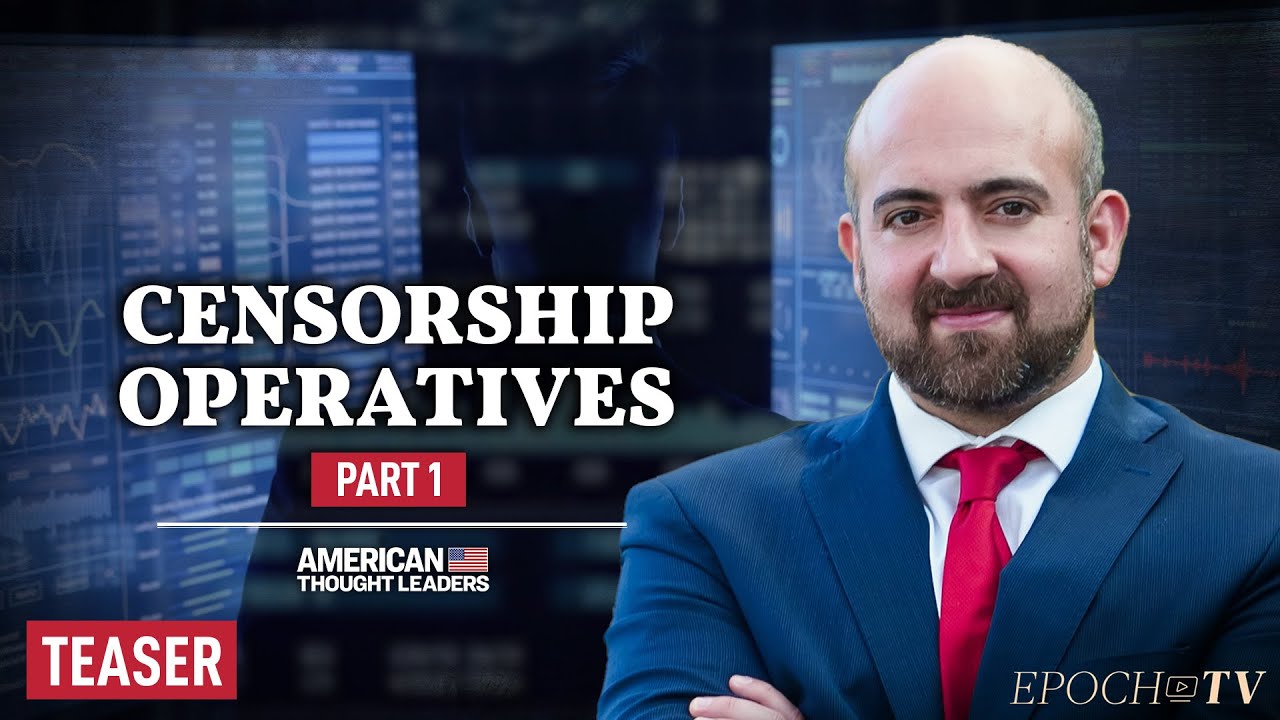
- Mike Benz (Part 1): The West’s Burgeoning Censorship Industry and the Government Funds Pouring In
“Whoever can control the Department of Dirty Tricks is able to use it to remove all opposition,” says Mike Benz. He is the executive director of the Foundation for Freedom Online and a former State Department diplomat under the Trump administration. The Twitter Files were just the tip of the iceberg, says Benz, who has been tracking the rise of the West’s censorship industry for years. “22 million tweets were categorized as misinformation for purposes of takedowns or throttling through [the Election Integrity Partnership],” Benz said. “It wasn’t just government individual takedown requests. It was government pressure … to create whole new categories of things to censor and then arming them with the artificial intelligence to then automatically scan and ban the new thought violations.” In this comprehensive two-part interview, Benz breaks down the major players in today’s censorship regime and how tactics once used abroad were deployed to target Americans and so-called election “delegitimization” or COVID “misinformation” online. “Graphika was immediately working with NATO’s essentially psychological warfare branch—the Hybrid Center of Excellence—in January 2020 … They had this sophisticated typography of what right-wing media was saying, what left-wing media was saying, what was being shared, the nodes and links between nodes of all the different narrative discourses on social media.” “They will have a revolving door at the professional level. That is, people who are in government roles, for example, in Misinformation, Disinformation, and Malinformation at DHS, will get their next jobs at the German Marshall Fund or the Atlantic Council’s Digital Forensic Research Lab … It is a career path. It is a path to power,” Benz says. Interview trailer: Watch the full interview: https://www.theepochtimes.com/mike-benz-part-1-the-wests-burgeoning-censorship-industry-and-the-government-funds-pouring-in-from-dhs-to-darpa-to-national-science-foundation_5026384.html FULL TRANSCRIPT Jan Jekielek: Mike Benz, it’s such a pleasure to have you on “American Thought Leaders”. Mike Benz: Thanks for having me. Mr. Jekielek: Mike, in our conversations, you told me that you have a mission of fostering a free and open internet. Where are we at now? You’re basically saying that this is not the case here. Mr. Benz: We’re very far removed from the days of what I consider to be the golden age of the internet between 2006 and 2016, when you had this combination of a mature social media ecosystem where people could share information, basically a pure information meritocracy. After that, the political turbulence of the events of 2016, instituted a revenge of the gatekeepers, an increasingly, incrementally more regimented system of censorship that we are now in the process of negotiating our opposition to. Mr. Jekielek: You’re saying that something profound happened in 2016 that changed the ecosystem dramatically. You said it was political turbulence, but what actually happened? How did the system change? Mr. Benz: There were two enormous and unexpected political events that year. In June 2016, you had Brexit. Brexit at the time was not just a small isolated domestic issue within the United Kingdom, it was viewed as an existential threat to the integrity of the European Union. Because at the time there was a fear that France would then go through Frexit with Marine Le Pen’s movement. Italy would go through Italexit with Matteo Salvini’s movement. You would have Grexit in Greece, and Spexit in Spain. The EU would come undone, and NATO would fall apart. The entire rules-based international order would collapse if something urgent wasn’t done about it. And then, in quick succession, you had a candidate who at the time was an almost 20 to one underdog in the New York Times. On the morning of the 2016 election, you had Trump at about 5 per cent and Hillary Clinton 90 per cent, and a little bit left for the stragglers. But basically, it was this idea that this couldn’t happen, and yet it did. And it seemed like everything was going to fall apart with the rules-based international order unless the information ecosystem was radically and permanently altered. Because both of these events were viewed as being internet elections, if you will. Social media was the reason that Nigel Farage developed the popularity of the Brexit movement. It was through his viral YouTube speeches to the European Parliament. It was the domination of Twitter hashtags and Facebook groups that were responsible for Donald Trump’s popularity at the base level. So, you had an organized effort to contain populism by containing the means through which populists could distribute their messaging and mobilize politically. Mr. Jekielek: Populist seems like a catchall term. Is it actually populists that we’re talking about? Mr. Benz: That’s their terminology. It’s fair to use because it captures the idea that base level opposition to elite institutions can come from both the Right and the Left. It’s not necessarily a Right-wing or a Left-wing thing. Left-wing populists like Bernie Sanders in the U.S. or Jeremy Corbyn in the UK were targeted with equal ferocity. It’s just that they didn’t come as close to power as Trump and the Brexit movement did. Mr. Jekielek: Why don’t we just sketch out where we are today? You describe it as a whole of society effort, which just sounds massive and unbelievable. You’re saying that a lot of people are beginning to understand what this is. They might know, “Oh, the Twitter files have exposed a lot of censorship.” They might have themselves experienced something, but they can’t necessarily see the whole picture. The whole of society, what does that mean? Mr. Benz: That’s actually the terminology of basically every mainstream censorship industry professional. Audio: Addressing disinformation requires a whole of society approach. This information is not going to be fixed by governments acting alone. I think we’ve seen that a whole of society effort is really key to the solution. This is a whole of society challenge. A whole of society approach. This is a whole of society problem. Mr. Benz: This is something that is now such a well-worn phrase within the censorship industry, that they often apologize at conferences for using the term, because it’s so well worn at this point. What it means is four categories of institutions in society all working together towards the common goal of censorship. You’ve got government, the private sector, civil society, and then news media and fact checking. So, let’s break down these four elements. You’ve got DHS, FBI, DOD, the State Department, the National Science Foundation, the CIA, and National Endowment for Democracy. On issue-specific issues like Covid censorship, you’ve got HHS, NIH, CDC, and NIAID, all of these playing various roles at the government level. Then, you’ve got the private sector, and you’ve got the tech platforms where the censorship actually occurs. That is where the button gets pressed, so to speak, or where the algorithms play out. You’ve also got private sector censorship technology development, which is the private companies whose job is to create machine learning and artificial intelligence to incorporate the training data to create the tools that are used for the active censorship. And then, you’ve got corporate social responsibility, the CSR money that pours into it from the private sector. In fact, there’s a whole new impact investing angle, VCs investing in censorship companies, because there’s such a gold rush into this field. On the civil society side, you’ve got universities, NGOs, activists, nonprofits and foundations. And then finally, at the news media and fact checking level, you’ve got the politically like-minded within the media who are propped up by the government, by the private sector, and by the civil society so that they can manage public narratives about various issues and can amplify pressure for censorship, by creating negative press on the tech companies, for example. You’ve got the fact checking conglomerates within those who flag the individual posts for the tech companies to manage. So, all four of those in concert have all been fused into basically the nucleus of a single atom. Mr. Jekielek: It’s hard to conceive how all of this works. Mr. Benz: When they have disinformation conferences, there will be representatives from all four institutions there. They will negotiate what their own preferences and needs are, and they will talk with each other about doing favors for favors. They will work out common terminologies, and common problems that they’re having. They will have a revolving door at the professional level. People who are in government roles in misinformation, disinformation, and malinformation at DHS will get their next jobs at the German Marshall Fund, at the Atlantic Council’s Digital Forensics Research Lab, or at the Alliance for Securing Democracy. Stanford University has a fellowship there. It is a career path; it is a path to power. We’re now going on essentially year five or six of this industry being created, so it’s reaching a stage of maturity, as it would for a technology space or an energy space. It’s becoming much more seamless as these roles become more interchangeable. Mr. Jekielek: What is it that unites these people, is it ideology? Mr. Benz: Different people are in it for different reasons. What I find most fascinating is the young people. It’s my contention that censorship is the fastest growing major on college campuses for ambitious young people who want jobs in Washington DC, or in Silicon Valley. Often, a top career path was you would go to Georgetown, you would major in international relations, and you would aspire to get a job on the Hill, and then work your way up, and/or maybe you’d start in finance and then transition over. What has happened with the rise of the censorship industry, basically they don’t call it that, you don’t get your degree in censorship, you’ll get it in something like computational data science, advanced linguistics, the internet research lab, or the media lab. There are so many different ways to launder the concept, but essentially what they’re doing day-to-day in these majors and in these PhDs is they are fusing the social sciences with the computer sciences to help both Silicon Valley and big government control public discourse and control the political momentum of various ideas. This puts young people right at the nexus of Google, Facebook, Washington DC, and Congress. So, you can shortcut making a tiny salary at the Hill out of Georgetown. You can take that pedigree into long term by going directly over to Google’s content moderation team or public policy team and working directly with Congress there, or essentially working directly with congressional cutouts. It is a path to power that is stunning in both the salaries these folks make and in how glitzy it is. You really do get the cocktail party invitations, you really do get access to a beautiful life, and you get impact. You’re not a sort of desk jockey who’s correcting typos for the first five years of your career, you’re in the action. So, I think it’s very exciting for people, and I think they become very intoxicated with the power, the god-like power, if you will, that total censorship capacity gives you. Mr. Jekielek: As I’m listening to you speak, I’m still having trouble imagining how in 2016 this whole industry suddenly launches or is created. You’re saying it’s not out of nothing. You’re saying it’s maturing at this time, and it happened without most people being entirely aware, even though they were aware that there was more censorship, especially if they were targeted, of course. But you never imagined it would be something so grand as what you’re portraying here. Mr. Benz: These things were not on the front page of the New York Times or the Wall Street Journal. You pick it up in strange vibrations. For me, I came to it through the artificial intelligence space. I was an avid chess player as a kid, and I lived through that period when computers overtook humans in the capacity to play chess well. I remember all the naysayers saying, “Chess computers will never be able to beat Garry Kasparov,” or “There will always be this ability to have the purity of the human spirit pierce through the dead soul of a chess computer.” And then, I remember the existential dread that came over the chess community when Garry Kasparov lost to Deep Blue, and it was like humans would never be able to compete against computers again. It was like this existential question, “What do we do in a world where you’ve got no hope?” I remember in late 2016, when I first came across literature around the deployment of artificial intelligence for purposes of content moderation, it gripped me. I became fixated at the cognitive level on the existential threat that this posed. Every time I would try to have conversations with folks about it, both socially and politically, nobody took the concern seriously and laughed it off, in a very similar way that people did in 1996 before the Garry Kasparov match. And so, for me, none of what’s happened has been a surprise to me. I only wish that folks had taken the issue much more seriously before the infrastructure became consolidated. Because now, it’s like trying to stop a cancer once it has already metastasized into the brain and the lungs, it’s much harder to do. It’s still essential to do, and that’s what I consider to be my purpose. Mr. Jekielek: What is it that you saw exactly? What did you realize that no one else realized? Mr. Benz: The power of control over words was very similar to the power of control over chess pieces. The way chess computers work for algorithms is they condense everything into a number system, so that you can grade every aspect of a chess position on a number scale to spit out a clean number that tells you who’s winning by and by how much. For example, if the computer says the position is -0.5, it means that the computer assesses the person who’s playing the black pieces to be up by approximately half of a pawn. When I started looking into what was being done with artificial intelligence and natural language processing and machine learning training models that were being developed, they were using a very similar system to map linguistically what was happening in the human language on social media. If someone was talking about a Trump policy, you could map the linguistic topography of that narrative and you could grade all the different words and slogans and memes and concepts into essentially what looked like a chess computer readout for whether you want to play knight to F3 or bishop to C5. The power this gives you is to be able to automatically trip varying levels of interventions, as they call it, which means censoring things. If the threshold goes above 1.5, this thing just gets banned. If it’s between 1 and 1.5, we’re going to shadow ban it. If it’s between .5 and 1, we’re going to just affix a fact checking thing to it. It gives you perfect control over the ability to determine the popularity of a narrative. Mr. Jekielek: Let me talk about the Twitter files. Okay, we’ve known about censorship for a while. At the Epoch Times, we’ve experienced hit pieces, and the deplatforming and demonetization associated with such hit pieces. This is some of what we’ve been talking about here. But what the Twitter files revealed to me was that there is censorship happening. The thing that really hit me at one point as we were looking at these dumps is there is the ability to shape the perceptions of a whole significant portion of society by just excluding information. This is what you’re making me think of right now as you describe this chess analogy. But you say that the Twitter files are just kind of the tip of the iceberg? Mr. Benz: A very tiny tip of it. The fact is, my foundation, the Foundation for Freedom Online, had already covered a lot of the things that ended up coming out in the Twitter files. A lot of this was available just by listening to these folks involved in their own public meetings. A lot of these things were done on YouTube, or were added as Facebook videos, or were on their own websites. What the Twitter files revealed was basically the presence of censorship operatives at virtually every national security-related institution in the U.S. government, as well as in the intelligence and public health spheres. There were Twitter files for the FBI, for the DHS, for the DOD, and for the State Department. I saw that at the State Department myself, everything from funding censorship-themed video games to promoting censorship of populist groups around the world, often with a conscious view of it having a boomerang effect on limiting the popularity of populist groups in the U.S. What the Twitter files tended to focus on, even in their most explosive cases, were one-off requests for censorship takedowns. For example, the FBI would send a message to the Twitter Trust and Safety Team saying, “Here’s a batch of six or seven tweets that we don’t like, and we want you to take down. They violate your terms of service, so you may want to take them down.” That only captures the tiniest fraction of censorship that was actually done in each of the major geopolitical events that we’ve experienced in the past few years. Look at these six or seven takedowns in the context of something like the Election Integrity Partnership [EIP], which had a formal partnership with the Department of Homeland Security to operate as their formerly designated disinformation flagger. 22 million tweets were categorized as misinformation for purposes of takedowns or throttling through the EIP. Compare that to the six or seven tweets highlighted in a Twitter files dump. These are six or seven orders of magnitude, it’s not even the same ballpark. This is because it wasn’t just government individual takedown requests, it was government pressure and coordination with the changing of the policies in the private sector themselves to actually coerce the tech companies to create whole new categories of things to censor, and then arming them with the artificial intelligence to then automatically scan and ban the new thought violations that they themselves had helped install. So, they did a one-two punch behind the scenes that the Twitter files still have not even come close to touching. Mr. Jekielek: How are you cataloging all this? Where are you discovering all this, and the evidence of this happening? Mr. Benz: What we just covered was stated very frankly and directly by an individual named Alex Stamos, who was the head of the Stanford Internet Observatory, the anchor entity of the Election Integrity Partnership. Speaker One: My suggestion is if people wanted to get the platforms to do stuff, first you got to push for written policies that are specific and that give you predictability. And so, this is something we started in the summer in August, is as Kate talked about, Carly Miller led a team from all four institutions to look at the detailed policies of the big platforms and to measure them against situations that we expected to happen. Now, we’re not going to take credit for all the changes they made, but we had to update this thing like eight or nine times, right? And so, like putting these people in a grid to say, “You’re not handling this, you’re not handling this, not handling this,” creates a lot of pressure inside of the companies and forces them to kind of grapple with these issues because you want specific policies that you can hold them accountable for. The second is when you report stuff to them, report how it’s violating those written policies, right? So, there’s two steps here, get good policies and then say, “This is how it’s violating it.” We will have our statistics, right? But I think we were pretty effective in getting them to act on things that they hadn’t act on it before. Mr. Benz: The November 9th, 2022 report has about 20 to 25 embedded videos of censorship professionals confessing what they did. What I just cited here is how EIP, using DHS’s clout and pressure on the backend, coerced the tech companies to create a new category of censorship called delegitimization, which was anything in the 2020 election that delegitimized public faith or confidence in mail-in ballots, early voting drop boxes, or ballot tabulation issues on election day. 100 per cent of their targets were Trump voters and Right-wing populist groups. It was the tech companies that didn’t want to do these policies initially, but they were coerced by EIP and EIP’s friends in the legislature; Amy Klobuchar, Elizabeth Warren, Mark Warner, Adam Schiff, and this whole intelligence committee, foreign affairs committee faction, as well as from others in the DNC to put pressure on the tech companies to create the censorship category. And then, he laid out in that video the two-step process, which is one; you get them to change the policies by putting them in the grid and threatening and then creating negative news media. And then two; you engage in this mass documentation and assist with the actual development of the capturing of all the violations of the new policies you just got put in. Now, the reason they do all these confessions on video is because you have to understand censorship is not just an industry, it is a mercenary business. Everyone in the censorship industry is competing for the same pool of government grant funds and donor dollars. It is a competitive industry at this point, we’re not in 2018, 2019 anymore. It is a mature industry with many players in it. You need to stand out. You need to prove what a good mercenary you are, what a good censor you are, how effective you are at silencing the opposition to the donors and the grant organizations. You need to brag about it on video, so that you are more qualified than your opposition and your competitors at getting more government grants. In fact, right after Alex Stamos made this confession, not just on video, but in a 292-page public report, he, and the lab that he partnered with, got a $3 million government grant from the Biden administration. They became government-funded for the first time ever right after he made that confession. Mr. Jekielek: So many things are coming out of what you just said. But the first one is that this is now actually a competitive market for censorship that you’re talking about. Mr. Benz: It is an industry. It is a business subsidized by the federal government and by large entrenched commercial and political interests who all have varying investment in neutralizing opposition to their concerns, which can be done through censorship. Because social media is the great equalizer when it comes to creating social and political momentum. Mr. Jekielek: What is really interesting is what you’re describing. You’re talking about it in the context of election integrity, you used that term. It also applies directly when it comes to Covid misinformation, similarly. Is it the exact same tools that are essentially being used in the same way? Mr. Benz: Actually, it’s funny you say that, because we just covered the Election Integrity Partnership, EIP. It’s the entity that DHS formerly partnered with as their disinformation flagger. When the 2020 election ended, they had censored their 22 million tweets. They had 120 staffers censoring the Trump supporters for the 2020 election for DHS. There was no more election cycle until 2022, when they came back and partnered with DHS again for the midterms. But in between then, they folded up briefly and then rebranded and renamed themselves as a new entity consisting of the same censorship entities. But instead of calling themselves EIP, they called themselves VP, the Virality Project. They did the exact same system of coordinating the government, the civil society, the private sector, and the news media and fact checking organizations. Instead of doing election censorship, they did Covid censorship, but they did it with the exact same ticketing system. They had the exact same relationships with Facebook, with Google, with YouTube, with Twitter, with TikTok, with Reddit, and with the 15 different platforms they monitored. They had the same system of chopping conceptual opposition, which was in the election context, opposition to mail-in ballots and drop boxes and ballet tabulation. It then became censoring opposition to Covid origins, to vaccine efficacy, to mask mandates, or to narratives about Bill Gates or Anthony Fauci. In fact, in their own after-action report, they detailed how they micro-targeted 66 distinct narratives about Covid and chopped all of them up into all of the different component claims. Then, they basically helped advise on the artificial intelligence censorship, helped the reporting and flagging, and coordinated the censorship army that was trained on censoring Covid. So, it was a seamless transition from election censorship to Covid censorship. Mr. Jekielek: So, basically, all you need to do this is to know what the correct view is. Is this what you’re telling me? And then, you just basically engage the system, and you’re good to go? Mr. Benz: It’s an evolutionary process as well. One of the things that was onboarded several years ago into the censorship industry was this concept of subject matter experts on a narrative-by-narrative basis who can help do the linguistic mapping and monitoring the rise of new memes, and of new ways of talking about an issue, and then continually fold that into the censorship paradigm that you’ve established. I do want to quickly say though, that I highlighted EIP turning into VP for Covid censorship after the 2020 election. But Covid started at the end of 2019, and actually the Covid censorship consortium began immediately, I mean really immediately. For example, Graphika is one of the four component entities of the EIP censorship consortium that DHS partnered with. Graphika is essentially a U.S. Department of Defense-funded censorship consortium. They were initially funded to help do social media counterinsurgency work effectively in conflict zones for the U.S. military. Then, they were redeployed domestically both on Covid censorship and political censorship. Graphika was deployed to monitor social media discourse about Covid and Covid origins, Covid conspiracies, or Covid sorts of issues. In January 2020, they began their first formal domestic campaign. COVID-19 didn’t even have the name COVID-19. In January 2020, it was still called Coronavirus at the time. And yet, Graphika was immediately working with NATO’s psychological warfare branch, the Hybrid CoE, Hybrid Center of Excellence in January 2020. Immediately, they were doing social media network graphs on Right-wing social media, and they did this along political lines. They had this sophisticated topography of what Right-wing media was saying, what Left-wing media was saying, about what was being shared, the nodes and links between nodes of all the different narrative discourses on social media for the purpose of handing that to the government to say, “Here’s what people are saying, what should we do to stop it?” So, the censorship set in right away. Mr. Jekielek: You’re reminding me of something I read that I wanted to get you to comment on, which is the foreign to domestic disinformation switcheroo. It sounds like you’re touching on something about this, so what is that? I think it’s very important to this whole picture. Mr. Benz: This is so important for understanding the history and chronology of how we got here, and it’s something that many commentators to the Twitter files are discovering for the first time now. Matt Taibbi has spilled a lot of ink in the past several weeks talking about how shocking it is, the Russian disinformation predicate, how central that was in retrospect, as he’s been writing about the normalization of domestic censorship. This is something I’ve been screaming about for five years now. What happened was before 2016, the idea of domestic censorship in the U.S. was not just rare, isolated, and frowned upon—it was a sacred existential attack on everything American. Censorship was the one thing that really distinguished at the governmental and at the social contract level the United States of America from every other country on the face of the planet. No other Western democracies have a First Amendment. We look at liberal democracies like Canada or the United Kingdom as being just like America in the Western tradition of governmental democracies. But what makes America distinct is that we have total free speech in this country, at least that’s what it was billed as. Now, we are going directly from that into this system of mass domestic censorship, where if you challenge mail-in ballots in a Twitter post on a Thursday night, the Department of Homeland Security has an entire division sitting there who when they see your tweet will categorize you as conducting a cyberattack on U.S. critical infrastructure, because you’ve undermined public faith in the elections. This is something that needed an intermediary step, and that intermediary step was the foreign predicate. Now, this is something that the U.S. foreign policy establishment has been doing since time immemorial, but essentially since the 1940s, when the national security state was established and consolidated with the 1947 National Security Act. The American foreign policy establishment basically came to a consensus opinion that if we want the 20th century to be the American century, we’re going to need a Department of Dirty Tricks. We’re going to need to play rougher on the world stage than we’ve been used to. We will still have constitutional protections for Americans, we’ll still have free speech in America, and we’ll still have due process in America. But we’re going to empower our foreign intelligence in our foreign influence capacities with much more ruthless and dirty capacities than we have at home. This is because it’s a tough world out there. The Bolsheviks are going to do it if we don’t do it. There is this whole new order coming out of World War II that is going to need some tough love to consolidate. Even in the 1960s, when there were opposition movements to the bipartisan consensus on several things, including on war and foreign policy, the counterintelligence division at the FBI often deployed this Department of Dirty Tricks to neutralize anti-war protestors, or some of the more stringent elements of the civil rights protest. Martin Luther King, for example, was targeted by the FBI formally because of his connection to Stanley Levison, who had these affiliations with communism. And so, you could wiretap Martin Luther King’s phone, you could have COINTELPRO [Counterintelligence Program] write nasty telegrams, and death threat letters, because there was a foreign predicate. If you simply conflated the domestic with the foreign, then it wasn’t really the classical type of deprivation of due process, this is just being really aggressive about countering Russian influence. So, it’s a way of laundering, of bringing the Department of Dirty Tricks that’s supposed to stay overseas and bringing it home. If you think of it as a war between two political factions, it’s a sneak attack by bringing in powers that aren’t supposed to be there for this game. They did that in the censorship industry through the creation of a Russian boogeyman that was said to have hacked the 2016 election, that was said to have interfered on U.S. social media, that was said to have created these sophisticated bot farms and troll farms and Facebook pages and this enormous network tapestry that magically disappeared right before the 2020 election. Somehow, in 2016, it was said to be enormous. Of course, all the digital forensics were a total hoax. They were done by the same disinformation experts as Graphika and the Atlantic Council’s Digital Forensics Research Lab that ended up becoming massively discredited in subsequent years when they completely made up results. They called real people Russian bots, and those people went on TV and read their name, rank, and serial number. It was a hoax from the start, but it was a useful one, because it allowed the handoff of the censorship infrastructure on the foreign side to be grafted on to the domestic side. We’ve talked about the Department of Homeland Security and how it became this hub within the U.S. federal government for coordinating whole society censorship. At the time, before the Biden administration and for the 2020 election, the only thing that existed at the time to partner with EIP to outsource all this censorship, to coordinate the domestic censorship of the U.S. election in 2020, was technically a group within DHS called the Countering Foreign Influence Task Force. The Countering Foreign Influence Task Force was technically the coordinating wing for censorship of you, and of people in Ohio talking about how it was a little weird that early voting drop boxes were open for six weeks before an election, and you can imagine what might go wrong with that. In the very first week Biden took office, this was in January 2021 before the calendar even hit the word February, one of the first courses of action that Biden’s DHS did was they revamped the Countering Foreign Influence Task Force with the same personnel and the same staffers. They simply went from countering foreign influence to “MDM,” misinformation, disinformation, and malinformation as a general catchall, with no distinction between foreign and domestic. That way it could paper over the fact that they weren’t supposed to be operating on domestic soil. Mr. Jekielek: As you’re describing all this, readers of The Epoch Times and viewers of this program just keep thinking Russiagate, Russiagate, Russiagate. Underpinning Russiagate was this idea that there were Russians who had hacked the election. In fact, there’s still Americans that believe that Russians hacked the 2016 election. And then, there was the whole weaponization of the Pfizer warrants, which is what you’re alluding to and what you’re speaking about. Perhaps this is Matt Taibbi’s realization in the last few weeks—no one imagined that the whole system could be somehow engaged in all of this at the same time. Does this make sense? It’s still straining credulity that everyone, all these different institutions are working in lockstep. Mr. Benz: Unfortunately, real people with real names at real meetings were very cognizant of this. In fact, it’s my belief based on compelling evidence that I’ve assembled that this is actually very conscious from the very start. Take for example, in early 2017, you had the foreign policy establishment trying to reconcile the fact that an essentially uniparty apparatus that had existed from Truman until Trump on foreign policy. It had this shared left-hand, right-hand understanding that there would not be any sort of partisan disagreement on foreign policy grounds. We may disagree on whether it should be high taxes or low taxes, we may disagree on something like pro-life or pro-choice, or civil rights, but when it comes to what are we going to do about Venezuela, what are we going to do about Southeast Asia, there’s not going to be any sort of intense existential Right or Left distinction. Because that’s what keeps Washington unified, and part of that is because of the commercial interest around that. But when populism emerged and became powered by social media, it threatened the very bedrock of those institutions, because now domestic manufacturing concerns may actually impede the political will of these multilateral institutions that form the basis of the consensus architecture. This is what happened when they were negotiating the response to the threat of social media in the very beginning. I’ll give an example. Ambassador Daniel Fried is one example of this. Now, I don’t know Ambassador Fried, I assume he’s a very nice person in his personal life. He has a certain grace with which he conducts diplomacy, but he was part of the architecture of the censorship industry’s development on this Russiagate issue in a way that I find to be profoundly disturbing. Ambassador Fried was a 40-year diplomat at the U.S. State Department. He’s on the board of the National Endowment for Democracy. In February 2017, he left the State Department in order to take his talents for coordinating government responses to sanctions. He was the sanctions coordinator for the Obama administration after the annexation of Crimea in 2014. After the Crimea referendum, he did the roadshow in Europe to get all the different NATO countries to pass what were for themselves painful sanctions on Russia over the Crimea annexation. A lot of European countries didn’t want to do these sanctions, because of the economic impact it would have on their own populations. But Ambassador Fried took his State Department and network clout to put pressure on Europe to do sanctions on Russia for purposes of this Crimea response. He then turned around after the 2016 election and took those same connections, those same power networks and organized all these disinformation conferences, these whole of society meetings and mobilizations. The same thing that he did on sanctions coordination, he did on censorship coordination. He was a part of this network that helped pressure and contort the European regulatory climate to passing new censorship laws. Like, for example, Germany’s NetzDG [Network Enforcement Act] passed in August 2017. Germany is the industrial powerhouse of Europe and when they passed NetzDG, it compelled Facebook and YouTube to adopt artificial intelligence censorship techniques in order to comply with $54 million fines for leaving various kinds of content on their platforms that violated this new German law. And so now, Facebook and YouTube had to adopt all this new AI that had an immediate impact on that AI being redirected inward in the U.S. context, and in the UK context to counteract Brexit support. Now, Ambassador Fried was talking openly about this at his own disinformation conferences with European regulators, with national security officials, and with extremely important and influential people. At the time they were saying, “Ambassador Fried, that sounds like a great idea, but it’s just not enough. The Russians are only one component of these populists. They’ve taken on a life of their own, and they seem to have their own independent interests.” Ambassador Fried is in the room telling them, “Listen, I understand, I understand. But in America, we can’t just go from zero to one, we have to boil the frog.” Speaker Two: As an old diplomat, the thing to do is to set up an informal mechanism, maybe formal, but start informally between the U.S., the EU key shareholders and bringing in the civil society. And then use that to have a conversation with the social media companies. Like we’ve got a lot of leverage, we can use it, and they will adjust, their culture is malleable. They will respond to the incentive structure that we set up if we do our job. Mr. Benz: If you do your thing in Europe, it will help the Trans-Atlantic Alliance merge towards a common set of norms and values with respect to social media speech. And in the creation of this counterintelligence infrastructure, it will naturally gravitate, as the Mueller investigation is ongoing, as pro-Trump groups are seen more and more as an arm of Russians themselves, it will be easier to simply consolidate those two concepts into one: Trump, Russia. If you simply create a censorship infrastructure for Russia, as Trump gets merged into Trump, Russia, the two become one and the same. And then suddenly, no one is crying tears if a suspected Russian propagandist who happens to be some 17-year-old high school kid in Wisconsin who has an opinion about the border wall, when they get taken down as part of a 10,000-person roundup of suspected Russians, no one is going to cry tears, because at least you’re aggressively dealing with a national security threat. So, they were aware of this. This is February 2017; this is right at the outset. We should be far past the spotter stage at this point. To get notifications about new Kash's Corner and American Thought Leaders episodes, please sign up for our newsletter! Here 👉 Get Alerts - PRE-ORDER "The Shadow State" DVD: https://www.epochtv.shop/product-page/the-shadow-state-dvd The Real Story of January 6 | Documentary BUY Jan 6 DVD: https://www.epochtv.shop/product-page/dvd-the-real-story-of-january-6, Promo Code “Jan” for 20% off. - Follow American Thought Leaders on social media: Twitter: https://twitter.com/AmThoughtLeader Truth Social: https://truthsocial.com/@AmThoughtLeader Gettr: https://gettr.com/user/amthoughtleader Facebook: https://www.facebook.com/AmericanThoughtLeaders Gab: https://gab.com/AmThoughtLeader Telegram: https://t.me/AmThoughtLeader
- Mike Benz (Part 1): The West’s Burgeoning Censorship Industry and the Government Funds Pouring In–Fr
“Whoever can control the Department of Dirty Tricks is able to use it to remove all opposition,” says Mike Benz. He is the executive director of the Foundation for Freedom Online and a former State Department diplomat under the Trump administration. The Twitter Files were just the tip of the iceberg, says Benz, who has been tracking the rise of the West’s censorship industry for years. “22 million tweets were categorized as misinformation for purposes of takedowns or throttling through [the Election Integrity Partnership],” Benz said. “It wasn’t just government individual takedown requests. It was government pressure … to create whole new categories of things to censor and then arming them with the artificial intelligence to then automatically scan and ban the new thought violations.” In this comprehensive two-part interview, Benz breaks down the major players in today’s censorship regime and how tactics once used abroad were deployed to target Americans and so-called election “delegitimization” or COVID “misinformation” online. Interview trailer: Watch the full interview: https://www.theepochtimes.com/mike-benz-part-1-the-wests-burgeoning-censorship-industry-and-the-government-funds-pouring-in-from-dhs-to-darpa-to-national-science-foundation_5026384.html FULL TRANSCRIPT Jan Jekielek: Mike Benz, it’s such a pleasure to have you on “American Thought Leaders”. Mike Benz: Thanks for having me. Mr. Jekielek: Mike, in our conversations, you told me that you have a mission of fostering a free and open internet. Where are we at now? You’re basically saying that this is not the case here. Mr. Benz: We’re very far removed from the days of what I consider to be the golden age of the internet between 2006 and 2016, when you had this combination of a mature social media ecosystem where people could share information, basically a pure information meritocracy. After that, the political turbulence of the events of 2016, instituted a revenge of the gatekeepers, an increasingly, incrementally more regimented system of censorship that we are now in the process of negotiating our opposition to. Mr. Jekielek: You’re saying that something profound happened in 2016 that changed the ecosystem dramatically. You said it was political turbulence, but what actually happened? How did the system change? Mr. Benz: There were two enormous and unexpected political events that year. In June 2016, you had Brexit. Brexit at the time was not just a small isolated domestic issue within the United Kingdom, it was viewed as an existential threat to the integrity of the European Union. Because at the time there was a fear that France would then go through Frexit with Marine Le Pen’s movement. Italy would go through Italexit with Matteo Salvini’s movement. You would have Grexit in Greece, and Spexit in Spain. The EU would come undone, and NATO would fall apart. The entire rules-based international order would collapse if something urgent wasn’t done about it. And then, in quick succession, you had a candidate who at the time was an almost 20 to one underdog in the New York Times. On the morning of the 2016 election, you had Trump at about 5 per cent and Hillary Clinton 90 per cent, and a little bit left for the stragglers. But basically, it was this idea that this couldn’t happen, and yet it did. And it seemed like everything was going to fall apart with the rules-based international order unless the information ecosystem was radically and permanently altered. Because both of these events were viewed as being internet elections, if you will. Social media was the reason that Nigel Farage developed the popularity of the Brexit movement. It was through his viral YouTube speeches to the European Parliament. It was the domination of Twitter hashtags and Facebook groups that were responsible for Donald Trump’s popularity at the base level. So, you had an organized effort to contain populism by containing the means through which populists could distribute their messaging and mobilize politically. Mr. Jekielek: Populist seems like a catchall term. Is it actually populists that we’re talking about? Mr. Benz: That’s their terminology. It’s fair to use because it captures the idea that base level opposition to elite institutions can come from both the Right and the Left. It’s not necessarily a Right-wing or a Left-wing thing. Left-wing populists like Bernie Sanders in the U.S. or Jeremy Corbyn in the UK were targeted with equal ferocity. It’s just that they didn’t come as close to power as Trump and the Brexit movement did. Mr. Jekielek: Why don’t we just sketch out where we are today? You describe it as a whole of society effort, which just sounds massive and unbelievable. You’re saying that a lot of people are beginning to understand what this is. They might know, “Oh, the Twitter files have exposed a lot of censorship.” They might have themselves experienced something, but they can’t necessarily see the whole picture. The whole of society, what does that mean? Mr. Benz: That’s actually the terminology of basically every mainstream censorship industry professional. Audio: Addressing disinformation requires a whole of society approach. This information is not going to be fixed by governments acting alone. I think we’ve seen that a whole of society effort is really key to the solution. This is a whole of society challenge. A whole of society approach. This is a whole of society problem. Mr. Benz: This is something that is now such a well-worn phrase within the censorship industry, that they often apologize at conferences for using the term, because it’s so well worn at this point. What it means is four categories of institutions in society all working together towards the common goal of censorship. You’ve got government, the private sector, civil society, and then news media and fact checking. So, let’s break down these four elements. You’ve got DHS, FBI, DOD, the State Department, the National Science Foundation, the CIA, and National Endowment for Democracy. On issue-specific issues like Covid censorship, you’ve got HHS, NIH, CDC, and NIAID, all of these playing various roles at the government level. Then, you’ve got the private sector, and you’ve got the tech platforms where the censorship actually occurs. That is where the button gets pressed, so to speak, or where the algorithms play out. You’ve also got private sector censorship technology development, which is the private companies whose job is to create machine learning and artificial intelligence to incorporate the training data to create the tools that are used for the active censorship. And then, you’ve got corporate social responsibility, the CSR money that pours into it from the private sector. In fact, there’s a whole new impact investing angle, VCs investing in censorship companies, because there’s such a gold rush into this field. On the civil society side, you’ve got universities, NGOs, activists, nonprofits and foundations. And then finally, at the news media and fact checking level, you’ve got the politically like-minded within the media who are propped up by the government, by the private sector, and by the civil society so that they can manage public narratives about various issues and can amplify pressure for censorship, by creating negative press on the tech companies, for example. You’ve got the fact checking conglomerates within those who flag the individual posts for the tech companies to manage. So, all four of those in concert have all been fused into basically the nucleus of a single atom. Mr. Jekielek: It’s hard to conceive how all of this works. Mr. Benz: When they have disinformation conferences, there will be representatives from all four institutions there. They will negotiate what their own preferences and needs are, and they will talk with each other about doing favors for favors. They will work out common terminologies, and common problems that they’re having. They will have a revolving door at the professional level. People who are in government roles in misinformation, disinformation, and malinformation at DHS will get their next jobs at the German Marshall Fund, at the Atlantic Council’s Digital Forensics Research Lab, or at the Alliance for Securing Democracy. Stanford University has a fellowship there. It is a career path; it is a path to power. We’re now going on essentially year five or six of this industry being created, so it’s reaching a stage of maturity, as it would for a technology space or an energy space. It’s becoming much more seamless as these roles become more interchangeable. Mr. Jekielek: What is it that unites these people, is it ideology? Mr. Benz: Different people are in it for different reasons. What I find most fascinating is the young people. It’s my contention that censorship is the fastest growing major on college campuses for ambitious young people who want jobs in Washington DC, or in Silicon Valley. Often, a top career path was you would go to Georgetown, you would major in international relations, and you would aspire to get a job on the Hill, and then work your way up, and/or maybe you’d start in finance and then transition over. What has happened with the rise of the censorship industry, basically they don’t call it that, you don’t get your degree in censorship, you’ll get it in something like computational data science, advanced linguistics, the internet research lab, or the media lab. There are so many different ways to launder the concept, but essentially what they’re doing day-to-day in these majors and in these PhDs is they are fusing the social sciences with the computer sciences to help both Silicon Valley and big government control public discourse and control the political momentum of various ideas. This puts young people right at the nexus of Google, Facebook, Washington DC, and Congress. So, you can shortcut making a tiny salary at the Hill out of Georgetown. You can take that pedigree into long term by going directly over to Google’s content moderation team or public policy team and working directly with Congress there, or essentially working directly with congressional cutouts. It is a path to power that is stunning in both the salaries these folks make and in how glitzy it is. You really do get the cocktail party invitations, you really do get access to a beautiful life, and you get impact. You’re not a sort of desk jockey who’s correcting typos for the first five years of your career, you’re in the action. So, I think it’s very exciting for people, and I think they become very intoxicated with the power, the god-like power, if you will, that total censorship capacity gives you. Mr. Jekielek: As I’m listening to you speak, I’m still having trouble imagining how in 2016 this whole industry suddenly launches or is created. You’re saying it’s not out of nothing. You’re saying it’s maturing at this time, and it happened without most people being entirely aware, even though they were aware that there was more censorship, especially if they were targeted, of course. But you never imagined it would be something so grand as what you’re portraying here. Mr. Benz: These things were not on the front page of the New York Times or the Wall Street Journal. You pick it up in strange vibrations. For me, I came to it through the artificial intelligence space. I was an avid chess player as a kid, and I lived through that period when computers overtook humans in the capacity to play chess well. I remember all the naysayers saying, “Chess computers will never be able to beat Garry Kasparov,” or “There will always be this ability to have the purity of the human spirit pierce through the dead soul of a chess computer.” And then, I remember the existential dread that came over the chess community when Garry Kasparov lost to Deep Blue, and it was like humans would never be able to compete against computers again. It was like this existential question, “What do we do in a world where you’ve got no hope?” I remember in late 2016, when I first came across literature around the deployment of artificial intelligence for purposes of content moderation, it gripped me. I became fixated at the cognitive level on the existential threat that this posed. Every time I would try to have conversations with folks about it, both socially and politically, nobody took the concern seriously and laughed it off, in a very similar way that people did in 1996 before the Garry Kasparov match. And so, for me, none of what’s happened has been a surprise to me. I only wish that folks had taken the issue much more seriously before the infrastructure became consolidated. Because now, it’s like trying to stop a cancer once it has already metastasized into the brain and the lungs, it’s much harder to do. It’s still essential to do, and that’s what I consider to be my purpose. Mr. Jekielek: What is it that you saw exactly? What did you realize that no one else realized? Mr. Benz: The power of control over words was very similar to the power of control over chess pieces. The way chess computers work for algorithms is they condense everything into a number system, so that you can grade every aspect of a chess position on a number scale to spit out a clean number that tells you who’s winning by and by how much. For example, if the computer says the position is -0.5, it means that the computer assesses the person who’s playing the black pieces to be up by approximately half of a pawn. When I started looking into what was being done with artificial intelligence and natural language processing and machine learning training models that were being developed, they were using a very similar system to map linguistically what was happening in the human language on social media. If someone was talking about a Trump policy, you could map the linguistic topography of that narrative and you could grade all the different words and slogans and memes and concepts into essentially what looked like a chess computer readout for whether you want to play knight to F3 or bishop to C5. The power this gives you is to be able to automatically trip varying levels of interventions, as they call it, which means censoring things. If the threshold goes above 1.5, this thing just gets banned. If it’s between 1 and 1.5, we’re going to shadow ban it. If it’s between .5 and 1, we’re going to just affix a fact checking thing to it. It gives you perfect control over the ability to determine the popularity of a narrative. Mr. Jekielek: Let me talk about the Twitter files. Okay, we’ve known about censorship for a while. At the Epoch Times, we’ve experienced hit pieces, and the deplatforming and demonetization associated with such hit pieces. This is some of what we’ve been talking about here. But what the Twitter files revealed to me was that there is censorship happening. The thing that really hit me at one point as we were looking at these dumps is there is the ability to shape the perceptions of a whole significant portion of society by just excluding information. This is what you’re making me think of right now as you describe this chess analogy. But you say that the Twitter files are just kind of the tip of the iceberg? Mr. Benz: A very tiny tip of it. The fact is, my foundation, the Foundation for Freedom Online, had already covered a lot of the things that ended up coming out in the Twitter files. A lot of this was available just by listening to these folks involved in their own public meetings. A lot of these things were done on YouTube, or were added as Facebook videos, or were on their own websites. What the Twitter files revealed was basically the presence of censorship operatives at virtually every national security-related institution in the U.S. government, as well as in the intelligence and public health spheres. There were Twitter files for the FBI, for the DHS, for the DOD, and for the State Department. I saw that at the State Department myself, everything from funding censorship-themed video games to promoting censorship of populist groups around the world, often with a conscious view of it having a boomerang effect on limiting the popularity of populist groups in the U.S. What the Twitter files tended to focus on, even in their most explosive cases, were one-off requests for censorship takedowns. For example, the FBI would send a message to the Twitter Trust and Safety Team saying, “Here’s a batch of six or seven tweets that we don’t like, and we want you to take down. They violate your terms of service, so you may want to take them down.” That only captures the tiniest fraction of censorship that was actually done in each of the major geopolitical events that we’ve experienced in the past few years. Look at these six or seven takedowns in the context of something like the Election Integrity Partnership [EIP], which had a formal partnership with the Department of Homeland Security to operate as their formerly designated disinformation flagger. 22 million tweets were categorized as misinformation for purposes of takedowns or throttling through the EIP. Compare that to the six or seven tweets highlighted in a Twitter files dump. These are six or seven orders of magnitude, it’s not even the same ballpark. This is because it wasn’t just government individual takedown requests, it was government pressure and coordination with the changing of the policies in the private sector themselves to actually coerce the tech companies to create whole new categories of things to censor, and then arming them with the artificial intelligence to then automatically scan and ban the new thought violations that they themselves had helped install. So, they did a one-two punch behind the scenes that the Twitter files still have not even come close to touching. Mr. Jekielek: How are you cataloging all this? Where are you discovering all this, and the evidence of this happening? Mr. Benz: What we just covered was stated very frankly and directly by an individual named Alex Stamos, who was the head of the Stanford Internet Observatory, the anchor entity of the Election Integrity Partnership. Speaker One: My suggestion is if people wanted to get the platforms to do stuff, first you got to push for written policies that are specific and that give you predictability. And so, this is something we started in the summer in August, is as Kate talked about, Carly Miller led a team from all four institutions to look at the detailed policies of the big platforms and to measure them against situations that we expected to happen. Now, we’re not going to take credit for all the changes they made, but we had to update this thing like eight or nine times, right? And so, like putting these people in a grid to say, “You’re not handling this, you’re not handling this, not handling this,” creates a lot of pressure inside of the companies and forces them to kind of grapple with these issues because you want specific policies that you can hold them accountable for. The second is when you report stuff to them, report how it’s violating those written policies, right? So, there’s two steps here, get good policies and then say, “This is how it’s violating it.” We will have our statistics, right? But I think we were pretty effective in getting them to act on things that they hadn’t act on it before. Mr. Benz: The November 9th, 2022 report has about 20 to 25 embedded videos of censorship professionals confessing what they did. What I just cited here is how EIP, using DHS’s clout and pressure on the backend, coerced the tech companies to create a new category of censorship called delegitimization, which was anything in the 2020 election that delegitimized public faith or confidence in mail-in ballots, early voting drop boxes, or ballot tabulation issues on election day. 100 per cent of their targets were Trump voters and Right-wing populist groups. It was the tech companies that didn’t want to do these policies initially, but they were coerced by EIP and EIP’s friends in the legislature; Amy Klobuchar, Elizabeth Warren, Mark Warner, Adam Schiff, and this whole intelligence committee, foreign affairs committee faction, as well as from others in the DNC to put pressure on the tech companies to create the censorship category. And then, he laid out in that video the two-step process, which is one; you get them to change the policies by putting them in the grid and threatening and then creating negative news media. And then two; you engage in this mass documentation and assist with the actual development of the capturing of all the violations of the new policies you just got put in. Now, the reason they do all these confessions on video is because you have to understand censorship is not just an industry, it is a mercenary business. Everyone in the censorship industry is competing for the same pool of government grant funds and donor dollars. It is a competitive industry at this point, we’re not in 2018, 2019 anymore. It is a mature industry with many players in it. You need to stand out. You need to prove what a good mercenary you are, what a good censor you are, how effective you are at silencing the opposition to the donors and the grant organizations. You need to brag about it on video, so that you are more qualified than your opposition and your competitors at getting more government grants. In fact, right after Alex Stamos made this confession, not just on video, but in a 292-page public report, he, and the lab that he partnered with, got a $3 million government grant from the Biden administration. They became government-funded for the first time ever right after he made that confession. Mr. Jekielek: So many things are coming out of what you just said. But the first one is that this is now actually a competitive market for censorship that you’re talking about. Mr. Benz: It is an industry. It is a business subsidized by the federal government and by large entrenched commercial and political interests who all have varying investment in neutralizing opposition to their concerns, which can be done through censorship. Because social media is the great equalizer when it comes to creating social and political momentum. Mr. Jekielek: What is really interesting is what you’re describing. You’re talking about it in the context of election integrity, you used that term. It also applies directly when it comes to Covid misinformation, similarly. Is it the exact same tools that are essentially being used in the same way? Mr. Benz: Actually, it’s funny you say that, because we just covered the Election Integrity Partnership, EIP. It’s the entity that DHS formerly partnered with as their disinformation flagger. When the 2020 election ended, they had censored their 22 million tweets. They had 120 staffers censoring the Trump supporters for the 2020 election for DHS. There was no more election cycle until 2022, when they came back and partnered with DHS again for the midterms. But in between then, they folded up briefly and then rebranded and renamed themselves as a new entity consisting of the same censorship entities. But instead of calling themselves EIP, they called themselves VP, the Virality Project. They did the exact same system of coordinating the government, the civil society, the private sector, and the news media and fact checking organizations. Instead of doing election censorship, they did Covid censorship, but they did it with the exact same ticketing system. They had the exact same relationships with Facebook, with Google, with YouTube, with Twitter, with TikTok, with Reddit, and with the 15 different platforms they monitored. They had the same system of chopping conceptual opposition, which was in the election context, opposition to mail-in ballots and drop boxes and ballet tabulation. It then became censoring opposition to Covid origins, to vaccine efficacy, to mask mandates, or to narratives about Bill Gates or Anthony Fauci. In fact, in their own after-action report, they detailed how they micro-targeted 66 distinct narratives about Covid and chopped all of them up into all of the different component claims. Then, they basically helped advise on the artificial intelligence censorship, helped the reporting and flagging, and coordinated the censorship army that was trained on censoring Covid. So, it was a seamless transition from election censorship to Covid censorship. Mr. Jekielek: So, basically, all you need to do this is to know what the correct view is. Is this what you’re telling me? And then, you just basically engage the system, and you’re good to go? Mr. Benz: It’s an evolutionary process as well. One of the things that was onboarded several years ago into the censorship industry was this concept of subject matter experts on a narrative-by-narrative basis who can help do the linguistic mapping and monitoring the rise of new memes, and of new ways of talking about an issue, and then continually fold that into the censorship paradigm that you’ve established. I do want to quickly say though, that I highlighted EIP turning into VP for Covid censorship after the 2020 election. But Covid started at the end of 2019, and actually the Covid censorship consortium began immediately, I mean really immediately. For example, Graphika is one of the four component entities of the EIP censorship consortium that DHS partnered with. Graphika is essentially a U.S. Department of Defense-funded censorship consortium. They were initially funded to help do social media counterinsurgency work effectively in conflict zones for the U.S. military. Then, they were redeployed domestically both on Covid censorship and political censorship. Graphika was deployed to monitor social media discourse about Covid and Covid origins, Covid conspiracies, or Covid sorts of issues. In January 2020, they began their first formal domestic campaign. COVID-19 didn’t even have the name COVID-19. In January 2020, it was still called Coronavirus at the time. And yet, Graphika was immediately working with NATO’s psychological warfare branch, the Hybrid CoE, Hybrid Center of Excellence in January 2020. Immediately, they were doing social media network graphs on Right-wing social media, and they did this along political lines. They had this sophisticated topography of what Right-wing media was saying, what Left-wing media was saying, about what was being shared, the nodes and links between nodes of all the different narrative discourses on social media for the purpose of handing that to the government to say, “Here’s what people are saying, what should we do to stop it?” So, the censorship set in right away. Mr. Jekielek: You’re reminding me of something I read that I wanted to get you to comment on, which is the foreign to domestic disinformation switcheroo. It sounds like you’re touching on something about this, so what is that? I think it’s very important to this whole picture. Mr. Benz: This is so important for understanding the history and chronology of how we got here, and it’s something that many commentators to the Twitter files are discovering for the first time now. Matt Taibbi has spilled a lot of ink in the past several weeks talking about how shocking it is, the Russian disinformation predicate, how central that was in retrospect, as he’s been writing about the normalization of domestic censorship. This is something I’ve been screaming about for five years now. What happened was before 2016, the idea of domestic censorship in the U.S. was not just rare, isolated, and frowned upon—it was a sacred existential attack on everything American. Censorship was the one thing that really distinguished at the governmental and at the social contract level the United States of America from every other country on the face of the planet. No other Western democracies have a First Amendment. We look at liberal democracies like Canada or the United Kingdom as being just like America in the Western tradition of governmental democracies. But what makes America distinct is that we have total free speech in this country, at least that’s what it was billed as. Now, we are going directly from that into this system of mass domestic censorship, where if you challenge mail-in ballots in a Twitter post on a Thursday night, the Department of Homeland Security has an entire division sitting there who when they see your tweet will categorize you as conducting a cyberattack on U.S. critical infrastructure, because you’ve undermined public faith in the elections. This is something that needed an intermediary step, and that intermediary step was the foreign predicate. Now, this is something that the U.S. foreign policy establishment has been doing since time immemorial, but essentially since the 1940s, when the national security state was established and consolidated with the 1947 National Security Act. The American foreign policy establishment basically came to a consensus opinion that if we want the 20th century to be the American century, we’re going to need a Department of Dirty Tricks. We’re going to need to play rougher on the world stage than we’ve been used to. We will still have constitutional protections for Americans, we’ll still have free speech in America, and we’ll still have due process in America. But we’re going to empower our foreign intelligence in our foreign influence capacities with much more ruthless and dirty capacities than we have at home. This is because it’s a tough world out there. The Bolsheviks are going to do it if we don’t do it. There is this whole new order coming out of World War II that is going to need some tough love to consolidate. Even in the 1960s, when there were opposition movements to the bipartisan consensus on several things, including on war and foreign policy, the counterintelligence division at the FBI often deployed this Department of Dirty Tricks to neutralize anti-war protestors, or some of the more stringent elements of the civil rights protest. Martin Luther King, for example, was targeted by the FBI formally because of his connection to Stanley Levison, who had these affiliations with communism. And so, you could wiretap Martin Luther King’s phone, you could have COINTELPRO [Counterintelligence Program] write nasty telegrams, and death threat letters, because there was a foreign predicate. If you simply conflated the domestic with the foreign, then it wasn’t really the classical type of deprivation of due process, this is just being really aggressive about countering Russian influence. So, it’s a way of laundering, of bringing the Department of Dirty Tricks that’s supposed to stay overseas and bringing it home. If you think of it as a war between two political factions, it’s a sneak attack by bringing in powers that aren’t supposed to be there for this game. They did that in the censorship industry through the creation of a Russian boogeyman that was said to have hacked the 2016 election, that was said to have interfered on U.S. social media, that was said to have created these sophisticated bot farms and troll farms and Facebook pages and this enormous network tapestry that magically disappeared right before the 2020 election. Somehow, in 2016, it was said to be enormous. Of course, all the digital forensics were a total hoax. They were done by the same disinformation experts as Graphika and the Atlantic Council’s Digital Forensics Research Lab that ended up becoming massively discredited in subsequent years when they completely made up results. They called real people Russian bots, and those people went on TV and read their name, rank, and serial number. It was a hoax from the start, but it was a useful one, because it allowed the handoff of the censorship infrastructure on the foreign side to be grafted on to the domestic side. We’ve talked about the Department of Homeland Security and how it became this hub within the U.S. federal government for coordinating whole society censorship. At the time, before the Biden administration and for the 2020 election, the only thing that existed at the time to partner with EIP to outsource all this censorship, to coordinate the domestic censorship of the U.S. election in 2020, was technically a group within DHS called the Countering Foreign Influence Task Force. The Countering Foreign Influence Task Force was technically the coordinating wing for censorship of you, and of people in Ohio talking about how it was a little weird that early voting drop boxes were open for six weeks before an election, and you can imagine what might go wrong with that. In the very first week Biden took office, this was in January 2021 before the calendar even hit the word February, one of the first courses of action that Biden’s DHS did was they revamped the Countering Foreign Influence Task Force with the same personnel and the same staffers. They simply went from countering foreign influence to “MDM,” misinformation, disinformation, and malinformation as a general catchall, with no distinction between foreign and domestic. That way it could paper over the fact that they weren’t supposed to be operating on domestic soil. Mr. Jekielek: As you’re describing all this, readers of The Epoch Times and viewers of this program just keep thinking Russiagate, Russiagate, Russiagate. Underpinning Russiagate was this idea that there were Russians who had hacked the election. In fact, there’s still Americans that believe that Russians hacked the 2016 election. And then, there was the whole weaponization of the Pfizer warrants, which is what you’re alluding to and what you’re speaking about. Perhaps this is Matt Taibbi’s realization in the last few weeks—no one imagined that the whole system could be somehow engaged in all of this at the same time. Does this make sense? It’s still straining credulity that everyone, all these different institutions are working in lockstep. Mr. Benz: Unfortunately, real people with real names at real meetings were very cognizant of this. In fact, it’s my belief based on compelling evidence that I’ve assembled that this is actually very conscious from the very start. Take for example, in early 2017, you had the foreign policy establishment trying to reconcile the fact that an essentially uniparty apparatus that had existed from Truman until Trump on foreign policy. It had this shared left-hand, right-hand understanding that there would not be any sort of partisan disagreement on foreign policy grounds. We may disagree on whether it should be high taxes or low taxes, we may disagree on something like pro-life or pro-choice, or civil rights, but when it comes to what are we going to do about Venezuela, what are we going to do about Southeast Asia, there’s not going to be any sort of intense existential Right or Left distinction. Because that’s what keeps Washington unified, and part of that is because of the commercial interest around that. But when populism emerged and became powered by social media, it threatened the very bedrock of those institutions, because now domestic manufacturing concerns may actually impede the political will of these multilateral institutions that form the basis of the consensus architecture. This is what happened when they were negotiating the response to the threat of social media in the very beginning. I’ll give an example. Ambassador Daniel Fried is one example of this. Now, I don’t know Ambassador Fried, I assume he’s a very nice person in his personal life. He has a certain grace with which he conducts diplomacy, but he was part of the architecture of the censorship industry’s development on this Russiagate issue in a way that I find to be profoundly disturbing. Ambassador Fried was a 40-year diplomat at the U.S. State Department. He’s on the board of the National Endowment for Democracy. In February 2017, he left the State Department in order to take his talents for coordinating government responses to sanctions. He was the sanctions coordinator for the Obama administration after the annexation of Crimea in 2014. After the Crimea referendum, he did the roadshow in Europe to get all the different NATO countries to pass what were for themselves painful sanctions on Russia over the Crimea annexation. A lot of European countries didn’t want to do these sanctions, because of the economic impact it would have on their own populations. But Ambassador Fried took his State Department and network clout to put pressure on Europe to do sanctions on Russia for purposes of this Crimea response. He then turned around after the 2016 election and took those same connections, those same power networks and organized all these disinformation conferences, these whole of society meetings and mobilizations. The same thing that he did on sanctions coordination, he did on censorship coordination. He was a part of this network that helped pressure and contort the European regulatory climate to passing new censorship laws. Like, for example, Germany’s NetzDG [Network Enforcement Act] passed in August 2017. Germany is the industrial powerhouse of Europe and when they passed NetzDG, it compelled Facebook and YouTube to adopt artificial intelligence censorship techniques in order to comply with $54 million fines for leaving various kinds of content on their platforms that violated this new German law. And so now, Facebook and YouTube had to adopt all this new AI that had an immediate impact on that AI being redirected inward in the U.S. context, and in the UK context to counteract Brexit support. Now, Ambassador Fried was talking openly about this at his own disinformation conferences with European regulators, with national security officials, and with extremely important and influential people. At the time they were saying, “Ambassador Fried, that sounds like a great idea, but it’s just not enough. The Russians are only one component of these populists. They’ve taken on a life of their own, and they seem to have their own independent interests.” Ambassador Fried is in the room telling them, “Listen, I understand, I understand. But in America, we can’t just go from zero to one, we have to boil the frog.” Speaker Two: As an old diplomat, the thing to do is to set up an informal mechanism, maybe formal, but start informally between the U.S., the EU key shareholders and bringing in the civil society. And then use that to have a conversation with the social media companies. Like we’ve got a lot of leverage, we can use it, and they will adjust, their culture is malleable. They will respond to the incentive structure that we set up if we do our job. Mr. Benz: If you do your thing in Europe, it will help the Trans-Atlantic Alliance merge towards a common set of norms and values with respect to social media speech. And in the creation of this counterintelligence infrastructure, it will naturally gravitate, as the Mueller investigation is ongoing, as pro-Trump groups are seen more and more as an arm of Russians themselves, it will be easier to simply consolidate those two concepts into one: Trump, Russia. If you simply create a censorship infrastructure for Russia, as Trump gets merged into Trump, Russia, the two become one and the same. And then suddenly, no one is crying tears if a suspected Russian propagandist who happens to be some 17-year-old high school kid in Wisconsin who has an opinion about the border wall, when they get taken down as part of a 10,000-person roundup of suspected Russians, no one is going to cry tears, because at least you’re aggressively dealing with a national security threat. So, they were aware of this. This is February 2017; this is right at the outset. We should be far past the spotter stage at this point. To get notifications about new Kash's Corner and American Thought Leaders episodes, please sign up for our newsletter! Here 👉 Get Alerts - PRE-ORDER "The Shadow State" DVD: https://www.epochtv.shop/product-page/the-shadow-state-dvd The Real Story of January 6 | Documentary BUY Jan 6 DVD: https://www.epochtv.shop/product-page/dvd-the-real-story-of-january-6, Promo Code “Jan” for 20% off. - Follow American Thought Leaders on social media: Twitter: https://twitter.com/AmThoughtLeader Truth Social: https://truthsocial.com/@AmThoughtLeader Gettr: https://gettr.com/user/amthoughtleader Facebook: https://www.facebook.com/AmericanThoughtLeaders Gab: https://gab.com/AmThoughtLeader Telegram: https://t.me/AmThoughtLeader
- Chaya Raichik, ‘Libs of TikTok’ Creator, on Classroom Indoctrination and TikTok ‘Narcissists’
“I think gender ideology, in general, is very narcissistic … It’s like, ‘These are my pronouns. This is my gender. Let me talk to you about how I want to be referred to and how you should refer to me,’ says Chaya Raichik, creator of the viral Twitter account “Libs of TikTok.” “And the whole idea of an app, where you go online and you just film yourself talking … I think that it’s a really good match—those activists and TikTok—because TikTok is really a platform for narcissists.” Raichik was doxxed in a controversial Washington Post article last year, and since then, she has embraced her public persona. “I’m a Hasidic Jew. There’s a concept in Judaism that every single person is in this world for a reason. Every person has a purpose … Through running Libs of TikTok, I feel like this is my mission now. And I’m very empowered to continue doing it,” says Raichik. Raichik and I discuss wokeness and indoctrination in the American education system, and dive into why Libs of TikTok has been so effective, having resulted in new legislation and even in the termination of school officials who promoted gender ideology or grooming in their classrooms. “They create this content, and then I put it out there in their own words. And they don’t really want us to see it. They want to just live in their bubble, where everybody agrees with them. So, I’m posting this content and they just can’t handle it,” says Raichik. “My account really is just centered on protecting the innocence of children. That’s the main focus.” Interview trailer: Watch the full interview: https://www.theepochtimes.com/chaya-raichik-libs-of-tiktok-creator-on-classroom-indoctrination-and-tiktok-narcissists_5021412.html FULL TRANSCRIPT Jan Jekielek: Chaya Raichik, such a pleasure to have you on “American Thought Leaders”. Chaya Raichik: It’s so great to be here. Thank you for having me. Mr. Jekielek: As many of us have, I’ve been following your account, LibsofTikTok, for quite some time. There were many times when it was actually unavailable for a whole suite of reasons. The first thing I want to ask you is, when these Twitter files came out, and when Elon Musk took over Twitter and these Twitter files came out, what was your reaction to what you were seeing? Ms. Raichik: It was a very emotional night when I saw the Twitter files, but my first reaction was I just felt entirely vindicated. Because for months I had been growing my LibsofTikTok Twitter account, and I knew I wasn’t violating the rules. I was very careful to follow their guidelines, and I kept getting suspended. It was so frustrating. It seemed like every other week I was getting another suspension. And then, the Twitter files came out, and the Twitter employees were saying that I never violated the rules and they were just looking for any excuse to silence me. So, I felt vindicated. It was a great feeling. I know that a lot of other people also were mentioned in the Twitter files, and I’m really happy for them, because it really meant a lot. Mr. Jekielek: Why do you think your account was getting so much attention? Ms. Raichik: I think LibsofTikTok is really effective. We just showcase what the Left themselves are saying, and their views don’t hold up to scrutiny. They create this content and then I put it out there in their own words and they don’t really want us to see it. They want to just live in their bubble where everybody agrees with them. So, I’m posting this content and they just can’t handle it. Mr. Jekielek: But you do provide commentary on some of these, and some of it’s pretty pointed. I’ve been scrolling your feed recently. Ms. Raichik: As far as the actual videos, there’s no editing. As far as the commentary, it is very, very minimal commentary. It is probably the least commentary you’ll see from any account my size. Mr. Jekielek: How often do you get people sending you content? Ms. Raichik: My content now is sort of half and half. Half is what I find, and half is what people send to me. I get a lot of messages. I get hundreds a day. I have desperate parents who want me to help them expose the wokeness in their schools. I have people sending me TikToks sometimes. My platform really is about giving a voice to people who don’t have a platform. I’m able to share the stories of a lot of really concerned citizens. Mr. Jekielek: That’s amazing. Do you do this all alone? Do you have a team now or how does this work? Ms. Raichik: Pretty much just me. I basically spend all day, every day, going through all of my messages, and going through TikTok, and choosing what to post and how. A lot of the stories require research. I do have someone helping me a little bit part-time. But hopefully, we will expand. Mr. Jekielek: You did different things with your Twitter account before you seemed to settle on LibsofTikTok. I want to talk about the evolution of that. What was your thinking? Ms. Raichik: I joined Twitter, honestly, just for Trump, because his tweets were really funny. We all missed the mean tweets. I joined Twitter for that, and I was just starting to get into politics. It was during COVID, and then I stumbled across TikTok. I saw all of this really bizarre content, and I was like, “I need to show this to people, people need to see this, people need to see what’s going on.” So, I started posting the videos to Twitter. That’s really how LibsofTikTok started. And then, I changed the name to LibsofTikTok. It just came to me one day. I didn’t think about it too much, and the rest is history. Mr. Jekielek: When you started, you just wanted to consume content, and then you started experimenting with different things. I saw you had some health freedom-related things early on as well. Ms. Raichik: Yes. I wasn’t looking to go viral or to be famous. It was more just having fun. I had met some people through Twitter. We kind of would just change our usernames, and just have fun with some of the ideas that were floating during that time. I changed my username quite a few times before changing it to LibsofTikTok. Mr. Jekielek: As we go through this, I want to pull up a few posts that you made and get you to comment on them. Here’s one actually recently, January 16th, a teacher laughs about bringing political unrest in her school by pushing pronouns, showing up with purple hair, and mocking the Bible. Video: I have my first day as a sub today, and there are many things I would like to talk about, but today I would like to talk about how I am the political unrest that Cedar City needs. And I just realized that my hydroflask is in this video and that’s my “I Don’t Care What the Bible Says” sticker, which I forgot I left up at the front of the classroom when I was in the back office. Mr. Jekielek: How is it that you go about choosing these things? Ms. Raichik: I go to TikTok and I spend about 15 to 20 hours a week on TikTok. I have very high standards of quality for my content. In most of my content, I want to have a message. I’m not just laughing at people. All the videos have an underlying message. For this specific one and most of the ones that feature teachers, it’s really important to show what is going on in classrooms across America. Mr. Jekielek: What is it that you see on TikTok from these classrooms? Ms. Raichik: There is a lot of indoctrination and grooming going on in classrooms. TikTok, in general, is a cesspool for activists to target children. I think TikTok was designed to attract youth, and their algorithms are very sophisticated. It’s been discussed that it’s also sort of a weapon. TikTok is owned by China. It’s sort of a weapon to destroy us from within. So, TikTok is really the center for targeting kids with radical gender ideology. Mr. Jekielek: Explain to me what you mean by grooming, because this has become a controversial word. Ms. Raichik: Up until recently, if you wrote it on Twitter, then you were banned. Grooming is tearing down childhood innocence by confusing children with gender ideology, and about their identity. We’re seeing a lot of that in schools and in other institutions. Mr. Jekielek: Let’s talk about TikTok. On this show, we’ve extensively covered how TikTok does actually function as a weapon for the Chinese Communist Party, and may well be amplifying the types of things which foment social chaos for the benefit of the Chinese regime. For starters, you see a lot of what you describe as toxic content for 20 hours a week. How do you deal with that? Ms. Raichik: It’s tough sometimes, I’ll be honest. It’s very dark, it’s very depressing, it’s scary, but it’s so important. I push myself to scroll and to find content to show people what’s going on in classrooms. It’s not just teachers, it’s in every single field that we have these activists. In general, with the mental health crisis in America, I feature a lot of videos that show that. Mr. Jekielek: There are a few questions about these videos. Some people ask, and I’ve had this question myself, why are some of these folks admitting what they’re doing publicly on camera. They’re saying, “I’m doing something very subversive,” for example. A number of videos that you have featured talk about how they’re hiding things from parents. Why do you think people are posting these things? Ms. Raichik: TikTok attracts narcissists with the whole idea of an app where you go online and you just film yourself talking. Gender ideology in general is very narcissistic. It’s like, “These are my pronouns, this is my gender. Let me talk to you about how I want to be referred to and how you should refer to me.” It’s a really good match, those activists and TikTok, because TikTok is really a platform for narcissists. They love seeing themselves talking, and they love seeing themselves on camera. So, it’s perfect. Mr. Jekielek: Another thing you mentioned, you talked about gender ideology and LGBTQ. That’s not necessarily the same thing. There’s an account which seems somewhat aligned with what LibsofTikTok is doing called GazeAgainstGroomers. They would probably also say, “We’re part of the LGBTQ community.” But, they’re definitely against gender ideology. Do you ever communicate with folks like this? Ms. Raichik: Yes, I’ve been in contact with that account. They’re doing something really important and they don’t align with LGBTQ, I don’t think. They align with LGB. Their whole thing is LGB without the T, and obviously everything else that comes after that. That acronym just keeps getting longer. There’s a need for that, because there are a lot of people who are gay, and that’s fine. They just want to do that without being lumped in with all of the activists. Mr. Jekielek: I see. When you’re talking about this, you’re talking about the specific people that have this gender ideology orientation. Ms. Raichik: Exactly. Mr. Jekielek: I see. That’s interesting. It wasn’t necessarily obvious to me before. When it comes to TikTok, I had an interview with January Littlejohn, who’s daughter was socially transitioned in school, transitioned without her knowledge. One of the things that she talks about is these accounts on TikTok, where basically people encourage confused youth. “If you do all the things that will make you trans, follow the trans ideology, we’ll create this family for you, this very, warm, safe space.” Do you see this kind of content? Ms. Raichik: I see a lot of that content. They specifically target children who already have something else in their life which is bringing them down. There has been reporting how they target autistic children or they target kids from broken homes. They entice them, and they say, “Look, join our community. You’ll feel loved, you’ll feel accepted, you’ll get attention.” So, they do prey on confused children, children who are struggling to begin with, and also, children struggling with gender dysphoria, which is a real struggle. I really feel for children who are struggling with that. Instead of helping these kids with their issues, they’re saying, “Oh, come join us. We’ll affirm you and you’ll only have love and acceptance.” So, it sounds good for a child. Mr. Jekielek: From what I understand from studies, most of that gender dysphoria will resolve on its own. Ms. Raichik: That’s what I believe. I’ve read a lot of similar studies, yes. Mr. Jekielek: I want to talk about your background, before Twitter and TikTok, back when you were in Brooklyn, and you were in real estate. You had a regular job, but then things changed. Ms. Raichik: I quit my job to run LibsofTikTok. I’m a Hasidic Jew and there’s a concept in Judaism that every single person is in this world for a reason. Every person has a purpose. I feel that through running “LibsofTikTok”, this is my mission now, and I’m very empowered to continue doing it. Mr. Jekielek: How is it that you ended up working with Seth Dillon? Ms. Raichik: Around the time that I was doxed, Seth reached out and he offered support. He shared how he believed in my mission, he believed in what I was doing, and he wanted to help me. So, we now work together. Seth is one of the most incredible people I’ve ever met, definitely the most incredible person I’ve ever worked with, and I’m so grateful to have him. Mr. Jekielek: Let’s talk about this doxing, because that’s when you definitely got a lot of attention. What happened there? Ms. Raichik: My account was anonymous, like most Twitter accounts, and then the far-Left media sent their little minion from the Washington Post to dox me. They thought that it would intimidate me into silence or scare me. Obviously, that was ever going to happen. Taylor Lorenz from the Washington Post shared my name and my location, and then obviously I wasn’t anonymous anymore. It was very stressful, chaotic, overwhelming, and I never imagined this would happen. But the silver lining is LibsofTiktok’s influence skyrocketed. Our follower count tripled. We got so much bigger. The whole point of LibsofTikTok is just to show the content. If more people are seeing it, that’s a win. There are good things to come out of everything and that is one of them. Mr. Jekielek: The idea behind the account is that you just want people to see it, right? What do you think that accomplishes? Ms. Raichik: There’s a few things. Number one, when it comes to things like radical gender theory and critical race theory, we’ve been told by the far-Left that it’s not happening. The drag queen entertainment for children we’re told, “Oh, it’s not happening. These things are not happening. It’s a Right-wing conspiracy theory.” And then, I come in with firsthand evidence of teachers and drag queens talking about these things and saying, “Yes, I’m doing this.” The other thing is that my account really is just centered on protecting the innocence of children. That’s the main focus. I do that by showing what these people themselves are saying they want to do, and how they want to tear apart childhood innocence. We need to do something about it. I know that a lot of legislators have used LibsofTikTok’s content in order to bring up legislation to protect children. I’m really grateful for that. Mr. Jekielek: Yes, I heard that it played some role in forming the Parental Rights in Education bill in Florida, for example. I don’t know if you’ve heard that as well? Ms. Raichik: Yes. Mr. Jekielek: Did people contact you about that specifically? Ms. Raichik: I heard from people on DeSantis’ team that the videos inspired the creation of and helped to pass the bill. They thought of the bill, they wanted to do it, and they had to garner support for it in the Florida House. How can you get support for it if you don’t have the proof and the evidence that it’s actually a problem? I’ve been told that they were able to use some of the content from LibsofTikTok to help get support for the bill. Mr. Jekielek: Going back to the doxing, I’m just remembering you said that Governor DeSantis also offered you a place to live. Is this right? Ms. Raichik: It was the day I was doxed, and someone from DeSantis’ team called me and said, “The governor wanted me to give you a message that you’re welcome to come stay in the governor’s mansion if you need a place to stay, if you need to hide.” I was obviously really touched. He obviously has a full plate. He’s very busy. He’s the governor of one of the largest states. And he took time out of his day to make sure that I had a safe place to go. Mr. Jekielek: Why do you think he did that? Ms. Raichik: I actually had the opportunity to meet him a few times in person, and I was kind of like the underdog, and he was looking out for the underdog, which I think is a really good quality. I was working alone. Now, people saw my background through the doxing story, and it was clear that I didn’t have backup. I don’t really have a lot of resources. I’m a total outsider who just decided to make a difference, to come in, and to do this work. And I think he felt like he wanted to step in and help me because of that. Mr. Jekielek: Did you need to hide? What happened? What was the reaction? Ms. Raichik: So, I did need to hide. It was confusing, because now my name is out there, so what comes next? It’s making quick decisions and trying to figure out what to do. For a couple days after, for about a week actually, I went to stay somewhere else in a secure private location, because I didn’t know what was going to happen. Were there going to be people coming and egging my home? I didn’t know, I had no idea. I did go into hiding and thank God nothing happened. But, I had to take the precaution and I did get a spike in death threats. I did file a few police reports. I did have to do that. Even now, I still take a lot of precautions. I’m going to do whatever I have to do to protect myself. But, it just shows this is the whole reason I was anonymous to begin with, because the far-Left has no problem with violence. They’ve shown that. Mr. Jekielek: When you said a spike in death threats, does that mean that you get them regularly? Ms. Raichik: Every single day. Mr. Jekielek: Wow. What’s that like? Ms. Raichik: Some are trolls, but if it sounds serious, then I’ll file a police report. I know that the police have visited at least one of the people that I reported. It exactly validates why I’m doing this, because they want me silenced so badly with the doxing, the death threats, all of the lies they make up about me, and the insults and slurs that they call me. It just shows how important the account is when you get so much backlash and pushback. I’m never going to stop doing it. They could call me any name they want, and they could send me any amount of death threats. I’m not scared. Mr. Jekielek: From these accounts that you’ve showcased, do people ever reach out to you in a way that isn’t just simply angry, or in a way that you might actually be able to have some dialogue? Ms. Raichik: Never. Mr. Jekielek: Something that I’m concerned about a lot is that there is this very deep polarization. It can be Left or Right. It can be liberty versus control. There are many, many different ways in which this polarization manifests. Somehow, we have to find some kind of common ground. Do you ever think about that? Ms. Raichik: Yes, the majority of the country has a lot of common ground. There’s also the extreme far-Right. Anything too extreme is not good. But, specifically with the extreme far-Left, with their activism, indoctrination, and grooming efforts, I don’t want to have anything to do with that. Mr. Jekielek: You talk about the extreme far-Left, but it would seem, especially on TikTok, that this group has a disproportionate influence. Ms. Raichik: That’s exactly right. They do have a disproportionate amount of influence. They’re very loud, they’re very demanding, and they’re very controlling. They demand that we all change our language, we change our actions, and we change our culture. They demand all those things. It feels like they’re controlling every single aspect of our society, because you’re not allowed to have any opposition. We’re not allowed to criticize them, and we’re not allowed to call them out. We just have to do exactly as they say. Mr. Jekielek: Maybe I’ll get you to comment on another piece, and this is something from back in September of 2021. You titled it, “This Insanity Is Happening On College Campuses”. Video: Okay, this white man thinks he can take up our space and this is why we need a multicultural space, because they think they can get away with this . I’m going to sit here the whole time and you can find somebody to kick me out. That’s cool. We will. We’re not kicking you out. We’re asking you to leave if you have any consideration for people of color and our marginalization. They clearly don’t. Is there a room that I can go to? Yes, the whole rest of the campus, the whole… The second floor, the first floor, the whole MU, every single part of the campus centers you. This is the only space that you’re not centered and you’re still trying to center yourself, which is peak white cis male. Mr. Jekielek: This was a massive one. This is one that really gave your account a huge push. Tell me about that. Ms. Raichik: There was a video of two white students in a multicultural center on campus at Arizona State University, and they got harassed and attacked by two non-white students. Those students were saying, “We don’t feel safe with your presence here. You can’t be here.” In the end, the two other students had to apologize to the white students. They had to issue a statement. I think they got reprimanded. And the two white students got a lot of support. There was even a GoFundMe for them. It just shows that colleges are a breeding ground for Democratic activists. That’s where they really teach them to become activists for the Democratic party. If you look at teachers too, where did they learn this? All these young teachers who are pushing gender ideology onto their students, where did they learn that? They’re young, most of them. They just went through a couple years in college and that’s where they learned all of it. Colleges are teaching these young people to go out and become activists. Those students were probably taught in college that they should behave that way towards white people. Mr. Jekielek: In this particular video, you mentioned the students had to walk back what they did, at least there was some kind of reprimand. In another case, you said that your content was used by people crafting the Parental Rights in Education bill. Do you have some other examples of how running LibsofTikTok has affected society or changed the discourse? Ms. Raichik: Yes. There have probably been about a dozen teachers who lost their jobs after posting videos of themselves on TikTok, bragging about what they were doing to their students. I took those videos, posted them on Twitter, and then they lost their jobs, were placed on leave, were reprimanded, things like that. I know that there’s a lot of discourse now about drag. I helped mainstream it through LibsofTikTok to show how pervasive it is, and why it’s problematic for children. And then, we saw there was some legislation. It was Tennessee that proposed a bill that would criminalize drag queens performing for children. There was a bar in Florida that lost their liquor license after the video went viral. More recently, again in Florida, they were threatening to take action against venues that were going to host drag events for children. Mr. Jekielek: There’s a lot of people that are very demoralized right now, in this country, in this society. Ms. Raichik: I feel that too. It could feel really depressing when you realize that so many people in the government are corrupt and it feels like everything is just going downhill in society and in our culture. But I’m actually really hopeful right now, because the first step to fixing something is to realize there’s a problem. Recently, there’s been a lot of talk about this problem. People are waking up and people are realizing that things are going to change soon. Mr. Jekielek: Elon Musk has been talking a lot about citizen journalism. Do you imagine yourself that way? What do you think? Ms. Raichik: Yes, 100 per cent. It’s not just the government and the three letter agencies, it’s the media too. People are realizing that they’re just full of garbage and untrustworthy. Independent journalism spiked a lot recently and it’s going to continue to spike. LibsofTikTok is probably a really good example of that. I am with Elon on that. Citizen journalism is so important and it’s only going to get bigger. And the power of the media is going to go way down. Mr. Jekielek: I’m going to pick another one of your posts. This is a bit different from your normal mode of posting a TikTok video. You say a school board member of Jackson Public Schools has a history of making racist comments. She says whiteness is evil and causes trauma and calls white people stupid, dangerous, and difficult to be near. So, this is another kind of newer format for LibsofTikTok. Tell me about this. Ms. Raichik: Half my content is TikToks and the other half is other content like screenshots and pictures. I write articles too on my Substack, libsoftiktok.com. It obviously started with just TikToks, but then I kept seeing all this other content and I thought it needed to be shared. So, it’s still the same idea. I provide very, very little commentary. I posted screenshots from that school board member of tweets that she had sent. I just summarized what she was saying in those tweets. It’s obviously racist. This person is in charge of the education of thousands of people. If I had a child in that district who was white, I don’t know how I would feel about that. She obviously hates white people, so I don’t know how she could be in charge of the education of white people when she hates them and is openly racist towards them. Mr. Jekielek: Are you aware that you’re referred to on the Anti-Defamation League’s website? Ms. Raichik: What do they refer to me as? Mr. Jekielek: It says that you attempt to generate outrage and stoke anti-LGBTQ hostility by reposting selected out-of-context social media content created by LGBTQ+ people and liberals. And, of course, Anti-Defamation League is a group that says it’s fighting anti-Semitism. Ms. Raichik: Interesting. I am probably listed on a lot of websites in the same vein. They label me all kinds of things. They label me homophobic, transphobic, and anti-Semitic, interestingly. My answer to that is it’s not hateful, or homophobic, or dangerous, or violent. They call me violent a lot for posting public videos onto Twitter. What is hateful, and dangerous, and harmful, is sterilizing and mutilating children, exposing children to inappropriate adult entertainment, giving kids pornography in school, and confusing children about their identity. Those are the things that I feature in the videos that are actually harmful and dangerous. Mr. Jekielek: This is another thing I wanted to ask you about. When you say pornography in schools, what are you talking about? Ms. Raichik: There are a lot of books in thousands of schools across the country that basically have pornographic content in them. These books are available to children, to minors. I featured a lot of that type of content on my account. It’s so important to show what your kids are reading in schools. People ask me, “What should I do? I found these books in the library at my kid’s school. “ And I say, “All you have to do is open up the book to one of the pages and just show them what the book says.” They can’t defend it when you do that, because there’s literally pornography in the books. And so, people have been showing up at school board meetings, and reading from these books, and showing pictures from them, and that’s really the way to tackle this problem. When they do that, the school board members are oftentimes very shocked. There are a lot of times where they shut down the parent, they say, “Okay, stop reading. It’s too graphic. There are kids in this room. It might be illegal to expose children to this.” That’s exactly the point. These books are in schools for children, but they’re saying that it’s too graphic for adults. How does it make sense? Mr. Jekielek: Are you aware of schools having removed that content? Ms. Raichik: Yes. Mr. Jekielek: Okay. Ms. Raichik: There have been quite a few that after I have called them out removed those books. Mr. Jekielek: People will say, “You’re getting books banned, Chaya. That doesn’t sound very good.” Ms. Raichik: Whenever I’m called a book banner, I just show images from the book and they can’t defend it. You just have to show them what’s in the books. It’s the most effective way. And then, they have no answer. Are they going to admit that they want kids to read porn? Mr. Jekielek: The truth seems to be a very powerful weapon. Ms. Raichik: Exactly. Mr. Jekielek: What do you think are the consequences of the truth being lost among some of these legacy media? Ms. Raichik: The Left-wing media is basically just a mouthpiece for the Democratic party. It’s been going on for a long time. It obviously got a lot worse in the last few years. They’re just losing all of their credibility. They’re all losing their ratings, and they’re dropping like flies. CNN Plus was totally canceled. They got rid of Brian Stelter. A lot of these shows are just plummeting, because they’re just activists and they’re just repeating the narrative that they are given. Mr. Jekielek: What does a positive future look like for you? Ms. Raichik: In regard to LibsofTikTok, or just how I want to see our country? Mr. Jekielek: How do you want to see our country? Ms. Raichik: I would love to see radical gender theory completely eradicated from all our institutions. It’s sowing chaos, division, and confusion among our children. The reason that we’re all fighting today is for our children. What kind of country do we want to raise our kids in and do we want to leave to our children and grandchildren? It’s so important to protect the innocence of children. Mr. Jekielek: Chaya, any final thoughts as we finish up? Ms. Raichik: My message is that every single person has the power to make a difference. Look at me, for example, I am just an individual, an outsider with a Twitter account and an idea. And look what we accomplished. So, if you see something, you need to speak up, go to school board meetings, go to city council meetings, run for school board, post it on social media, and send it to me to post. Mr. Jekielek: Chaya Raichik, it’s such a pleasure to have you on the show. Ms. Raichik: It was such a great opportunity. Thank you for inviting me and I’m glad we had this conversation. Mr. Jekielek: Thank you all for joining Chaya Raichik and me on this episode of “American Thought Leaders”. I’m your host, Jan Jekielek. To get notifications about new Kash's Corner and American Thought Leaders episodes, please sign up for our newsletter! Here 👉 Get Alerts - PRE-ORDER "The Shadow State" DVD: https://www.epochtv.shop/product-page/the-shadow-state-dvd The Real Story of January 6 | Documentary BUY Jan 6 DVD: https://www.epochtv.shop/product-page/dvd-the-real-story-of-january-6, Promo Code “Jan” for 20% off. - Follow American Thought Leaders on social media: Twitter: https://twitter.com/AmThoughtLeader Truth Social: https://truthsocial.com/@AmThoughtLeader Gettr: https://gettr.com/user/amthoughtleader Facebook: https://www.facebook.com/AmericanThoughtLeaders Gab: https://gab.com/AmThoughtLeader Telegram: https://t.me/AmThoughtLeader
- Orlando Gutierrez-Boronat: Cuba’s Pawns, Informants, and Financiers, from China to America
Since July 2020, thousands of Cubans have been protesting against their regime, demanding change, freedom, and an end to communism in their country. Orlando Gutierrez-Boronat is a spokesperson for the Cuban Democratic Directorate, who has spent decades raising awareness about the brutal reality of living under the Cuban regime after he fled the communist island as a child. “When you look at the collapse of infrastructure that collapsed the economy, they’re killing that nation-state. They’re killing the Cuban nation,” said Gutierrez-Boronat. His recent book “CUBA: The Doctrine of The Lie” exposes propaganda about Cuba and dispels common myths and misconceptions. “The regime is the platform for the expansion of Communist tyranny throughout Latin America—in Venezuela, in Nicaragua, in Bolivia, and now perhaps also in Chile and Colombia,” he says. “It’s very convenient to many powers that be – Russia, China, and others here in the United States—that the regime maintains the illusion of having been successful.” Gutierrez-Boronat has been involved in peaceful protests against Cuba throughout the world, many of which were hijacked by violent, pro-Cuban mobs. “In Panama, we were attacked by Cuban embassy thugs together with local pawns of the regime. And several of us were badly hurt. I had two ribs broken. My knee was torn. I needed reconstruction surgery on my knee,” said Gutierrez-Boronat. Interview trailer: Watch the full interview: https://www.theepochtimes.com/orlando-gutierrez-boronat-cubas-pawns-informants-and-financiers-from-china-to-america_4994607.html FULL TRANSCRIPT Jan Jekielek: Orlando Gutierrez-Boronat, such a pleasure to have you on American Thought Leaders. Orlando Gutierrez-Boronat: Thank you, likewise. Mr. Jekielek: So, tell me about what’s happening in Cuba right now. Mr. Gutierrez-Boronat: The big news in Cuba is that there is a sustained citizen uprising against the tyrannical regime, the totalitarian regime which Cuba is suffering from. Since July 11th, 2021, thousands of Cubans have gone out to publicly protest against the regime, especially young artists, women, youth, all demanding change, and demanding the end of communism. They’re fighting for their life and they’re fighting for their freedom. And it’s there, the videos are there, the political prisoners are there. Hundreds of people have been arrested and imprisoned. Cuba has 122 women who are political prisoners. It’s the country in the world with the greatest number of political prisoners per capita, and there’s a deep desire to change the regime. Mr. Jekielek: Why so many women? Mr. Gutierrez-Boronat: You can look at Cuban birth rates after communism took over, when you look at the level of exodus, over 200,000 Cubans have arrived in the U.S. since January of 2022. When you look at the collapse of infrastructure, at that collapse of the economy, they’re killing that nation state and they’re killing the Cuban nation. Women perceive this in a very intuitive and profound way. They know that their children, their families, and their communities are being wiped out. They’ve taken the lead in trying to save the country by organizing communities for civic resistance against the regime. Mr. Jekielek: You don’t seem to hear a lot about this these days. There were these large protests over a year ago now. That did get some general coverage, but a lot of people today could be forgiven for not realizing that there’s even anything going on. Mr. Gutierrez-Boronat: There’s been large protests taking place even after last year against the regime. This summer was full of protests throughout Cuba. But there seems to be a literal blackout on what’s going on in Cuba with the citizen defiance of the regime. Mr. Jekielek: Any thoughts on why that is? Mr. Gutierrez-Boronat: One of the main reasons is that Cuba is iconic to the Left. Cuba is supposed to be the model of the successful socialist revolution, and it’s not that at all. It’s a highly-repressive regime that has downgraded the lives of Cubans, that has destroyed living standards in that country, and that has created a crisis for the Cuban population. But that regime has a very good propaganda machine in its favor, and it’s not just entirely Cuban, it’s also international. And the regime is the platform for the expansion of communist tyranny throughout Latin America—in Venezuela, in Nicaragua, in Bolivia, and now perhaps also in Chile and Colombia. This regime is essential for the spread of these ideas and of the creation of totalitarian advocates throughout the hemisphere. It’s very convenient for the many powers that be, Russia, China, and others here in the United States, that that regime maintains the illusion of having been successful. Mr. Jekielek: Let’s go back into history here. You’re the author of a wonderful book that I’ve been reading about Cuba. What was it like before the Revolution? Mr. Gutierrez-Boronat: I can say this, in 1898, when the Cuban Spanish American War ended, Cuba was devastated. Cuba had been a very profitable colony for Spain because of sugar production and tobacco production. The wars of independence resulted in 200,000 Cubans dying and the country’s economic infrastructure being destroyed. The Cuban independence leadership, which took over Cuba in 1902 after an American occupation, a very good occupation which did a lot of good for the country, faced a country that was still in a dire state. Between 1902 and 1922, the Cuban economy boomed. Cuban living standards experienced a spike in improvement, in growth, in literacy rates, hygiene, education, they all increased dramatically. Because to a great degree, Cubans put their best effort into rebuilding their country in freedom. There were political crises, there were conflicts between political parties, but the economy of the country and the social growth remained very steady and very even. It was done within a model of trying to build a rule of law within respect for individual freedom, respect for religious spirituality and all its expressions, so Cuba grew very swiftly. What occurred was that there was an institutional and political crisis in the late 1950s with a military government taking over that led to an insurrection. Then, Castro and his acolytes took control of the country with great support from American liberals in every way you can imagine. The myth began to be constructed that this country had risen from a medieval state to great progress through socialism and communism, which is completely the opposite of what really happened. What happened was that a country that was flourishing and was about to take off in the development stage collapsed under a communist regime. Mr. Jekielek: An excellent book that I read last year was called The Gray Lady Winked by Ashley Rindsberg. One of the things he talks about is how a New York Times journalist, whose name escapes my mind right now, essentially made Fidel Castro into a hero. The guy was so pro-Castro and so pro-communism that eventually he was fired. It was even too much for the New York Times. But apparently, on his first visit to America, Fidel spent a lot of time at the New York Times, and apparently thanked them for their support. I don’t even know what to make of that. Mr. Gutierrez-Boronat: Herbert Matthews was essential in building the Castro myth. He went up into the mountains, the Sierra Maestra, when Castro barely had 20 people following him, and built that into he already had an army of hundreds, for the consumption of the U.S. public. Herbert Matthews was very important. That tour of the U.S. that you mentioned in 1959 by Castro, a public relations firm in the U.S. set that up. Who paid for that firm? Who paid for that tour of the U.S. by Castro, which presented him as a democratic reformist who was anti-communist and pro-America? All that was false. They were already building a communist state in Cuba. It’s very obvious, the steps that were taken, and what they did with that trip to the U.S. The work of Herbert Matthews was to somehow deflect attention from what they were really doing inside Cuba. The Left needed a successful socialist revolution that didn’t have any of the stains of the bad reputation that Stalinism had already gained in the world. Remember, by 1959, Khrushchev had revealed the crimes of Stalin at the Congress of the Communist Party. The invasion of Hungary in 1956 had taken place, along with the crushing of the East German worker strikes, all of that was in the air. People saw how repressive communism was. Then along comes this revolution in a tropical country with some charismatic leaders promising utopia and heaven for Cubans. They began to build that up from the very onset. Castro was surrounded by international advisors to help design that totalitarian state. It’s very clear in Che Guevara’s writings, the purpose was to create a platform through which to create a socialist revolution in the U.S. and in Latin America, through a combination of planning and preparation by the Cuban Communist Party and the U.S. Communist Party and other Left wing forces. An opportunity emerged, and Cuba became a force for socialism in Latin America. That’s why to this day there is still an attempt to protect that regime from any bad publicity it generates itself. Marcuse clearly states in his essay on liberation that the Cuban Revolution was essential for socialism in the U.S. When you see the role of that regime since it took power, it has been a place to train U.S. Left-wing activists, to indoctrinate, to create underground cells and espionage networks in the U.S. Throughout the region it facilitates any kind of activity aimed at opposing America’s plans and subverting democracies throughout the region, not dictatorships, but democracies. From the very onset the Castro regime wanted to take over Venezuela, to the point that they even sent armed invasions throughout the 1960s. The same thing was repeated in key countries which they thought were essential to creating the united socialist republics of Latin America, and of course, to also cause social tension, class struggle and radical transformation of the United States. That has always been the plan. It’s always been part of what the regime, and they don’t hide it that much, of what the regime states it wants to pursue. What got me started on my book was I found a long dialogue between Che Guevara and Left-wing journalists that took place in New York City in 1964 at the Cuban Mission. It was extremely revealing as to what Guevara was seeking, and also what these so-called journalists were seeking. Mr. Jekielek: What was revealed? Mr. Gutierrez-Boronat: It revealed to me the madness of Che Guevara, a man bent on his own vision of what the revolution should be and how to bring about socialist transformation, and also recognizing the great disasters they were causing. But at the same time, these journalists who are all born in the U.S. and citizens of a free republic, are urging him on. They’re creating the myth and putting that into Guevara’s mindset as they interview him. It’s obvious they’re using Guevara to push the idea of a socialist revolution, and Guevara thinks he’s using them to consolidate that regime. To me, it was fascinating the relationship between so-called progress, the woke ideology, and hard-line, radical, dangerous people like Ernesto Guevara. Mr. Jekielek: I really want to explore that more. But before we do that, given everything you’ve just said, what do you make of the fact that it’s very common to see kids running around in Che Guevara T-shirts? Mr. Gutierrez-Boronat: I’ve been a teacher for a long time. I’ve taught at the university level and high school for 25 years. I think that 90 per cent of kids wearing Che Guevara shirts have no idea what they’re wearing, because they don’t know what Cuba was. It’s very sad, and it’s very frustrating. My country has gone through concentration camps where people were interned simply for their faith or their lifestyle, throughout the ’60s and ’70s. Castro did acts of repudiation against people for wanting to leave the country, with massacres one after another against people trying to escape from that hellhole, a police state that was created with thousands of people incarcerated for their beliefs. What Cuba has gone through is a tragedy. It’s a collapse of a culture and civilization, an induced collapse with no other comparison in Latin American history. And yet, it’s ignored, and it’s brushed away on purpose. Mr. Jekielek: As you’re describing this, I can’t help but think of Venezuela. Mr. Gutierrez-Boronat: Venezuela is part of that same blueprint. One of the most advanced and consolidated democracies in Latin America was finally subverted through electoral means by a radical, Left-wing, totalitarian movement, aided and abetted and instructed from Cuba to destroy Venezuela as a democracy. We have seven million Venezuelan refugees leaving a country that was prosperous, that was helping democracy in the region, and is now a basket case. That is part of what these people are pursuing. Now, we have to be very careful about what’s going on in Chile, and what’s going on in Colombia. These revolutions don’t happen in poor countries, they happen in prosperous countries. They happen in countries that have a possibility of leadership, and that’s what attracts this totalitarian virus. And Cuba was certainly there in the 1950s. Mr. Jekielek: I want to learn more about you. You are so passionate about Cuba, and freedom in Cuba, and freedom in general. Where do you come from? Mr. Gutierrez-Boronat: My family has been in Cuba for many, many generations. Part of my bloodline was already there before the Spanish got there. My family comes from eastern Cuba, from a province that is very important in Cuban history. I’m part of that extended and unified family that was full of tradition and good values and principles. The other part of my family is from the other part of the island, from the Western part, and they were also very loving people. I grew up within that extended unified family, and I saw how communism had torn my family apart, and how it had separated them. There were beloved family members we never saw again, because you could not return to Cuba once you left. My parents were professional and successful. They initially saw the revolution as a way to improve Cuba, but they quickly saw that a communist police state was being set up, and they decided they didn’t want me to grow up as a slave. They wanted me to grow up as a free man. That makes me very emotional when I think about that. They and my grandparents made some very hard decisions. My grandparents made the decision not to see me again when they said, “No, take him out of here, have him grow up free.” So, I know what freedom means. Freedom is not a theory, freedom is a reality. It’s a way of life. It’s a mystery that’s revealed to the human condition as it ascends spiritually, so it cannot be discarded. Although I’m very proud to be American and I deeply love the U.S., and I’ve grown up in a country of possibilities, part of my soul is Cuban, deeply Cuban. I cannot let go of that while the Cuban people are still enduring what they’re enduring. It’s a regime that is willing to destroy the Cuban nation and destroy the Cuban people in order to preserve a platform for the expansion of an evil ideology, which has caused so much harm across the world. Mr. Jekielek: How old were you when they sent you to the U.S.? Mr. Gutierrez-Boronat: I left my parents when I was five years old, and I got to the US when I was seven. We had to go from one country to another until finally making it to the U.S. And then, I was raised mostly in Miami. My degrees are in journalism and political science. I have a PhD in philosophy and international relations. I’ve pursued activism for a free Cuba since I was very young, in my teenage years. My calling was there from the beginning, a spiritual calling to serve the Cuban nation as best as I could. I had a great childhood. But I grew more and more aware and I saw what my family had gone through, the pain they had endured, and the family members who had been executed by this regime. We have one cousin who was 21 years old, and he was executed. He was tried and executed within 24 hours. I have another beloved cousin who spent 18 years in prison for his opposition to the regime as part of the Catholic Labor Youth. I can give you more and more examples. I have a great-uncle, who when he arrived at the farm he had built up and he had turned into a successful enterprise, it had been confiscated by the communists. He had a heart attack and collapsed right there and died. I began to see these stories and I began to read Cuban history and see what had occurred, and what had happened. There was an intentional decision by Fidel Castro and his followers to destroy Cuban tradition, to destroy Cuban culture and civilization and build something new, build a horrible thing, a police state. And more than a police state, they kept on saying they want to destroy the Cuban individual. Guevara said, “The Cuban individual, as he has existed up till now will cease to exist. We’re going to turn this into a collectivist culture, a culture of the masses where there’s no individuality.” They’ve done everything possible to do that, and it’s just grotesque what’s occurred. Mr. Jekielek: Initially, at least, it seems like in these revolutions they always say, “The dictatorship part is just temporary. We use that to foster change.” Mr. Gutierrez-Boronat: It’s a big lie. That’s another lie. An authoritarian regime is deeply different from a totalitarian. In an authoritarian regime, a branch of government takes over the functions of government for a limited period of time. Of course, there’s repression. I’m not justifying it, it’s wrong. But generally, authoritarian regimes don’t meddle with society, and society keeps on functioning. A totalitarian regime is something very different. That’s where a leader or family takes over a party, the party controls the government, controls the military, and they seek to destroy society and any free agency within society. They seek to absorb society. And they’re willing to do whatever it takes; murder, slaughter, massacres, and incarceration on a mass scale in order to destroy the free will society and create a lobotomized population that does whatever the state wants. It’s metaphysical—it’s an attempt to destroy free will within individuals. I’ve seen nothing more diabolical than that. Mr. Jekielek: That’s very interesting. The population is somehow involved in the actions of the repressed, and history almost supports it. And there’s a decided effort to create or foster that portion of the population by the system to help perpetuate it. Mr. Gutierrez-Boronat: Once the masses emerge as a political unit, then the individual is in grave danger. By mid-1959, in the last free surveys that were carried out by the remaining independent press in Cuba, just a few months after Castro taking power, already a good portion of the Cuban people, up to 40 per cent, were saying, “Hey, when are the elections going to happen?” Castro had promised elections in 18 months, and that never occurred. But at the same time, by mid-1959, Castro was saying, “We will always be the majority.” What he meant by that was that they knew there were scientific ways, there was a method to create a permanent mob of people who would do whatever the regime wanted, who would surrender their moral decision-making to the state, and were willing to do whatever was required of them, because they liked the comfort of totalitarianism. Freedom is very difficult. Liberty demands a great deal of decision-making, responsibility, and being aware of consequences. It means taking hold of your life and ascending spiritually. It’s very, very difficult to live in freedom, and totalitarianism promises a release from all that. “You don’t have to think anymore, Fidel Castro will do all the thinking for you.” This was something you could read in the Cuban press starting in the early ’60s, “Fidel will think for us.” No, that went against everything Cubans had ever fought for, the ability to decide on your own, like Jose Marti, our great national philosopher and hero. Everything he did was about, “Cubans must decide on their own.” “There’s a moral structure to the universe, and if you join that moral structure to your free will, then you will be free, with a type of freedom which is unmatched in any material terms.” That’s the promise of the Cuban nation. This guy went against all that. Fidel Castro and Guevara wanted to destroy that, but they ran into something they didn’t expect—an unrelenting resistance from Cubans, 63 years of resistance. We haven’t given up because this is transcendent. Mr. Jekielek: It’s astounding for me to hear that in the propaganda press in Cuba that they were saying, “Fidel will think for us.” I got shivers as you said this because another characteristic of these communist or neo-Marxist ideologies is they’re very out in the open about what their intentions are in a lot of ways. But some of us don’t want to look at that. Mr. Gutierrez-Boronat: Exactly. Exactly. Mr. Jekielek: What do you think? Mr. Gutierrez-Boronat: No, it’s there. Once you really read what they were saying, they were clearly saying what they wanted to say. People perhaps want to listen to something else or they want to construe the words in a different fashion, but totalitarians say what they’re going to say, because it’s a huge enterprise they’re carrying out and they need to give clear instructions to their followers. There’s something totalitarianism offers, which a lot of people deeply enjoy. I won’t say a lot of people, but some people. It takes away all control you have over your own life, but it gives you incredible power over the life of your neighbor. You can’t rule your own life. You’ve lost free will within your society, but you can destroy somebody else’s life or you can improve somebody else’s life. That ability to lord over somebody else or to have power over somebody else, for some people is a great substitute for freedom. That can be reinforced through diverse psychological means through mass media. Castro used television, which Cuba had a lot of. Cuba was one of the countries in Latin America that had the greatest access to TV in the late ’50s, and he used television very ably. Once you used mass media, there was no private education, and all education was controlled by the regime. Once you control everything being printed, once you control leaving and entering the country, then people become enclosed within a very, very narrow tunnel where very little information gets in. And unless you have very strong convictions and you’re very firm in your beliefs and your faith and you understand history, you can get trapped in that mindset. Many have broken with it. There is a way of breaking through it, but it’s not difficult. It’s a limiting of the spiritual ascension of you as an individual and of your society. Mr. Jekielek: Everything we’re discussing here is of profound significance, not just for Cubans, but for Americans, and for any society which is struggling to some extent with these questions of what does it mean to remain a free society or even what does freedom mean? There is a weird freedom to being able to influence someone else’s life so profoundly. And of course, we know exactly what we’re talking about. You can cancel someone by saying the right word in these societies. This is the term we use here, and it’s in many cases a softer version, but the principle seems to be the same. Mr. Gutierrez-Boronat: If you wrote an article against the regime, at the bottom they would put in a few lines saying that the author was a kind of revolutionary, and the workers who printed this newspaper did not share his views. It began like that. Castro would use the podium to morally assassinate anybody who stood in his way; the initial president, then the prime minister, or anyone who dared to oppose him. He would use the podium and the mass. There’s a group of people who are being churned into a mass formation based on everything the communists and the Nazis knew about that, about how to turn a society into a mass formation. He was using that to destroy any individual who could stand in his way, and to morally assassinate them. When I see that and I see cancel culture, it’s the same script. It’s the same philosophy, and the same method underlying both. Mr. Jekielek: You mentioned that these protests are continuing. We’re sitting here in Miami and there’s a huge Cuban contingent, all these people that have come over from Cuba and their descendants. I think you organized a 30,000-strong car rally. Mr. Gutierrez-Boronat: Yes. Mr. Jekielek: It’s amazing. There is this moral support from a portion of the population here. But at the same time, I didn’t fully realize until we’re sitting here that these significant protests are still happening. Mr. Gutierrez-Boronat: Yes, the protests continue. These regimes are imperfect, and initially they seek to destroy an economy to control the people. In the case of Cuba, they had to control and destroy Cuban agriculture in order to control food supply. It’s always about food. Totalitarian regimes are very big on food and agriculture. They need to control food to control cities, and they need to control cities to control the middle class, because the middle class can oppose them successfully. It can happen. But once they unleash these forces of destruction, they lose control. Totalitarians are not perfect, they’re not gods. They are human beings with diabolical ambitions, but also limited in their understanding of things. So, they unleash these terrible forces which they never can control. Part of that is the collapse of the Cuban economy, and they can’t fix it. In order to fix it, they would have to allow the freedoms they suppress. So, the fact is, this regime is collapsing economically. The economy will not flourish, because individual initiative is completely restrained. The little experiments they’re doing with individual initiative are very conditioned and very regulated, so they won’t prosper. They are facing deep-seated problems in Cuban agriculture, which turn Cuba from a country that fed itself to a country that depends on U.S. food imports. 85 per cent of Cuban seed comes from the U.S. That fact is rarely known. If it weren’t for the U.S., there would be starvation and famine in Cuba because the regime cannot feed its own people. That’s the number one failure of any regime. So, Cubans are rebelling against all this because they know that it’s not U.S. economic sanctions against a dictatorship which prevent food from the Cuban countryside to be available in markets where Cubans can freely purchase. They know about all the wrong decisions this regime has made economically and how they haven’t benefited the Cuban population. They see that the country has 12, 13, 14-hour blackouts, and yet, the hotels for foreigners, the five-star hotels that the generals profit from are illuminated, plus have air conditioning, and people there have all the amenities they need. Cubans see all this. No one can fool them about their own reality. And this is what drives the insurgency forward. The regime still has a strong security apparatus that can prevent the emergence of a unified national movement, but they can’t destroy the movement as it is now; organic, based in neighborhoods and towns, and flourishing. In the past few months, we’ve seen very moving videos and photographs of families collaborating to set up barricades so that police can’t enter neighborhoods, as part of the protests. That was unheard of in Cuba five years ago or three years ago. It’s a new phase of resistance by the Cuban people. Mr. Jekielek: There are well-meaning Americans who wish the Cuban people all the best and hope they have freedom. They’re very wary of Americans or America or the government getting involved in foreign expeditions, so to speak, and they have some good reason to be wary. How do you square all this? Mr. Gutierrez-Boronat: The Cuban experience between 1902 and 1959 is an example of successful American nation-building. First of all, U.S. intervention helped to end a genocide of the Cuban people, 200,000 Cubans died in that process. The U.S. built infrastructure in Cuba with roads and sanitary systems, over 1,000. I think 2,000 Cuban teachers were brought to the U.S. for training in order to serve Cuban public schools. The Cuban public schools were very successful in raising literacy rates. The U.S. terms of commerce for Cuba were generally very positive. Cuba before 1959 always had a balanced budget, and it always had a positive trade balance with the U.S. In other words, Cuba exported more to the U.S. than it imported from the U.S. All that was successful. The failures in emerging policy came from support for the Castro movement, which was there. There was covert support for Castro, U.S. diplomats have recognized this. And then, there were a series of mistakes that were carried out in the beginning about not realizing what the movement was, and what Castro was trying to do. There was the betrayal of the liberation force that landed at the Bay of Pigs in 1961, which was horrible for Cuban history. I can keep on listing several mistakes. With regards to Cuba, the U.S. mistake has been to not act decisively, to not take a position and address the problem. Instead, it has a zig-zagging policy that leads nowhere. There’s something called the Cuban Liberty Act, which in writing is very good. It’s a comprehensive plan to help Cubans achieve their own democracy without U.S. intervention. But that has never been fully applied, and it should be. The sanctions on the regime are necessary, and they should continue. But it should be part of a comprehensive effort, especially in light of what this regime has done throughout the hemisphere, and what it has done in Latin America. A big mistake we made is that in 1991, ’92, the powers that be proclaimed that the Cold War was over. No, the Cold War wasn’t over. Soviet communism had fallen, but you still had a communist totalitarian state in China. You still had it in Cuba, and you had a different kind of totalitarian state in Iran, and one in North Korea. They’re still there and they’ve continued to grow. What’s happened is that we’ve erased from the academic memory what totalitarianism is and how it functions. It can adapt, it can mutate. Lenin himself experimented with capitalism, as he set up the communist system. The Chinese Communist Party has experimented with capitalism, but that doesn’t change the essence of the system, which is to control the human soul. Mr. Jekielek: To control the human soul. Mr. Gutierrez-Boronat: Yes. Mr. Jekielek: I’ve said those words myself, actually. You’ve been actively involved in numerous protests, both in the U.S. and outside. A very prominent example of a protest was in the UK in Birmingham in front of the Chinese embassy, where people came out of the Chinese embassy and attacked protestors with seemingly not too many repercussions. This actually reminded me of something that happened to you. Maybe you can tell me about that. Mr. Gutierrez-Boronat: We’ve had numerous incidents around the world where activities we were carrying out to denounce the situation in Cuba and advocate for freedom in Cuba were the subject of violent attacks directly by the Castro regime personnel, agents of that regime, ideological agents, or even paid agents. In Panama, we were attacked by Cuban embassy thugs together with local pawns of the regime and several of us were badly hurt. I had two ribs broken, my knee was torn, and I needed reconstruction surgery on my knee. A few weeks ago in Mexico City, we were attacked in front of the Cuban embassy by club-wielding thugs, paid and sponsored by that regime. And again, some of the Mexicans who were demonstrating and myself were hit by these individuals, and some members of our team were also attacked. We’ve had many instances in Peru. We were also attacked at an event we were holding at a hotel. A mob of communists came in and attacked us. One guy was going to hit me in the head with an iron bar, but thanks to a Mexican friend who intervened, I was not hurt. That would have deeply injured me if I had been hit in the head with that kind of weapon. So, we’ve had many instances. In Bolivia, we also had another attack at a university where we were going to have an event. Throughout the world, we have felt the persecution by this regime. They’re more careful in the U.S., but outside they do it constantly. This is a dangerous regime. I’ve had death threats from Castro’s spokesman here in Miami because of my activities, repeated death threats, which the police to this day are still investigating and following up on. The regime has constantly attacked us. They’ve labeled me as a terrorist. In my lifetime, have I ever carried out a terrorist attack? But this regime which came to power, by putting bombs in movie theaters and parks and intimidating the Cuban population, which is all part of their method, this terrorist regime labels us as terrorists. We’re advocates of freedom, and we’re advocates of democratic transformation. We are not the violent people. The violent people are the ones in power in Cuba. Mr. Jekielek: There is this term which is popular called projection. There seems to be a lot of projection, which is a favorite hard-Left tactic. What are you doing in all these countries, protesting in front of the Cuban embassies? Tell me about that. Mr. Gutierrez-Boronat: Because there’s so little press coverage of what happens in Cuba, we have to break that blockade. That’s the real blockade, the blockade on information on what happens inside Cuba. Going on these missions, participating in international conferences, organizing protests, meeting with political leaders, and meeting with labor leaders and student leaders is how we get the word out. And it has been successful. A network of solidarity for a free Cuba has emerged over the past few years, and we greatly contributed to that. We’re not exclusively responsible, others have also worked on this , but we’ve contributed to that. And there’s a network of people now around the world who care about what really happens to Cuban people and support that movement inside Cuba. But it’s a very dangerous regime, it’s a deadly regime. It has a pattern, a method of massacres and assassinations. Four American citizens were massacred in 1996 over international airspace by this regime. Among them, very close friends of mine, in an unarmed aircraft that was shot down. They’ve carried out massacres of entire families trying to leave Cuba, the most recent a month ago in western Cuba. They ran over a refugee boat, seven people died, including a two-year-old girl. They’ve done this over and over again repeatedly. To me, it’s a tragedy that Canada and the European Union finance this regime. To me, it’s a tragedy that the European Union, which is slapping sanctions on Russia, is aiding and abetting Russia’s number one ally in the Western hemisphere and in the international community. It’s morally incoherent, and it’s possible because of the lie about Cuba, the doctrine of the lie, and not enough people in the responsible Left have broken with this lie. There are some in the extreme Right who also sympathize with that kind of regime. Until we get a consensus that there needs to be change in Cuba and for this awful regime to end, the Cuban people will have to continue with their fight alone. Mr. Jekielek: You’re saying that a lot of these people in these communities, some of them are actually acting as actual agents or they were paid agents of the regime. Mr. Gutierrez-Boronat: Certainly in the U.S. Mr. Jekielek: How did you-figure this out? Mr. Gutierrez-Boronat: Because we are the object of their surveillance and their intelligence work in the U.S. I’ve been warned repeatedly by U.S. intelligence services that I’m a target. In the trial against the Cuban espionage network called the WASP Network, which functioned in the U.S. until the late ’90s, early 2000s, there was a list of people they were following, and my name was on that list. In their attacks against me, they’ve revealed personal information. How did they know these things about me? All that is designed to intimidate me. They’re not going to intimidate me. I have fear, but my love for Cuba and my love for freedom is greater than my fear. Besides, what the people are going through inside Cuba is much greater and much worse than anything I can face. The regime uses its control on the Cuban population to try and expand its intelligence outside of Cuba. It has never managed to control the exiled community as I’ve heard China has managed to do with its many exiled communities. That’s something I’ve heard. They never managed to establish that control because of the unity of the community against the regime. But they keep on trying and they have an ample network of informants and of pawns that they use for violence. For example, in Mexico. In Mexico, they bus people in from another city to attack us in front of the Cuban missing embassy. They themselves admitted that. Who paid for those buses? Who paid for their lunch? Who paid for their breakfast, their dinner, and that day-long trip in Mexico? Where did all those Cuban flags and the bamboo staffs for their flags come from? Anyone who knows about martial arts will tell you there’s a reason for using bamboo, it’s to hit somebody. Bamboo doesn’t break easily, and it hurts a lot when they hit you with it. Everything was very well organized. And besides that, there was a Cuban in the back who was guiding them, who was telling them what to do. I faced this over and over again, in Honduras. We went to Honduras to the OES conference, and they brought a mob of 300 Sandinistas with their red and black handkerchiefs. They surrounded the hotel where we were at, asking for our execution. I clearly saw a guy in the back of the park in front of the hotel standing by a tree, and he was the Cuban guiding the whole thing. I went down and I confronted them and they surrounded me and I faced them with what they were doing. Again and again, we face this kind of international repressive machine. They don’t have money for food for the people of Cuba, but they do have money to finance this kind of repression internationally. They’ve done much worse, they have killed people outside Cuba. They have gravely injured people outside Cuba, their opponents. They’ve carried out these massacres in international airspace. They’ve done a lot worse than just simply attack us. They’ve murdered leaders of the movement. Oswaldo Paya was a Catholic engineer, a man who mobilized 35,000 Cubans for a pro-freedom plebiscite was murdered. He and Harold Cepero, a young Catholic leader, were murdered in a mysterious car crash in eastern Cuba, and everything indicates it was one of their operations. Laura Pollan, the founder of the Ladies in White, women who to this day march for the release of political prisoners in Cuba, died of a mysterious illness that just wiped her out within days. I can go on and on with all these leaders who’ve been murdered by the regime. They have a pattern of executions, and they have a pattern of massacres. Where did the Havana Syndrome start? Where did the directed energy attacks against U.S. and Canadian diplomats start? They started in Cuba. And that happened, I’m sure. I’ve written a paper on it. There’s a direct connection, a close symbiosis, and a close alliance between the Russian and the Castro regime intelligence services and this attack on American and Canadian diplomats. But over and over again, all this gets brushed off to the side. I went to school here, and I have four college degrees. I spent my life arguing with professors that were presenting incomplete information on Cuba. Sometimes they themselves were uninformed, other times they were ideological, they wanted to say it no matter what. But I’ve faced this throughout academia, how there is this desire to protect that regime from its own worst crimes, and not to have people know what they’ve done. Mr. Jekielek: The common thread for every communist regime is that it always has its apologists, and they’re very fervent in many cases. Mr. Gutierrez-Boronat: The apologists are part of the system, they’re not accidental. Something we’ve told pro-democracy leaders over and over again, the regime in Cuba is not a temporary adversary, it’s an existential enemy of democracy. Part of the totalitarian virus is its manifestation within the free world. Without the fifth columnists, totalitarian regimes could not succeed. Look at the case of China with Harry Dexter White. What role did he play in subverting the ability of the national forces to finally defeat the communist guerrillas? He played a great role. And how many more are like him? In Cuba, we have the same case. There’s a lady in prison who is the person in charge of Cuba intelligence for the Defense Intelligence Agency. She was working for the Cuban regime as a spy for the Castro regime, Ana Belen Montes. There have been many more arrests of people within the U.S. government that were working for the Castro regime. We’re facing a bankrupt, collapsing communist regime that has a top-level intelligence force. Mr. Jekielek: In Cuba, there is the Ministry of the Interior, which is sort of analogous to the Ministry of State Security in China, ultimately responsible for the repression and control of the people. I understand that actually the Chinese have been training the Cubans, so tell me a bit about this. Mr. Gutierrez-Boronat: Yes, the story has been broken. There’s photos and there’s graphic evidence of instructors from something called the People’s Armed Police, which were apparently the leading force in crushing the Hong Kong pro-democracy protests, who have trained specialized forces of the Castro regime to repress the Cuban people. I’m talking about the so-called Black Berets, the Maroon Berets, which are units which have put down protests and uprisings in different parts of Cuba. They’re being trained by the Chinese. Mr. Jekielek: Cuba has a seemingly very successful tourism industry. Mr. Gutierrez-Boronat: It’s a tourism industry controlled by a few corrupt generals, by the military, which finances mostly the repressive military sector. Cuba is an attractive nation, the Cuban people have a way of life, have a joy about living that nothing can crush. Cuba is a very culturally-powerful nation. Look at the amount of music we’ve given in the world, as well as art and literature. Now, most of those tourists don’t see Cuba. They see very well-defined tourist areas where they remain, which is particularly the case with Canadians. They go in massive numbers to Cuba and they don’t leave their tourist enclaves. You’re not seeing how Cubans live or what they’re doing. But the money from this, the money from this tourism industry funds repression. There’s a direct connection between one and the other. Until the pandemic, it had a successful tourist industry, and it also had it before Castro. But it’s important to know that there’s a moral cost to engaging in this kind of tourism. You’re going to feed a dictatorship, and you’re going to feed a machine that crushes and imprisons children. There are minors in Cuba in prison for protesting, and also women. It is a regime which persecutes religion openly. It just got included in the list of countries where religious freedom is not respected by the U.S. State Department. When you go there and you take your money, you’re financing the worst, a beast that will devour you. Mr. Jekielek: And there’s no way to go and not finance the regime? Mr. Gutierrez-Boronat: It’s difficult right now. I would recommend that you don’t stay at a tourist hotel. Try and stay in somebody’s private home, a private house that is available. The regime supervises it and controls it, but it’s a little different from what a hotel constitutes. And try to speak directly with the Cuban people, and they’ll tell you what’s going on. They’ll tell you what they are suffering. Mr. Jekielek: You were mentioning there are a few generals who benefit from this industry and run it. There’s been some sort of purge of generals in the last year, hasn’t there? What is that all about? Mr. Gutierrez-Boronat: Something very strange has happened in a regime as tightly closed and as militaristic as this one. Since July 11th, 2021, we’ve had 26 Cuban generals, many of them in key positions, who have mysteriously died. The regime often blames COVID. But this regime has been very bloody in its internal purges. It has been totally intolerant and destructive of anybody within their own ranks who tries to protest or disagrees with a decision. The deaths of so many generals in so little time indicates to me that some kind of purge has taken place, and that there are real deep divisions within the regime. Mr. Jekielek: You mentioned that Canadians go to Cuba en masse, I think that’s correct. I certainly know many people that have, and hence my question about tourism. But what is this Canadian-Cuban connection? Mr. Gutierrez-Boronat: There’s an article we published in the Toronto Star, which is that the Canadians care for Cuba in a careless way. They care for Cuba in a superficial way—the beaches, the music, the culture. But do they really care about what Cubans are undergoing, about the kind of repression they’re suffering from? It indicates to me that the level of Canadian economic investment in Cuba, both in tourism and in the mining sector and other areas, is completely negligent of what this regime represents for most Cubans, and the kind of repression most Cubans suffer. I wish Canada would reflect on this and come to a moral reckoning about what its policies have caused the Cuban people. Mr. Jekielek: Is this the success of the propaganda initiative saying this is a great place? One of the things you often hear is the medical system in Cuba is fantastic, right? Mr. Gutierrez-Boronat: Cuba has a long tradition of very good medicine. In 1955, Cuba had more neurosurgeons than the United Kingdom. There’s a long tradition there, from the colony, of good doctors and good medicine. You have to understand that the good medicine a foreigner can find when they go to Cuba isn’t available to most Cubans. Cuban doctors are good, they’re dedicated, they’re committed. They don’t have the tools with which to attend their patients. And the embargo doesn’t cover medicine. The fact that the Cubans lack basic medicines and they have to ask their family members in Miami to send them or buy them medicine or food is the result of the failed policies of the communist system. Mr. Jekielek: Do you have a sense of what portion of the population is freedom seeking, and what portion of the population is indifferent, and then, what portion of the population is captured in this mass formation? Mr. Gutierrez-Boronat: That’s a very interesting question. The few independent surveys which have been carried out indicates a great majority of Cubans want change. I’d say no less than 80 per cent of Cubans want change. I would say there’s 10 per cent of apathy, people who don’t want to get involved, and 10 per cent hardcore mass-formation communist cadres. Recently, when the regime carried out the so-called municipal elections, because there’s only one candidate with one political party, the regime admitted that 41 per cent of those who can vote, didn’t vote, they didn’t participate. If the regime recognizes 41 per cent, the number is far higher. It could be 61, 71 per cent. This shows you the level of discontent and also the level of people who are leaving the country. They don’t want to be there. Now, of those 80 per cent, many still have fear, but a substantial portion of that 80 per cent has been breaking with that fear. That’s why I think that change is coming. Mr. Jekielek: What is it that you hope Americans can know and do, or the American policy establishment should think and do? Mr. Gutierrez-Boronat: There’s a blueprint for change in the Cuban Liberty Act, and far more importantly than the Cuban Liberty Act, there’s a blueprint for change in the soul of the Cubans. Cubans are a freedom-loving people, wherever Cubans have found freedom, they have prospered around the world. The only place Cubans aren’t prospering is in Cuba because of communism. The problem will only get worse. Procrastinating about the problem of communism in Cuba will only increase the problem. And we’re seeing it now with all its effects. So, a proactive policy that takes as a platform the Cuban Liberty Act and the need to empower Cubans to conquer their freedom and to limit the ability to repress for that regime, I think that is paramount. Mr. Jekielek: What do you say to folks that will say, “Look, America’s engaged in all these places”? There’s all this support for Ukraine, there’s pretty serious activities across the Pacific, there’s the increasing China threat. And so, this would be yet another place for America to overextend itself and maybe cause more harm than good. Mr. Gutierrez-Boronat: There are deep cultural issues in countries that the U.S. can fix, and that they can begin to address. We’re a force for good in the world because the values upon which we were founded are solid values. They are solid representations of the reality of the human soul. America has also had a great deal of success in helping to foster democratic cultures. Certainly in Japan, in Taiwan, in Germany, the Baltics, Poland, Czech Republic, Hungary, you’ve had the emergence of democratic societies that take responsibility for their actions and grow both spiritually and materially. Cuba could be one of those successes, because certainly the history of Cuba and the nature of the Cuban people are conducive to freedom. It’s taken a great deal of energy to repress that freedom, to repress the Cuban people, and that regime has had international support from the get-go. It’s been an international creation from the beginning, the repressing of Cubans. If that were to change, if Cubans could take control of their own destiny, then they could build a very successful democracy. I have faith in the Cuban people. Mr. Jekielek: Orlando Gutierrez-Boronat, such a pleasure to have you on the show. Mr. Gutierrez-Boronat: It’s been an honor to be here. Mr. Jekielek: Thank you all for joining Orlando Gutierrez-Boronat and me on this episode of American Thought Leaders. I’m your host, Jan Jekielek. To get notifications about new Kash's Corner and American Thought Leaders episodes, please sign up for our newsletter! Here 👉 Get Alerts - PRE-ORDER "The Shadow State" DVD: https://www.epochtv.shop/product-page/the-shadow-state-dvd The Real Story of January 6 | Documentary BUY Jan 6 DVD: https://www.epochtv.shop/product-page/dvd-the-real-story-of-january-6, Promo Code “Jan” for 20% off. - Follow American Thought Leaders on social media: Twitter: https://twitter.com/AmThoughtLeader Truth Social: https://truthsocial.com/@AmThoughtLeader Gettr: https://gettr.com/user/amthoughtleader Facebook: https://www.facebook.com/AmericanThoughtLeaders Gab: https://gab.com/AmThoughtLeader Telegram: https://t.me/AmThoughtLeader
- Josh Stirling: Dissecting Excess Death Data and How Insurance Industry’s Trillions Could Be Deployed
“The more doses on average you have in a region within the United States, the bigger increase in mortality that region has had in 2022 when compared to 2021,” said Josh Stirling, an insurance research analyst who has been dissecting alarming trends in life insurance, mortality and disability data over the past couple of years. Looking at CDC data, Stirling ranked the number of doses administered across regions in the U.S. and compared that to the increase or decrease in mortality in 2022 compared to 2021. He said what he found was a clear regression line to the right. In other words, more doses correlated to greater increases in mortality. He has also conducted extensive analysis of U.K. data which show greater mortality rates among the vaccinated than the unvaccinated in 2022, as well as German hospital data showing alarming trends in immune-related issues and female fertility. According to Sterling, COVID-19 vaccine manufacturers have turned their backs on the vaccine-injured—and face essentially no financial consequences for doing so. But there is one multi-trillion industry that actually does have a big financial incentive to help the vaccine-injured, said Stirling. He is the founder of Insurance Collaboration to Save Lives. “If we were actually just screening for these people, the vast majority of these health issues—before they become catastrophic—could very easily be managed, not necessarily solved, but certainly managed with amazing medical advances and simple things like blood thinners, or changes in lifestyle,” he said. “If we can help at scale people understand their current health situation, then, absolutely, we can save a bunch of lives,” said Stirling. Interview trailer: Watch the full interview: https://www.theepochtimes.com/josh-stirling-dissecting-excess-death-data-and-how-insurance-industrys-trillions-could-be-deployed-to-help-the-vaccine-injured_5006731.html FULL TRANSCRIPT Jan Jekielek: Josh Sterling, such a pleasure to have you on American Thought Leaders. Josh Stirling: Jan, I’m so happy to be here. Thank you for the opportunity. Mr. Jekielek: We met last December at the hearing that Ron Johnson convened on COVID-19 vaccines; what they are, how they work, and the possible causes of injuries. And indeed, you presented at this hearing some very interesting and very troubling data around all-cause mortality, and some ideas about what might be causing a very significant increase in America and other places around the world. Why don’t you just remind us of what you presented? Mr. Stirling: What I presented at the hearing in DC was the semi-famous chart that tells the whole story, which is using data from the United Kingdom’s Office of National Statistics, where for about 18 months they had been tracking the monthly mortality for the vaccinated populations by the number of doses, as well as the unvaccinated in the United Kingdom. Starting in January 2021, they generated this data with a couple of months lag. They released the most recent version of it over the summer of 2022. What you see when you analyze this data is that although the vaccinated appear to have had lower mortality in the year 2021 in general and aggregate across all ages, in 2022, generally the vaccinated have had much higher mortality than the unvaccinated. In particular, there were a couple of really troubling things that emerged, which is one of the reasons that Senator Johnson was so interested in this data. You can see that people who only took one dose of the vaccine had 145 per cent higher mortality in the more recent months, and that’s not a recent phenomenon. That’s what’s been going on for a number of months throughout this dataset. That’s probably because they were injured by the shot, and of course that’s a real tragedy, because we all know someone who had a bad reaction to the COVID vaccine shot. That’s a very common thing, unfortunately. It also showed that on average across all populations in the United Kingdom, you can see that overall, in the last data we have available, there’s a 26 per cent higher mortality rate for those who’ve been vaccinated, versus those who haven’t. And under the age of 50 it’s a 49 per cent higher mortality rate. Those are really troubling numbers. I’ve gotten a fair amount of interest in what I said in DC. Just to put a pin in it, if you just take those numbers and you apply them against the United States, we have about three million deaths a year. If you use the number of people who are vaccinated, the different proportions of the United States and the different categories, and you apply the experience from the United Kingdom to the United States, you end up concluding that we are probably having about 20 per cent additional mortality as a result of the vaccine, which if those numbers hung true, would be 600,000 deaths a year in the United States. Mr. Jekielek: This isn’t something where you know for sure this is the cause, just to be clear. Mr. Stirling: No. I used to work on Wall Street, and you were a financial detective where you pulled pieces of data from lots of different things to try to figure out what’s happening right now, and what’s likely to happen in the future. And so, we’re working with lots of different types of data and consulting with medical doctors and people in the insurance community and public health researchers. Ultimately, there’s a lot of different ways to look through the numbers. There’s at least three or four different ways to triangulate into a similar conclusion from big data sets that have tens, if not hundreds of millions of people in them. But ideally, we would all like to do a lot more research to know for sure. Mr. Jekielek: Because there are other reasons why there might be higher mortality. For example, when the shelter-in-place policies were active. And actually, in the UK it was a bit different than here too, which is interesting. But arguably, that could be a factor that plays in. How do you tease that out? Mr. Stirling: Let me share some data that could possibly speak to some of that. One of the data sets that insurance people in particular look at is non-COVID mortality. Let’s just set aside COVID, and just talk about what’s going on besides COVID. That’s what that means. In the summer of 2020, during peak lockdown in a lot of places, there was a little bit of a blip in non-COVID mortality. That was probably attributable to social deaths from isolation, loneliness, the loss of a job, alcohol, fentanyl, and things like that. But those went away, and you saw non-COVID mortality be like a net benefit. It was lower than you would expect for a couple of quarters late in 2020, and then early in 2021. What’s happened on that data series is since the third quarter of 2021, it generally has continued to be elevated. And recently, non-COVID mortality, excess mortality but not from COVID, represents about 62 per cent of our current mortality problem. And so, it’s not COVID. It could be a lot of things. It could definitely be some of the social stuff. It could possibly be contributed to long-term lockdown impact. Long COVID is a possibility, too. The spike protein floating around does a lot of damage, it really doesn’t matter where it’s coming from. There are multiple sources, obviously, whether it’s the vaccine or whether it’s the infection. But for the big systemic change, as a data analyst if you’re looking at the time series, you end up saying the easiest way to explain this, and probably the most statistically likely way to explain this is in fact the change that occurred in 2021 was largely when the vast majority of the world got vaccinated. Because the group I’ve been working with is a bunch of insurance geeks, and we’ve looked at it in a bunch of different ways. The UK data is one of the most powerful ways of looking at it. Ultimately, what they’ve done is not a randomized control study, because there’s going to be sample biases between people who do or don’t take the vaccine. It’s hard to know for sure if they’re healthier or they’re less healthy. There’s a lot of different theories on what the bias would be, either a good guy or a bad guy for different analysis. But ultimately, what you’re looking at is that it’s a real-world experiment with tens of millions of lives. And so, the statistical credibility is real. How one interprets it is always open for debate. Mr. Jekielek: This last bit of data you were describing, I think that was U.S. CDC data, if I’m not mistaken. Mr. Stirling: Yes. Mr. Jekielek: But then before you were talking about UK data. Why not just use CDC data across the board? Mr. Stirling: Because this is a global phenomenon, one of the issues that’s been helpful is that there’s a lot of different global public health authorities with different types of data available in different amounts. The CDC provides a lot of data, but they don’t provide some of the most critical pieces of data. We’ve done work with German hospital records, because the Germans are very well organized, and they’re very open and transparent with a lot of their records. You can analyze what the trends are, different diseases and symptoms, treatments, and the procedures in hospitals in Germany. That data is not public in the United States. It’s just not available. Similarly, I would love to do a report showing that in the United States we’ve got 250-something million people who have taken the vaccine at varying levels of dosing and a number of boosters. Obviously, the U.S. government, through the CDC and Social Security Administration as well of all the various states, has records that could be merged to do all of these things, and to literally recreate that same study. If they’ve done that study, they haven’t published it. They absolutely haven’t released it to the public, the data analyst community, the public health researchers, and the insurers for us to do it ourselves. The best we can do in the United States is to use the aggregated data that the CDC does release. One of the things that’s really interesting—everybody involved with this is working 24/7, it’s an emerging problem and there’s a lot of things happening quickly—is that we didn’t have this data in DC. But since then, we’ve pulled together an analysis that uses CDC data from the United States that compares the vaccination status ranked by the number of doses across regions in the United States and then compares that to the amount of increase or decrease in mortality this year versus last year. If the vaccine was neutral, there would just be no relationship between these two things. If the vaccine was helpful at reducing all-cause mortality, you would see that the more doses of region, in the state of Vermont or Maine or Hawaii or Connecticut or someplace that’s pretty highly vaccinated, you would see lower levels of mortality year over year, because people got more vaccines than in other places that didn’t do as much for whatever reason, you would see an improvement and you would see a line that slopes down to the right. Instead, when we did that analysis and cut it a number of different ways, by different types of city and region and by age group as well, we gave it some thought to make sure there wasn’t a bias in it. But no matter how you do it, what you end up seeing is that you create a regression line goes up and to the right, which is simply to say that the more doses on average you have in a region within the United States, the bigger increase in mortality that region has had in 2022, when compared to 2021. That is an aggregate statistical tool that exactly confirms the conclusion of the UK data. It’s a different way of doing it. It’s a totally different dataset. But ultimately, it leads to a very similar mathematical conclusion. It’s a really unfortunate one, because obviously, hundreds of millions of us had our friends and family and all of society having to deal with these long-term health consequences. I’m hopeful that we as a society can start to focus on those, because that’s an opportunity to solve this problem by focusing on health. Mr. Jekielek: There’s something that’s a bit unintuitive, but you’re arguing that it tells the same story. One of them is what you just described, that with this regression line, the more boosted people are, the mortality among those groups increases. But in the UK data, you said that it’s the first shot that actually shows the highest mortality. How are these things not in opposition to each other? Mr. Stirling: It’s a really good question, Jan. It has to do with how the data is structured. On an individual basis, you can make a better prediction for a person’s mortality risk based on the UK data. Which is to say that if you took one dose and stopped, because it wasn’t a design study and it’s an observational study, it’s literally that you stopped at one dose. Then, we can infer, based on the statistics that we have from the UK, you’re likely to have substantially higher elevated mortality. The reason that we can speculate intuitively to explain that, is that these people stopped because they were injured on the first dose. Mr. Jekielek: Basically, they said, “Okay, I’m not doing this again.” Mr. Stirling: Within 21 days they were supposed to get a second dose and they said, “No, I’m not going to do that.” In the U.S., that’s about 12 per cent of Americans. What the data would suggest here is that if the relationships in the UK are the same in the U.S., those people would have a 145 per cent higher mortality rate. The reason that doesn’t carry on to the U.S. data in aggregate is because when you look at big groups of people, the little individual signals of their behavior is washed out. Because really what we’re just saying is “Were there more doses in Georgia than Alabama, or in Vermont versus Maine? In that case, it’s all just a question of what is the aggregate level of dosing? In which case, if you use the regression line on that data, you end up being able to very clearly draw a conclusion that says the slope of the line is basically how much mortality increase you’re getting from every dose. It’s about a 7 per cent increase in aggregate mortality from U.S. data per dose. If you’re over the age of 50 and you took all five doses, that would be a 35 per cent increase. Mr. Jekielek: Right. For the benefit of our viewers and my own sanity, in the UK you know that there are specific people; one, two, three, four people that you’re tracking. In the U.S., you can only say that overall, in this state or that state, this is what it looks like. Mr. Stirling: Yes, and that’s exactly right. The statistical department in the UK is really good, and they seem like they’re really good in Germany too, so we have better data to work with overseas. But the data we have here is troubling. We started our conversation talking about excess mortality, generally. As of the third quarter COVID is in the rear-view mirror now. It depends on how you calculate these things, but if we use CDC numbers and then compare it to 2019, current mortality is elevated by about 12.4 per cent in the third quarter of 2022, relative to where it was in 2019. Approximately, that rounds up to 400,000 people a year just on that number. Mr. Jekielek: That’s across all age groups? Mr. Stirling: It is across all age groups. You get into measurement questions with the different age group levels, because of challenges in the pull forward effect in trying to figure this out, which is particularly extreme in the older ages. The increased mortality isn’t as extreme for the older ages than the younger ages, largely because there’s about a million people who died in 2020 and 2021, mostly in the older ages, who if they hadn’t died in those years due to COVID, or due to failure to treat COVID, or bad hospital protocols that led to deaths that were not necessary, if those people hadn’t died then, they would be dying now. But since they have already died, it looks like we have less deaths now. That’s not really a win. That’s kind of double counting. You would say it’s a distortion. A Wall Streeter might talk about it as a pull forward effect, like when a retailer runs a special and a promotion and they sell a lot of extra toasters this year, but then nobody buys the toasters the next year, because they just got a big discount. So then, their numbers are much lower the following year. That’s what is going on in a lot of the U.S. in particular, because we had much higher mortality than a lot of other countries for a variety of reasons. We have a bigger pull forward effect too, which is why it looks like on some measures we have lower mortality right now than in other places. Mr. Jekielek: It was concentrated in some of those higher risk groups, especially of significantly advanced age people. Mr. Stirling: Yes. Mr. Jekielek: Wow. You’re clearly a numbers guy. Why don’t you tell me how you got interested in this? The numbers are fascinating in themselves, but they’re also pretty morbid. At the same time, you could get in a lot of trouble looking at these numbers from what we’ve seen over the last few years. Please tell me about how you got here. Mr. Stirling: The short answer is I’ve been an insurance guy my whole career and I’ve had enough prior experiences looking at numbers that are controversial and getting in trouble, and that didn’t push me away. I’m not an economist, but every morning I wake up and I look at a whole bunch of charts about the economy, because I’m a former Wall Street guy. I like thinking about numbers. I like understanding the relationships of things. All of a sudden, this explosion of public health data coming out led me to this journey of trying to understand what’s going on. Along the way I became passionate about it as a matter of faith and of calling. I want to try to help people, because I began to realize what the data was saying. I began to either meet or see people, and I’m sure it’s just anecdotal, who were real people that were harmed in some fashion by COVID policy in general. But in particular, I saw some of the things that are driving mortality, morbidity, and disability up through the roof at record levels in 2022. I just felt moved to try to help folks. Ultimately, that’s why I’m here with you today, and that’s why I met with Senator Johnson last month. Mr. Jekielek: You’re a father as I understand it. Mr. Stirling: I am. I’ve got two beautiful girls. I’m very lucky they are okay. I saw videos of people like Maddie de Garay, the poor girl who was in the Pfizer child study who suffered completely debilitating paralysis. And I can’t speak for her. I’m not sure of her current status, but ultimately the stories are heart-wrenching as a father. As a professional analyst who likes to read things and likes to look at numbers, I read the child study, the Pfizer study, and realized that they didn’t even code her as a serious adverse event. That starts to piece things together. I began to realize there was a lot to this where I, as a moral duty, and as a humanitarian calling, could use those skills that I learned on Wall Street for a better and more noble purpose. And that’s why I’ve been trying to help. Mr. Jekielek: Insurance industry data is very difficult to interpret. This is what became your specialty to try to tease through it and explain it to the Wall Street types who are deciding how to deal with different realities. You were quoted in this story about Lincoln Financial and their unusual credit downgrading. There seems to be some kind of signal, in one insurance company at least, that suggests that there is increased mortality and they’re concerned about it. But you’re not seeing it in other places. Is that really a signal that needs to be looked at? Mr. Stirling: You’re seeing it in the raw data. I don’t think this is just a Lincoln thing. Certainly, most life insurance companies are going to face different, potentially very serious challenges coming out of whatever we want to call this, the knock-on effects of COVID. Whether we say it’s the vaccine or something else, it doesn’t really matter. The legal complexities, in terms of losses, as well as in the terms of incidental litigation that will come from this and other complexities, are likely to be a problem. But for your viewers, I used to be a professional insurance analyst. For many years I kept a fortune cookie I had happened to find on my desk to remind me, and the fortune cookie was saying it’s your job to simplify. But the simple story for life insurers in particular, and insurers generally, is that their accounting is not bad. It’s the way it’s designed, and they follow the rules. But the rules are designed to smooth out bumps in the road and make very gradual changes over long periods of time. As an industry, they also really don’t have to borrow any money. For your financially astute viewers, you’ll recognize those things are basically exactly the opposite of banks and hedge funds and other types of financial intermediaries that borrow most of their money, and they sometimes borrow it overnight, so a lot of their assets and obligations are very much marked to the market. Here is something which can be like a canary in a coal mine in the insurance industry for potentially huge problems. A leading industry player like Lincoln Financial gets downgraded from A+ to A. I’m not saying anything bad about Lincoln, and I don’t think it’s their fault. They are being downgraded because their policyholders are keeping their policies longer as they age, presumably because they want their production, and presumably because maybe they’re feeling like they’re not as healthy as they were hoping to be. That would argue for potentially more losses in the future relative to higher mortality, because the policy holders themselves are revealing through their actions their choice to keep their policies, and that perhaps there are adverse health signals. Mr. Jekielek: Basically, you’re saying people are not canceling their insurance policies at the normal rate, and that indicates that people have health concerns, so they’re keeping them. Am I reading this right? Mr. Stirling: Yes. That would be the best interpretation. That’s the underlying signal, and that’s the way I interpret it. AM Best regulates insurance companies, and I’ve talked to them a number of times about these issues. They were very kind to quote me in this article talking about that saying, “Hey, we think this could be a sign of things to come,” politely. Again, it’s not a Lincoln thing. It’s a systemic thing. The way it works in insurance world is this could take two decades to play out. If this is unbelievable, with people who’ve heard of long-term care, maybe some of your viewers have these policies. The insurance industry was right into them gangbusters in the 1990s. GE [General Electric] back in those days was a life insurance company, and they did all sorts of things under Jack Welch back in the 90s. They sold that business, in part because of all the money they were losing in long-term care in the mid-2000s. They took it public, and it became Genworth. Genworth, after a decade completely imploded in the 2010s, because of problems created in the 1990s. They had lots of financial troubles, got downgraded, and became more of what they call a company in runoff that doesn’t really write new business. The regulators were very much looking over everything they did. In 2018, shortly before COVID, GE surprised the world when all of a sudden, they found they still had problems buried in GE relating to long-term care, which the world had thought were gotten rid of in 2004 or 2005. They were bad decisions relating to long-term care insurance policies that were made in the early 1990s. Life insurance accounting in particular is very long duration. It’s important to look for the signal and not get too hung up on the accounting, because the accounting is going to take a lot longer to play out than the actual underlying reality. Mr. Jekielek: I want to switch gears. You mentioned that Germany has really good data, so what is the German data showing? Mr. Stirling: The German data, we were able to get access to aggregated information from tens of millions of individual hospital visits, based on procedures and diagnoses and billing codes. This is the kind of work a good health insurer would do. They want to understand, “What are we paying for? How does that change over time? What are the trends? Are there signals and different types of procedures?” Because obviously, if you think about what’s going to predict for the funeral home, you have to look at the nursing home, and what predicts for the nursing home is the hospital. You want to look further up the chain to get closer to the actual underlying health issues to try to predict what’s coming. The most important thing we saw was that there were a lot of variants. There was a lot of evidence that there’s multisystemic harm. There’s lots of stuff happening. It’s not stable and there’s lots of different types of bodily systems that seem to be affected. It’s worth noting that there were a lot of very high increases in the other, the unknown, and the, “we’re not really sure,” categories. But if you look at those by orders of magnitude, 200 per cent, 500 per cent, those big increases in categorization were not obvious to the hospital practitioner who was coding the event. Mr. Jekielek: What were the examples? Mr. Stirling: Examples of things that we would get were very clear significant increases, including things like pulmonary embolisms, which feels like a lung problem, but is typically related to blood clotting, as best I understand it, not being a medical person. There are also very significant signals in fetal problems, as well as maternal health. There was a signal from our database from this German data of something like a 67 per cent increase in ovariectomies in childbearing age women. There were very big increases in various immune related issues, and substantial increases in cancer. That’s interesting because you don’t see that in the CDC data, which again speaks to the benefit of the multiplicity of sources. Every data set is going to have its own quirks, whether it’s an accidental bias, or perhaps some policy decision about how they want to code things. There’s a lot of people who think that there’s some degree of policy judgment in how the CDC presents and stores its data. In the German data you see clear signals for cancer, and you know don’t really see that, at least in the way I’ve looked at it, from the analysis here in the U.S. and in the CDC’s data. One of the things that was surprising, and now that I’m aware of it, I see it all over the place in people in my own life; eye-related problems. Eye-related problems. You wouldn’t see that in a cause-of-death analysis because eye related problems don’t kill you. But there were order of magnitude increases of 150 per cent in eye-related surgeries and similar types of procedures. Since we discovered that, we have talked to some practitioners and they said, “That could very easily be explained by micro-clotting within all of the super small eye. You might have cerebrovascular and other things that would show up in these datasets, basically blood clotting that causes a problem not in just a general place like your leg, but also in a critical bodily organ like your eyes or your lungs or your kidneys, which happens to be a logical secondary effect. It’s very troubling stuff. Mr. Jekielek: Have you looked at disability data? What is the disability data talking about? Mr. Stirling: The United States does a pretty good job of tracking disabilities. This is not disability claims data. That’s a different data set. This is literally every month the Bureau of Labor Statistics when they do their employment surveys to figure out who’s employed and not for the unemployment report that gets a lot of media attention. They also ask the question, “Is there anyone disabled in your household?” In order to be disabled, there’s a number of criteria you have to meet. They ask you about your activities of daily living, and they’ve done that for about 15 years. In 2021, particularly in March or April, it really started rising rapidly. We’re now at record levels, not just on a numbers basis, but also on a percentage of the population basis, we’re at levels we’ve never seen before. Approximately, depending on how you think about it, somewhere between two and four million people incrementally have been disabled over the past year or two. As a percentage of our workforce, certainly it’s more than one per cent, maybe it’s two per cent, depending on which of these numbers you use. Some of our unemployment challenges over the past couple of years have probably been in part because of these disability issues. This is not conclusive by any means because it’s not designed to be. But if you were to do a temporal study, you end up saying that most of the disability increase came in the couple of months after the vaccines rolled out. It’s an eminently plausible theory that one is related to the other. That doesn’t prove it, but it certainly raises questions. Mr. Jekielek: There was a Rasmussen poll that said that something like 28 per cent of Americans, in fact more Democrats than Republicans, which was an interesting finding, believe they know someone who has actually died from vaccine injury. That’s a fascinating and kind of crazy poll. And again, there is some signal there, right? Mr. Stirling: Absolutely. That’s a very large group of Americans, especially if they cut across both parties. We will have to address these issues. Mr. Jekielek: Even looking at Pfizer’s own data, all the signals that we’re seeing are essentially pointing in the same direction. Is that how you read it? Mr. Stirling: I sometimes give institutional audiences a bunch of charts together and that’s the story I tell, which is not just one thing. It’s a whole half dozen of them now, really. It’s not like we want to be right on this. We’d rather be wrong. We’d rather find there’s no relationship. But when you really do it as a statistics-oriented professional analyst who spent his entire career thinking about insurance, which is counting up burned buildings and car crashes and dead people and unfortunate stuff and trying to figure out the parameters of that, so we can price for it, or reserve for it, or invest in a company based on those things, you do your best work and say, “My goodness, this is a big problem,” you end up having confidence, not just because of the numbers, but because the multiplicity of it. If something is true, you can prove it in many ways. Mr. Jekielek: The bottom line is you’re saying that there is very significant mortality that has happened. I’m really interested in how you’re thinking about trying to rally some sectors of society that might be difficult to rally around something that a lot of people don’t even want to admit exists at this point. I’m talking about this excess mortality even as a reality. You can’t hide that. Mr. Stirling: Yes. There’s a lot of different people doing different things to try to help. My focus has been, and it’s going to continue to be, how can I bring the global insurance industry into being part of the solution? The reason I’m doing that is because I know the vast majority of people who work in insurance do so because they want to help their neighbor. They’re not central to this problem, but they’re dealing with its consequences. There’s something like $7 trillion in the life insurance industry in the United States alone in terms of assets. I’ve been on the phone for the past two weeks with lots of important people in the insurance industry, because we are founding an organization called the Insurance Collaboration to Save Lives. I’ve been shocked and blessed by the amount of momentum that we’re starting to get. We’re absolutely not pushing a vaccine-focused message, because that’s a divisive message. Ultimately, it’s a divisive message. To your point earlier, there’s only so much anybody can know. And the more practical answer is it doesn’t really matter. That part of the damage has been done. I believe the insurance industry, if it focuses its resources on helping to solve this problem, there’s no question that we can make a huge difference. The challenge that we have, and we’re in the process of trying to organize resources around and get support for, is we want to save a million lives. We’re going to do it by screening with blood tests. Because the vast majority of things we just talked about, without inventing new science, we can figure out the symptoms of people who have subacute problems relating to myocarditis, to blood clots, to a lot of these infections, to a lot of autoimmune type stuff, and to inflammation. There are a number of different very standard medical technologies that can be deployed at scale in a cost-effective way to figure out who are the five or 10 per cent of Americans today who are at risk of some potentially catastrophic outcome that they are not aware of. I’m thinking of the sports figures who die, and the kids with all the sad stories we see all the time now. If we were just screening for these people, the vast majority of these health issues, before they become catastrophic, could be very easily managed, not necessarily solved, but certainly managed with amazing medical advances, and simple things like blood thinners or changes in lifestyle. You don’t want to be a powerlifter and go to the gym and use a ton of adrenaline through your weakened heart, if you’ve got a weakened heart. If we can help at a scale where people can understand their current health situation, then absolutely we can save a bunch of lives. The scale of this problem means that something like a million lives is not crazy. In doing that we’re also going to dig up a lot of data. That’s not the focus. The focus is saving lives. But ultimately, we’re flying blind. I’m really good at what I do, but I wasn’t a public health researcher. We’ve gotten all this data to realize that we see signals of problems. We see that we have really good hunches based on the data, and we piece it together, but we don’t know for sure. The only way to know for sure what’s going on with American health right now is to go out and test them. Until someone else can answer why we’ve got excess mortality, that’s got to be the expectation. We should be asking if you’re a sports team, you got to test your players. If you’re an airline, you have to test your pilots. If you’re in the military, you have to test your soldiers. If you’re an employer, maybe you should test your employees. This doesn’t have to be limited to insurance. But what’s special about insurance is insurance cares. Insurance has a lot of money. And insurance has always been a leader, and has always been a leader for safety. Auto safety comes from the insurance industry. Worker safety comes from the insurance industry. Underwriters Laboratories and electrical device safety come from the insurance industry. Building codes in fire departments come from the insurance industry. This is what we do. We try to help people and prevent loss. Mr. Jekielek: You’re incentivized to do that, I think. Mr. Stirling: We’re incentivized to do it. Mr. Jekielek: This is the key, because I’ve learned, and I’ve mentioned this in many interviews, an idea from Thomas Sowell—looking at the world not from the goals people necessarily have, but from the incentive structures that exist. This tells me that this is a very promising direction that you’re taking. Here’s a couple of things just off the top of my head. One is that you’re talking about lifestyle choices being a solution for people. For example, knowing that they have a condition that they need to be careful about, that they didn’t know about before. Then, they can make lifestyle choices, and that might be enough to basically deal with that increased risk. Secondly, the insurance companies are going to be extremely incentivized to reduce problems upstream, which you describe as certainly happening now. Based on the criteria you mentioned, you could assume it would continue. But in terms of accountability for what has happened, do you want to leave that somewhere else? Mr. Stirling: There’s a lot of folks involved in all aspects of this. I don’t think that’s where we could add anything of any particular value. From an insurer’s perspective, this was like a hurricane. A hurricane came through. Call it whatever you want. There’s now a bunch of people that are damaged and injured. Instead of it being buildings without roofs where we have to help you get some tarp over it quickly, and get you some temporary living expenses, and get thousands of our people from all over the country down to Florida or Louisiana, or wherever it is, to try to put people back together—we have to use that same muscle and that same energy and that same care for our neighbors. That is central to the whole purpose of insurance, and what most of these companies care about and think about, especially the mutuals. We just have to use that on a different field, which is there’s a lot of sick people that don’t even know they’re sick that need to be helped, and we can help. If we did so just by screening and triage and lifestyle choices that are basically free, and with better understanding and knowledge, my goodness, we could save hundreds of millions, perhaps hundreds of billions of dollars. It depends on where this catastrophe goes. But the sooner we take an activist approach to it and try to focus on solving the problem, that’s ultimately when society moves forward. Mr. Jekielek: And this is lives and dollars. Mr. Stirling: The lives matter, but the insurers can pay to save the lives, because they’re already on the hook. And that’s lost mitigation. That’s what insurers do all day long. Mr. Jekielek: Let me ask this. In general, there’s a healthy distrust of the insurance industry, and a distrust of Big Pharma and medicine at the moment. You’re advocating for very large-scale testing, which someone is going to be making money from, and then someone else is going to be getting the data from. People may be skeptical of the proposal, despite the incentive structures seemingly working here. Mr. Stirling: You’re right in some ways. I’m laughing as you said this, because we just lived through this whole; test, test, test, test. And then, depending on how much you’re plugged into that, you realize a lot of that wasn’t even meaningful. The reality is that it’s about empowering the individual to manage their health. It’s not the place of the life insurance industry or the disability insurance industry, but really the individual to make the best decisions they can, including using doctors and the teams of professionals that are out there. But the thesis here is basically that people just don’t know. We have a duty because of where we sit in the economic chain, where we can stare at these numbers straight in the face. We have a humanitarian duty and a unique opportunity to be able to save people, or at least to empower them to consult with their local doctor and make the changes that they need to better manage their health. If there weren’t this otherwise inexplicable rise in excess mortality, it really wouldn’t be the insurance industry’s place to do this. Or maybe at least it wouldn’t be necessary. But no one else is offering to do it and it needs to be done. And I think we could start this. Mr. Jekielek: You’re saying that you’re getting significant buy-in from people. Mr. Stirling: People are excited about helping. People don’t want to be in the middle of a political fight. And so, we’re going to make an inclusive effort to seek answers, save lives and mitigate laws, which are our three goals. We’re going to help a lot of people. The other aspect of all of this is that there are really good professionals who are going to focus their efforts on helping to rebuild society. Mr. Jekielek: Josh Sterling, it’s such a pleasure to have you on the show. Mr. Stirling: Thank you so much, Jan. It was great to be here. Mr. Jekielek: Thank you all for joining Josh Sterling and me on this episode of American Thought Leaders. I’m your host, Jan Jekielek. To get notifications about new Kash's Corner and American Thought Leaders episodes, please sign up for our newsletter! Here 👉 Get Alerts - PRE-ORDER "The Shadow State" DVD: https://www.epochtv.shop/product-page/the-shadow-state-dvd The Real Story of January 6 | Documentary BUY Jan 6 DVD: https://www.epochtv.shop/product-page/dvd-the-real-story-of-january-6, Promo Code “Jan” for 20% off. - Follow American Thought Leaders on social media: Twitter: https://twitter.com/AmThoughtLeader Truth Social: https://truthsocial.com/@AmThoughtLeader Gettr: https://gettr.com/user/amthoughtleader Facebook: https://www.facebook.com/AmericanThoughtLeaders Gab: https://gab.com/AmThoughtLeader Telegram: https://t.me/AmThoughtLeader
- How Schools Are Weaponizing ‘Inclusion’ and ’Social Emotional Learning’ to Indoctrinate Children
“My great grandfather ran from communism. The people that dragged him out of his little bakery shop and beat him weren’t soldiers. They were college kids—the Red Guard. And I see that that’s what they’re creating now with a lot of these kids.” After watching the destructive impact that progressive policies were having in California, Alvin Lui packed up and relocated to the Midwest. But in Indiana, he saw the same ideology taking hold. “So I realized that if I didn’t try to at least do something … that I can’t complain. And I have nothing to complain about because I grew up in the time where I might be able to do something about it, even if it’s just a couple of parents at a time,” says Lui. Today, Lui is president of Courage Is A Habit, which creates resources for parents to help protect their children from ideological indoctrination masquerading as education, from pronoun ideology to “social emotional learning.” “When you weaponize parents’ kindness against them to guilt them—to emotionally blackmail them so that they give up control of their kids—there’s no way that you’re the good guy,” says Lui. We discuss how transgenderism is being pushed in schools by teachers, administrators, counselors, and social workers, who aim to drive a wedge between parents and their children. We also look into how social media corrupts young minds and predisposes them to depression and a negative body image. “Social media really messes with girls’ minds, right? Men? We get it too, but not as badly as girls. This is why the transgender cult affects girls more than boys,” explains Lui. Interview trailer: Watch the full interview: https://www.theepochtimes.com/alvin-lui-how-schools-are-weaponizing-inclusion-empathy-and-social-emotional-learning-to-indoctrinate-children_5007771.html FULL TRANSCRIPT Jan Jekielek: Alvin Lui, such a pleasure to have you on American Thought Leaders. Alvin Lui: Thank you, it’s such an honor to be here. I’m really excited about our conversation. Mr. Jekielek: Well, I am too. I’ve been coming across these very, well-designed materials that seem to be floating around the internet, explaining in very simple terms things related to gender ideology, what parents should know in relatively simple language that anybody could understand. I found myself wondering where’s all this coming from? I kept seeing the “Courage is a Habit” moniker popping up, and then I discovered Alvin Lui. Mr. Lui: Yes. Mr. Jekielek: You’ve been very active in trying to educate parents, especially, but also kids, around the realities of what’s being taught in schools these days. And you’re a parent yourself, obviously. Just give me a sense of how this all began. When did you realize that something was amiss? Mr. Lui: I’m originally from California. I was born and raised in California, and I moved my young family from California to Indiana in April of 2020. Now, that was right in the beginning of the pandemic. We didn’t move because of the pandemic. It was already planned, and we moved to Indiana. The Midwest is wonderful. We couldn’t be happier. But then, I started seeing the same seeds starting to grow that ruined California. To be frank, I was just tired of fighting. In California, you’re just fighting all the time. At the time, you didn’t realize that a couple of generations of kids had already been indoctrinated in academia in K-12. Because California is always ahead on what the rest of the country is seeing now. When I saw this in Indiana, what was interesting is that everybody reacted the way we did 20 years ago. “Oh, it’s not that bad. Oh, it’ll fix itself.” In Indiana, and especially in the Midwest, they’ll go, “It will never happen here.” Mr. Jekielek: We’re talking casually about 20 years of indoctrination, but what exactly was being taught back then, and what were people being indoctrinated with? Mr. Lui: Instead of teaching children rigorous academics in school so that they could be independent, successful people, they were teaching them a certain brand of politics. It wasn’t, “Here is the Left, here is the Right,” and then let them make the decision. It was, “Here is the woke ideology. Here is one side, and the other side is bad.” When you do that, children will naturally grow up, of course, to vote one way. And that’s what happened in California. Everybody laughs at California about how they got that way. They got that way because they were indoctrinating the children to vote only one way, and to vote that way even if it’s to their own demise. When I saw the same thing in Indiana, I saw the same seeds being planted, it was like watching the same movie again, except I knew the ending. At that moment, when I realized this, I realized there was really nowhere to run. My great grandfather ran from Communist China when he was already an older man. That’s how my father got here, and my siblings and I were born here as well. Moving from California to Indiana is nowhere nearly as dramatic, obviously. We’re very lucky to still live in this country. But I realized that there’s nowhere for my children or anybody’s children to run. There’s nowhere to go. As I always allude to, nobody’s escaping the United States to go to Cuba in the middle of the night. I realized that if I didn’t try to at least do something, even in the tiniest form, that I can’t complain. I have nothing to complain about, because I have grown up in a time when I might be able to do something about it, even if it’s just a couple of parents at a time. Mr. Jekielek: 20 years ago, there wasn’t as close a tie between voting for the Democratic Party and say, woke ideology. Mr. Lui: Right. Mr. Jekielek: And by no means is it a one-to-one thing, even today. It’s definitely much more prevalent. Mr. Lui: Sure. Mr. Jekielek: Was it the voting that you noticed, or was it the ideology that you noticed, or both? Are they always tied together? What do you mean by that? Mr. Lui: It was a lot of young people having opinions and thoughts that, when questioned, they would fall back on a lot of rhetoric and a lot of slogans. One of the things in California is the whole issue of illegal immigration. They have convinced generations of people that letting floods and floods of illegal aliens into the state has no impact on your finances or your safety or anything, no matter what facts, and no matter what kind of statistics you show them. That doesn’t matter. They just go, “No human is illegal.” Growing up there, it’s like fish that don’t know they’re wet, right? When you’re growing up there, you have no idea because you grew up there. Then, when you start having kids, and you’re just trying to build a business, you start to go, “Why is it like this here in California? And then, you start traveling. The thing about people in California is they don’t travel very much. That’s the funny thing. They just stay around California. When you start traveling to other parts of the country, you start to ask, “Why is this state using their tax dollars so well? They don’t have any of the GDP of California, yet their roads are better. Their infrastructure is better. This is better. That’s better. Schools are better. Their safety is better. Why is that?” That’s what started me kind of working backwards. Mr. Jekielek: Okay, I understand. Then, you decided, I’m going to get out. I’m going to go to Indiana.” You realized now that there’s nowhere else to go. So, you got busy doing something, and it was like, “Okay, I must make educational materials that everyone can understand.” How did that happen? Mr. Lui: I had a small nonprofit in Indiana, focused on a very local level. I live in a very nice city called Carmel, Indiana. Even there, the school board and the schools already have these ideologies in there, the transgender ideology and the critical race theory. They have porn in schools. The superintendents straight up lie and say, “No, I don’t think we do,” and we present it to them at the school board and read it out loud, the same thing. This is in a really nice, affluent place. But then, I also realized that it’s something that is going to blanket the whole, entire country. It is not a red state, blue state thing, and to be fair, it’s not even the Democrat-Republican thing. It really isn’t. Mr. Jekielek: Right. Mr. Lui: It’s really just an attack on children’s innocence. It’s a complete attack on separating children from families. We can talk a little about how they’re doing that, and some of my tools are about explaining that, but that’s really what it is. My great grandfather ran from Communism. The people that dragged him out of his little bakery shop and beat him weren’t soldiers. They were college kids, the Red Guard. I see that’s what they’re creating now with these kids is this revolutionist thinking; to hate America, to hate American values, and to drive a wedge between the family. You have to drive a wedge between the parents and children first before you can get them to be revolutionists. Throughout history, that’s always been the playbook. That has to be the first step. Mr. Jekielek: How is that wedge being driven? Mr. Lui: In K-12 today, the way they’re driving that wedge is using both race and gender. It’s coming through a mental health program called Social Emotional Learning, and it sounds really great. They use terms that all parents love, like empathy, personal responsibility, and responsible decision making. All those things sound great, but they’re doing what we call language contamination. So, for example, empathy. You and I and probably everybody watching, all the just normal people watching, we generally know what empathy is. In the schools today, when they bring in social emotional learning, what they mean is, today, when a little girl is in a dressing room or a locker room, if a boy walks in and is changing next to them, now, they have to have empathy. This is not using empathy. They’re weaponizing kindness, and they’re weaponizing empathy. They’re not using it in the way that we think of it. Now, about school counselors. We did a big expose on school counselors and social workers. They are redefining two words, safe and abuse. We always believed that if a child is unsafe, it’s because they’re being neglected at home, beaten, or starved, that kind of thing. Today, they’re not safe if you don’t succumb to the transgender ideology—if you don’t use their pronouns, if you don’t let them have breast binders, if you don’t let them take puberty blockers. Then, the schools say, “The parents are unsafe. They’re causing the suicides. They’re neglectful and abusive, but we’re the safe space.” And what’s interesting is that if you redefine a term, you don’t have to change the laws. You just expand on that existing law to be able to separate the kids from their families, which is why we see a lot of these stories now becoming more and more prevalent across the country. In Maine, there was a social worker that gave a breast binder to a 13-year-old. You have one in Wisconsin where they’re transitioning a minor against the wishes of their parents, and there’s a lawsuit there. On and on, you’re seeing that, and it’s happening mostly due to the counselors and the social workers. It’s coming through the mental health program, Social Emotional Learning. We can go into more detail, but in a nutshell, that’s how they’re using it to separate the kids from their family, by sexualizing kids early. When the parents disagree, because what parents wouldn’t disagree with this, they use that to say they’re unsafe and they’re abusive. Mr. Jekielek: Of course, there are parents who are abusive. Mr. Lui: Right. Mr. Jekielek: And there are parents who create unsafe situations at home. Mr. Lui: That’s right. Mr. Jekielek: It’s just that the concept of that has now been redefined to include people who are trying to create a loving home. Mr. Lui: Right. Mr. Jekielek: But because it doesn’t fit with the gender ideology specifically, now they are the abusers. Mr. Lui: That’s right. You know, it would be like, let’s say there are parents that say, “I don’t ever feed my child fast food. Everything has to be freshly made.” Okay, great, but imagine if those parents went to school and they wrote the policy, and they said, “If you feed your child McDonalds, you’re abusive.” The problem is, with Social Emotional Learning and all these really arrogant teachers and school board members and counselors and social workers, they believe they know better. They know better. They want to push their idea of what good parenting is onto everybody else, but that’s not what a government entity is supposed to do. This is a public school. If they are truly abusive, we already have programs existing that protect those kids. Is it a perfect system? No, of course not. We see a lot of these terrible stories where the system does miss it, but the answer isn’t to do a blanket-wide program in the schools and say, “All parents are abusive and continue to expand on that.” That’s how you separate children from their parents. Mr. Jekielek: We hear about Social Emotional Learning as multifaceted tool to bring people into this way of thinking, but it’s just a survey. What’s wrong with a survey? Mr. Lui: The survey is how they continually do a self-fulfilling prophecy. I can talk about the data mining. The data mining is actually very, very, important, and that’s something that every parent can do. Every parent should be getting their kids out of this data mining survey. Before I talk about the survey, let’s talk about why Social Emotional Learning is so deceptive. I spoke earlier about empathy. You use empathy, but that really is about trying to get girls to suppress their natural rejection of having a male in the locker room and changing next to them. But let’s take another example of Social Emotional Learning—responsible decision making. Mr. Jekielek: Who would disagree with that? Mr. Lui: Who would disagree with that, right? What parent does not want their children to have responsible decision making? We teach them that from a very young age. Pick up your toys, right? It’s responsible decision making through the lens of a critical race theorist. It means that if you’re white, when you become voting age, you need to vote for things like reparations. That’s your responsible decision. You need to give up certain things because of white privilege. And if you’re not white, you need to be taking down the systems that are oppressing you, and everybody else. It doesn’t matter how successful you are in life, you’re being oppressed. That’s your responsible decision making. That’s you being responsible. Let me give you an example, and this is an analogy that I use for parents who are just getting into this, because a lot of this can be very nebulous. Mr. Jekielek: By design. Mr. Lui: By design. Mr. Jekielek: Yes. Mr. Lui: Yes, when parents go to school and say, “You’re pushing political indoctrination. You’re pushing critical race theory,” and you’ve already heard this many times, Jan. “We’re not teaching it. We’re not teaching critical race theory.” Okay, I’m going to say it, they are correct. They are not teaching critical race theory. But California actually has a critical race theory program before you graduate high school, but most other states don’t. If you teach critical race theory, it means that you have a class, like 5th year critical race theory. Parents can opt their kids out. Kids don’t have to take it. That’s fine. They’re not teaching kids what critical race theory is. They are teaching students on how to think and behave and live like a critical race theorist. Let me give you this example. Let’s say you and I decided to start a private school. You and I sit down and say, “Our goal is to create world-class mathematicians. These students coming out of our private school are going to win the most Nobel prizes ever for mathematicians. Mr. Jekielek: Mathematicians, yes. Mr. Lui: Yes. You and I sit down and that’s our plan, but of course, we can’t sell it like that because most parents don’t want to pay that much money for a private school, unless it’s a well-rounded private school. So, we advertise it as a very high-end private school. We have sports, we teach history, we teach science. We do all those different things. But our school is structured in a way where as soon as the students walk in, the hallways have math formulas and pictures of historical mathematicians. During personal development, our teachers read books about how mathematicians have changed the world, and how important math is. You and I are sitting at these beautiful seats. Well, they are engineered through math. That is how they are engineered, how they’re holding our weight. Everything that we’re looking at here is based on math angles. Teachers wear t-shirts with formulas. When we have assemblies, we bring in mathematicians from NASA, from Big Tech, from finance. Then, after a couple of years, parents come to you and I, and say, “Jan, Alvin, I really like your school, but your school seems really heavily focused on math.” We’re like, “No, no, no, all we do is just teach basic algebra, pre-cal, calculus, and geometry. If you and I created a school like that, what are the chances of kids graduating high school, as a K-12 private school, where all of them are extraordinarily good at math, better than the average person, even if they don’t have an aptitude for it? And the ones who have aptitude for it, they are going to go off and win Nobel prizes. Now, take everything I said and replace the word math and mathematician with critical race theory and critical race theorist. They’re teaching children to live it and to be it, to think like one and to behave like one, and to structure their whole life purpose to push that mission. Mr. Jekielek: Tell me about school counselors. You were saying how they’re the biggest purveyors of this. That feels like there’s a lot of purveyors. Why are school counselors so significant here? Mr. Lui: There’s a lot of attention given to teachers and school board members, superintendents, and rightfully so. However, the teachers largely affect the culture of a classroom. School board members can spend the money on data mining. I’ll get back to the data mining. They can sign the contracts for the teachers, but they don’t generally impact a culture of a particular school. They will impact the school district, but that particular school board member is not affecting that middle school, but the school counselors do. The school counselors and the social workers, they’re the ones in the break room. They’re the ones in the back, wagging their fingers at everyone when they’re not using the right pronoun and not using the right slogan, whatever the slogan happens to be. The American School Counselor Association, I’ll refer to them as ASCA. They are the largest organization that trains all school counselors and social workers in K-12. They have a chapter in all 50 states. They’re the ones that drive the mission and the training and the objectives for school counselors and social workers. They had an annual conference in Austin last July. The conference was called No Limits, which by the way, we found that very obtuse. When you’re around kids all day and you call your conference No Limits, we thought that was kind of on the nose. But we made sure that we went, and we grabbed their videos, their training, their speeches, their power points, their slides, and their handouts, because we knew that parents did not know that counselors are complete ideologues today. They still think that they’re the nice guidance counselors we had when we all were growing up that helped you with your academics. Maybe you didn’t feel so good, and they talked to you a little bit, but if they thought there was a real problem, they’d bring your parents in to try and work with the parents. That’s long gone and no more, but it’s hard to prove that. We decided that we are going to use their own words in their own habitat to expose who they are. We found so much. Some of it was online. Some of it was in that conference. Since then, we found a lot of different things, all the webinars and things. We created something called Behind Closed Doors. If anybody wants to see this, you can go to COURAGEISAHABIT.org, that’s COURAGEISAHABIT.org, and under School Counselors, you’ll see our Behind Closed Doors expose. We’re going to do a lot more this year. We found all these videos and all this training of them essentially driving the transgender ideology and telling these counselors to keep secrets from parents. If you’re in a state that doesn’t have good parental rights laws, you can behave differently than if you’re in Florida. We have the head of their Ethics Committee, her name is Caroline Stone. She’s been the head of the Ethics Committee for 20 years. In their opening monologue to kick off the conference, she talked about how a young school counselor came to her and said, “I took a minor girl to go get contraceptives against her mother’s wishes. I’m a little nervous about it now. What should I do?” In her advice to this counselor, Stone says, “There were three things I could have done. I could have told the counselor, ‘You have to convince the girl to own up to her mom. Number two, you can call the mom and own up to what you did, or number three, hold your breath and pray.’” And she goes, “Everybody, what do you think we should have told her to do?” And everyone said, “Number three.” And they laughed and had a grand old time. Video: And then, she explained that she had just taken a child to get contraceptives at a clinic because her mother wouldn’t let her have them. She said, “What do I do?” “Okay, school counselors, solve this for me. Do you, 1, do you tell her go back and convince the student to tell her parent? Or do you tell her, 2, call the girl’s mother yourself and confess? Or do you tell her, 3, ‘Hold your breath and pray?’” Turn to your neighbor and tell your neighbor what you’re going to tell her.” “Three.” “Three, I’m there. See? You are all ready to be part of the Ethics Committee. So, sign up.” Mr. Lui: If I told you this story without video proof, everyone’s going to say, “You’re lying. You’re exaggerating. There’s no way that’s true.” Behind Closed Doors is showing them in their natural habitat. Mr. Jekielek: It’s obvious to everybody in the room what the answer is already. She’s not even telling anybody. It’s just a kind of a private joke. That’s what you’re saying. Mr. Lui: Right. There are all these videos and handouts. There are some handouts where the question was, “If students aren’t comfortable with calling someone by a different name or pronoun, what should we do?” And the handout says, “You can re-educate them and have a talk with them or you can turn them in for bullying and harassment.” So now, if you’re a family that sends your kids to public school and says, “I don’t believe in calling someone a different pronoun. I don’t want to participate in this.” Now they are the ones that are bullies and they are harassing. Now, you’re pitting students against each other. Mr. Jekielek: Yes, because it’s one thing when someone says, “Hey, I’d like you to call me X. “ Then, someone can make a decision. “Sure, I’ll call you X,” or, “I won’t because I don’t want to.” And that’s fine. It’s different when it’s a coerced thing. If you don’t do it, then it’s called bullying and harassment. Mr. Lui: Right. It’s very popular and it’s true to say that children are being brainwashed. But really, what Courage is a Habit really also focuses on is not just that the children are being brainwashed. The parents are being brainwashed first, because parents know how to stand up for their kids. Parents have been standing up for their children for eons, crossing oceans, crossing deserts, risking life and limb just to give their children a better life. What is so special about this time when parents have no idea how to stand up for their kids is because you point a finger at a parent’s face and call them some label, whatever the label they want to call it. Why? What’s so magical about that? It’s because parents are brainwashed. They have weaponized people’s natural kindness and empathy. Let’s say the parent says, “My 11-year-old saw this pornographic book,” and the mom and dad are just livid, and they had a head full of steam. They go into the principal’s office, ready to just hold his feet to the fire, and they say, “What is this? Why are you showing this to my 11-year-old?” The principal goes, “What’s the matter? You want kids to feel bullied? You don’t want them to fee included?” The parent goes, “Well no, that’s not what I mean.” All you have to do is just tug at one of the brainwashing levers, and then the steam comes right out of the parents. Mr. Jekielek: I want to go back to these surveys, because you describe the Social Emotional Learning process, of which the survey is a key feature of this brainwashing. How is it brainwashing? There is also this data mining component that you alluded to earlier. Mr. Lui: Every time parents push back against these really radical policies, oftentimes, the answer is, “This is data driven. It’s evidence based. Research shows.” They never tell you from where. They just say that, and then most parents think, “I don’t have an answer for that.” What they’re alluding to is these surveys, these Social Emotional Learning surveys that they give in class that the parents never see. There are also health surveys that come from the Department of Education that the parents can see. But in any case, with these types of surveys, they can call them climate surveys, health surveys, or social emotional learning. We can split hairs on those surveys, and there are differences, but the point that I want parents to understand is that data is being manipulated to justify more Social Emotional Learning, and more radical policies. It’s like a self-fulfilling prophecy. The problem with these surveys is, most of the time, they ask very innocuous questions that most parents won’t find offensive. There are some questions that are pretty offensive, especially when it gets to the older grades. The middle school and high school talk about sex and anal sex and blow jobs, and they ask those questions. That was when parents had a reaction. It’s also the innocuous questions that are equally as dangerous. I will give you an actual Social Emotional Learning question. “What is your level of confidence that you can complete the work assigned to you in school?” What is so dangerous about that question, right? In another time and place, that’s probably a pretty good question. But instead of using that question to really help the child do more work, they will then use that answer when the kids answer, “There’s too much work. I can’t.” Of course, kids are going to say that a lot. A lot of kids are going to say that. They’ll say, “The school climate is oppressive. The system is oppressive. Certain students of color cannot complete their work because the school is not inclusive enough.” The suggestion to improve academics would be to include more LGBTQ books, more Black Lives Matter flags or the GSA clubs so that children feel included. Then, they’ll be able to do their work. But of course, we all know when you bring that stuff in, all that does is destroy academics. It destroys actual personal responsibility, because now they’re thinking more about activism than education. Next year, they run that survey again. Guess what? The scores are even lower. And that’s just one question. There are a lot of these questions. Mr. Jekielek: Okay, basically you’re saying that woke ideology is baked in to how you analyze the questions. Mr. Lui: Correct. There’s a lot of companies that give these surveys as sales surveys. One of them is Panorama. On their website, they talk about how we look at these answers through an equity lens. Anybody that studies even a little bit of this knows that is through the lens of a critical race theorist. Every answer that is given will be interpreted through the lens of an equity lens, through the lens of a critical race theorist, and then they will justify bringing more policies. It doesn’t matter how you answer it, it will always justify bringing in more policies. For example, there’s never a school that got one of these surveys and said, “Hey, we’re doing really good on inclusion. We can tamper down now on the inclusion and the books and the flags. We can stop that this year and we can do something else.” It’s always more. Mr. Jekielek: The other thing that struck me about these surveys is that they would provide very individualized information about which students are more susceptible to being indoctrinated. Mr. Lui: Absolutely. Here’s a question that they were giving to young kids that will fit exactly what you just said. How many times a week do you have dinner with your family? What’s wrong with that question? Actually, they shouldn’t ask that because that’s very personal. It has nothing to do with the school. But if a child answers, “Oh, we have dinner with my parents at home four days a week.” Okay, chances are, the parents are probably involved. They’re having dinner four times a week. If the child goes, “Zero or one,” they are a little more vulnerable, with maybe not as much adult supervision. Mr. Jekielek: Is there any evidence of these things being used in such a way? Mr. Lui: Sure, because Social Emotional Learning is completely in the schools. Every time you ask, “Why do you need this?” they go, “It’s because it’s evidence based. It’s data driven.” That’s why they collect the data. This is also why when parents try to see the SEL surveys, they are told they can’t see them, because it’s a private company and they have proprietary rights. Literally, we are spending taxpayer dollars, tens, if not hundreds of thousands, depending on how many years they’re doing it, to hire these companies to survey your children, and then not showing you the questions, and then manipulating the data to bring in more policies. When you ask, they’ll say, “Oh, this is data driven. It’s evidence based.” You ask, “Can I see the survey?’ The answer is, “No.” Mr. Jekielek: Basically, I think critical race theorists will say, “Well, everything is brainwashing.” Mr. Lui: Yes. Mr. Jekielek: Really, so we’re just brainwashing the right way. Mr. Lui: Sure, whatever religion you believe, whether you believe in a religion or not, I think that parents should have the authority to pass their values on to their children and their family, whatever they believe. When you weaponize parents’ kindness against them to guilt them, to emotionally blackmail them, so that they give up control of their kids, there’s no way that you’re the good guy in this. For example, every time you push back against a transgender cult, they’ll immediately say, “If you don’t agree with this, your child is going to kill themselves.” Mr. Jekielek: Many people on this show have talked about how they were told, “If you don’t help, if you don’t participate in the social transitioning at the beginning for your child, they will kill themselves, or there’s a high likelihood that they will commit suicide.” Mr. Lui: Right. With the tools Courage Is A Habit, we try to help parents learn to think past emotional blackmail, because when you get into that emotional blackmail box, it’s very hard to see outside of it. Mr. Jekielek: Because you care about your kids. Mr. Lui: You care about your kids. Mr. Jekielek: Right. Mr. Lui: Right. So, we try to help parents not stay on defense, but to go on offense. When you go on offense, it pushes you outside of that dark box. There are several ways that we try to help with that. We give parents questions to respond to this, and then they can fire back at these transgender activists, what we call child mutilation advocates. At Courage is a Habit, we call them child mutilation advocates or CMAs. We do not parent using that standard with anything when it comes to children. “I’m 13 years old. If you don’t let me run away with that 40-year-old man, I’m going to kill myself. If you don’t let me get a tattoo, I’m going to kill myself. If you don’t let me drink alcohol, I’m going to kill myself. If you don’t let me see that boy, I’m going to kill myself. If you don’t let me go to that R-rated movie, I’m going to kill myself.” We don’t ever succumb to that, but when it comes to this, we succumb to it. Why? It’s because you’ve been brainwashed. Because that’s obviously not true. Mr. Jekielek: But it’s usually not the kid saying it. It’s someone who’s supposed to be a trusted figure, like the counselor or the school principal. Mr. Lui: Right. Again, if it’s a principal or someone who’s trusted, we teach parents how to fire back at that. We would say something like, “So, if I don’t call them by the right pronoun, they’ll kill themselves? Are you going to say that when they do the breast binders? If I don’t give them breast binders, they’ll kill themselves? If they don’t get puberty blockers and hormones, they’re going to kill themselves? If I don’t let them have surgery, they’re going to kill themselves?” The problem is these parents get brainwashed, because they believe if we just call them by the right pronoun, they won’t kill themselves, and then, it will all be over. They’re only good with it if you walk them into it slowly. It’s like a long con, right? “This is a pronoun. Don’t worry about it. Just call them by a different name,” and then it’ll all be over, right? They’re weaponizing their kindness, and it starts with something very simple, like allowing porn, and not drawing that line. By the time the child gets to surgery, there’s nothing the parents can do about it, because they’ve already put the child through the system. They’re already separated. The parental rights are gone because long ago they’ve already been deemed abusive and unsafe. Mr. Jekielek: If they go against any step in this inevitable process. Mr. Lui: Right. One of the tools that we put out is called the Safety and Inclusion Express, and you can download it on COURAGEISAHABIT.org. It’s called the Safety and Inclusion Express, and it takes the parents through each of what we call the train stops. And the pronoun is the ticket. It’s the stamping of the ticket that gets the children on the train, and there’s no exit from this train. You can get on the train if you agree with it. If you don’t, then you’re outside and at each stop along the way, you’re getting further and further away as a parent. The Safety and Inclusion Express talks about how if parents want to get ahead of this, the best chance of you winning this fight is at the pronoun level. The problem today is that the puberty blockers and the hormone blocker or the cross-hormone surgery drugs and the surgeries are so horrific that parents are ignoring the pronouns, thinking that at least they are not drugs, and they are not binders. But once you get them on that pronoun ideology, the chances of them moving to the next level is higher, and at each step it’s harder for the parents to pull them out. Mr. Jekielek: They have something that maybe does need treatment, that does need support. Mr. Lui: Yes. Mr. Jekielek: But that thing is pushed aside in favor of this being the solution. Mr. Lui: Absolutely. Instead of treating the underlying issue, they’re moving them into this horrific cult. What we don’t focus on enough is the addictiveness of social value. Most of these kids, because they have certain issues, have already felt outcast socially. And we all did, who among us hasn’t felt that way growing up? And then, we learn where our niche is, where our strengths and weaknesses are, and then we grow out of it. All of us get uncomfortable, and girls in particular, because the body image through social media really messes with girls’ minds. Men get it too, but not as badly as girls. This is why the transgender cult affects girls more than boys. A lot of these kids, especially the autistic kids, don’t feel socially accepted. They feel kind of picked on. They feel like they don’t fit in anywhere. So then, you get this group that comes along that says, “If you join us, you have instant social value.” You are heard, you are seen. You’re celebrated. You get the enormous love bombs. For those watching that don’t know what a love bomb is, it’s just this enormous outpouring. “You’re so brave. You’re so stunning. You’re so beautiful.” For most of these kids, especially when they’re on the autistic scale, this is the first time they’ve gotten this almost celebrity-like status among their social group and their peers. That is very addictive. It would be addictive to adults, this kind of fame. For a little kid, there’s no chance that they’re not going to fall prey to that. It’s the endorphins and it’s like that gambler’s high. But once you say, “I’m gay or I’m bi,” you get that love bomb. Then, you have to move forward to say, “I’m trans or I’m binary.” And then, when that love bomb ends, you got to move to the binders. Because each step that you take, each more aggressive step you take, the cult rewards you with more of it. This is why parents have the best chance of stopping it at the pronoun level, and to find out why your child wants to go towards that, because there’s an underlying issue as to why. But, once you let them into this and they feel that instant shot of celebrity and fame, it is very difficult to get them off it. With some of the detransitioners’ stories, when they finally say, “I made a mistake,” the nasty messages and the outcasting from the people that have love bombed them is really horrible. That’s what a cult does. A cult loves you only if you succumb to all their rituals. The moment you miss one ritual, they will punish you. In fact, one of the very early tools that we created during the Summer of 2022 was called “Cult Fiction.” For a time, it was our most downloaded tool. We studied the eight steps that successful cults in the past have used. You start listening to the survivors who come out of the cult, and you read some of their testimonies. So, there’s a pattern on recruitment. There were eight things that these cults would do, according to the members who are now out of the cult, and we matched it up to what is happening at schools through Social Emotional Learning, and how they’re getting the kids into the cult. We matched it up into eight steps as to exactly what they’re doing. Mr. Jekielek: You just offered a lot of very disturbing realities. How many parents are involved in Courage is a Habit? How many people are you communicating with? How big a thing is this? How many parents know that all of this is reality. Mr. Lui: Certainly, we reach parents all across the country, and we’re very privileged to work with a lot of great organizations that reach a ton of parents; Parents Defending Education, Moms For Liberty, and Moms For America. I know the Heritage Foundation does great work. I would say that more parents do need to wake up to what’s happening. But at the same time, over the last year-and-a-half, thousands and tens of thousands of parents have woken up, which is why we have this pushback and this movement. We have also done a lot in a very short time, and we’re up against people who are really well funded. These people are not working with a $500,000 budget. They’re not working with a million-dollar budget. They’re working with hundreds of millions and it’s very well coordinated. It’s in every single school district. As parents, if you think it’s not in your school district, I assure you it is, even if it’s not as extreme as California. Mr. Jekielek: And it’s also in the private school system as well. Mr. Lui: It is definitely in the private school system. Mr. Jekielek: Some people tell themselves it won’t be there, but it is. Mr. Lui: It is. So, it’s really important for us to give parents a call to action and things to do. It’s a bad habit for people in our space to talk about the problem, but not offer solutions. There are two things I would say every parent can do. Get your children out of the data mining because that’s the bloodline to a lot of this. They use that data to justify and push more, and they’re spending money on it. So, you can really throw a wrench in this if you get your kids out of data mining. At COURAGEISAHABIT.org, if you look under the tab or the button “SE Social Emotional Learning Opt Out,” or “SEL Data Mining Opt Out,” at the end of each of those tools is our opt-out form. Now, does that guarantee that they’re not going to give your kids a survey? No, a lot of these schools, depending on how extreme they are, and how radical they are, they might just ignore you. But the point is, now you’ve got some leverage legally, because you’ve already turned it in and now you’ve got them on record as ignoring it. There are some things you can do, but you have to start with that opt-out form. Then, the second thing would be going to the Behind Closed Doors items, where there is a form where you put your school on notice, and the school counselors, that they are not to meet with your child formally or informally without your consent. Because if you think about it, if you, as a parent, want to pick a dentist or a therapist or a pediatrician, what do you do? You don’t just blindly close your eyes and pick one. You research. You read reviews. You ask for referrals. These mental health professionals, you don’t know who they are. You’ve never met them. If you’ve met them, you met them for five seconds. Why are they talking to your child about really personal things like sexuality and your home life? They wouldn’t do that with anything else you pick for your child. If you sent them to a music class, you would research the heck out of that music teacher. You would get referrals. I know a lot of parents do that, especially moms. So, you have to exercise your rights because you still have them today. Mr. Jekielek: Alvin Lui, it’s such a pleasure to have you on the show. Mr. Lui: Thank you for having me. This has been wonderful talking to you. Mr. Jekielek: Thank you all for joining Alvin Lui and me on this episode of “American Thought Leaders.” I’m your host, Jan Jekielek. To get notifications about new Kash's Corner and American Thought Leaders episodes, please sign up for our newsletter! Here 👉 Get Alerts - PRE-ORDER "The Shadow State" DVD:https://www.epochtv.shop/product-page/the-shadow-state-dvd The Real Story of January 6 | Documentary BUY Jan 6 DVD: https://www.epochtv.shop/product-page/dvd-the-real-story-of-january-6, Promo Code “Jan” for 20% off. - Follow American Thought Leaders on social media: Twitter: https://twitter.com/AmThoughtLeader Truth Social: https://truthsocial.com/@AmThoughtLeader Gettr: https://gettr.com/user/amthoughtleader Facebook: https://www.facebook.com/AmericanThoughtLeaders Gab: https://gab.com/AmThoughtLeader Telegram: https://t.me/AmThoughtLeader
- Cleo Paskal: Inside CCP Entropic Warfare, From Shipping Fentanyl to Bribing Elites to Fueling Civil
“The overt, stated goal of China is to be number one in the world in terms of comprehensive national power … In a relative sense, if you’ve knocked [other countries] down, you’re doing better than they are. So this explains, for example, why from a comprehensive national power perspective, it is beneficial to the Chinese Communist Party (CCP) to pump fentanyl into middle America,” says Cleo Paskal, a senior fellow at the Foundation for Defense of Democracies. Fentanyl “destroys communities. It destroys families. It’s real entropic warfare, creating this fragmentation, disintegration, [and] chaos within a target country,” says Paskal. Paskal, a leading expert on China and the Indo-Pacific region, breaks down the CCP’s strategy in the region, from promoting division and civil war to buying off the elite of small island nations. “They learn from Japanese movements and American counter movements in the Pacific [during World War II]—which islands and locations are strategic, where you have to hold, where the deep water ports are,” Paskal says. “Xi [Jinping] in particular has staked his reputation on delivering Taiwan. But it doesn’t stop with Taiwan.” The CCP’s goal is to “push the Americans out of the Indo-Pacific … and push American functional operational capabilities back to Hawaii,” she says. Interview trailer: Watch the full interview:https://www.theepochtimes.com/cleo-paskal-inside-ccp-entropic-warfare-from-shipping-fentanyl-to-bribing-elites-to-fueling-civil-wars_4933502.html FULL TRANSCRIPT Jan Jekielek: Cleo Paskal, such a pleasure to have you back on American Thought Leaders. Cleo Paskal: Thank you. It’s really good to see you and great to be back on the show. Mr. Jekielek: So, Cleo, you wrote a fascinating article, China Winning Entropic Warfare in the Pacific Islands. When I was reading this, I was thinking to myself, this entropic warfare just doesn’t apply to the Pacific Islands. Let’s start there because this is your real area of expertise. And so, what is going on over there? Ms. Paskal: First, it’s not warfare in the tropics, so we have to define the term entropic, E-N, tropic, entropic. A state of entropy is when things start to fall apart or fragment and become chaotic. If you look at how the Chinese Communist Party conducts its political warfare and targets countries, part of it is entropic warfare. To get there it helps us to understand the goal of the Chinese Communist Party is foreign policy. A core component of that is, and we see it in the Chinese think tanks, is comprehensive national power. To explain that term, it’s a term that the Chinese use to rank countries. It’s an empirical metric. Each country has a comprehensive national power numerical value, and the overt stated goal of China is to be number one in the world in terms of comprehensive national power—everything that we think of economically and militarily. But it goes down to if you have a rare earth mineral mine in your country, but it’s a Chinese company that’s mining it, they count that towards their comprehensive national power, not yours, because that is feeding into their systems. They have a completely different way of looking at it. If you have a panda in the zoo, that means that they’ve got a point off of you for soft power on their ledger. It’s very empirical, and it’s a little bit insane. A lot of things that you see with the Chinese Communist Party is where they think they can break things down into numbers, and they can break humanity down into numbers. But it’s a really important driving force and comprehensive national power. There are two ways of improving your relative ranking. One is the typical American way, which is you work hard and get better. The other is you knock everybody else down. And then, in a relative sense, if you’ve knocked them down, you’re doing better than they are. This explains why from a comprehensive national power perspective, it is beneficial to the Chinese Communist Party to pump fentanyl into middle America, because it destroys communities, and it destroys families. It’s real entropic warfare creating this fragmentation, disintegration chaos within a target country. In a relative sense, it’s a city in middle America that has been hit by fentanyl drops. And in a relative sense, China is doing better off. That gives an indication of what they’re willing to do in order to advance comprehensive national power, which is to use unrestricted warfare, which of course, is another Chinese term. It’s the name of a book from 1999 from two PLA Air Force Colonels, where they talked about what they thought were the valid methods of warfare against enemies like the United States. They listed 24 different types of warfare including drug warfare, but also including sanctions. We know for over 20 years they’ve been thinking of not only defending themselves from sanctions but using sanctions like we’ve seen against Australia, for example, to try to create an environment where their relative comprehensive national power is higher. So, we’ve got two Chinese terms, comprehensive national power and unrestricted warfare. Those are their terms. They look at a country and if they can do elite capture, they prefer to do that. They just get the country through the elite. If they can’t do that, then they use unrestricted warfare to wage entropic warfare to disintegrate and weaken those societies, so that the resistance to Chinese coercive behavior is lessened. They tend to identify an authoritarian leader and then back them. In the case of entropy or civil war, an authoritarian leader has an advantage, especially if they’re backed with PRC assets and intel. They also tend to get pushed away from the Western sphere. Americans don’t want to deal with some proto-authoritarian leader. The leader is left with even less choice, and so, they’re even closer to China. The pattern I’m describing now is exactly what happened in the Solomon Islands during a three-year period. In 2019, they switched from Taiwan to China. Mr. Jekielek: I want to jump in and qualify. They switched, meaning previously they recognized Taiwan as being China. And now, for the benefit of our readers, they switched to the PRC. [People’s Republic of China] Ms. Paskal: Yes. Mr. Jekielek: And how did that happen? Ms. Paskal: Usually bribery, the usual elite capture. With the Solomon Islands, and this is another thing to understand, we’ve forgotten how important the Pacific Islands are strategically. The Solomon Islands are the home of the battle of Guadalcanal which was just over 80 years ago this past summer. This was a highly strategic location that the Japanese needed to control if they were to control Australian access into the region. And the Americans needed to control it if they were going to push back the Japanese ability to interdict Western behavior. That movement was very closely studied by the Chinese. They learn a lot from history. They’ve learned from the Soviet Union how not to collapse. They learn from Japanese movements and American counter-movements in the Pacific, which islands and locations are strategic, where you have to hold, and where are the deep-water ports. They’re trying to do with political warfare in those Japanese and American locations, what was bought in blood by the Americans during the liberation of the region. These locations, Guadalcanal, and some of the other countries as well, are soaked in the blood that was necessary to liberate them the last time around. This time, China got them just by buying off the right people at that 80th commemoration of the battle of Guadalcanal. The America sent the daughter of John F. Kennedy. John F. Kennedy had his boat sunk, was torpedoed during the battle, and his life was saved by two Solomon Islanders. His daughter, who’s now ambassador to Australia, came up for the commemoration. The prime minister of the Solomon Islands wasn’t even there. All of these high-level people came in for this commemoration. There were Japanese representatives. The Prime Minister just didn’t show up, because he’s so deep in China’s pocket that he didn’t want to give any importance to this liberation from the last authoritarian imperialist power. That’s how deep it is. They have switched, and that’s how fast it happened. They switched in 2019 from Taiwan to China. In the intervening time, there were riots, then they signed a security agreement between the Solomons and the PRC that allows the deployment of Chinese military personnel to protect Chinese citizens and assets in the Solomon Islands at the request of the Solomon’s government. The key thing is, they bought off 39 of the 50 members of Parliament, which was enough to change the Constitution to delay elections. This is what happens. A pro-PRC authoritarian leader is setting the groundwork to delay elections, and if there’s a civil war because of it, that’s fine with him. because his Chinese backers will come in with a military that will keep him in power, and he’ll never have another election again. That’s entropic warfare. Mr. Jekielek: Fascinating. Previously on the show, we also covered what happened to one person that stood up against this approach if you could remind us. Ms. Paskal: Yes. This is really important. As China was coming into the Solomons, there was one province in Solomons, Malaita province, that is led by Daniel Suidani, the elected premiere. He said, “No, I don’t like this.” He saw what was coming, and they issued the Auki Communiqué. Auki is the capital of Malaita province. The Auki Communiqué, which was signed by his government and the traditional chiefs of the region says, “We don’t want any CCP-linked companies operating in Malaita.” And that’s what the Chinese come in with, right? “Oh, we’re going to come in with economic development, we’re going to have those companies, and we’re going to come in with money. And he said, “We don’t want it.” There were some reasons for it, but the main reason for it was, and it’s in the communiqué, “We believe in freedom of religion. In this case, we are Christians.” There was a freedom of religion issue. “We don’t want to deal with a systemically atheist country. They knew about the relationships in the Chinese Communist Party. They could see what communism was in the context of religion, much more clearly than many of the people here who get caught up in all these other different things. As people of faith, they wanted to have nothing to do with these guys. And then, Premier Suidani got sick, and he needed an MRI. The central government led by this pro-PRC prime minister, refused to give him the funding to get the MRI outside the country, which would’ve been standard operating procedure for the premier of a province, unless he took the investment from the Chinese, which is an exportation of the Chinese social credit system, “Accept the Chinese into your heart, or you die. Accept the Communist Party in your province or you get no treatment.” And he said, “No.” If you want to see people who are willing to die, rather than take Chinese Communist Party money, go look in the Pacific, they are there. They are actually all over, and there tend to be people who believe in something bigger than themselves—people of faith, people who believe in their community, people who care about their family, which can give you an indication of how to fight back. But that is also the exact definition of the people that Chinese Communist Party tries to destroy inside of China. They know that they are a threat to them. They know faith, family, community, and freedom are kryptonite to the Chinese Communist Party. Daniel Suidani said, “No, I’m not going to take the money.” People who believe in the same things as he does, which is faith, family, and freedom, heard about it. One of them in India said, “We can’t let you die.” And he happened to know President Tsai in Taiwan and called President Tsai. President Tsai said, “Come to Taiwan, we’ll bring you to Taiwan for the medical treatment you need.” And he got the treatment that he needed, and eventually, he came back. Now, what’s missing from this story? What were the Australians doing? Because the Australians are the five eyes partner that is supposed to be leading the Western engagement, especially in that part of the Pacific. They didn’t offer him any help, and he had to transit through Australia to and from Taiwan, and none of them ever went to talk to him. No debriefing, no courtesy visits, nothing, which is a bit of a different issue. But it’s telling that countries that we may not be identifying as frontline fighters in the fighting against the Chinese Communist Party like India will act in way. There’s an individual in India, but it’s consistent. In fact, Prime Minister Modi is going to be going to Papua New Guinea, which is a neighboring Pacific Island country in the beginning of the year. It’s the first visit by an Indian Prime Minister to Papua New Guinea, because they’re worried. They’re worried that China is coming in and the Western Five Eyes’ construct is failing. Mr. Jekielek: Let’s talk for a moment about Papua Guinea because it’s generally, not a country you think about very often. I think of cargo cults, things that I’ve read from the past. But this is actually, a pretty sizable country in its own right and pretty significant in the region. Ms. Paskal: It has a larger population and a larger land mass than New Zealand. It has gold and copper and all sorts of stuff. If we weren’t still looking at it through colonial lens, we would be paying a lot more attention to Papua New Guinea than we would to New Zealand. The relationship with New Zealand is historical, and there are installations and it’s part of infrastructure. If you’re India and you’re not part of that Western construct to begin with, Papua New Guinea potentially offers you a lot more in terms of potential for engagement. It’s very strategically located, and also a very complex country. It has scores of languages, if not more. It needs help in everything in the education sector and healthcare sector. But the reason you’re going to hear about Papua New Guinea is there’s one section of it called Bougainville, which had a civil war. There was a civil war between Papua New Guinea and Bougainville over a big mine that was in Bougainville. And it was a very bloody, horrible civil war. And very recently Papua Guinea was an outright colony of Australia until 1975. As part of that decolonization, the Australians wanted to keep control of some of the mining assets, including this mine, and it contributed to the civil war. The civil war ended with a peace treaty 20 years ago, which hasn’t been fully enacted. But in the peace treaty, there is a provision for an independence referendum. They had the independence referendum, and 97 per cent voted for independence. And now, it has to go through the parliamentary process. This is another clue as to how China will look for fragmentation. If Bougainville doesn’t get independence, it’s very likely the civil war will reignite. If it does, and the West isn’t part of both sides of the discussion, the Chinese will come into whichever side the West isn’t on and they will be very happy to have a civil war where it’s backing a side that becomes more alienated from the West. If we accept that Bougainville is going to go independent because that’s what its people want, and that’s what was in the part of the process for the peace treaty, then instead of having just one country that’s friendly to the West, we can have two countries that are friendly to the West. We can see that as an opportunity, but we need to build from the ground up. Again, this is what the Chinese Communist Party doesn’t like. It doesn’t like stable, peaceful communities. Instead of doing what the Chinese did in the case of the Solomons, where the Chinese gave weapons to Sogavare, this corrupt, pro-PRC Prime Minister, the Australians said, “We’ll give you more weapons.” They can say, “The Chinese are going to give you weapons? We’re going to work with you on a peace treaty. We’re going to help bring real security and stability to the population, not weapons. We’re going to fight your warfare with peace.” Mr. Jekielek: What I’m thinking to myself right now, and maybe there’s some other viewers that are thinking this as well, this entropic warfare, as you’re describing it, it seems like the U.S. may have engaged in similar type practices in some parts of the world that didn’t work out very well. This isn’t an issue of whataboutism, it’s more just like how is what the PRC is doing different from what the U.S. was trying to do at one point? Ms. Paskal: I would equate it more to what the British were trying to do in the 19th century—divide and conquer to set up a colonial government. That is more of the model, because that’s very much the end game that Beijing wants to set up. You can see it in a place like the Solomons. It is sort of self-governing like a British colony, but the resources are being extracted. The foreign policy is controlled essentially out of Beijing. The locals are suppressing the other locals, that kind of thing. It’s very much just a colonial model. And it’s an open deference to China. There were a lot of American covert activities, but there weren’t necessarily publicized. You didn’t necessarily want the American ambassador going through the center of town on a carpet of rose petals or something like that. But the Chinese do, they want to be acknowledged as being the center of all under heaven. The U.S. didn’t do a lot of great stuff. But if you’re trying to look to history to understand what this model is, so that you can figure out how to fight it, it’s the colonial model, the classic European colonial model, especially the British model, which from a Chinese perspective was successful for a very long time, and is more relevant. Mr. Jekielek: Very interesting. So, there is this whole idea of wanting to establish the rest of the world as a vassal states to the CCP, ultimately. Is that how you see it? Ms. Paskal: Yes. There is the imperial vassal state, and you pay your tribute. As I see it getting set up in a place like the Solomons, the advantage of looking at the Pacific Islands is that they are very small. The Solomons are 350,000, 400,000 people, something like that. You can see the mechanisms a lot more clearly. The layers are a lot thinner. You can see who China is targeting, and what they’re going after. You can see they go after democracy and the judiciary and the media. There’s more to the Daniel Suidani story. They tried to do a vote of no confidence. In fact, they’re trying to do another one. I was doing an interview with somebody from that team and they were saying, “We’ll go to the court.” My experience on this is, by the time you’re saying, “We’ll go to the courts,” the Chinese have the courts. Before a big action is taken, they will have tried to block off all of the escape routes. So, the judiciary will have been compromised, the media will have been bought off, as well as definitely social media, before a big move is made. Just to give you an idea of how far down the road the the Solomons are, they are the headquarters of one of the major fisheries, and the regional fisheries organizations are there. The U.S. was doing a patrol with Coast Guard cutter in the region. It was a Coast Guard cutter, an anti-illegal fishing patrol, which all the countries in the regions say they want. It was supposed to come into the Solomons to refuel, and it was refused entry. Currently, no foreign military ships are allowed entry into the Solomon’s. But they’re letting the Australians and the New Zealanders in, which tells you something. But American ships can’t go in, British ships can’t go in, and Indian ships can’t go in. I’m sure the Chinese can go in if they want. But they have closed their ports to the country that died on their beaches to liberate them the last time. And this isn’t what the people of this Solomon’s want. Effectively, it is elite capture. Mr. Jekielek: It’s very interesting to me. I’ve been thinking a lot about what we’ve been learning about in the Twitter files. I’m going to make a bit of a leap here. You mentioned how important the capture of the media and social media is, and that these institutions have a real power to shape public opinion. You say that in the Solomons that people’s opinion isn’t there. But my guess would be if these institutions are captured somehow or very aligned in the CCP direction that is changing. With this Twitter files release, we see how public opinion has been shaped. We’ll be seeing a lot more of that, for example, around President Trump. We’re probably going to learn more about what happened with respect to COVID policy. We’ve seen all sorts of dumps of emails showing this interaction between different institutions to shape opinion. My point is, it’s very powerful. My question is, how does what we see happening there relate to what we see happening there? Is there any comparison in your mind? Ms. Paskal: Yes, there’s a lot of comparison. The goal would be to take over easily. We talked about unrestricted warfare, and the 24 warfares, there are all these different warfares. There are three warfares that we hear about the most, which is psychological warfare, media warfare and lawfare. They would prefer to create a CCP-friendly domestic environment through positive media portrayal, that kind of thing. But they’re also happy to create division in this society, so that you get this entropic effect, and the citizens are fighting each other rather than looking at what’s happening from the outside, coming at them from the outside. If you’re fighting over whether to defund the police or not, because there are people who are hooked on fentanyl, who are creating havoc within your society, and your focus is on that, “Do we defund the police? Do we have money on top? How do we do that domestically?” You’re not asking who’s pumping in the fentanyl, right? What you’re doing is teaching people to hate each other. In the U.S. especially about two years ago, you started to hear a lot of language comparing this period to the civil war, when Americans are fighting Americans. I would argue that a better comparison would be the war of independence, where you’re trying to free the country from outside influence and control, in this case from China. If you’re focused on a civil war and not a war of independence, it’s obviously beneficial for the outside power, because it’s easier for them to walk right in, and find the factions that are more likely to support it. How do they do that? They do it through social media. And COVID was great for them. We were all stuck inside looking at our computers. It helped them gather metadata and put together profiles to feed into the AI systems, to do mass customized manipulation, and to get into our heads. We were sitting there in front of a machine that had the capability to get right into our brains and create an environment that is conducive to the things that China wants to get out of the United States. But this is global. In the case of the Pacific Islands, the main entry point is Facebook. It’s not the nightly news, it’s not the New York Times, it’s Facebook. They have enough fake profiles, and they also focus a lot on languages. The people at the local Chinese embassy will speak the like the locals. If they’re in Tongan, they’ll speak Tongan. If they’re in Samoa, they’ll speak Samoan. That means they can get onto Facebook, and they can start to affect the debate at various levels. There was a case recently in the Marshall Islands, which was very important case, and we can get to it. They almost brought down the government, and the the amount of bribes was only $7,000 and $22,000. The amount of money needed, if you can find the right person through this profiling and affect the society to get it ready for these things, is very, very small. Mr. Jekielek: Fascinating. Very briefly, what happened in the Marshall Islands? Ms. Paskal: If somebody asks you which countries are the best friends of the United States, so what would you say? Mr. Jekielek: Canada, I’d like to think. Ms. Paskal: So, would I. Mr. Jekielek: Right. We’re both Canadian. Ms. Paskal: Yes. Mr. Jekielek: What were you going to say? Ms. Paskal: There are three countries, Palau, the Marshall Islands and the Federated States of Micronesia that have through the voluntary Compact of Free Association, that’s the name for the documents, given over their defense and security to the United States of America. They literally trust their lives to the United States of America. The Pacific Islands, you think they’re small, but when you look at the zone they cover in the Pacific, they are as large as the continental of United States, and it starts from just behind the Philippines. If you have that zone and you have Guam and the Marianas, which are part of the United States, the security perimeter of the United States goes from Hawaii all the way to just behind the Philippines. That’s how important those countries are. They push the front line of the U.S. from Hawaii all the way to essentially the other side of the South China Sea. It is very, very important strategically. Those countries are independent countries, but they have these Compacts of Free Association with the U.S. Every 20 years, there’s a financial component to it. The people of those countries can work in the U.S. In fact, many of them serve in the U.S. military at a higher rate than the general U.S. population. They are in a lot in place like Arkansas, and they are in different places all over the U.S. We are in a period right now when the financial component is being renegotiated, and it happens every 20 years. In the meantime, two out of the three recognize Taiwan, including the Marshall Islands, which is the location of the U.S. Kwajalein Missile Base. A Chinese couple who got ahold of Marshallese citizenship around 2018 decided to try to set up essentially a country within a country. Remember this is a country that recognizes Taiwan. They wanted to set up on an atoll called Rongelap, an equivalent of special administrative district, which would have its own visa requirements, and customs requirements. It would essentially be a little China-run node within the Marshall Islands. To do that, they needed legislation passed. To do that, they paid off a whole range of different people, and they came within one vote in the parliament of the Marshalls of getting their way, and that was in 2018. And it was only because the president stood against it that it didn’t happen. That president lost the next election and the effort restarted. The FBI got involved because the NGO through which they were running the bribery money is based in New York and is affiliated to the United Nations. And the Marshall’s wasn’t the only country they were involved with. They’re involved with Vanuatu, and the high-ranking people from Bangladesh were at the launch party. And this, from the outside, looks like a Chinese intelligence operation. Because they had that headquarters in New York, the FBI could get them extradited. They were in the Philippines and brought to New York to stand trial. Just within the last couple of weeks, they pled guilty, which means we’re never going to actually find out what happened. But they came very close to creating a country within a country in the middle of one of the most strategically important zones that the United States has is Indo-Pacific defense architecture. They had a free run for a few years, which shows how unmonitored the area is, and how active the Chinese political warfare is. Mr. Jekielek: I see. There was a plea deal, but there won’t be discovery of what actually happened. Is that what you’re saying? Ms. Paskal: Yes. Not only will we not get to hear more about what happened apart from what was in the indictment in the Marshalls, we’re not going to hear about their relationship to all these other countries, and what other operations they had going in all these other countries. Now, it could be that they’re part of the plea deal was that they are giving intelligence to all relevant organizations in the United States. I would hope so, but that’s not guaranteed. I personally believe in transparency, and it would be helpful for the people of the Marshalls to see that the United States believes in transparency, accountability, and rule of law, and that they learn who in their country is playing these games. Mr. Jekielek: Do you think that the American establishment fully grasps the significance of this perimeter that you’re describing? Ms. Paskal: How can I answer in a polite fashion? No. When the compacts were originally set up in the 80s, there were people in Congress who had fought in the Pacific Theater. They might have been wounded there. They knew people who had died there. They understood the cost of creating these relationships in the first place, the cost and blood and treasure. They knew what these countries were, and they also knew that U.S. Guam is right next to these countries. They’re neighbors. Now, there are high-ranking people in the U.S. administration who cover this professionally, who have said when they were originally given the assignment, they couldn’t find them on a map. These are people who are in expert positions on the topic. It’s not through lack of intelligence or devotion to the US or anything like that. It’s just that we don’t talk about them anymore. Mr. Jekielek: I want to talk about another nation in the region, Taiwan. But before we go there, you’re doing something to help people understand the significance. Ms. Paskal: Talking to you. But apart from that, there is a lot of growing interest by testifying before Congress and talking to various other people. We’re also trying to understand more about how the three Freely Associated States, Palau, Marshall Islands, and the Federated States of Micronesia can be in a better position to defend themselves. The interest of the U.S. might wax and wane. I would hope it would become strong and stay strong. But things change. All they want to do, and for the most part is to be able to defend themselves to be safe. Their strategic location means, they’re on a maritime highway if somebody’s trying to get from Asia to America or vice versa. They’re never going to be unimportant. Because the U.S. took responsibility for defense and security, their defense and security abilities have been frozen in aspect. Mr. Jekielek: As many countries, even the number of European countries, maybe at a dramatically different scale, are still in that boat, right? Ms. Paskal: Yes, that’s right. What’s starting to happen is they’re starting to look at setting up their own national security councils. Palau has a national security coordinator, and she’s very good. She’s a former prosecutor, and she’s trying to create an office and get out information about what China’s doing in the region. Palau is a country with a population of 20,000 people, and they put out a national security strategy. She put out a research document on the illegal activities of one of the Chinese spy ships, the Yuan Wang 5, in Palau waters, showing it going up and down the cables and creating problems for them. The other two countries are also in the process of thinking about putting in their own national security councils. Wang Yi, the Chinese Foreign Minister went through the region in the spring with his two documents, which was a common vision for China in the Pacific Islands, and then a five-year plan to achieve it. The president of the Federated States of Micronesia, President Panuelo, put out a letter saying, “This is one of the most game changing things we’ve ever seen in our lifetimes.” And specifically, it tied Chinese ambitions in the Pacific Islands to Taiwan, and said they want to take Taiwan peacefully, if possible, and by force if necessary. And that’s why they’re looking at the Pacific Islands. Mr. Jekielek: You mean game changing, but not in a positive aspect. Ms. Paskal: Yes, game changing in a way like when you’re playing a baseball game and a typhoon comes through, that kind of game changing, completely overturning what’s there already. This is the one of the three countries that does recognize China. He was writing a letter to other Pacific Island leaders saying, “This is really dangerous. We see the Chinese ships going up and down our cables. We see all this other stuff going on, and we know this is about Taiwan.” They’re ready to talk about their security environment. That’s why they are looking at putting together these national security councils. That’s a topic that I’m trying to learn more about and figure out if there’s a way to be helpful in setting up something. They’re leading it, but they don’t even know. In fact, not many people know how the U.S. National Security Council works. How can the systems work together effectively? In the Freely Associated States, those compacts are actually managed through the Department of Interior, not even the state. So, the state is negotiating, but the money’s supposed to run through interior, but it’s a defense thing because of their location. But the post office is involved because they have U.S. postal codes. So, there’s all these different departments and agencies that are FEMAs, and everything’s involved. It’s uncoordinated on the U.S. side, and the FAS has somewhat limited capacity. We need to try to figure out if there are institutional adjustments or creations that could streamline both sides, so that they can fit together more like Legos and not more like a hammer and a screw. The two pieces really don’t fit particularly well at the moment. Mr. Jekielek: This is of much greater importance to the U.S. than many people realize. There’s one lesson from everything we’ve heard today, and I hope some of the right people are listening. Let’s jump to Taiwan because this is the critical question. There were just elections in Taiwan, which I think surprised a lot of people. What are the implications of that from your analysis? And also, why exactly, it’s so obvious from that five-year plan, that vision that the Chinese foreign minister had, that Taiwan is the target. Ms. Paskal: If you look at what they ask for in the plan, it’s things like, “We’ll help you set up fingerprinting labs, and we’ll help you run your customs, and we’ll help you do forensics. It’s getting into the nitty-gritty of a security state. “We’ll help you train your police, and we’ll help you do all of those. That’s why it’s so interesting to take a look at the Pacific Islands, because you can be sure that this is the same thing they’re trying to do in Africa or South America. But because it’s so small and because the Pacific Islands are leaking all the time, you can actually see what it is. If you want to take Taiwan, and we know that Chinese want to take Taiwan, you look at this power projection from the coast of China or maybe from the South China Sea Islands, and then you build out from there. If you take Taiwan, and you plan on holding Taiwan, Taiwan is the center, and then the circle goes out from there. If the circle goes out from there, those are those Pacific Islands. You can’t be secure in holding Taiwan unless you also hold those islands. Guam would be in that periphery. But you don’t hit Guam, so you don’t provoke a response from the U.S. But you’ve got your pieces in place in all the other ones. For example, in Palau, something that the national security coordinator has brought out is that the U.S. is looking at putting in an over-horizon radar station. Chinese interests have bought real estate in very strategic locations that give it line of sight into where the U.S. installation would be. You want to use that installation, but who knows, the power gets cut off, and a missile comes in from a house right next door, and you don’t know what it is. But you know that China knows what it is. They’ve done a survey of every piece of valuable real estate in each of those Freely Associated States and figured out where are the U.S. facilities are that they would need to disable. They investigate whether they can buy or lease a shop, an apartment, or something within the line of sight. If you’re going to take Taiwan and hold Taiwan, you need to have functional control in at least that band of Pacific Islands. And if you go down the map and you’ve got Solomons and PNG and maybe Vanuatu, then you can cut off the Australians and the New Zealanders, who are functionally irrelevant anyway. And it also makes it a lot more difficult for Japan to come down from the north. This is the World War II map, right? It is exactly the same thing. The island chain defense, which is part of what Taiwan is, that island chain off the coast of China is a Cold War thing. The geography hasn’t changed except China has built itself new islands in the South China Sea that allow it to project power even further out. Mr. Jekielek: Not a lot of people are aware that taking Taiwan is central to the education of anyone in the Chinese military. That is a foregone conclusion as I understand it. Where are things at with us? Ms. Paskal: As Xi said at the 20th party conference, they prefer peaceful reunification, but no means are off the table. All means are available. There are a million guesses. If you look at how they’re building their navy and their rocket force, they’re building it to be able to do it, and also with the amphibious capabilities of the Marines. With civil-military fusion, their roll-on, roll-off ferries, the use of civilian aircraft, they have enormous capabilities, an enormous lift already. It would be hard to argue they are not designing a military capable of that specific task. This is what they’re building for. Would they prefer to wait until 2024 and get a different administration that just capitulates, or has a two country, one system-type agenda? Yes, they would. Xi has staked his reputation on delivering Taiwan, but it doesn’t stop with Taiwan. If you take Taiwan, that’s the necessary preliminary step for doing what we know they want to do, which is push the Americans out of the Indo-Pacific, particularly the Pacific, and push American functional, operational capabilities back to Hawaii. This was in 2008. There’s testimony, one of the admirals said that a Chinese officer come up to him and said, “Why don’t we take Hawaii West and you take Hawaii East and don’t worry about it. We’ll report back to you if there are any problems.” That sort of thing. He took it as a joke. I don’t think it was a joke. I think that’s really the goal. If they take Taiwan, then what will all the American allies in the region think? Will the Philippines think that the U.S. is going to back the Philippines? What will the Japanese do? What will the Malaysians do? What will the Indonesians do? You get a whole band of failure of U.S. ability to protect allies and partners in the region. And so, countries scramble to cut a deal with China hoping that they’ll be eaten last, so to speak. And then, that pushes out one way, and then it pushes out the other way towards the Pacific, which is why the Indians are so nervous, and why Prime Minister Modi is going to Papua New Guinea again. India is helping to rebuild Angkor Wat in Cambodia. They’re doing defense deals with Vietnam. They’re trying to give the countries in the region the ability to fight China, so that China doesn’t come at them by the land border or up into the Indian Ocean. Because right now, that if Taiwan goes, that whole region doesn’t look good. Mr. Jekielek: Some people watching might be thinking to themselves, “The U.S. is just way over extended. There’s a big war support for Ukraine. I’m concerned. I think the U.S. needs to focus on its own problems, which are considerable.” Why is Taiwan and that whole region so important at this stage? Ms. Paskal: This is, I would argue, and I would take the Chinese at their word on this, a battle of systems. So, you have a choice. You have a choice of a system like you’re seeing happen in the Solomons. You accept the Chinese Communist Party into your heart or you die, or you have a system where you have the ability to live a free life in the faith of your choosing, with the people you care about. And the state isn’t trying to make sure that you are just a supportive component of its ambitions. We’re back to the old battle of systems that you always tend to see with an authoritarian regime, in this case, the Chinese Communist Party. They are fundamentally expansionist. They don’t know how to not expand. They’re not going to stop because it’s like Russia and the Ukraine. Some people will argue, if you just give Russia that portion of Ukraine, then it will feel secure. There’s another portion next to that portion of Ukraine, and that will make the Russians feel secure also. And so, they’ll want a little bit more, and then they’ll want a little bit more, and then they’ll want a little bit more. You can ask if people in Lithuania or Poland what they feel about that, just give them a little peace and the alligator will be satisfied. It is the same with the way the Chinese Communist Party looks at it. It will just expand, expand, expand, and expand. If it takes Taiwan, the U.S. will have demonstrably failed at defending a successful democratic open society. That is a key component of the strategic architecture of the Indo-Pacific. It is a very, very big win. Taiwan is incredibly important strategically, philosophically, economically, and any way you can imagine. That’s why China wants it, wants to destroy it, and then turn it into Hong Kong. Mr. Jekielek: And not to mention chip manufacturing. Ms. Paskal: Yes. The chip manufacturing is important, but when you get back to comprehensive national power, it’s like COVID, okay? Wherever it came from, China knew it had a problem. There was this virus that was in Wuhan, and what did they do? They blocked internal flights, and they allowed external flights, so it was allowed to spread. They turned what was an domestic epidemic into a global pandemic. Because if your mentality is comprehensive national power, you’re going to take a hit when you know you’ve got a problem. But if everybody else takes a hit also, and you use that arbitrage moment to gather PPE, and to position yourself, you can come out relatively ahead, which they did. The same thing with the chips. If the chip manufacturing is destroyed, it hurts China, but it hurts everybody else also. So, if they can be in a position where they’re hurt relatively less, they come out ahead. Mr. Jekielek: There’s been some compelling arguments made that the vision of the world that you described, in the West there are quite powerful entities and people endeavor for a similar vision. The way that our societies responded to COVID reflects that. Some of these folks might say, “Okay. Fine and good that the CCP wants this, but we have our own struggle that we need to have here as well.” How do we deal with this? Ms. Paskal: We’re Canadian, eh? So, let’s talk about the truckers. Did you watch any of the commission? Mr. Jekielek: Yes, I’ve been following the issue closely. Ms. Paskal: So, for those who are not graced by God to be Canadians, we had this trucker thing and the Canadian government invoked the Emergencies Act, which had only ever been invoked during serious terrorist incidents in the early 1970s. Mr. Jekielek: Right. By Trudeau’s father. Ms. Paskal: By the father of Trudeau, the current Prime Minister, and during the war. And it was invoked during what was until then not an illegal protest. Part of the act is that, subsequently, you have to have a commission of inquiry into whether this was legitimate use of the act or not. There have been these weeks of testimony that have been presented. Everybody has to testify, including the Prime Minister. The testimony has, for me as a Canadian, has actually been terrifying. One of the people who testified was our deputy prime minister, and she was talking about the freezing of bank accounts. What was happening was, the bank accounts of the families of truckers were being frozen, so that the families would call the trucker and say, “I can’t get money to feed the family. I can’t get money out of the bank account. We can’t pay, I can’t buy food for our kids,” as a way of applying pressure for the truckers to come home. Well, it worked, right? That is to me, the Chinese social credit system style of control. And there were reports, there’s more documents that have been coming out that there was also a thought to make people report to the police station before their bank accounts were unfrozen. Remember, these protests were not illegal. We’ll see the outcome of the inquiry of the commission, but thinking of the mechanisms of state and using them in that way is really terrifying to me. I don’t know where it’s going to go. This is something that’s in progress, but this is not dissimilar in concept, although it’s in scale to what somebody like Daniel Suidani went through in Malaita province, where wrongthink is punishable in ways that are not what I thought my country would do to its citizens. Mr. Jekielek: What you’re talking about is a very good point. One of the upcoming interviews that we have on American Thought Leaders is with Aaron Kheriaty about his book The New Abnormal, which talks about how under emergency power a state exercised all power that is very difficult to roll back, even if you ever lift that state of emergency. And in many cases that decision hasn’t been made in some democratic countries. So, your point is very interesting. This is not a finished story, and this is an opportunity for people in a free society to act as free citizens. Ms. Paskal: I don’t think anybody sought Elon Musk coming. They are things that happen in these systems like the Twitter files that will change behavior. We know that other tech companies are quickly deleting files as quickly as they can, but our system is better than the Chinese system. It just is, and it has self-correcting mechanisms and things can get bad. If there is some core of that system left, it can self-correct. I heard what happened with that testimony and I didn’t accept it. The danger would be if I thought, “Oh, yes, that’s normal and that’s fine. Why shouldn’t they report to police stations?” Then, they’ve gotten into my head, then this whole psychological warfare through social media, that stuff has gotten to me. And then, we’re really in trouble, unless people feel like this isn’t normal and discuss it and get back to some of the basics of what gave us the ability to have these societies in the first place. If you’re in the United States of America, it’s being willing to cross a frozen river in the middle of the night on Christmas Eve, and go and kill your enemies, right? Because they are trying to force you into submission. Then, as long as those discussions are being had and those thoughts are being thought, then there’s hope. You don’t have to be stuck in this moment. It can be part of this pendulum that occasionally goes back and forth. And that’s why, again, the Elon Musk Twitter story isn’t finished either. So, I’m not despairing. I don’t think we’ve lost the entropic warfare attack on our cultures and our countries, but the attack is there. We are under attack. That definitely needs to be acknowledged and internalized and understood, and then countered. Mr. Jekielek: The thing that I want to get to the bottom of is how these different types of attacks intersect with each other? How is the Chinese Communist Party using its entropic warfare to further create more entropy here and make things chaotic enough that it just might be able to achieve its ends? That’s what I want to get to the bottom of. Ms. Paskal: What the Chinese Communist Party is very good at doing is identifying real problems, legitimate grievances, and then leading you to the wrong solution. To use a silly example, if the problem is that your ice cream is too cold, then the solution is burn down the creamery. That’s a very simple example. But if your problem is racism in society, which is a completely legitimate problem, your solution is to cut the society up into racial groups and pit them against each other for what are presented as scarce resources. That’s a solution that serves external goals and benefits China, not necessarily the United States of America or Canada. The way to counter that, to get back to the Pacific Islands in a case like Bougainville and Papua New Guinea, is to acknowledge there is a real problem here. Bougainville was promised or fought for independence and signed a peace treaty. If the solution being presented is to reignite a civil war to get it, that’s not great. Get back to that real problem and figure out what the real solution would be, which I would argue would be to get back to that original treaty. It’s very hard to sign a peace treaty. You’re in a war, people have died, you’ve done terrible things, the hurt is there, but you’ve decided to put that aside for a hope for the future. That takes an enormous personal sacrifice. It’s very difficult, but they did it, and they did it in the Solomons 20 years ago. Those sacrifices should be honored and should be built upon. Then, you’ve got a real problem, but you’ve got a real solution that has buy-in domestically. And China hates that. First, forget what China thinks because it’s really about the people. But in that situation, China can’t find purchase. The cracks aren’t there. It’s like a sheet of ice which has little cracks in it, and China will jump on it and jump on it until the cracks break open and the ice flows all disaggregate. If you can keep it together and bind it together and put another layer of water on top and reinforce the situation, China hates it, and the people are better off for it. Similarly, they’re going to look for cracks and disagreements and real problems, and we should solve them before they have a chance to exploit them. Mr. Jekielek: Cleo Paskal, it’s such a pleasure to have you on the show. Ms. Paskal: Thank you. It’s always great to see you. Thank you. To get notifications about new Kash's Corner and American Thought Leaders episodes, please sign up for our newsletter! Here 👉 Get Alerts - PRE-ORDER "The Shadow State" DVD:https://www.epochtv.shop/product-page/the-shadow-state-dvd The Real Story of January 6 | Documentary BUY Jan 6 DVD: https://www.epochtv.shop/product-page/dvd-the-real-story-of-january-6, Promo Code “Jan” for 20% off. - Follow American Thought Leaders on social media: Twitter: https://twitter.com/AmThoughtLeader Truth Social: https://truthsocial.com/@AmThoughtLeader Gettr: https://gettr.com/user/amthoughtleader Facebook: https://www.facebook.com/AmericanThoughtLeaders Gab: https://gab.com/AmThoughtLeader Telegram: https://t.me/AmThoughtLeader
- David Bernstein: How Woke Ideology Provides the ‘Perfect Template for Antisemitism to Thrive’
“When you have an ideology that pretends to know exactly who the oppressors are and who are the oppressed, and you have an ideology that conflates success with oppression … then Jews who do, on average, better than the mean, are going to be viewed as oppressors.” For decades, David Bernstein has served in senior roles at major Jewish organizations. But when he saw the effect that woke ideology was having on these institutions, he decided to tackle the problem head-on and start a new nonprofit demanding a return to classical liberalism. “I want there to be conservatives. As the social psychologist Jonathan Haidt says … a bird needs a left wing and a right wing in order to fly,” says Bernstein. We dive into his book, “Woke Antisemitism: How a Progressive Ideology Harms Jews,” and discuss Kanye West, Elon Musk, and the Soviet-Jewish refusenik Natan Sharansky. “When he hears woke ideology in America and the West, it sounds the same to him as the communist ideology that he grew up with, except that they’ve replaced class with race,” says Bernstein. Interview trailer: Watch the full interview:https://www.theepochtimes.com/david-bernstein-how-woke-ideology-provides-the-perfect-template-for-antisemitism-to-thrive_4932842.html FULL TRANSCRIPT Jan Jekielek: David Bernstein, such a pleasure to have you on American Thought Leaders. David Bernstein: Great to be with you. Mr. Jekielek: Let’s just start here with Kanye West or Ye. He said some shockingly, horrifically anti-Semitic things recently. There was, of course, this huge outcry, but one of the things I noticed is there was an outcry from some people on the Left who struck me as being quite anti-Semitic. I’m trying to make sense of all this. Give me your thoughts here, please. Mr. Bernstein: Yes. With the dynamics of American politics today, being as polarized as they are, people use anti-Semitism as a political football. We’ve even seen this in polling data that the Right tends to blame the Left for anti-Semitism, and the Left tends to blame the Right for anti-Semitism, and the center, they treat it as a pox on both of your houses. And I think they’re probably right. You’re seeing different variants of anti-Semitism on the far-Right and you’re seeing another variant of anti-Semitism on the Left. We’re seeing it manifest in both places. Whenever they see anti-Semitism on the Left or from somebody who’s not really on the Left but expressing a different variant, they’ll blame it completely on the Right. They’re parroting white supremacy, that’s what they’ll say. That’s what they’ve accused Kanye West of doing is parroting white supremacy, when he’s actually expressing a variant of anti-Semitism that you see, I call it black supremacist anti-Semitism. It’s got a little bit of radical social justice ideology in it, with some white supremacy and traditional anti-Semitic tropes mixed in with some unique variants that you see in radical black spaces as well. Mr. Jekielek: That’s fascinating because you’re saying that Kanye has included some kind of critical social justice anti-Semitism in what he’s talking about. You don’t typically associate him with that though. Mr. Bernstein: Yes, so many of his followers and the people who defended him on the Left would say that as a black person he cannot be racist. Kanye himself might have made similar comments that racism requires you to have power, and you only have power if you’re part of the white dominant class. That is where you start to hear echoes of radical leftist social justice ideology. Mr. Jekielek: Fascinating. I didn’t even realize that he was making this case, because obviously he’s not without privilege himself, right? Mr. Bernstein: No, he’s a billionaire, that should give him plenty of privilege. Mr. Jekielek: Right. Let’s jump to another current issue as we start discussing your wonderful book, Woke Antisemitism. Actually, I found it went quite beyond just the concepts of anti-Semitism, and we’re going to discuss all this today. But what do you make of everything that’s happening on Twitter right now, for example, Elon Musk being called far-Right, saying that he’s supporting terrorist groups with his tweet of a little bunny, all this kind of stuff? What do you do make of all this? Mr. Bernstein: Yes, Obviously Elon Musk comes in and points out what we all knew, which was that there was a decided leftist bias in Twitter, and you can see this in the various analyses that are being done by Bari Weiss and others where there were people that were filtering out certain views that they didn’t agree with. That was happening, and we all knew it was happening. What he did is to bring a level of transparency to that. Transparency is going to be very important for Twitter’s future. You don’t have to let anybody say whatever they want, but you should be intellectually honest. You should be honest to the public about what you are filtering, and what you’re allowing to go unfiltered. Sometimes I wish he would be a little less bombastic. His credibility is important and I’d rather he did not go off on these various tangents, but that’s probably just his persona and it’s given expression in Twitter. But there are people who have lost that sense of place, because now the people that they wanted to be filtered are no longer filtered. Maybe they’re worried that they’re going to be filtered, and they’re accusing him of being a fascist or a fanatic. It’s just ridiculous, of course. The word fascist is one of the most abused terms today. You can call anybody a fascist who disagrees with you now, and that’s what they’re starting to do with Elon Musk. Mr. Jekielek: When we think about what was happening on Twitter, I think of cancel culture. But there’s a quiet element of cancel culture where the populace simply just doesn’t know what was canceled, because it’s filtered using all these means that Elon Musk and his people have been revealing over the last days and weeks. In conversations, I remember you’ve told me before that you feel like cancel culture itself is half the road to anti-Semitism or halfway to anti-Semitism. How does this phenomenon exist, where you can basically remove a whole realm of thought or way of thinking, some of it extremely legitimate and critically important? For example, the Great Barrington Declaration proposal on how to deal with the pandemic, which was actually just traditional pandemic policy, got shelved and hidden through these methods. Please tell me about that. Mr. Bernstein: Sure. When you talk about cancel culture, the people who deny it or deny that it happens like to focus on the cancel part of it, but they don’t like to talk about the culture part of it. “Okay, a few academics get canceled here and there and you’re treating this as if it’s some great sin.” Well, there’s a culture, and this culture is extremely censorious. It’s meant to uphold certain ideas as being beyond scrutiny, and that there’s only one way to understand disparity in society, for example. That’s a big one. You have to adhere to that one set of explanations or you’re beyond the pale. There are many people who are imposing this in various ways. One way, of course, is just to filter it out, and another way is to go after people who say, “the wrong thing.” Another way is what I call micro-cancellations. Micro-cancellations are the everyday snark and dismissal that you see on Twitter and social media that treat people who articulate alternative ideas as if they’re somehow beyond the pale. That’s all part of this culture. You’re seeing it in these survey data on a regular basis. We did a survey in August 2022, and it found that literally everybody believes that they are in a much more censorious culture today than they were 10 years ago. Even progressives, by the way, are worried about being canceled by other progressives. So, you can see how that’s changed. Americans are self-censoring at rates higher than they were during the McCarthy era in the United States. To me that’s what a cancel culture is. It plays out on social media, and it plays out in our everyday lives. Mr. Jekielek: We have all done it. We’re all a bit complicit in this. Mr. Bernstein: Yes. We are a bit complicit in this because no one wants to be called out, and so sometimes we just stay silent. It’s a remarkably small percentage of American society that is doing all the tweeting. I just heard recently, it’s probably about 6 per cent of Americans doing 97 per cent of the tweeting, creating this sense that they’re a much larger, bigger, more amplified voice than they actually are. That means that there are self-identified progressives who probably have disproportionate power in the discourse. What will happen with Twitter is really hard to say. I don’t know how you create both a platform that allows for maximum free speech and at the same time filters out some of the most extreme sentiment, whether it’s from the far-Right or the far-Left. It’s very hard to do, and it’s very hard to do by algorithm. It’s very hard to entrust a group of people who are your censors, especially if they are 23-year-old woke ideologues from Stanford who are coming in there and controlling what gets heard and what doesn’t get heard. I don’t have the answer on how to make it the kind of platform that will both allow free speech and mitigate against the most extreme sentiment. Mr. Jekielek: I have shifted in my thinking over the last some years to becoming more and more of a free speech absolutist, even though there’s some things I really find abhorrent. For example, Holocaust denial would be a great example. Mr. Bernstein: It is challenging and there are the edge cases. Some people want to use the edge cases to say, “Okay, well there really shouldn’t be free speech.” And that’s where I’ll push back. We should err on the side of the free expression of ideas. We need ideas to be brought out in public, to be subjected to the spotlight, to be scrutinized so that we know when we’re wrong. I want to know when I’m wrong. But there are times when there are situations like Holocaust denial, and very explicit, demeaning racist slurs. I think it’s proper for us to say, “Well, I’m not going to engage with that. I’m not going to platform that. I’m not going to allow my media company to be a place where that kind of discourse takes place.” But it’s hard because there are a lot of edge cases along the way where you could say, “Well, something that I strongly disagree with still might be legitimate discourse. The person is engaging in good faith. The person is trying to bring out an idea to the marketplace that at least deserves a hearing.” So those are hard cases. Certainly, I’m a first amendment absolutist. I believe that the first amendment should apply almost in every circumstance where somebody has the right to speech and we should guard that vigilantly. But that doesn’t mean that every private company or every private organization has to play host to the most extreme sentiment. Mr. Jekielek: But the problem is, especially in this social media sphere, and I’ve been struggling with this, you can take some really crazy abhorrent ideas and seed them into the discourse and then they take off. And that’s deeply disturbing to me as well. Mr. Bernstein: Yes. In some ways, in this wild west social media environment, what we want are consumers who are capable of having critical thinking skills and being able to make sound judgements, because we’re being exposed to many more things today, than we were years ago in ways that we were not exposed to. I grew up with Walter Cronkite and Dan Rather, who are sort of narrating a perspective. You can say it wasn’t always accurate, it wasn’t always inclusive, but it still limited the number of really extreme voices that were in the mix. We no longer have that ability to narrate and mediate those voices anymore, so we need people who are more capable of sifting through complex ideas and figuring out what’s legit and what’s not. Mr. Jekielek: The obvious thing to talk about now is wokeness or critical social justice ideology, because it seems to be somewhat antithetical to critical thinking. That’s been my conclusion based on numerous scholars I’ve read in the area. Mr. Bernstein: That’s right. I define wokeness as being two things. One, it’s this belief that racism and prejudice and oppression are not just a matter of one’s personal attitude, but they’re built into the very fabric and structures of society—that’s the first observation. The second is that only those with lived experience of that oppression are qualified to define it for the rest of society. It is that second tenant of woke ideology that really makes it an ideology. It’s often weaponized to say that you’re speaking from a place of privilege if you offer an alternative point of view. The ideological source of cancel culture is the claim that you have to have that lived experience, you have to have been oppressed yourself. Both of those things can be true, but they’re not always true. There is oppression in societies. Jim Crow America was probably a pretty oppressive place. I know Nazi Germany was a very oppressive place. So oppression can be woven into the fabric of society. It can be true that somebody who’s suffered from oppression might have an insight that the rest of us should listen to and we should be open to. As a Jewish person who experienced a lot of anti-Semitism, I’d like to think you would want to hear my point of view on it, but it can’t be the final say. Because there are also data points out there. First of all, there might be other Jews who have totally different experiences than me, and so why would you just listen to me? Also, if the Pew study comes out with a survey, as it did, that says that Jews are the most admired religious group in America, I have to take that seriously too, and that might balance my own personal lived experience. Mr. Jekielek: Are Jews white? Mr. Bernstein: It depends on what you mean by white. Anti-Semites tend to associate Jews with whatever they don’t like. So, when whiteness was considered a moral good, as my colleague Pamela Paresky likes to say, “Jews weren’t white.” When whiteness now is considered by the woke left as an unmitigated moral evil, then Jews are white. My mom is from Baghdad, Iraq, so according to 23andMe, I’m 50.4 per cent Western Asian. Am I white? Well, if someone considers me white, I guess. Unfortunately, when people say that Jews are white, or that Asians are “white adjacent,” what they mean is that they’ve taken advantage of the white power structure for their success. That’s the ideology that’s behind it. It’s a way of saying, in order for you not to be considered white, you’re going to have to now be an ally with this ideology and you’re going to have to condemn those who are using their whiteness as political power. Mr. Jekielek: These things seem to be somewhat arbitrary. Mr. Bernstein: So arbitrary. A friend of mine who is a Chinese American was saying that she was put into an Asian affinity group in her school system with an Iranian who has really nothing in common ethnically with her. Their experiences were not anywhere near each other, yet they’re both put into this arbitrary Asian category. That’s very destructive. Racism may be one explanatory factor for why some people have more and some people have less, but it’s only one factor. We should be able to look at these complex social problems. We know that there are multiple factors why some groups do better than other groups in any given time and that it’s fluid. If we’re not honest about those various factors in mobility, then we end up not even solving the problem. If you say that systemic racism is the only reason why certain groups do better than other groups, what you may be missing in the process is that there are some deep social factors that may be critical that we have to actually address if we’re going to see the kind of mobility that we want. And I think that’s lost in this entire discourse, and it’s really a disservice to the people it pretends to help. Mr. Jekielek: You’re making me think of Harvard admissions. There’s a lawsuit going on, and how the current approach to limiting Asians entering the system actually mirrors how Jews were limited from entering the system back in the day. Mr. Bernstein: Yes. The fact that Asian Americans are being explicitly discriminated against in today’s admission policies is a big problem. There was a fascinating statistic that I saw from Pew’s Research that 62 per cent of black Americans oppose affirmative action in higher education. That tells you how diverse these communities are and how wrong it is to essentialize them in everything that they do, including in how they admit people into college. This discourse wants to attach privilege and power to identity as if it’s always true under every circumstance. It’s profoundly ridiculous to say that just because you have what is considered white skin, that you are automatically privileged in every context, and that if you’re black, you’re automatically oppressed in every context. It breeds a kind of resentment that we see on the part of many people who say, “Listen, you can call me privileged all you want, but I’ve grown up under the most extreme circumstances and I don’t feel privileged.” That also breeds a kind of identity politics, a white identity politics that can go in the wrong direction as well. Mr. Jekielek: I can’t help but notice, as we’re speaking here, that your organization has the word liberal in its name. So why don’t you tell me about your organization and your background? You mentioned that you’re 50 per cent West Asian. That’s not even a category I was familiar with until just now. Please tell me about that. Mr. Bernstein: Sure. The organization is the Jewish Institute for Liberal Values, JILV.org. By liberal we mean classically liberal, we don’t mean politically liberal. When I was growing up in Columbus, Ohio in the 1970s and 1980s, most of the politically liberal people I knew were also classically liberal. They believed that in the free expression of ideas. They would have defended the old ACLU when it was still defending civil liberties, and not just an all-purpose progressive organization. That’s what I believed at that time. I also held traditional politically liberal views on a lot of issues like church/state separation, immigration and the like. As woke ideology took over the discourse, those two versions of being liberal became disjoined. Many liberals became what you might call progressives today, people who believe in the woke proposition of power and privilege and the like. There are a lot of us out there, a lot of us classical liberals out there who still believe in many politically liberal ideas, but we also believe in the free expression of ideas. I want there to be conservatives. As the social psychologist, Jonathan Haidt says, “A bird needs a left wing and a right wing in order to fly.” And I think that’s true. I want to be in conversation with people who are politically to the right of me, who I might disagree with on key issues, and maybe they’ll pull me a little bit in their direction, maybe I’ll pull them a little bit in my direction. That’s what a healthy body politic does. Unfortunately, I don’t think we’re in a very healthy body politic today, especially if the liberal ideas have been purged from the ranks of the progressives. Mr. Jekielek: Tell me more about how it got to today. You’ve been deeply involved in all sorts of Jewish organizations. Mr. Bernstein: I grew up with a father who was a traditional civil libertarian, a deep believer in civil rights, and a mom from Baghdad, Iraq who was Jewish, but left Baghdad and came to this great country of the United States of America thinking that the streets were paved with gold. And for her, they still are. She can’t imagine why anyone would want to talk poorly of this country. Those were two forces in my life which made me resistant to woke thinking, because woke thinking tends to view America as a country that’s fundamentally corrupt. It also doesn’t much value the civil liberties and free speech tradition of this country. That was also uniquely Jewish. I grew up debating around the dinner table, at the Shabbat dinner table, and that meant that I could have any view I wanted and argue with my parents and my friends. And we argued constantly, some people have called it the Jewish debate culture. That’s part of what it means to be Jewish to me. It’s deeply embedded in the Jewish tradition. There’s even a phrase in Hebrew which is, arguments for the sake of heaven. That’s very much a part of our culture. To me, when woke ideology started encroaching on Jewish life, it was a shock because that to me was deeply un-Jewish, that you were now imposing a set of views on how correctly thinking people should think. I resisted that from the very beginning. Very early on when I started hearing people use phrases that racism equals prejudice plus power. I thought to myself, where is that coming from? Does that mean that a group that’s considered part of the power structure like Jews are not capable of being victims, and does that mean that marginalized groups can’t be victimizers? Very early on, even 20 years ago, I started warning in the Jewish community that this ideology, which was in its infancy perhaps outside of the academy, was making its headway into various forums and that we should watch out for it. I wrote about it, but obviously no one took my warnings. Fast forward 15 years, 20 years, and it really became the dominant discourse. Mr. Jekielek: I’m not going to say the dominant view, but sometimes it feels like it’s the dominant view and that’s very different, isn’t it? Mr. Bernstein: Right. That’s a very good distinction. Most people, if you ask them whether racism equals prejudice plus power, the vast majority of people would say absolutely not. But the people with a lot of cultural power in certain institutions are precisely saying that, and very often going unchallenged. There’s this phrase that I’ve liked, “Never wrestle with a pig because you’ll get dirty, and the pig likes it.” A lot of mild mannered, thoughtful people, whether on the Right or the Left, when they first heard these ideological claims, they didn’t take them very seriously and they didn’t want to wrestle with the pig. They didn’t want to get dirty in the process. If someone was making these vehement claims about the way the world was, they just went along with it. And slowly but surely, that started taking over many institutions in institutional life. That’s what we’re seeing in so many institutions. We’re seeing it and now in medicine, we’re seeing it in law, we’re seeing it in the arts, we’re seeing it in the Jewish community, and we’re seeing it in the civil rights community. That’s because none of us wanted to “wrestle with a pig.” We just let it go and it gained more and more cultural power to the point now where we can’t even have proper discussions with each other. Mr. Jekielek: How is it possible that this has entered the Jewish community, given there is the strong Jewish debate culture that you’re describing? Mr. Bernstein: It’s a very powerful force, especially for Jews, the American Jews who fashion themselves to be part of the Civil Rights Movement in the 1960s. They want to be on the right side of history. They want to be with the good guys who are helping people realize their rights. That’s very deeply embedded in Jews. So, when people in the name of civil rights are bringing in the wokeness Trojan horse and saying that racism equals prejudice plus power, or they’re saying that America is an oppressive country, it’s very hard for American Jews in particular not to be on their side. They’re pulled in that direction. They want to be with the supposed good guys. Unfortunately, sometimes the supposed good guys aren’t really the good guys. Sometimes they’re doing it for power, sometimes they’re trying to gain power and pose perspectives on other people. It has a certain totalitarian feel to it. They’re being pulled into this sort of totalitarian ideology and maybe not even fully aware of it. Some people start to feel that this is just not right. I don’t believe America is a pervasively racist country. It’s a country that’s constantly trying to live up to its own highest ideals. It has failed sometimes, but it’s a country that we can be proud of, and that has brought so much to the world. That’s been the traditional Jewish narrative. That is completely under assault, and I think many just haven’t realized how far they’ve moved in this direction and how destructive that is for the American ideal and their own best interests. Mr. Jekielek: Just very briefly, when you say it’s a totalitarian ideology, what do you mean exactly? Mr. Bernstein: Maybe I should say it’s a totalizing ideology in that it claims to have the total truth, and that anybody who doesn’t go along with it is engaged in an oppressive discourse or racism. But I do also see it as very similar to the totalitarian ideologies that took over the former Soviet Union. Natan Sharansky, the great Soviet Jewish refusenik who was in the Gulag nine years, talks a lot about how when he hears woke ideology in America in the West, it sounds the same to him as the communist ideology that he grew up with, except that they’ve replaced class with race and ethnicity. It sounds exactly the same. That’s why so many Jews from the former Soviet Union and other countries that have lived under real tyranny, they tend to wince whenever they hear these platitudes coming from the woke Left, and they oppose them. Mr. Jekielek: And of course, he talks about that in the forward to your book. There’s a profound irony in a way that as you described, there’s so many Jewish people that may have become enticed by this ideology. Because you make a convincing case in the book that wokeness essentially will always lead to anti-Semitism. I want you to explore this idea, because it’s quite compelling to me. Mr. Bernstein: When you have an ideology that pretends to know exactly who the oppressors are, and who are the oppressed, and you have an ideology that conflates success with oppression, in other words, if you’re above the mean in average educational achievement and income, by definition you are complicit in oppression. Then Jews who do on average better than the mean, are going to be viewed as oppressors. That can easily be applied to countries as well, and you see it applied to Israel. If Israel is doing better economically than its neighbors, if it has more technology and greater firepower, it’s going to be viewed as the oppressor, even if it’s not instigating the conflict. That is what we’re seeing in woke ideology. It provides the perfect template for anti-Semitism to thrive. It says that your identity as a person, whether it’s as a man or as a white person, or as a Jew or as a black person or as a female, is inherently attached to privilege or oppression. Jews are going to end up on the wrong end of that formula every time, and we’re already seeing evidence of that. Mr. Jekielek: You’ll hear this commonly said, “I’m not anti-Semitic, I’m just anti-Zionist.” What’s your position on that? Mr. Bernstein: Israel is a country, and as a country it can be legitimately criticized by people. On any given day in Israel you can read the press or watch the news and you can see Israelis criticizing the government. That can’t be viewed as anti-Semitism, it’s not anti-Semitism. Now, if you say that the country, Israel, has no right to exist as a Jewish state 75 years after its founding and it’s thriving in the Middle East, and you say it is absolutely an illegitimate enterprise, that comes pretty close to being anti-Semitic. It’s denying the Jewish people what you would give to almost any other people, the right to self-determination. And I think that is primarily an anti-Semitic movement. Mr. Jekielek: It almost seems to be the dominant manifestation of anti-Semitism. Would you agree with that? Mr. Bernstein: Certainly on the Left. I would equate anti-Semitism on the Right, like a heart attack. It kills you. Now and then, there are people who buy into the ideology who might take their weapons to a synagogue, and that’s caused the Jewish community to have to increase its security. Now, almost every single Jewish institution now will have a police officer on site. We have to become more secure, and that’s mostly from extremist anti-Semitism on the Right, also from fears of radical Muslim anti-Semitism and terrorism. Anti-Semitism on the Left is more insidious. It’s more like cancer than it is a heart attack. It is corrosive to Jewish wellbeing. It makes it harder for young Jews to express themselves on a college campus and to be supportive of Israel on a college campus, because they’re told they’re part of this oppressive class and that they have no right to speak. It makes it so Jews worry about their future in American politics. Many Jews worry that they’re going to be disenfranchised over time from American politics if this ideology continues to have its way. So, it’s a slower moving form of anti-Semitism, but just as dangerous in many ways as anti-Semitism from the Right. Mr. Jekielek: It’s sometimes described as a horseshoe. Mr. Bernstein: As a horseshoe. Yes, I think that’s right. And at times the two converge, like in a Kanye West when the extreme Right and the extreme Left start to make common cause in their antisemitism, which you’ll see. There are extreme Right-wingers, by the way, who promulgate the idea of Jewish privilege, which then gets parroted on the extreme Left. You can see that these are very similar ideas, the idea of Jewish power and that Jews are controlling the media and banking and Hollywood, and everything else morphs easily into the idea of Jewish privilege on the Left and vice versa. Mr. Jekielek: One of the things that you mentioned in the book, which I thought was really interesting, is the Jewish Mapping Project. Mr. Bernstein: There was a group in Boston that was associated with the Boycott Divestment and Sanctions Movement, which tries to boycott Israel around the world, working from U.S. college campuses. These are radical activists. They undertook this mapping project where they mapped out all the Jewish organizations in the Greater Boston area, as well as the individual leaders, and they doxed them. They gave out their personal addresses and the addresses of these institutions. By the way, even some of the Left-wing Jewish organizations that are nominally pro-Israel were also targeted, and their addresses were publicly exposed. So, this was an obvious, very extreme case of this. But you can imagine this becoming more and more commonplace as this ideology continues. If people are going to see the world in these stark oppressor terms, then it gives permission for radicals like the Mapping Project to go and start naming people and where they live, because they’re part of the oppressive class, of course. Mr. Jekielek: I want to switch gears. I’ve been thinking about groups like the ACLU, [American Civil Liberties Union] or the ADL, [Anti-Defamation League] a Jewish organization, that seem to have really imbibed a lot of this woke ideology. You see it in some of their pronouncements, and some of their decision-making. You mentioned that the ACLU has deviated significantly from its core mission. Are these organizations no longer able to fulfill their mandates? How do you see this? Mr. Bernstein: The ACLU is probably a great case study here. Over time, maybe a CEO of the ACLU who didn’t really abide by the same civil liberties and sensibilities as his predecessor came in. They hire a lot of young staff who are woke themselves. They don’t ask them questions about whether they actually believe in civil liberties. They start to make demands on the organization, and they become more populated in the organization. The traditional civil liberties stalwarts in the organization, who still exist, by the way, even in the ACLU, they continue to do some civil liberties work, and they become the minority voice within the organization. Before you know it, the ACLU is doing 18 other things, with free speech just being one of them. That often loses out to other political concerns that they may have. There are Jewish organizations that also have gone down a similar path. It’s like slowly boiling the frog. People don’t know it’s happening around them or they sense things are changing, but they can’t quite put their finger on it. And before you know it, the organization itself is not what it used to be. This has happened in institution after institution. It certainly happened to great effect after the death of George Floyd, when many organizations who had probably been putting off some of these changes, suddenly just embraced it wholesale and signed on the dotted line at that time. They’ve adopted policies that are very radical and maybe they don’t feel radical to them, but they’re very radical, putting their own employees into affinity groups and the like, white affinity groups and black affinity groups. And they’ve embraced diversity practices that are anything but diverse in nature. It’s going to be very hard for them to put that aside. Even if they now secretly believe, if some of the leaders secretly believe that they went too far in the moment, it’s going to be very hard for them to now reclaim that lost territory. The only way to do that is to find courageous people in institutions who are willing to challenge it. They’re in greater number than they even realize themselves. I always tell people to do the awkward dance in your institution. And the awkward dance is, find somebody who you think might agree with you that there’s problems in the current diversity, equity and inclusion training and say, “I have some issues with this.” If they’re with you, they might express some similar concerns. And before you know it, you realize you’re in full agreement. If you have enough people like yourself out there, then you can then go and perhaps challenge the situation at your workplace or in your school or wherever else you’re finding it. Jan Jekielek: You mentioned diversity, equity, and inclusion, and you’ve made the argument that anti-Semitism has even appeared in this whole framework. Mr. Bernstein: Yes, it has. There was a study done by Jay Greene at the Heritage Foundation that looked at the Twitter accounts of DEI professionals in college campuses and found that they were disproportionately tweeting negative things about Israel and almost nothing about China, which tells you something about their overall orientation. It’s not a slam dunk that they’re all frothing at the mouth anti-Semites, and I don’t think that’s true, but it tells you that of a certain ideological inclination and that’s going to play out in the way that they understand Jews. We’ve seen this in many settings in DEI settings. I know you had Nicole Levitt on your show, she’s a domestic violence attorney in Philadelphia. She raised the issue of antisemitism in a DEI conversation at work and was basically shut down and was told that she was decentering anti-blackness. She’s removing the spotlight from anti-blackness to anti-Semitism. That’s something that we’re hearing over and over again. A psychiatrist at Stanford raised the issue of anti-Semitism in a diversity conversation and was told that had no place in the conversation, even though what the event that they were talking about, was a bombing that had swastikas. It was explicitly anti-Semitic. They were still not given the permission to talk about it. So, you can see how this plays out in DEI. In many ways, we’re empowering a bureaucracy, a new bureaucracy of tremendous numbers that has got this ideology built into it. Many of those people are ideologues who look at the world through this oppressor-oppressed lens. Some of them are going to have attitudes about Jews in Israel that are abhorrent, and I’m worried that that’s now being institutionalized in many places in the United States. Mr. Jekielek: As we finish, you’ve started talking about this. What is your advice here to the Jewish community on one side, and then the rest of the community in a broader sense? Mr. Bernstein: For Jewish organizations that have started to go down the path of anti-racism or whatever we’re going to call it, critical social justice ideology, I would urge them to hit the pause button and to deliberate on these concepts. What is equity? What do they mean by equity? Is equity really about just doing what’s fair for people, or is it saying that anybody who succeeds is by definition, complicit in oppression? And if it’s that latter, is that a path you really want to go down? Is that really the path you want to go down? Are you aware that ideology is being weaponized against Jews and is going to foment more anti-Semitism at a time we’re seeing a lot of anti-Semitism coming from all directions. In the larger society, I would say it’s time for people, generally, but also in the Jewish community, to start showing some courage. I was watching these Iranian soccer players who refused to mouth the words of their own national anthem. That’s bravery—that’s bravery. They’re going to go back home to Iran, and I don’t know what they’re going to face, or have faced already. Speaking out at your workplace might be a little bit of bravery, but it’s not the kind of moral courage that we’ve seen great people exercise. We can do it. We can provide support to each other. We can stand up for our values, our classically liberal values, our American values, and we can stand down this extremism that’s coming from the far Left, and also from the far Right, different, but from the far Right as well, by standing up for our democratic values, and by standing up for the free expression of ideas in society. Mr. Jekielek: David Bernstein, it’s such a pleasure to have you on the show. Mr. Bernstein: It’s been great talking to you. Mr. Jekielek: Thank you all for joining David Bernstein and me on this episode of American Thought Leaders. I’m your host, Jan Jekielek. - PRE-ORDER "The Shadow State" DVD: https://www.epochtv.shop/product-page/the-shadow-state-dvd The Real Story of January 6 | Documentary BUY Jan 6 DVD: https://www.epochtv.shop/product-page/dvd-the-real-story-of-january-6, Promo Code “Jan” for 20% off. - Follow American Thought Leaders on social media: Twitter: https://twitter.com/AmThoughtLeader Truth Social: https://truthsocial.com/@AmThoughtLeader Gettr: https://gettr.com/user/amthoughtleader Facebook: https://www.facebook.com/AmericanThoughtLeaders Gab: https://gab.com/AmThoughtLeader Telegram: https://t.me/AmThoughtLeader
- Enes Kanter Freedom: Why I Sacrificed My Future in the NBA to Stand Up to the Chinese Regime
“How can the biggest dictatorship in the world control a 100 percent American-made organization and put pressure on them to fire an American citizen?” I sit down with NBA player Enes Kanter Freedom. After playing 11 seasons, his career abruptly ended when he made headlines, speaking out about human rights abuses in China. “NBA is not the only one,” says Freedom. “You see Hollywood, you see Big Tech, you see academia, you see Wall Street, you see Congress … They’re pretty much trying to invade America from the inside because they know they’re not strong enough to invade America from the outside.” Freedom tells me about what made him the man he is today, and what gave him the courage to stand up to major multinational corporations and the Chinese Communist Party. He grew up in Turkey under a repressive regime, and was ultimately forced to choose between family and principle. “They sent police to my house in Turkey and they raided the whole house. And they took every electronic away: phones, computers, laptops, iPads, because they wanted to see if I am still in contact with my family or not … They put my name on the Interpol list. So, until this day, I am pretty much an international criminal,” says Freedom. Interview trailer: Watch the full interview:https://www.theepochtimes.com/enes-kanter-freedom-why-i-sacrificed-my-future-in-the-nba-to-stand-up-to-the-chinese-regime_4941221.html FULL TRANSCRIPT Jan Jekielek: Enes Kanter Freedom, such a pleasure to have you on American thought leaders. Enes Kanter Freedom: Of course. Thank you for having me. Mr. Jekielek: These days you are building a foundation that’s going to focus on basketball as a unifying force in the world and I want to talk to you about that. But before we go there, I really want to talk to you about how we got here, because not too long ago you were scoring and getting some pretty great numbers in the NBA. Why don’t we start at the beginning? Mr. Freedom: Of course. I was eight years old, and I decided to play a sport. It’s funny, soccer was number one in my homeland Turkey, and I wanted to be a soccer player growing up. I just loved the game, but just because of my height, and because of how big I was, my teammates were just making me a goalie. I was like, “You know what? I cannot do this anymore. I’m just going to switch to sports.” I actually started playing basketball very late. I was 14 years old when I first started to play basketball. Five years later I became an NBA player when I was 19. Obviously in Turkey, you either have to pick education or sports, you cannot really do both. My family actually wanted me to come to America. They wanted me to play basketball and get my education at the same time. I’m glad that I made that choice because I went to high school here. I went to college, and I’ve played 11 beautiful years in the NBA. Mr. Jekielek: It’s a very different reality in Turkey. This is something that you talk about, and that you know about. You have been quite vocal about issues you see in many places around the world, but it started there. Mr. Freedom: Until my second year in the NBA, I really didn’t care about anything as much as playing basketball, and having fun with my teammates. Pretty much that was it, that was my whole life. And then back in 2013, it was my third year in the league, there was a big corruption scandal that happened in Turkey. President Erdogan and some of his family members were involved in it. I was following the news after he got cut. He was going around and putting innocent people in jail—journalists, prosecutors, judges, and people who own media outlets. And then after that he started to go around and shut down media outlets. I wasn’t an NBA player, I wasn’t even educated about the situation, so I just put a tweet out there. Because of the NBA platform, it became a conversation in the United States, in Turkey, and in many other countries around the world. I was like, even one simple tweet can affect this much. I was like, from now on I’m going to start to educate myself and study about what’s going on. I remember after that moment going forward, my teammates were going out having fun, and going out to clubs and bars. I was going back to my house, and I started to study. I was studying the things happening between America and Turkey, what’s happening in Middle East, and the political structure in Turkey. The more I studied, the more I realized I needed to talk about these issues. So, I ended up writing an op-ed to one of the biggest newspapers in the world. I started to give interviews, and I started to sit down and meet with some people. The things that were happening in my country, I was very vocal about it because it’s human rights. I never talk about the political side of my country or anywhere in the world. I really try to avoid that. Mr. Jekielek: I’m going to do a little bit of a segue here because there is this view, and actually it’s a view quite popular here and it’s certainly the view in communist China, which is relevant to our discussion, that anything you do is political. Anything you do, and everything you do is politics. So, what do you think about that? Mr. Freedom: If you look at all my interviews, if you look at everything that I’ve ever talked about, if you look at all my op-eds that I wrote, every word of them, even on these dictatorships, I never talk about politics. I have never said, “Okay, we should vote for this guy. Or we should take him out.” I say, “This regime needs to go because they’re violating so many human rights violations. There is no freedom of speech, religion, expression, movement, or protest.” Because when you say human rights, that is the one thing that is going to connect to both sides, Right and Left. That’s what I’m hoping for. That’s why after my basketball career ended. I came here to DC, and I sat down with many senators, many congressmen, and many people in very important positions. I was like, “Well what now? Should I get into politics?” All of them said, “Absolutely not. Because in America, the country is divided so much right now, once you get into politics, you’re going to lose 50 per cent of the people. Just keep focusing on the message you have in your head and try to bring two sides together.” Mr. Jekielek: I agree with you that everything isn’t politics, but I feel like we’re often dragged into it by people who are very politically-minded. Mr. Freedom: True. But like I said, I have my message and I’m just going to keep talking about it. I started to talk about the problems that were happening in Turkey. It affected me and also my family. My dad was a scientist. He got fired from his job. My sister went to medical school for six years. She still cannot find a job. The saddest one was my little brother. He was 12 years old, and he wanted to be like his big brother, play in NBA one day, represent his country, and represent his family doing something he loved. But he was getting kicked out of every team because of the same last name. They were getting affected so much they had to put a statement out there and said, “We are disowning Enes publicly.” Actually, the letter is still out there on the internet. Everyone can find it. The Turkish government didn’t believe that. They sent police to my house in Turkey, and they raided the whole house, and they took away all the electronics, phones, computers, laptops, and iPads. They wanted to see if I am still in contact with my family or not. They couldn’t find any evidence, but they still put my dad in jail for a while. But we put so much pressure on Turkey from here with the media, politicians, celebrities, and the NBA, that they had to let him go. After that, they revoked my passport. They put my name on Interpol. Until this day, I am pretty much an international criminal. Mr. Jekielek: This is an incredibly difficult decision that people who choose to be courageous with their voices have to make. What was it like seeing that letter from your family? Mr. Freedom: I remember going to a practice that day and it was all over. First it was in Turkish media, then one of the American media picked it up and one hour later, it was everywhere in the world. All the media were talking about that letter. And I mean it was tough. I remember going to a practice that day and all my teammates were looking at me in the locker room and just because it was so personal, they were scared to come and ask me, “Hey man, are you okay?” But I could have just seen in their eyes that they were worried for their teammate. So, I had to tell them. I’m like, “Listen, it’s a different system in Turkey.” There are so many people who talk about the regime in Turkey outside of the country, but just because of Turkey wants to shut them up, they put their family members in jail and they torture them. Unfortunately, it is like that in many countries around the world. Iran is like that. China is like that. Russia is like that. Turkey is one of them. Yes, that’s what the government does. Mr. Jekielek: How difficult is it to have lost that contact? Mr. Freedom: Family is more important than everything. That’s your mom, that’s your dad, that’s your siblings that you grew up with. It was very tough. I have not seen them for almost 10 years now, it’s almost been 10 years. And just because the Turkish government listens to everything on their phones, they track their IP numbers, they are doing whatever they can to just make their lives miserable. They’re not even allowed to leave Turkey. They took their passports away. They said, “Oh, you’re not allowed to leave the country.” Like I said, again, it doesn’t matter what you stand up for at the end, that’s your family. That’s what my teammates were asking me, “Dude, I understand you want to stand up for something so beautiful, but at the end that’s your family.” But then I tell them and say, “Listen, my family’s only one. I understand it’s my family at the end, but it’s only one.” There are so many families in the jail right now waiting for help. There’s a really good website, I don’t know if you have heard of it or not, turkeypurge.com. And if you go on this website, you see the numbers. Right now, there are 17,000 innocent women are in the jail getting tortured and raped. There are so many kids and babies that are in jail with their mothers, and there are so many academics and professors who have lost their jobs. Many media outlets have been shut down. Now, I have the power to actually put a lot of pressure on to just release people or change it. I do work with a lot of people in DC, so they’ve been helping me a lot. Mr. Jekielek: We will be talking about China shortly and that’s the country I’m most familiar with. These types of impossible decisions that we’re talking about right now are something that people have to make. We have a mutual friend, Anastasia Lin, who experienced a very similar situation when she did her activism as Miss World Canada. You mentioned that your career in the NBA ended, but I think officially you’re still in the NBA, right? Mr. Freedom: I am officially. I did not announce my retirement, which I am not going to until age 50 or 60. Because whenever I do an interview, whenever I go on the shows, when people call me former NBA player, I stop the interview and I fix it and I say, “Listen, I’m not a former NBA player, because that’s what destroys the NBA.” The NBA’s like, “You know what? Once he declares his retirement, okay, we know 100 per cent that he’s not going to try to play for any of the teams he can.” But right now, I’m still working out, still in good shape, 30 years old, healthy and I can play. I could start with many teams out there. So, I’m not announcing it. Mr. Jekielek: Let’s go back to how you started thinking about China. It seems pretty clear why you were thinking a lot about the reality in Turkey, but what turned you on to the reality in China? Mr. Freedom: For the last 10 years, I’ve talked about the problems happening in Turkey. Just last summer, I’m doing a basketball camp in New York. I had an amazing basketball camp with this congressman, Hakeem Jeffries. After the basketball camp, we are taking pictures, I’m taking pictures with the kid. They come in and get autographs and stuff. I remember taking a picture with this kid and his parents literally were right there, like a couple feet away. She said, “How can you call yourself a human right activist when your Muslim brothers and sisters are getting tortured and raped every day in concentration camps in China?” I’m still smiling for the camera, for the kid. I was shocked because he literally called me out in front of everybody. The media was there, a lot of my friends were there, kids were there, parents, everybody. I took the picture with this kid, and I turned around and I said, “I promise I want to get back to you.” Mr. Jekielek: You didn’t know about this at the time? Mr. Freedom: I was hearing it, but I was just focused on Turkey so much, and obviously my plate was so full, and my family was there. I’m always trying to get them out of there, my friends, my neighbors. I really focused on Turkey. So, that day I canceled everything. I went back to my hotel, and I started to study about what’s going on. The more I studied, the more I was ashamed of myself. I cannot believe for the last 10 years I was just focusing on one dictatorship. Once you’re going to talk about some of the important issues around the world, you have to know if they are facts or not, if they are fake news or real news. So, I called my manager that night, I said, “I need you to find me a concentration camp survivor.” He found one, and it was a lady. We sat down and we had a one-hour conversation. She was telling me about all the torture methods. She was telling me about the gang raping. She was telling me about organ harvesting, forced sterilization, and abortion. She told me how many people are in there, and how many people are getting killed in those concentration camps. And she was telling me about how seven Chinese policemen one night took her and raped her and they were biting every part of her body. It’s actually on YouTube and you can go and find her very easily. I don’t want to expose her name. She was telling me about this electric stake and these Chinese police were putting that electric stake in her private parts. I don’t want to go into too many details, because I don’t know who’s going to watch this interview. Because if a kid watches it will really literally will leave a scar in their head. Mr. Jekielek: These are utterly barbaric methods that have been used on any group that’s targeted by the regime. Mr. Freedom: Exactly. I don’t want to go into too much detail. At the end of our one-hour conversation, I asked her, “Okay, how can I help you?” She said, “I’m good. I don’t need your help. I don’t want you to help me.” And I stopped for a second. I’m like, “What are you talking about? We just had this one-hour conversation for no reason?” She said, “No, I’m good. I’m in America. I can go wherever I want. I can do and say whatever I want. I can eat whatever I want. Don’t help me. Help those people in the concentration camps.” So, I started to study. I started to talk to people. From one topic, you can jump into another one, because once you focus on Uyghurs and then there’s another link that pops out. Then you click on what’s happening in Tibet. Then you click on what’s happening in Hong Kong. Then you see Taiwan. Then Falun Gong. Then Mongolians. I was like, “Wow.” And the only thing that I couldn’t see, that I didn’t see is that there is not one celebrity. Forget about athletes, singers, rappers, actors, whoever you are that are not talking about this country. They talk about all the other problems. They talk about Iran, Saudi Arabia, they talk about Russia, they talk about North Korea, but when it comes to China, they’re silent. I was like, “Okay. I guess that’s my job now.” Mr. Jekielek: Why do you think there’s this deafening silence around the CCP and not these others? Mr. Freedom: I’ll give you an example from my story. When I grew up I was obviously a huge NBA fan, and a huge Lakers fan, actually. If the Celtics fans hear this, they’re going to be mad at me. Whenever I watched an NBA game, the first thing I was watching was the shoes. What color are the shoes that these players are wearing, what brand it is, is it comfortable? The next day I was waking up and telling my dad, “Please buy those shoes for me.” Every kid in the world loves shoes. So, I came up with this idea. I was like, “Let’s find these artists around the world who have been oppressed by their government and let’s reach out to them and ask them to create these shoes for us. Not slave labor shoes. We are going to put all the struggles, all the violations and everything on the shoes—what’s happening in Tibet, Hong Kong, Taiwan, and with the Uyghurs, organ harvesting, surveillance cameras, and concentration camps.” And then obviously, we went to different topics—Venezuela and Cuba and Iran and Russia and North Korea. I remember my first game. It was the Celtics against the Knicks at Madison Square Garden, opening night for New York, on national TV with ESPN. The whole country was watching. It was the perfect moment, and my first topic was Free Tibet. The reason I wanted to do Tibet and not the Uyghurs was because I didn’t want people to say or think, “He’s only doing it because he’s Muslim.” And I grew up as a fan. So, I put the shoes on. I went out there. I started to warm up. A minute before the game, the game hadn’t started yet. A minute before the game, two gentlemen came from the Celtics. They were working for the NBA. They said, “You got to take your shoes off.” And I was very confused. I’m like, “What are you talking about?” Because I did a lot of research, and there’s no rule against it. Two years ago, when they put us in the NBA bubble, all the players were putting on their shoes; Black Lives Matter, “I cannot breathe,” Breonna Taylor. I’m like, “If that is the case, then I can say, Free Tibet.” I can say, Stand with Hong Kong. I can say, Stand with Taiwan. I can say, Free Uyghurs. They said, “Take your shoes off.” I’m like, “Why?” They said, “Your shoes have been getting so much attention internationally.” It was from China, but they didn’t say it was from China. They said, “You got to take off your shoes. We’ve been getting a lot of pressure.” It was a perfect moment for me, because I was just getting ready for my citizenship test. I closed my eyes. I was like, “Okay, there are 27 amendments.” The first amendment is freedom of speech. I told them, “I’m not taking my shoes off. Even if I get fined, I’m not taking them off.” And they said, “We are not talking about a fine. We’re talking about getting banned.” I was like, “Wow. They’re really threatening to ban me because of my shoes.” I didn’t take them off, obviously. The first half of that game, I played zero minutes. I went back to my locker room, and I looked at my phone. There were thousands of notifications. I clicked on the one that my manager sent me. He said, “Every Celtics game is banned in China.” That clearly helped my case. That pretty much shows the dictatorship and the censorship that is happening and how scared they are. In that game I played zero minutes, but I had played in every game before that. After the game, my phone was ringing. When I had talked about the problems that were happening in Turkey, they did not even call me once. Adam Silver, the commissioner of the NBA, texted me twice and said, “We got your back. Keep doing what you’re doing.” When I talked about the problems that were happening in China, my phone was ringing once every hour. The NBPA, the Players Association, to whom I paid thousands of dollars every month to protect my rights against the NBA, were calling me and saying, “You cannot wear those shoes ever again, because we are getting pressure from the NBA.” They pressured me and my manager so much. I was like, “You know what. Promise. I’m not going to wear Free Tibet shoes ever again.” They said, “Promise?” I said, “Promise.” We hang up the phone. The next game, I wore the Free Uyghurs shoes, and they called me after the game. They were like, “You’re a liar. You lied to us. How could you do it?” I’m like, “First of all, I never lied to you. I never said, I’m not going to wear Free Uighurs shoes. I just said, “I’m just not going to wear Free Tibet shoes.” At that moment, they understood that they’re not going to be able to handle me. After the second game, a guy called me, his name is Daryl Morey. He was the first guy who had tweeted and said, “Stand with Hong Kong.” And then, the NBA lost millions of dollars. He said, “Listen, they made me apologize. They made me take my tweet down. They made me say, sorry. Don’t you apologize. You keep doing what you’re doing.” I was like, “Wow, this is crazy.” After the first game, after the Tibet game, one of my teammates walked up to me and said, “This is your last year in the NBA, right? Have fun with it, enjoy it. But if you say anything against China, you’re not going to be in the league ever again. I hope you win a championship, but this is your last year.” Mr. Jekielek: I know you’ve told this story a number of times. It’s still unbelievable to me the soft power that the Chinese regime exercises, even with such a prominent, massive, iconic organization in America. Mr. Freedom: That was the one thing that really was driving me crazy. The biggest dictatorship in the world can 100% control an American organization and put pressure on them to fire an American citizen. But the more I talk to some people, and the more I have done research, the NBA is not the only one. You see Hollywood, you see Big Tech, you see academia, you see Wall Street, and you see Congress and local government. They’re pretty much trying to invade America from the inside, because they know they’re not strong enough to invade America from the outside. By buying these people, organizations, companies, they’re pretty much trying to destroy America from the inside. People are letting them because they are bowing down to money. They are bowing down to power. And the more I researched, America is not the only one. You see all the other Muslim countries around the world, all the Muslim leaders, when it comes to any other issue that is happening to Islam or Muslims around the world, these leaders, these sheikhs, these presidents or dictators come out and say, “It’s wrong. What’s happening to the Muslims is wrong.” But when it comes to Muslims in China, the Uyghurs, they’re silent. Why? Because of the economy. Why? Because they are scared of China, and what China could do to them. I keep seeing this hypocrisy. The one thing that made me really sad was my teammates. I was very disappointed. I told them what Nike is doing. I was like, “Listen, in America, Nike is beautiful. Nike stands with Black Lives Matter, no Asian hate, the LGBTQ community, and the Latino community. But when it comes to China, I’m sure you guys know about the slave labor and sweatshops. They cannot say a word about it in this country or they will lose billions of dollars.” That’s hypocrisy. It was the perfect moment for me because it was just right before the Beijing Olympics. I literally tried to reach out to everyone. Forget about the NBA, NFL, MLB. MLS, NHL. Forget about America. I tried to reach out to Olympians. I tried to reach out to athletes in other countries, including my teammates. They said, “Listen, I think what you’re doing is so amazing, so inspirational. You are sacrificing a lot. We love you, we support you, but we just cannot do it out loud.” I asked them, “Why?” They said, “Well, we have shoe deals and endorsement deals. We have jersey sales. We want to get another contract.” Mr. Jekielek: What do you think would have happened if the NBA decided to stand with you? Mr. Freedom: The thing is, more people watched NBA games in China last year than the American population. Around 450 million people watched NBA games in China. So, the Chinese government cannot just ban the NBA in China. It’s a bluff and the NBA is buying it. If not only me, but if a couple players joined me, it would have become a movement. If players like LeBron James, Kevin Durant, Stephen Curry, Giannis Antetokounmpo, Luka Dončić, or these players that have made a name for themself in the NBA and signed with companies like Nike, Adidas, Under Armour, and Puma, they could come out and say, “You know what? Enough is enough. We are sick of the NBA’s hypocrisy.” The NBA was the first organization where there were Black Lives Matter protests in America. The older players said, “Okay, we are not playing any games. We are protesting. There are problems happening in this country. We have to take a stand. We have a huge platform. We can inspire millions of people.” I’m like, “Okay, human is human. You either have no heart, no empathy, or you just care about money and business. The things that you stand up for in America are not going to cost you anything, not going to cost your money or business or any kind of endorsement deals.” Mr. Jekielek: It’s only really a statement when there’s a cost. Would you say? Mr. Freedom: 100%. I see these players standing up for things that have not cost them anything, that haven’t cost their family, any kind of money, any kind of business, nothing. I remember the third game I wore the Winnie the Pooh shoes that said Free China. My agent called me and he said, “Listen, I work for you. I don’t work for the NBA. But I have to be honest with you, if you stop right now and don’t say anything about it, you can put up an apology out there. You can just say you just didn’t know enough about the situation. You are not educated enough. People are going to forgive you. But if you wear another pair of shoes, if you say another thing, then I’m sorry, but I’m not going to be able to get you another contract after this. This is it.” I said, “Okay.” I hung up the phone in his face, that’s it. He called me a few months later and said, “This is your last year, and the estimated amount of money that you have lost is around $45 to $50 million because you just turned 30.” If I could have played another six years in a league and signed at around six or seven million a year, that’s with endorsement deals that I could have gotten with commercials, and blah, blah, it’s pretty much around like $45 to $50 million. I was like, “Well, this is bigger than that $50 million that they could have offered me.” If I really wanted that money, I could have just been cool with the Turkish government and played in every commercial possible, then I could have made close to a hundred million dollars from the Turkish government, but I didn’t. Money comes and goes, man. There are players in the league that become billionaires like LeBron James. What else do you want? What are you scared of? You are a billionaire. If he decided to talk about the things that happen in China or put pressure on Nike to get out of Xinjiang, I promise you that they could not do anything to him. He’s the face of the NBA. He’s the face of Nike. Nike’s pretty much paying him, and they signed him with a lifetime contract and gave him $1 billion to shut him up for the things that happened in China, and he took it. Mr. Jekielek: I see this scenario that you’re talking about playing out and again and again and in different formats. For example, right now everyone’s buzzing about Twitter. There’s a lot of steps being taken to foster free speech on Twitter. And we know that Elon Musk does have some exposure to China. We don’t necessarily need to talk about that. We could if you want. But the point is that there are all these companies that have basically said, “Oh, we’re not going to advertise on Twitter.” But guess where they’re doing business? And it’s not just China. Mr. Freedom: Exactly. Mr. Jekielek: Many other countries. Mr. Freedom: You know, what’s so funny, I’ll tell you this and I want whoever is watching, I want them to think about this. When the war happened in Ukraine, all these companies, CEOs, organizations, and even some of the athletes, players or actors were standing up for Ukraine, which I am for. But then one night right before I went to sleep, I was like, “If China, God forbid, happened to attack Taiwan, how many of these companies, organizations, CEOs, and people would stand with Taiwan? All my Boston Celtics coaches went to a game with the Ukraine pin on their chest. If China ever attacks Taiwan, would you go out there with a Taiwanese flag on your chest?” 0 per cent chance, zero. That is the hypocrisy. That is the one thing that kills me inside, because they really do not care, I promise you. Here’s a crazy story. When I was nine years old, I lived in the east side of Turkey in a city where it wasn’t that educated. The city is called Van, V-A-N. If you’re a politician in Turkey, the first thing you do is you attack America. You attack Israel. And because the base is just so uneducated, all they do is just see that propaganda on TV and they’re like, “Wow, look at our leader. He’s standing up tall against America. He’s standing up tall against Israel. Let’s vote for him.” So, if you’re a politician and you want to get elected again, you attack America and Israel. I remember one day I went downstairs from my apartment to play with my friends who are not even teenagers. They were 9, 10 years old. They were burning American flags. They were burning Israeli flags. They were breaking crosses. They said, “American people are evil. Jewish people are the most horrible people in the world, and we got to do whatever we can to just boycott them or protest them.” They gave me a flag to burn. I got so scared that I threw the flag down, and I ran upstairs to my mom. I was like, “Mom, what do I do?” She said, “I’m not going to tell you what to do, but do not hate anyone before you meet them.” And eight years later, I came to America for the first time when I was 17 years old. When I landed, I didn’t know what to expect. One of my friends invited me to dinner. It was a Thanksgiving and Shabbat dinner. They were Jewish, but they were celebrating Thanksgiving at the same time. Before I went to her house, I called one of my Turkish friends who lives in America. I was like, “Listen, if you don’t hear from me for the next two hours, call the police.” This is exactly what I felt because I just didn’t know what to expect. Think about this, for the last 17 years you grew up in this propaganda. I went to their house. It was a mixture of Shabbat and Thanksgiving dinner together. It was a very beautiful moment for me. They prayed first. They blessed the bread and then they were cutting turkey and stuff. And I’m like, “This is one of the warmest dinners that I have had.” And then I started to think, are they trying to brainwash me? What’s going on here? Then, I left the dinner and I came home. I was so sad because I know that there are millions of kids in the Middle East growing up anti-Semitic, anti-West, anti-American, anti-Christian because of their leaders. We have to do something to change it. Mr. Jekielek: You recently traveled to Israel. Tell me about that. Mr. Freedom: One of my friends, when I was playing for the Boston Celtics, was the Consul General of Israel, in Boston. He invited me to Holocaust Remembrance Day, and I went. He and I were sitting down having conversations, and he was trying to explain things to me and stuff. One of the ladies, I think she was maybe over 90 years old. She came with a wheelchair and she was looking at me. She was like, “I’ve never seen a Jew this tall before.” I started to laugh. The Consul General started to laugh. I was like, “Ma’am, you are so sweet, but I’m not Jewish.” And she said, “What are you?” I said, “I’m Muslim.” And she said, “Then what are you doing here?” I said, “I’m here to learn.” So, she started to tear up. And what I learned that day—they made me speak [at the event]. Everywhere I go, they are making me speak. Even if I don’t know the conversation, they are still making me speak. But that day I wasn’t there to speak. I was there to learn, because you always hear about the Holocaust. You always hear about how many people actually died and what happened to them and stuff. But you don’t know the details. Once you hear these details, these stories from the survivors, then you are like, “Oh my God. It’s not only Jewish people’s job to fight anti-Semitism, it is everybody’s job.” So, I came up with a couple crazy ideas which people were telling me were crazy. First I was like, “I’m going to start teaching kids in Muslim schools about the Holocaust.” Schools are very important because in the Middle East. In some countries, in front of the classrooms in schools, they have flags. They have an American flag and they have an Israeli flag. If you’re a student, if you don’t step on those flags, you’re not allowed to attend the class. I was like, “Let’s change that.” It took me a while, but we found this beautiful school in Brooklyn. It was a Muslim school. We started to give this Holocaust initiative to teach the kids about Holocaust, the Muslim kids. I had dinner with them once they finished the initiative. I was like, “How was it?” Some of the things that they said warmed my heart so much. The second thing was, as a Muslim athlete, I was like, “I’m going to take a trip to Israel.” We always hear about what’s happening between Palestine and Israel. I was like, “I’m going to go and I’m going to use basketball as a tool to bring two sides together.” We organized a basketball camp. It was Muslims, Jews, Christians, [inaudible,] Palestinians, and Israelis. I went there and I remember the coach said, “Can you just speak for a second?” I was like, “Yes.” He said, “Look at this little girl. She’s what? 11, 12-years-old. Her family was very well educated. Her family said, “There’s a basketball camp in Israel. Would you like to go?” She said, “Absolutely not. They are horrible people. They’re murderers.” But the family said, “Anna is going.” Then she said, “Okay, I’m only going to go for one hour just to meet him, shake his hand, get his autograph, take a picture and leave.” She ended up staying for two weeks. I’m on the same team with her and one of her teammates. I got the rebound. I’m dribbling the ball. I pass to this Jewish kid with a kippah on. He crossed someone over. He passed to this Palestinian girl, and she got a layup and she scored a ball. When she was coming back, they high-fived each other. I was like, “This is it.” This is how I know, from just one basketball camp that you cannot change the whole problem in the Middle East, but it’s a start and there’s no one that can stand against this. After that, I saw that they were exchanging numbers. They were exchanging social media. The mayor came to me and said, “Two weeks is not enough. You have to do this as a full year thing.” Then we went to Tel Aviv, and then we went to Haifa. It was definitely the most beautiful and warmest basketball camp I’ve had. Mr. Jekielek: That’s a beautiful, beautiful testimony. Years ago, I wrote this op-ed, “Why doesn’t the world respond?” First, I was looking at Jan Karski, I’m sure you’re familiar with him. After having seen the Holocaust with his own eyes, he tried to share with the world, and people didn’t want to believe. Similarly, when I started reporting on this murder-for-organs industry in China, forced organ harvesting as it’s called, when I realized it was true—and by the way, I didn’t want to believe it was true—I kept encountering people that were like me before I was convinced by the data. How often do you encounter people when you talk about these issues that say, “That’s not happening. You’ve been brainwashed Enes.” Mr. Freedom: Some of my teammates or some people in different organizations, different athletes say, “Dude, stop exaggerating. That cannot be happening.” Some people even said, “There’s no concentration camps, they’re just education centers.” I cannot believe these people are still thinking that there’s no concentration camps, Tibetans live in peace, Hong Kong is not under pressure, and China’s not trying to invade Taiwan. How blind can you be to not see what’s going on? I think the best way to do it is making them sit down with a survivor, with a Tibetan monk, with a concentration camp survivor, with a Hong Kong activist or protestor, or just someone from inside of Taiwan. Making them have empathy is the most important thing. Everyone carries their heart. Mr. Jekielek: We’re talking about how much influence the Chinese Communist Party has here. One thing I’ve been talking about a lot on the show here, and that you’ve been talking about, is the influence of TikTok in America. Tell me what your thoughts are about TikTok. Mr. Freedom: I do have a TikTok account. I’m going to explain why I actually got one. Before I started to get TikTok, I had a conversation with someone from congress, one of my longtime friends. My plan was to get a TikTok account and get verified, because I’m an NBA player and I’m going to start posting things about China and the Chinese government and what they’re doing with their own app. He said, “It’s an amazing idea, but get a second phone. That app with China will watch everything you’re doing.” So, I literally bought another phone just for that app. I downloaded it. I started posting things on TikTok against the Chinese government. I was talking about Hong Kong. I was talking about some of the protests that just happened recently. I was talking about Uyghurs and stuff. Just two days ago, they pretty much banned me from posting. Actually, I still have the email that they sent me. I can show it to you if you want. They said that I was violating community guidelines and blah, blah. I was like, “I have seen some of the creators that are posting the craziest things on that app. But you have a problem with me talking about Tibetans or Hong Kongers or protests that recently happened, and you have a problem with me talking about COVID and stuff?” I was like, “Come on, this is just horrible.” So, yes, they banned me from posting right now. Mr. Jekielek: Again, this is the long arm of the Chinese Communist Party right here. Mr. Freedom: Of course, they’re pretty much brainwashing this whole generation and everybody’s now addicted to that app. Everybody’s doing whatever they can, embarrassing themselves sometimes to get more likes, to get more views, and all their information is going to the Chinese Communist Party. Mr. Jekielek: I want to focus on a couple of tweets that you did recently. One of them, you’re saying enough with just the condemning, we have to start taking some solid action. Mr. Freedom: Whenever I sit down and have a conversation with these congressmen, senators, world leaders, presidents, prime minister, whatever, the one thing I tell them, “Listen, you know better than everybody, you know better than me, you know better than all the activists and journalists what is going on in these countries, in these dictatorships. But you condemning them is not going to change anything. Many, many countries condemned the Beijing Olympics. What happened? Nothing. It does bring awareness. Yes, cool. But bringing awareness is not enough anymore.” That’s why I was so frustrated with all these countries. Whenever I had a speech in Canadian parliament, whenever I had a conversation with the Sweden parliament or Norway or America, I go all around the world, the first thing I say is “Please do not condemn. If you’re going to condemn, then I don’t want to waste my time talking to you.” That’s why I was like, “Okay, what can we do to bring some real change, solid actions?” I think the best way to do it is coming up with these bills, sanctions, and maybe using the Magnitsky Act. I feel like using these to put pressure, not only pressure, but taking some solid action on these dictatorships is key. Because with condemning, they really don’t care about their condemning. They have the second largest economy in the world and they’re one of the most powerful militaries, and they’re now trying to open up this whole belt and road initiative. They have all these companies, all these CEOs tied up with billions of dollars. So you condemning is not going to do or change anything. Mr. Jekielek: When all these athletes descend on a place like Beijing and communist China, what people will say is, “Hey, it’s just about the athletics. Let’s keep the politics out of it.” Mr. Freedom: Human rights is above politics. That’s one. And two, athletes play a very important role in our society right now just because of all these apps, smartphones, and social media. There are so many kids idolizing and watching what we do every day. You can see the Iranian soccer team refusing to sing their national anthem because of the things that are happening in Iran. You can see people are sacrificing, sacrificing their families and their career for what they believe in. You can see these activists are getting banned from their country just because they want to amplify what’s going on. Mr. Jekielek: And there’s a real cost. Mr. Freedom: Exactly. Mr. Jekielek: That’s what I’m noticing. Mr. Freedom: Sacrifice is so important. That word is so important. Mr. Jekielek: What is your message to elite athletes in America and around the world? Mr. Freedom: I will say the first thing is educate yourself. When you put your signature on these papers and sign multimillion dollar deals with these companies, you’re not only putting your signature, but you’re putting your dignity, you’re putting your family name, and everything on the paper. If you cannot talk about the things that are happening in America, and at the same time sign with a company like Nike, whatever they offer you—just say no. Because what you stand for will be bigger than basketball, bigger than sports, and bigger than yourself. Mr. Jekielek: You were just saying bigger than yourself. I keep thinking as we’re talking today, that you believe in something bigger than yourself. My question is, how important is your faith to you? Mr. Freedom: My faith asks me to be a good person and I believe that this platform is given by God. So, my faith plays a very important role, because it always tells me to stand with innocent people. Be a voice, always help your neighbor. Always help others. Always help the people who cannot help themselves. Mr. Jekielek: What is your message for people out there in general, these kids at the basketball camp, or the audience watching right now? Mr. Freedom: We only have one world, we don’t have another. This is our home. So, we got to make this world better together. The second thing is to care about things and have some empathy. That’s what I was telling my teammates all the time. I’m like, “Listen, America is not perfect, but if you’re going to criticize America, let me buy your ticket and let’s go to these dictatorships together. Let’s go to China, Russia, Iran, Venezuela, Cuba, North Korea, South Sudan, and I can go on and on, Turkey and let me see if you can even put a tweet out there about these dictatorships. You’ll be in jail and tortured for the rest of your life, for one tweet.” My manager’s wife is Turkish, and her dad liked one of my tweets. He was put in jail for 13 days. Think about it. That’s what I’m trying to show people. I’m like, “Listen, America’s not perfect, no country is perfect. You can always find some kind of problem. But we are very blessed and lucky to be in a situation in a country like this.” That is my one message that I’ll always try to give it to people out there. Be a good person. Always try to help and educate yourself. Read. Reading is important. Now, people are so focused on these games and smartphones and apps and PlayStations and Xbox, that they are just not seeing what’s happening in the real world. Mr. Jekielek: I have to ask this one more question. You changed your last name to Freedom. Tell me what does freedom really mean to you? Mr. Freedom: Freedom, after air, water and food, I think that freedom is the most important thing that you and I can have. I remember coming to America for the first time back in 2009. I had practiced with my teammates and then right after the practice we were all sitting down in a locker room, just looking at our phones. One of my teammates posted something on Facebook and he was criticizing the president of America. I immediately turned around. I’m like, “Dude, what are you doing?” And he said, “What happened?” I was like, “Well, I saw your post.” He said, “Okay.” I was like, “Well, you might be in jail tomorrow.” And they all started to laugh and one of them said, “This is not Turkey, this is America.” And I was very confused. I was like, “What are you talking about?” Well, they tried to tell me about the freedom of speech that we have here, freedom of religion, expression, movement, and protest. I thought they were talking a different language because growing up, I never had any of those. I wanted to make that word part of me and carry it everywhere I go, put that on my jersey and literally just go out there and play basketball. Because every arena I go to, there are millions of kids around the world who are watching that game, seeing that word Freedom and researching that name. Why I took that name was very important for me. Now every time I walk on the street, people scream behind me and say, “Freedom.” And that is so beautiful. Mr. Jekielek: I absolutely love that. I have one final question for you. There’s a lot of people in this country who are concerned that some of these freedoms are being reduced if we’re not careful. Mr. Freedom: When I was growing up, obviously Turkey wasn’t the best country, but we still had some freedom until Erdogan took office. It wasn’t the best, but we still had little freedom and people literally didn’t care. They just thought, “Hey, the economy’s good, my pocket is full, so I’m good. Why would I care about the things that are happening in my country? My pocket is full, the economy is okay, not the best, but okay, so we are good.” The years went on, and things got worse and worse and worse. And now $1 is almost 19 Turkish lira. The economy is going bad. People have no freedom. Things started getting really horrible. There’s been so many terrorist attacks and Turkey is now considered a dictatorship. That’s actually a fact, and it’s all over the internet. Erdogan is now helping these terrorist groups in Middle East. Turkey is becoming this terrorist country, unfortunately, because of our leaders. So, if we don’t educate ourselves on this, I’m not saying America is ever going to return to being like Turkey, but you never know. No one ever thought that Turkey was going to become like what is now. Because Turkey was this mother Muslim country, and could have been the bridge of Islam and West, but now that’s impossible. Mr. Jekielek: Enes Kanter Freedom, it’s such a pleasure to have you on the show. Mr. Freedom: Thank you so much. Thank you for having me. Mr. Jekielek: Thank you all for joining Enes Kanter Freedom and me on this episode of American Thought Leaders. I’m your host, Jan Jekielek. - PRE-ORDER "The Shadow State" DVD: https://www.epochtv.shop/product-page/the-shadow-state-dvd The Real Story of January 6 | Documentary BUY Jan 6 DVD: https://www.epochtv.shop/product-page/dvd-the-real-story-of-january-6, Promo Code “Jan” for 20% off. - Follow American Thought Leaders on social media: Twitter: https://twitter.com/AmThoughtLeader Truth Social: https://truthsocial.com/@AmThoughtLeader Gettr: https://gettr.com/user/amthoughtleader Facebook: https://www.facebook.com/AmericanThoughtLeaders Gab: https://gab.com/AmThoughtLeader Telegram: https://t.me/AmThoughtLeader
- Dr. Robert Malone: The New Battlefield Is Your Mind—Twitter Files, Fifth Generation Warfare
“Is it 10 billion or 13 billion, in the United States alone, that was employed in this—what else can you call it—psyops campaign?… The government felt that it was acceptable to deploy these military-grade technologies against all of us to coerce, compel, and mandate that we accept an unlicensed product that turns out to not be safe nor effective,” says mRNA vaccine pioneer Dr. Robert Malone, author of the new book, “Lies My Gov’t Told Me: And the Better Future Coming.” In this episode, we dive into the Twitter Files, information warfare, psychological operations, and how we can make sense of the bewildering series of events we’ve witnessed in the last three years. “We’re now seeing the documentation on a daily basis released to us by Twitter of this intense collusion between the US government, tech, and corporate media,” says Dr. Malone. Some describe it as fifth-generation warfare, “or fifth-generation warfare gradient is a better way to think about it,” says Dr. Malone. “This new battleground in which your mind and your thoughts, your very emotions are the battleground. It is not about territory. It’s about what you believe. It’s what you think.” *** FOLLOWING the premiere of this episode, our senior editor Jan Jekielek hosted Dr. Robert Malone in a Twitter Space, doing a live Q&A with several other esteemed doctors and scientists. 👉 You can catch the LIVE STREAM of the Twitter Space (viewable on EpochTV!) here 👈 Interview trailer: Watch the full interview:https://www.theepochtimes.com/dr-robert-malone-the-new-battlefield-is-your-mind-twitter-files-fifth-generation-warfare-and-the-covid-vaccine-psyops-campaign_4947256.html FULL TRANSCRIPT Jan Jekielek: Dr. Robert Malone, such a pleasure to have you back on American Thought Leaders. Dr. Robert Malone: Jan, it’s been my enduring pleasure to have these chats with you from time to time. It always forces me to think more about things before I walk into your studio. Mr. Jekielek: Let’s talk about something that seems to be on everybody’s mind right now, which is Twitter, of course. You’ve said that Twitter isn’t a business, it’s a weapon. What does that mean? Dr. Malone: This is an essay we put out a couple of months ago, before Elon transformed the company in the way that he has. Twitter is one embodiment, as we all know now, of multiple social media platforms, in which ostensibly what you interact with, you believe to be free. As has been pointed out repeatedly, if you don’t know who’s paying for it, you’re the product, and the information that you provide is the value that’s being extracted. All of these social media platforms are actively employed by the intelligence community to shape opinion, to truly shape thought, and to shape emotion. And Twitter, it’s clear now, has become the premium platform for shaping emerging global consensus about the topics of the day. In the case of Twitter, what triggered me to write this article was an analysis that had been done where the author speculated that Twitter was deployed during Arab Spring. As I was reading that section, it triggered me because I knew that Twitter had been deployed during Arab Spring as a weapon. It’s often the case in our military industrial intelligence complex world, here in the United States, that we have a history of piloting weapons platforms during peripheral skirmishes that are occurring in our imperial world that we operate here out of Washington DC. In the case of Arab Spring, you’ll recall that we had a lot of young crowds moving and acting in ways that were very disruptive. We’ll just say disruptive, then we’re not placing value on this person versus that person, they were just disruptive. I knew that Twitter was deployed then because I had a client at the time that was deeply, deeply involved in both non-classified and classified research into being able to map the emotional content of language being used by individuals on social media platforms. It’s a multilingual program that analyzes the emotional content of language. It’s a form of language processing, based on well-established psychological parameters. So, it’s all statistically grounded. I was also working for a company, TASC, as a beltway bandit here, in a senior position having to do with business development. They had their own platforms that also were being developed for defense and intelligence communities to perform similar functions. What I’m referring to here is that with modern social media platforms one is able to extensively map relationship clouds and also to map the consensus within a relationship cloud about a given topic—where that consensus is moving, who’s driving it, and who’s at the fringes of that cloud, meaning the influencers dragging it in this direction or that direction. With the social media platforms, the technology that we’re all familiar with as individuals, we use this language like, “I’ve been shadowbanned, I’ve been deplatformed, I can’t get the reach that I thought I could get.” Or, “Oh, suddenly that tweet went really viral and a whole bunch of people saw it and oh, that’s so great, they all agree with me.” It is grossly naive to think that way. The way that these tools, these weapons, information warfare weapons work is that those controlling them can modulate the messaging that’s occurring within these influencer clouds that can be readily mapped. In fact, all the members of that influencer cloud can be physically mapped in space, particularly if they’re using a cellular device in an urban center, because you have multiple cell towers that can triangulate them. And then, that maps into what’s called Gorgon Stare, which is this incredible high resolution imaging capability that we now have in spy satellites. Your current state of mind, based on the language that you’re using and the topics that you’re talking about can be mapped very precisely psychologically. It can be tied into a web of influence relationships, it can be identified in geospatial environments, it can be tied to physical images, so that can then be tied the vehicle you’re driving, who do you get into that vehicle with, who are you traveling with, and who are you associating with. All these things can now be totally integrated and mapped. By using these tools of manipulating what information, what tweets you put out, what messages you put out to your influencer cloud, they can modulate how those people behave. You can actually very actively control what individuals are thinking, the information that they’re gathering, and what they’re being influenced to do. A crowd that is in a plaza protesting against some action that’s happened during Arab Spring, can very readily be modulated to go to this or that direction physically or intellectually or psychologically, using these tools. Mr. Jekielek: I’ll just jump in, without realizing that there’s any manipulation actually happening. Dr. Malone: Precisely. And that is the essence of this information warfare, this psychological operation. One word that’s coming, one phrase that’s coming to fore and more and more is fifth generation warfare. Actually, fifth generation warfare gradient, is a better way to think about it. It’s a new battleground in which your mind, your thoughts, and your very emotions are the battleground. It’s not about territory, it’s about what you believe and what you think. It’s done with these tools, that can be actively crafted, modified, manipulated in a very sophisticated way, and then propagated within the domain of those that you are influencing. Which is why there’s so much importance in targeting those that are hyper-influential within a cloud of connectivity. Mr. Jekielek: In your mind, what is the significance of Elon Musk taking over Twitter, given everything you’ve just told me? Dr. Malone: Early on before the acquisition, when there was still all this discussion about how many of the Twitter users were actually bots or synthetic users, not true individuals, there was much discussion about the business model that was driving the acquisition. This relates to the envisioned Company X, a name that apparently Elon has bought back from PayPal. To illustrate an angle to this, you recall that Elon recently discussed in some of his tweets—I don’t know how his board is letting him get away with it, by the way, he must have total control— that they’re building a new alternative to PayPal. What he indicated early on was the intended business model was more akin to WeChat, in which Twitter or whatever Twitter becomes, let’s call it X for the sake of argument, becomes one ring to rule them all, the universal application. It’s a universal application through which you’ll do your banking, your commercial transactions, buy your groceries, have your social media transactions, everything. Purportedly, that’s the logic that was underlying the acquisition. So from that, the importance of understanding the true user base becomes crucial, because that is something that is a commodity. You or me being on Twitter represents a potential node that has commercial transactions that could be monetized. So, what do we have here? I’m not sure, and I think a lot of people are on the fence. Certainly, we can all celebrate Elon’s willingness to be transparent and demonstrate integrity in disclosing the intense, almost casual routine interaction with the intelligence community, particularly the FBI and Twitter. In these recent Twitter files that have come out, that clearly demonstrates how closely integrated Twitter was as a weapon for forming public opinion and manipulating public opinion and reinforcing the intended public opinion and consensus. But what’s behind that and where is he really going with this, this gentleman that is one of the major defense contractors to the United States with SpaceX, among other platforms, and is advancing this clearly transhumanist technology that we call Neuralink. What is really behind Elon Musk’s business decisions? A lot of people get caught up in the enthusiasm of Elon Musk being a savior of democracy and free speech, and that may be one of his motivations. I can’t get in his head, and I don’t know what he’s thinking, but I do know that he is a business person. I do know that he’s been a very successful business person, as well as a very successful technologist. It’s hard for me to imagine that he could have invested, what’s the number, 40 billion? Mr. Jekielek: 44, yes. Dr. Malone: Yes, 44 billion, of which a substantial fraction is clearly not his capital. Somebody out there has decided to deploy a major chunk of change, and invest a lot of treasure in acquiring this thing. Intentionally or not, this puts Elon in a position where he’s functionally able to blackmail the United States government. Now, that’s a big word, and it has a lot of impact. But I’m reminded of J. Edgar Hoover, who used to keep his little black book where he had dirt on a lot of people here in DC. And then of course, we had this honey trap operation that we call Jeffrey Epstein and Maxwell, that was clearly an intelligence honey trap operation to compromise people. And now Elon is in the position where he has access to incredibly damaging information about the willingness of the U.S. government to collude with industry and compromise the First Amendment. Remember, this is a court case being brought by the two attorneys general, and they have just been given a huge gift, it basically makes their case. I found it fascinating that Janet Yellen, a few weeks ago, was talking about the need to evaluate the potential antitrust implications of Elon Musk’s acquisition of Twitter. Elon doesn’t have any other social media platforms, so Janet Yellen basically starts saber rattling. A week later, Elon Musk starts deploying intelligence about collusion between the U.S. government and Twitter to censor people on a routine basis. I’m trying to make the point that there are wheels within wheels within wheels here. I can’t ferret them out, and I don’t think you can either. We’re left here on the sidelines observing the passion play, observing the Kabuki theater and trying to discern meaning out of these little fragments of information which are being selectively released and deployed. We also know now that a major democratic operative lawyer was busy filtering all that information until fairly recently, unbeknownst to Elon Musk. Like I’m saying, there are wheels within wheels within wheels on this, and Elon doesn’t call me up. He contacted Jay Bhattacharya two Sundays ago, to go into Twitter HQ and start reviewing COVID files. I’m not talking to him, nobody in my close circle has direct personal communication on a routine basis with him, and I don’t know what he’s thinking. But I do know that he is a very intelligent individual, and I know that he is very strategic. If he’s doing things in this space to advance free speech and essentially to protect democracy or protect the integrity of the American experiment, I applaud that. I thank him for it from the bottom of my heart. Whatever his intentions are, if that’s one of the outcomes, it’s a win. But I don’t think any of us should be so naive as to assume that that is his only objective. Mr. Jekielek: One of the things that struck me, and I’ve written about this, is the gift that Elon has given everyone is that he has a substantial following. There’s a lot of people that love Elon. Dr. Malone: And a bunch of haters. Mr. Jekielek: And certainly a bunch of haters. But here’s the thing, this corporate media ecosystem has all of a sudden started hating Elon, when before they were either neutral or very positive to him for the majority of the time. Dr. Malone: Tesla stock tanked. Mr. Jekielek: Tesla stock tanked. My point is that all these people are now watching how this whole ecosystem has shifted on this guy and wondering to themselves, “Wait a second, maybe this has happened before.” It’s like this giant red pill, that’s what I think. Dr. Malone: I have a friend that corresponds with me that makes a case. It’s actually Alex Marinos, a key opinion leader in this social media space, and just a shout-out. I’m grateful because he endorsed that the data do support my thesis that I was the original inciting event inventor for this technology platform. That aside, Alex makes the case that Elon goes through these love-hate cycles about every two to three years and has been doing so for quite a long time. And his thesis, among others, is that he repeatedly battered and bruised Bill Gates, and basically outmaneuvered him on Tesla stock and also with SpaceX and beat the expectations. There is this long history of him going through these hero-villain cycles in corporate media. That appears to reflect underlying tensions within this cast that I like to call the overlords, this tiny, tiny fraction of elites that we can increasingly see that control a lot of global events. What we may be really observing are the artifacts of competition, technological and financial, between these heavy, heavy hitters that are so far above the world that you and I exist in, that we only have a vague kind of cloud awareness that they’re up there doing something. Mr. Jekielek: But you’re not entirely a stranger to this whole defense space here in Washington DC. You’ve got secret clearance, and you’ve worked with all sorts of contractors. We talked about this a little bit earlier. You’ve sat on a number of these boards in these three letter health agencies. Why don’t we start with how you got from doing the work that you did 3, 4, 5 years ago, into what you’re talking about today? Dr. Malone: To comprehend my world, it’s important to go back to the root of those events, that cascade of events that happened when I was 28 and 29. I was working for this leader in American biotechnology who was trained by David Baltimore, characterized reverse transcriptase for him, for which he got the Nobel Prize, David Baltimore being one of the most influential molecular biologists in the history of the world. I’m referring to Inder Verma, who eventually got run out of the Salk Institute because of me too. Basically, he finally got outed after decades of sexual harassment. Inder gave me an ultimatum, if I left his lab. You’ll recall from my personal story, I left it at a time when I’d had a nervous breakdown and was diagnosed by physicians at UC San Diego, as having post-traumatic stress disorder based on what I had experienced at the Salk Institute. But Inder told me that I would never get an NIH grant if I left. And by God, he was right. I was forced to find another way to proceed. Then, as if that wasn’t bad enough, I destroyed my career as a gene therapist by being a whistleblower about the Jesse Gelsinger death, this UPenn adenoviral vector overdosing situation that Jim Wilson got into, that collapsed the entire gene therapy industry. At the time, I was taking training with the bioethicist at U Maryland, who is also Jill’s PhD mentor by the way. I told him what I knew about what had taken place, and he said, “Robert, you have an ethical obligation to disclose what you know to the press.” The press at that time included Sheryl Gay Stolberg, and that became the basis for an article that really catapulted her career in the New York Times. It eventually resulted in the collapse of the entire gene therapy enterprise really, as funded by NIH. So, I was persona non grata times two, and I had to find a way forward. This is 1991, is that right? Yes, it’s like ’91, ’92, I had literally obtained a million dollar contract award by having good connections and knowing that there was an opportunity. It was actually when Bob Redfield got in trouble for ethics with the AIDS vaccine. Suddenly, a bunch of money became available for AIDS vaccine development. I had the connections and I managed to capture little over a million dollars to build a DNA vaccine for AIDS, which was a radical idea at the time. This was a Navy operation. I knew the DOD system, and I knew that it operated in parallel autonomously from the NIH system. So basically, I sought refuge within the DOD space and have a long history of working closely with those people, both being funded, and as a facilitator and problem solver. Over time, because of my connections and who I’d grown up with, people that had grown up within the Defense Threat Reduction Agency came to me again and again for advice and assistance in building teams to solve complicated problems. A notable example was when I basically spearheaded the development of the Ebola vaccine and got Merck to buy it. The Merck Ebola vaccine was a project that I took on in this surreptitious, at the fringes space between DOD and business. I have long operated in this gray zone between beltway bandits and service providers, contractors and Department of Defense, of necessity, because I couldn’t really operate within the traditional NIH academic space. And yet, NIH would come to me because I had this deep, deep experience in taking products all the way through from discovery, through licensure, regulatory affairs, clinical development, project management, all this stuff I’d had to master over decades. And so, NIH would come to me and ask me to serve as study section chair, particularly for these very large contracts, 80 million, 100 million, 150 million. I grew to specialize in assembling teams to solve complicated problems and capturing the money to get them funded to do this stuff that the govies wanted to have done. So, that’s been my business. And again, of necessity, I was forced into this space. The way that works for me as a consultant just trying to pay my bills, is that these clients want to take credit for what gets done. To operate a business like what I was doing, as essentially a small consulting shop, you have to operate behind the scenes. You have to keep quiet, let the client take the win—enable them, facilitate them, coach them. And that’s how I’ve gone along in my career now for decades, until this cascade of events, which is unlike any other. I’ve been doing this through multiple, multiple outbreaks. I mentioned Ebola, Zika, many rounds of flu. I’m a bonafide expert in flu vaccine development, used to be clinical head of Salve for their $330 million influenza vaccine, cell-based influenza vaccine contract. I know all of this area really well. But when this thing broke, this COVID crisis, it was unlike anything I or my peers had ever experienced. And as usual, I get this phone call from this character, Michael Callahan, that I was under the impression was at Wuhan at the time. He says that he wasn’t. He went to Wuhan shortly thereafter and then left with the quarantine is his story. And then he went to the Diamond Princess and managed that. But when I got this call, as I usually do, I made a threat assessment and I said, “What’s it going to take to build a vaccine? What’s the timeline? What’s the timeline for new drugs? What’s the timeline for repurposed drugs?” And with my team I threw myself into identifying repurposed drugs back in January of 2020. And once again, that’s a whole area and block of time that I really can’t disclose what happened. I was working as a government contractor for Defense Threat Reduction Agency. There was a period of time when we were interacting closely with Johnson & Johnson, because of some of the drugs that we had identified and wanted to move forward clinically. I was working under contract for Leidos. I worked for a long time on a big contract that I helped facilitate getting the money for, that we ran through the MIT Lincoln Lab, and this is all semi-classified government space. I’m not at liberty to discuss what I did then and what we did, if I had been able to. You can see the artifacts in some of the publications, both published and submitted to preprint servers. But we could never get published the interaction of Celecoxib and Famotidine or the interaction of Celecoxib, Famotidine and Ivermectin that we tried to get through the FDA to do clinical trials on. None of that stuff is really transparent to the average person. So, there’s this block of time where I was working my can off seven days a week, trying to advance repurposed drugs. And then, this cascade of events happens where I get to the point where I face a dilemma. Do I break my longstanding strategy that many here in DC use, “Keep your head down, if they can’t see you, that they can’t shoot you,” or do I come out and speak publicly and say, “This is not right.” And of course, history shows what my decision was. Yet now I’m being attacked by many because of this long history of deep connectivity within the government, that people are inferring that somehow I’m compromised because I have this long history. I can assure you and the viewers, I stopped receiving any capital from Leidos, I think it was January of last year, at the time when I resigned from the Active Drug Development Committee and disclosed some of the things that were going on there, and they were pretty insistent that I resign at that time. The problem with this whole thesis of j’accuse that’s been deployed against so many people, that we accuse you of being controlled opposition, is that it’s very difficult to refute this thesis. Because as a colleague of mine put it, it’s akin to a witch trial. Anything that you say is interpreted as confirming that you are in fact a witch. In terms of this whole thesis of how did I get from here to there, and to the wonderful woke journalist from the Atlantic Monthly who put out his hit piece, “How come you’re doing this? You must have some financial angle. You must have some conflict of interest,” my response to him was, “No, it was the right thing to do.” And he just couldn’t process that, that somebody would do something because it was the right and ethical thing to do, as opposed to having some ulterior motive or financial angle or conflict of interest. I’ve been through,I don’t know how many cycles now of people hypothesizing this, that, or the other conflict of interest. But I have the benefit of basically having an open heart, and when I get hit with these things, I know in my soul that I have been very conscious of potential conflicts of interest all the way through this. I’ve been trained on COI for years and years and years, and I’m very aware of what it is, and how insidious it can be. My wife, Dr. Jill Glasspool Malone, and I have supported each other by talking on a daily basis, “What about this, and what about that.” One can take this level of social influence that I now have been given and exploit it to extract wealth in some way. There’s a whole lot of different ways you can do it. We have tried really, really hard to avoid any of those things, knowing that if we did that there would be blowback. Hence, the substack is all free. Jill and I made a conscious decision when we launched that substack after Steve Kirsch had advocated for it, due to the fact we could make so much money, that we would make it all entirely free. The only restriction is that we would restrict comments within the substack comment section to people that are subscribers. This has the lovely side effect that it keeps most of the trolls out because they don’t want to spend five bucks a month. But in terms of the content and the information, which was our intention to get out, it’s all free. That’s because in large part, we have been very, very wary of the trap of, as biblical scholars would call it, the trap of mammon, the trap of money that can distort things so readily. Having been in the consulting business for decades, I’m very aware that the influence of a major client paying me on a routine basis will distort how I view the world. I’m human, as are we all. Jill and I have tried super, super hard to maintain a stance that protects us from the pressures that would cause us to bias our opinions and our actions. That said, we do have a bias. Our bias is to the truth, to data, to facts, and trying really hard to avoid going into the speculative realms of what is Tony Fauci thinking? I don’t know what Tony Fauci is thinking, I can’t get into Tony Fauci’s head. I don’t know what Klaus Schwab is thinking. I don’t know what Harari is thinking. I only know what they say and what they write. We can evaluate those things objectively, and so that’s why I’ve tried so hard to stay on the side of the line of documentable fact-based information. As you know, because you’ve experienced it here at Epoch Times, and NTD News, consequent to some of the things that I’ve said that were out on the edge, yet still fact-based, but were far from the accepted consensus of the time. I still took plenty of hits from that, as did both the Epoch Times and you personally. But by forcing this rigor of not allowing ourselves to cross that line and speculate about intent, speculate about somebody’s strategy, it’s allowed both of us to come through these three years with our integrity intact, and to a significant extent, with our reputations intact. Mr. Jekielek: There’s so many things to bounce off of here. There’s one specific thing coming to mind from your book, Lies My Government Told Me, which has been incredible for me to read. Let start with this. My first thought is truth seeking is a very difficult business, I’ve come to learn over the last 20 years, and especially when you try to tackle things that are very, very difficult for people to accept. For example, having done some of the original reporting on this murder for organs industry in China back in 2006, so many people just simply won’t accept this as a concept. It took me a while to grasp the evidence that was presented. I feel like in this space right now, we’re faced with these kinds of unbelievable realities. I’m very concerned in part that actually given this fifth generation warfare, 5GW architecture that you’ve been describing, that this could actually itself be intentional. You don’t know what’s up, what’s down, what’s real, what’s not. And so the only thing that I know is to try to get at the truth as much as possible and hope that that will act as the North star, and that will get us through to the other side. Okay, first thought. Second thought, I want to talk about your wife, Jill, and this is something a lot of people don’t know about, and this comes through in your book, that she actually plays a major role in your writing, and in your thought. It’s a very close relationship, both personally, but also academically and in terms of your work. There’s this moment in the book where it’s the thing that actually made you reevaluate a great many things at the beginning. I want you to tell me about that, please tell me the story. Dr. Malone: It goes back to this fateful call that we got in the beginning in January of 2020, with Michael Callahan saying, “You need to get your team spun up. We have a problem with this novel coronavirus,” which at the time had no name. In retrospect, none of us can disambiguate whether that was a genuine alert or whether it was yet another manipulation, because the timeline and the involvement of the intelligence community in the United States with this novel coronavirus keeps getting pushed back in time more and more and more. But from our lived experience, Jill and myself, I get this call and Jill and I talk about, ‘What does this mean?” I go through this process of threat assessment and she says, “Okay, what I can do in this situation is put together a text, a book, a paperback, and self-publish on Amazon.” She was a real fan of Amazon self-publishing, she likes to read self-published novels and things like that. She’s an avid reader and very much the intellectual, wonky woman that seems to have come to the fore in so many ways during the last three years. One of the key stories that’s not readily discussed is the voice of these intellectual women leaders coming to fore, like Whitney Webb, Mary Harrington, my wife, and many others, that are voices that we haven’t heard before, maybe because they’ve been drowned out by others that are more endorsed, the Blue Check crowd, let’s say. She says, “Okay, the one thing I can do is I can write and self-publish on Amazon, a paperback that would speak to the people, the kind of people that we have in our lives, the folks at the feed store, the 18-year-old that helps take care of our horses, friends and family, average people, and alert them to the underlying meaning of what has just been disclosed to us by Callahan.” And so, she gets going on building it up, and it turns out to be a little over 100 pages, a highly referenced academic type work, but written for the layperson. Mr. Jekielek: Common people. Dr. Malone: Yes, written for the layperson, to help them to prepare and protect themselves from the novel coronavirus, which doesn’t even have a name yet. She works her can off. We’re both sitting there on opposite couches. I’m working on the computational stuff on my laptop, and she’s working on the book. I edit her stuff, and I read a chapter about the virus. And she just busts her can and gets it out in the first week in February, which some detractors cite as evidence that I am deep state, because I must have known about this months and months before, in order to put out a book in the first week of February. But the fact is, as the world now knows, she’s a prolific writer and she did this thing, and her intention was by doing it as an ebook in particular, we would have the option of updating it every few weeks, as more information comes out, so that the ebook subscriber could buy the one version. Once again, we weren’t doing this to make money. She puts it out and she goes through revision one and two, and then revision three in March, and suddenly she can’t get revision three to go live. She’s like, “What’s going on? I don’t understand it.” And so, she writes to Amazon again and again and again, “What’s happening here?” Finally, they come back and they say, “Well, we can’t publish this. We’re going to have to take it down.” Their policy has always been that if they do that, you’re slandering somebody or using inappropriate language or publishing porn or whatever the thing is. Whatever the offense is, they will tell you what it is and you can then modify your book and they’ll allow it, that’s always been their policy. But they won’t tell us what’s going on. Then finally, we get a message that has these words that we’ve all come to know and love, that we have violated community standards. Yet, there’s nothing in the Amazon community standards for publication that has anything to do with COVID or viruses or anything that we’ve said. People have gone over that book, which is now dated because it was written before Trump officially, in theory, even knew what was going on. It’s hard for me to believe that to be the case, but that’s the party line, that government didn’t really wake up until March. Suddenly, this thing that she has thrown her heart and soul into has been deleted for violating community standards, with no appeal and no opportunity to rectify anything and no details. And she’s heartbroken. Think about if you’ve spent a month breaking your back, writing a highly detailed 100 page document just to help people, and then suddenly you’re told, “You cannot publish this. It cannot be in circulation. Nobody can obtain this.” Think about the psychological impact, this is her first book. And so, she digs in and documents this trail of publication in the New York Times, the Washington Post and others about the collusion, I think is the best word, between the World Health Organization, Amazon, the social media giants, and the White House. And of course, this is all in Trump time, as Peter Navarro would put it. All of these relationships were established then. What we now know, I didn’t know then. I was as influenced by the CCP propaganda as anyone. I believed that people dying in the streets and all of that, the rapid building of the hospitals, all that propaganda that got pushed into the U.S. government to justify the China solution that they then employed in all of us. It was really hard to come to terms with the fact that this had all been deployed, and then we learned that it had all been anticipated during Event 201. This was pre-planned, this whole propaganda censorship, I don’t know how else to say it, information warfare, psychological operations strategy that we’ve all been subjected to for the last three years. And Jill, in the frame of when this happened, was able to grab these stories that have been posted in these various organs that we now call corporate media or state controlled media, like the Washington Post and the New York Times. They clearly demonstrated that this was highly coordinated, and what we had just experienced was at the absolute front end, the tip of the spear, or as they like to say, the bleeding edge of the events and the strategy that would then be deployed against the entire world in a harmonized fashion. We have all been subjected, over the last three years, to military grade psychological operations that were using technology developed for offshore conflicts, and they have been deployed against the citizens of virtually the entire western world. And as Epoch Times is exquisitely sensitive to, these are the technologies and strategies that are central to the ability of the Chinese Communist Party to maintain control in its information battle space. We’ve now had this deployed against us, and we are now seeing the documentation on a daily basis, released to us by Twitter, of this intense collusion between the U.S. government, Big Tech, and corporate media. But for sure the first kind of radicalization event for Jill and I in our stepwise progression of becoming increasingly disenchanted with the government was what was being done to the citizens. We became increasingly attuned to the fact that they are breaching guardrail after guardrail in terms of ethics and the norms of drug development, bioethics, biodefense, and pharmaceutical development. All of that has been disregarded in a rush to advance a technology platform that just serendipitously happens to be the one that I played this key role in back in 1989, but has now been perceived as supporting multiple agendas, including convincing a skeptical population that historically has been very wary of genetically modified organisms, to allow themselves to become genetically modified organisms. In a way, you have to admire the technical prowess that has been on display in a global way in this deployment. Was it $10 billion or $13 billion in the United States alone that was employed in this, what else can you call it, psyops campaign to get people to accept products which are neither safe nor effective? They have not met traditional standards, are not licensed, fully licensed, yet they’re available under this special clause of emergency use authorization. And yet, the government felt that it was acceptable to deploy these military grade technologies against all of us, to coerce, compel and mandate that we accept an unlicensed product that turned out to not be safe nor effective. Mr. Jekielek: You can imagine something like this happening on a national scale, but for a lot of people it’s very hard to imagine something like this happening on this global scale—everybody speaking with the same talking points, the same vision, and oblivious to the many, many questions around the lockdown policy early on and the genetic vaccines and the harms associated with them. It can be hard to fathom. Dr. Malone: Let me respond to that, because I want to loop back to something you said earlier in your history, your personal story, having to do with your difficulty in coming to grips with the fundamental evil of live organ harvesting by the CCP and the meaning of that. As I’ve tried to wrestle with this and with people’s reflexive revulsion and unwillingness to even allow these discordant thoughts to come into their mind, the possibility that these things might be happening in this way, whether it’s organ harvesting or it’s the darkness of what appears to be the emergence of a pharmaceutical, corporatist, global, centralized state, I think it is a testimony to people’s intrinsic goodness. It demonstrates that most people really believe in these fundamental ethics that we could call Judeo-Christian, or there’s a number of other words that we could use around this, but the belief system that there actually is right and wrong, that there are ways that civilized people should behave. And to confront the possibility of something so evil where people willingly go along, like government officials. Who really is the puppet master, I have no idea, or is this just a swarm emergent phenomena, I just don’t have enough data to disambiguate that. But I do know that this reflexive reaction of people like yourself, in which it’s hard for you to even grapple with the possibility of such darkness as a globally coordinated propaganda campaign. As one example, I just learned from my trip to Austria that I came back from yesterday, that massive amounts of capital are being deployed to essentially buy off artist influencers across the world in a harmonized, simultaneous fashion. My friends in Vienna, when I was there, were complaining that all of the musicians and the artists and influencers in the arts in Vienna, one of the world’s capitals of the arts, were functionally all bought off. They all received money at the outset in order to compel them, coerce them, whatever language we want to use, to endorse these narratives. Mr. Jekielek: Encourage them, encourage them. Dr. Malone: Encourage, whatever the language. This is another point I want to make. Language really matters, as Orwell so clearly pointed out in his writing. Not only have we been subjected to this barrage of coordinated propaganda, we’ve been subjected to a barrage of intentional manipulation of our very language to support this initiative and this agenda. How do we recover from this? How do we recover our innocence? How do we move to a world in which we can trust one another, in an environment in which every single person doesn’t need to second think whether or not this person or that person is controlled opposition, where there’s always that doubt placed into your mind, where you have to approach every transaction with a modicum of suspicion. How can we form community? How can we form trust? Because in my experience with decades with clients, you have to give trust in order to get trust. People will not trust you if you don’t trust them. It’s a reciprocal relationship. It’s very subtle in human interactions. If we’re now forced into this environment by these chaos agents, let’s call them, these entities that are exploiting this psychological information warfare battlefield towards whatever their objectives are. I don’t think either of us really know what the endpoint is. Mr. Jekielek: There’s domestic actors, there’s foreign actors, it’s just this whole miasma, and they’re not all necessarily on the same page, so it’s very difficult to see through it. Dr. Malone: And some of it is emergent in the environment of modern social media, in that battlefield landscape, because that’s really what it is, in my opinion. That is the best metaphor to use, it is battlefield and your mind is the territory that’s being fought over. All of the psychopathology that exists in the human species comes out. It’s all there, it’s all raw—people’s agendas having to do with their own insecurities, their own desires for power and influence, and their need for independent validation. All of these come out and interact in a very complex way with these other forcing functions, these other agendas that are being pushed into the social environment. And it’s very, very difficult to disambiguate intentional, from emergent phenomena, from just normal human dysfunctional interactions—bullying, and all these behaviors that we all know from our schoolyard days. They’re all there on display on a daily basis in this amazing stream of human interactions that we call social media. And they all interact, as Mary Harrington said. In her lovely unheard essays, she speaks of this swarm emergent phenomena of consensus that Twitter has been so good at enabling and crafting and shaping, but that’s our new world and it’s different. Mr. Jekielek: There’s something particularly disturbing that Mary Harrington notes when talking about this swarmsim, so to speak. There’s no locus of responsibility, it’s diffuse. And I believe it. I’m even getting shivers up my spine as I say this right now, it fundamentally turns our whole way of dealing with responsibility and accountability on its head. Dr. Malone: Completely. And it’s a very DC thing, as I pointed out in that one essay where I speak about this. It has long been the practice here in DC to set up an elite commission on, fill in the blank. If you’ve got a problem, you set up a commission, the members come up with their own assessment and their own recommendations, and they file some study report that people ignore. Then, the decision makers can say, “Oh, well we gave it to this commission.” And the commission can say, “Well, this was a consensus opinion. No one of us is really responsible for this.” You can’t hold anybody on that commission accountable. You can’t hold the people that commissioned the commission accountable. It is the perfect Kabuki strategy and it has absolutely been refined to a fine edge here in the imperial capital. Mr. Jekielek: I want to reference your book here. Dr. Malone: Thank you. Mr. Jekielek: No, my pleasure. It’s quite the tome. It includes a series of essays, a number of them have been on the American Thought Leaders program here with me, on various topics. You divided into three parts. Please remind me of what you started with. Dr. Malone: I use the metaphor of how a physician approaches a patient. Mr. Jekielek: Yes. Dr. Malone: The first thing is to take the history of the physical, which is what I try to give the reader. It is a kind of front line, front row seat in vicariously experiencing what some of the people out on the front edge have experienced, Pierre Kory, being a great example, and Paul Marick. Then the middle part is sense making, in the physician metaphor, that’s akin to the diagnosis. How do we make sense out of what’s happened here? The book is a realtime journey. Jill and I could not have written this if we just sat down to write it right now, because we use this process of serialization using the sub stack tool, each of these chapters derives from a real time assessment of events that were occurring. It benefits from that because a lot of the citations are increasingly getting memory holed, and they’re hard to find. One of the things we’re talking about with the publisher is to grab all those citations and put them on a website that’s going to be protected, so they can’t be memory holed and deleted. Then the third part is this better future coming, basically in the metaphor of a physician treating a patient, and the patient in this case being the entire Western world. What can we do about it? What is the treatment plan? Now that we take this journey of seeing this is what people have experienced, this is making sense about what the heck happened that led to those experiences. And then the third part, what do we do about it? That’s the treatment. And that was the hardest of all to write—what is this better future? Mr. Jekielek: You described your purpose being that wanted to open up people’s Overton window. That was quite a good way of explaining things. Going through these last three-plus years, there have been many moments where I’ve been forced to challenge my assumptions about a whole series of things and really honestly look at the data, the information. Inherently being a very skeptical person, it’s been a very difficult journey in a lot of ways. So, when you look at these things, you don’t need to accept them wholesale, right? Dr. Malone: True. Don’t accept what I’m saying as truth. I don’t want to be the leader, that is not my goal. I believe that the best gift I could give to the world at this point in time, as I’m starting to age out, at the end of my career, as is Jill, the best gift that we could give to the world is to open people’s eyes and to help them learn how to find information and how to interpret information themselves. If I can help people, and this is a shared mission with Epoch Times, if we can help people to get access to information and learn to make their own interpretation and decisions, I think this is our best tool to counter, I’ll just say it, totalitarian propaganda that’s coming at us from every direction. Mr. Jekielek: Why don’t you give me a flavor of what is in this third section, something that you think is particularly important? Dr. Malone: There are the sections that have to do with the technical side of our U.S. government. This is the role of the administrative state, and the role of what Steve Bannon has given as a good metaphor, the role of the Praetorian Guard, his metaphor for the intelligence community that acts to protect the interests of the administrative state and the established political elite here in the United States, and very much operates in a similar way in the European Union, in Brussels, as I’ve learned over the last three years of travel. And what allows that, what in part significantly enables it is what many consider to be an abrogation of authority by the legislature in the United States. We’re supposed to have three co-equal branches and they each have segregated duties. One of the key sections discusses some very tangible actions that could be taken by a new administration that was committed to returning the American experiment back to something more akin to the original vision, as opposed to this expansionist, federalist monster that’s been created, that is basically consuming the world. This has to do with things like the legal underpinning that enables the existence of this permanent cadre that we call the senior executive service, these thousands of people that cannot be fired, that functionally run the government. Whatever you think of Mr. Trump, there’s obviously a diversity of opinion on this, but I don’t want to get into it. Part of my personal journey has been to come from that place of a stereotype version of Mr. Trump that was promoted in corporate media, which I bought, just like so many others did, to realizing that a lot of that was propaganda and that a lot of things that were done during that administration were dead on. One of those is Schedule F, this very clever effort to administratively reassign the employment classification of all these federal workers that surround us here in DC, in the beltway and throughout the country. Mr. Jekielek: In fact, the most influential ones are the ones that it inadvertently targeted. It was a very interesting. Dr. Malone: Yes, and no surprise that this was the thing that he managed to finally get through all of the court obstacles that are thrown at anybody that tries to change employment law having to do with these key federal employees. Schedule F finally overcame the last legal hurdles and then the election happened. The very first action that Mr. Biden took was to rescind the executive order about Schedule F, which I take as example of how powerful these entrenched administrative state interests are. There’s a bunch of technical things about the revolving door, about the problems with all of these federal agencies that have dual mandates, for instance. To take it out of the context of COVID, remember the 737 MAX? That turns out to be a great example of administrative capture by Boeing of the FAA. We have abundant examples of capture of the USDA by Monsanto. The head of the USDA for years has had close ties with Monsanto. All of these federal agencies that have dual purpose, they both regulate the industry and they promote the industry. We have to separate that, that cannot continue, it’s at the root of the corruption. Now, my colleague, Peter McCullough likes to point out the FDA under emergency use authorization acts as both the sponsor and the regulator of these medical products. That can’t happen. Anybody that has had accounting 101 knows that is wrong. You have to separate those kinds of functions or you get corruption, it will happen. Humans are humans, they behave in certain ways particularly in response to money. The corruption of the FDA and the CDC is at such a stage now that it is so self-evident that only the most hypnotized will deny it. There’s the technical stuff about the administrative state and what we can do about it. I put it there because we need to have discreet action items that could be taken up by another administration, that was the intention. Do I think that that’s going to resolve the problem? I’m afraid that the loss of integrity throughout our government is so deep and profound, and we see it on a daily basis. We see it with, and I’m sorry to pick on him, but Dr. Fauci is a skilled liar, as is typical of people that have been through the training in our intelligence community. It’s interesting that Tony Fauci, just to digress slightly, Tony Fauci’s appointed new stand-in during this time where he’s resigned, has all the hallmarks of intelligence community. He has worked in the biodefense sector and stood on all the main committees as Tony’s right hand for well over a decade. He is deeply embedded in the intelligence community and the biodefense enterprise. Another thing that I speak about is ARPA-H, this new division of NIH that is modeled after DARPA, functionally the developmental arm of the CIA. That’s what DARPA is, they created the SR-71 spy plane and they created the internet, among many other things. We now have an entity of similar structure led by a former DARPA program officer now, that has a line item budget for the first year of $1 billion with no detail for what appears to be advancement of transhumanism and biometric identification and all of that agenda, within NIH. It’s basically the intelligence community moving into NIH. We talk about this, but we also talk about the better future that people can enable on a personal level. One example that I love is this group in Italy called Ippocrate, which is the Italian spelling for Hippocrates, that have now created their own medical school. They are running into all kinds of obstacles to enable their intentional community network of alternative medical care and physician training programs and public training programs, but I think that they really offer some hope and some vision there. We also talk about victory gardens, empowering people in this landscape in which we are globally facing major risks of food shortages. This has been a theme of Jill and I for many years, and it was part of the original book that she put out. Actually that chapter is derived from the chapter that was in that original book, of how effective victory gardens were during World War II. They produced a huge amount of food. They set up victory gardens in Central Park, in Manhattan. Can you imagine that now? But they did. They were enormously productive. It’s something that people can do themselves to change their own trajectory and to enable them to be more autonomous, and to maintain personal sovereignty. The last part is this kind of mix of technical things that need to be fixed within the government—can we fix them, I don’t know—through very pragmatic things about how to enable a decentralized future for all of us, as opposed to this very dark fourth industrial revolution, transhumanism, central command economy world that these transnational organizations and really globalist organizations like the World Health Organization and the United Nations seem to be so actively, to use their own words, shaping for us. And this gets to the carbon credits and all those things. We don’t have to live in their world. Our opportunity now is to help build a vision and a way of interacting that can better capture the potential of humanity in a decentralized way that celebrates our diversity, without needing to try to enforce some centralized diktat of how we are to live our lives. That’s the opportunity with the persuadable middle, let’s all take a little time to think about what the world we would like to live in looks like. That’s the other part of that last section of the book, trying to lay out how do we start to get there. I want to say clearly and explicitly, I don’t know the answer. I can help contribute some ideas about process, but I’m really wary of people who think they know the answer and want to tell us what it is. I’ve come to really mistrust those people. We can all agree on enabling this better future of decentralization, where we all have our own little version of an Amish community and we’re all matrixed together. Let’s create a think tank to figure out how to do that, which loops us right back into the same problems that we currently have. How do you envision a future that has never existed? How do you envision a way of organizing humanity that’s different from anything that’s been tried before? Because what keeps coming back at us is a 19th and 20th century version of somebody else’s utopia, whether it’s Marxist or whatever. And I’m sorry, that’s yesterday. How do we get to 21st and 22nd century thinking about how to organize ourselves in a world of these vast social networks and virtual interactions that have all kinds of emergent properties? I don’t know, and I don’t think any of us know, but I think it’s a journey we’re taking. Mr. Jekielek: No, absolutely. And this is a journey we’ll be taking together. Dr. Robert Malone, it’s such a pleasure to have you on. Dr. Malone: Thanks, Jan. Mr. Jekielek: Thanks for joining us for this episode of American Thought Leaders with Dr. Robert Malone. We’re going to head over to Twitter Spaces right now to do a live Q&A. We have a short link for it, that’s ept.ms/malonespace. Again, ept.ms/malonespace. See you there. - PRE-ORDER "The Shadow State" DVD: https://www.epochtv.shop/product-page/the-shadow-state-dvd The Real Story of January 6 | Documentary BUY Jan 6 DVD: https://www.epochtv.shop/product-page/dvd-the-real-story-of-january-6, Promo Code “Jan” for 20% off. - Follow American Thought Leaders on social media: Twitter: https://twitter.com/AmThoughtLeader Truth Social: https://truthsocial.com/@AmThoughtLeader Gettr: https://gettr.com/user/amthoughtleader Facebook: https://www.facebook.com/AmericanThoughtLeaders Gab: https://gab.com/AmThoughtLeader Telegram: https://t.me/AmThoughtLeader
- ‘The Final War’ Documentary Reveals How the CCP is Waging War on America
The Final War Commentary As of November 2022, over 1,070,000 Americans have reportedly died with COVID-19. This is more than the number of deaths incurred during World War II. The Chinese Communist Party (CCP) covered up the origins of the COVID-19 pandemic and its possible ties to a lab leak in Wuhan, China. Meanwhile, China is supporting regimes like Russia and the Taliban and ramping up its military presence in the Taiwan Strait. At the height of the global crisis, why is the CCP expanding its military and aggressively preparing for war? Is the pandemic an international public health crisis or an act of world war? The EpochTV documentary “The Final War” provides answers to these questions. With the help of CCP insiders, award-winning investigative reporter for The Epoch Times Joshua Philipp uncovers the true intentions of the CCP, tracing back to the origins of the Communist Party and its 100-year plot to destroy the United States. Destroying America Robert Spalding, a retired U.S. Airforce brigadier general and author of “Stealth War,” explains the CCP’s hidden agenda. According to Spalding, the CCP leadership has consistently advanced its agenda and is not far from achieving its ultimate goal. He explains that the CCP wants the death of America. “I’m a father,” says Spalding. “Like every dad, I want to see my kids grow and prosper. And I’m afraid for their future.” The documentary talks about China’s stealth war, explaining that, like the axis of evil during WWII, something similar exists today. Casey Fleming, CEO of BlackOps Partners, says this evil axis is between the CCP, Russia, Iran, and North Korea. These nations are hungry for world dominance and desire the destruction of America. The film shows how they share with each other military equipment, espionage, training, intelligence, etc., to achieve their goal on the world stage. “As long as it serves to defeat the free word, they’re in,” says Fleming. The documentary goes into great depth in a multiple-part series to show how the CCP is at the center of recent world crises. This includes the Taliban takeover of Afghanistan, Russia’s invasion of Ukraine, and current tensions in the Taiwan Strait. Meanwhile, America is trying to catch up while struggling with inflation and the post-pandemic economy. Greatest Military Threat To understand the crucial military threat that the CCP poses to the United States, the documentary details the escalating tensions in the Taiwan Strait. Taiwan is a U.S ally. In August 2022, the Chinese regime held a major military drill surrounding the island, simulating a blockade. The CCP has said they are willing to block or take the island in an all-out war. Taiwan sits at a pivotal point in a chain that the United States sees as its first line of defense against the CCP’s naval expansion into the Pacific. If Taiwan is lost to China, it would be much harder for the United States to protect other surrounding nations, like Japan and South Korea. U.S. naval bases would be in danger, and if China put a naval base in Taiwan, that could affect the safety of places like Guam, the Philippines, and even Australia. Worse, deep water ports on the East Coast of Taiwan would allow Chinese nuclear submarines to enter the Pacific Ocean without being detected by U.S. forces. This would threaten every island in the Pacific, including Hawaii and the U.S. West Coast. The film puts it simply: the security of Taiwan is the security of Asia, and the security of Asia is related to the security of the rest of the world. Nuclear Arms Race and Terrorism China has been drastically building up its nuclear arsenal, with advanced hypersonic weapons that can go undetected by the United States. High-up U.S. military officials have warned that China may be looking to launch a surprise nuclear attack. Russia and the CCP are getting closer all the time, having signed a series of agreements with each other promising cooperation with no limits. The film shows the relationship between China and the Taliban takeover of Afghanistan following the exit of U.S. troops. Why is China working with a terrorist group? Internal Chinese strategy advisers have laid out the plan simply: because America is a free nation, it can be difficult for people to agree on what to do. The documentary says China understands that if America has one enemy, the country can unify against that enemy. But if it has multiple enemies, it will lose focus and fight within itself. The strategy also prefers that one enemy be a terrorist organization. In other words, the goal of the CCP is to distract the United States. Spalding says all Americans, regardless of their political affiliations, must understand that the greatest military threat facing the United States is the CCP. An image from video footage featured in “The Final War” documentary about the Communist Party of China’s plot to defeat the United States. (EpochTV) Stealth World War III According to the EpochTV documentary, a concept that has increasingly been coming from the CCP is talk of World War III. Chinese media called the pandemic World War III, citing the phycological war and the panic that would result in the collapse of the Western stock market. Top CCP officials have openly declared the pandemic a battle for the ascension of China to the center of the world order on a path to global domination. The film says the CCP used the coronavirus as an opportunity to learn how to control the world. It explains that the CCP’s goal is to defeat the democratic system and convince the world that a communist dictatorial system is the only one capable of leading. The 100-Year Plot Inside sources told The Epoch Times that since 1949 when the CCP took power, they have been following a strategy to defeat the United States and dominate the world. Their goal is to achieve this by 2049, the anniversary of the CCP’s founding. At its founding, the CCP laid out two basic strategic principles for the United States. First, “the United States is the ultimate enemy of the CCP, and defeating the United States is the only way for the party to achieve global domination.” Second, “defeating the United States is a long-term process and a protracted war.” Review of internal meeting recordings, documents, and the founding CCP leader’s own words all link directly to one ultimate goal. The documentary shows the history of CCP–U.S. relations. Opening China was part of the CCP’s ploy to change the world order fundamentally. The United States saved the CCP from the Soviet Union by offering its protection. But this didn’t stop Chinese leaders from seeing America as the ultimate enemy. The documentary reveals China’s journey of deceit as they built strength (often using the United States to do it) and bided their time. U.S. lawmakers have often hoped China would become a free market economy and even a free country. America has shared valuable resources, technology, investment, education, military goods, and intelligence with China. The film explains that China cannot thrive under conditions of normal competition. The CCP steals property rights to develop, and the Chinese economy is highly dependent on external resources. It knows there is only one way for it to compete, and that is hegemony. The documentary shows how the CCP often intentionally makes it look like they are opening up to capitalism and democracy. Still, every company in China, even those claiming to be independent or private, is controlled by the CCP. Foreign companies that do business with China are forced to share their private technology with the nation. This has helped the CCP build up its own brands and capture and monopolize the domestic markets, flooding the international market and squeezing out established manufacturers. Social War The film says the CCP is much stronger today but still refuses to implement political reforms as promised. Instead, they are ramping up attacks against America. Now that the CCP is fully integrated into the Western free market system, they take advantage of the open society. “This involves every man, woman, and child, and not the military,” says Fleming. “It is not targeted at the military. It is targeted at families. So we have to become comfortable with the term warfare under our own roofs and in our companies. We have to all understand we are at war.” The film labels the current situation with China as “unrestricted warfare,” which means the CCP will use every tool and point of contact to overwhelm American society. Through schools, congress, local governments, media, TV, social media apps, etc., the CCP’s infiltration into American society is well established. Once tainted by the CCP, American industries and institutions can reach American households. The film says the goal is to corrupt people’s morality and use those who have been corrupted to destroy America step by step. An image from video footage featured in “The Final War” documentary about the CCP’s plot to defeat the United States. (EpochTV) What Can Americans Do? The CCP has already killed over 70 million of its citizens. It is responsible for a host of atrocities and human rights violations. The EpochTV documentary describes the CCP as a parasite. It cannot survive independently, so it draws nutrients from the world to make itself strong. To defeat the CCP, the nutrients need to be cut off. First, according to the documentary, the United States must disentangle from the CCP through legislation, business dealings, and institutions. Next, America must rebuild its infrastructure, using capital that is no longer going to China. Once this is done, jobs will come back, and America will prosper, providing the best life for its people. When this happens, other nations will realize that liberty, human rights, and free trade define a successful and thriving society, not forced organ harvesting, genocide, and oppression. The film says that if Americans wake up to this common goal, they can defeat the CCP and ensure a future of freedom and prosperity for the world. Watch “The Final War” on EpochTV here. Views expressed in this article are the opinions of the author and do not necessarily reflect the views of The Epoch Times. Watch the trailer: Watch the full video: https://www.theepochtimes.com/the-final-war_4851409.html
- George Gilder on ‘Emergency Socialism,’ Accommodating Surprise, and Separating Power From Knowledge
Nearly four decades after investor George Gilder’s book “Wealth and Poverty” helped shape the economic policies of Ronald Reagan, Gilder sits down to discuss his forthcoming book “Life After Capitalism.” “As Peter Thiel declares, in the past, when you went public as a company, you gained new influence and power and marketing ability, and new capital and freedom. Now, when you go public, you get nationalized. And you become a kind of instrument of government policy,” says Gilder. Gilder also believes that many of the policies surrounding public health during the pandemic were actually weakening people’s immune systems under the guise of protection. “We’re trying to engineer a new dark age for our immune systems, trying to retard the learning processes that render our immune systems capable of facing the new threats—the unexpected threats—that may arise in the future,” says Gilder. We dive into environmental and pandemic policy, Silicon Valley and academia, and Gilder’s information theory on economics, which applies the study of how information is communicated and stored to our mental, physiological and political systems. “This information theory that’s often applied to fiber-optic lines or wireless transmissions actually also applies to our minds and bodies,” says Gilder. Interview trailer: Watch the full interview:https://www.theepochtimes.com/george-gilder-on-emergency-socialism-accommodating-surprise-and-separating-power-from-knowledge_4953832.html FULL TRANSCRIPT Jan Jekielek: George Gilder, such a pleasure to have you on American Thought Leaders. George Gilder: Great to be here. Mr. Jekielek: George, you are, as many people may remember, the author of an incredibly influential book from almost 40 years ago. It’s hard to believe. Mr. Gilder: More than 40 years. Mr. Jekielek: Oh, more than 40 years ago. Mr. Gilder: Almost 45 years ago. Mr. Jekielek: Wealth and Poverty, of course, is the book, and significant in the economic philosophy of Ronald Reagan, what’s often called the Reagan Revolution. Last night we were talking and you offered a really fascinating view. You were talking about learning curves. Basically, you made a comparison of how learning in our lives is somehow parallel to the way our immune systems learn in our biological lives, which I thought was just an incredibly fascinating idea. I want to get you to expound on that a bit for me. Mr. Gilder: I’m doing what’s called the Information Theory of Economics. I’m applying the information theory that Claude Shannon and John von Neumann and Alan Turing, the great figures of the computer revolution developed to enable these worldwide webs of glass and light that span the globe and allow us to communicate almost instantly everywhere around the world. It has created what we call the Age of Information, and established four great information companies, the four most highly valued companies on the face of the earth; Apple, Google, Microsoft, and Amazon. I’m applying this theory, this information theory behind the computer technology to economics. The key proposition that emerges is that information is surprise. It’s unexpected bits. That’s how Shannon defined it. If everything I say today you already understand, no information is being communicated. The principle that information is surprise is fundamental to the computer age. But many people in Silicon Valley are forgetting the foundations of their technology. They imagine that information is some determinist expertise, a science, as if science can predict the future. But the great insight of capitalism and of free economies is to accommodate surprise, entrepreneurial surprise. Human creativity always comes as a surprise to us. If it didn’t, we wouldn’t need it, and socialism would work, planning would work. That is Albert Hirschman’s great insight. So with information theory, the three key propositions beyond that information itself is surprise, is that wealth is knowledge. We know that. That Neanderthal in his cave, as Thomas Sowell pointed out years ago, had all the physical resources we have today. All the difference between our age and the Stone Age is the growth of knowledge. But if wealth is knowledge, what is economic growth? It’s learning. This is evident from all the great business consultancies; Boston Consulting Group, Bain & Company, and Accenture, all of them document learning curves. The most fully established principle in business strategy is that with every doubling of total units sold, costs drop between 20 and 30 per cent in all fields, whether it’s poultry, eggs, microchip transistors, lines of software code, or trucking miles, it doesn’t matter. The learning curve is absolutely essential. And then, the third principle is that money is time. When everything else grows abundant, and I believe we live in a world of super abundance now, what remains scarce is time, those hours and minutes we spend to earn the money to purchase goods and services. The real foundation of value is time. And these are time prices, and I’ve got a whole book about them. But this is a revolution in economics that I believe consummates the revolution that was initiated with Wealth and Poverty in the Reagan years. It means that capitalism is not principally an incentive system. All the economic models treat you and I as if we’re in a Skinner box, responding to rewards and punishments. It’s homo economicus. And homo economicus is not a man. It’s a mechanism. And mechanisms don’t produce surprises unless they’re breaking down. Human minds produce surprises. And that’s really the principle now. Information theory began with a paper by Claude Shannon. His PhD thesis at MIT, as few people know, was on genetics. He first applied this information theory that later animated the entire computer age. He first identified it in biology with DNA programming ribosomes to produce proteins, which transmit information through our bodies and our systems. And our systems, like our economies, grow by learning. We have to learn how to do things. And of course there’s a tremendous learning curve going on, as with an infant that grows up and learns how to talk and walk and maneuver and ultimately invent. This information theory that’s often applied to fiber optic lines or wireless transmissions actually also applies to our minds and bodies, and our interplay with other minds and bodies in a world economy. Mr. Jekielek: You took this a step further and focused specifically on the immune system as a learning system. Mr. Gilder: Right. And that is really important today. Because the real thesis of the dominant, big media academic system of the world that they’re trying to impose on us is that somehow the Industrial Revolution, the rise of energy production, globalization, urbanization, mass agriculture is all some kind of big mistake. It ultimately produces pandemics—we’re too much involved with one another, we’re too urbanized, and we’re too creative. Creation has become stigmatized as pollution, and our very emissions of CO2 are somehow depicted as a plague on the planet. Information theory really shows the opposite. Economic learning and growth and wealth and longevity, both in economics and in biology have steadily expanded. Since the Industrial Revolution, our population has risen from 300 million to 8 billion, more than 11 times. Our longevity has risen from about 30 years to over 70 years globally. During this period, longevity has increased mostly not in rural reaches where people are socially distanced all the time as a matter of course, but in cities. That’s where the greatest rises in longevity have occurred. South Korea has led the world in increases in their longevity and productivity and creativity over the last decades. They’re one of the most urbanized countries in the world. Most of the population lives in Seoul and its environment. And there are a couple others, big 20-million person cities. But the reason they’ve been such a spearhead of the world economy, growing as fast as any country in the world since the 1960s after the Korean War, is that they’re more urbanized. Because when people are all in cities, they all have cell phones, and they’re all communicating constantly with one another. Social distancing doesn’t do anything for us. Sunetra Gupta from Oxford University, an author of a book on pandemics written about 10 years ago, says that everything we’re doing for Covid is wrong. We don’t want to social distance. We want to teach our immune systems the nature of the viruses they face. After people were separated, when they came together again, half the people died because the immune systems on each side didn’t know each other. When the Indians, the natives in the United States encountered Europeans, many of them died of various viruses. But today, because of globalization and urbanization, our immune systems, all the T-cells and killer cells and B-cells, that whole elaborate system that protects us and keeps us alive, and rarely encounters a completely unfamiliar virus. Sunetra Gupta, this great Oxford expert on pandemics says she fears that we’re trying to engineer a new dark age for our immune systems, trying to retard the learning processes that render our immune systems capable of facing the new threats, the unexpected threats that may arise in the future. So, wealth is knowledge, growth is learning, money is time, and information is surprise. And those principles apply in biology, and also in cryptography, which is another great theory that Claude Shannon developed during the war. His cryptography system was suppressed and classified during the war. And so, when they built the internet, they built it on his information theory, but without his foundation in cryptography. That’s what we’re trying to restore today in a new global internet with a blockchain support, and a thus the greater security, identity, and benefits that blockchain can confer when it’s understood and applied correctly. Mr. Jekielek: Before we continue, I want to talk about how you’re actually a board member of the Brownstone Institute, and you’re from Great Barrington. Mr. Gilder: I am. My business is in Great Barrington. Mr. Jekielek: You were talking about Sunetra Gupta. Dr. Sunetra Gupta is one of the three original signatories of the Great Barrington Declaration, which clearly is named after where you’re from. Please explain to us the connection with all these factors. Mr. Gilder: Well, it’s been quite providential and amazing to me that I was one of the first people questioning the lockdowns and the whole emergency socialism, emergency Marxism that the U.S. adopted in the face of the Covid threat. From the beginning it seemed amazing to me that people were toting up deaths, but 80 per cent or more of the deaths were people over 65 with deadly comorbidities already. As a matter of fact, when they actually studied the data, they determined that only 6 per cent of the deaths were not accompanied by other deadly comorbidities, other cancers, heart disease, awful obesity, and diabetes. All these diseases were already killing most of the victims of Covid in Italy. They found only 5 per cent of the deaths were not accompanied by other comorbidities. And as soon as you realize that, you realize that this was mostly a trumped up crisis, and it was not real. The Spanish flu killed millions of young people around the world. President Eisenhower, who had been through the Spanish flu, knew enough in the 1950s not to close down the economy in order to fight a new form of flu. Here we had a much milder disease, much milder, incomparably less serious than the Spanish flu or the Asian flu of ‘57 and ‘58. But we locked down the whole economy. We destroyed millions of small businesses. We made people wear masks, and mandated masks on airplanes. It’s just complete superstition. There is virtually zero evidence that the propagation of a flu like this that depends on the robustness of people’s immune systems can be inhibited by making people wear masks. And this was evident to me from the beginning. So I began, and I discovered that I had friends. I met all sorts of new friends, and my chief writer on my newsletter business, John Schroeder, has written two books about attacking Covid policy. William Briggs, who was a brilliant statistician from Cornell, has written a book with the Discovery Institute, and I co-founded Discovery. And then, I discovered in Great Barrington, Jeffrey Tucker was holding out. I knew Jeff sort of, but I hardly knew him. The next thing I heard, there was the Great Barrington Declaration. So I went over. I’m part of AIER (American Institute for Economic Research), which was the host of the Great Barrington Declaration. I started discussing it with Jeffrey and I wrote a forward for his book. We were on our way to the Brownstone Institute, which has assembled people from all around the country. Everybody at the conference dinner had a fascinating story about various grassroots resistance to requiring little kids to wear masks, and getting vaccinated for something that doesn’t affect kids. It’s just a bizarre episode of the madness of crowds. And it’s sad to see it’s virtually global. Only a few countries like Sweden have really resisted. It’s great to be in Florida with Governor DeSantis. Dr. Ladapo is his chief medical advisor who’s speaking to the Brownstone Institute, and has held out against the mandates of vaccinations and masks for what’s actually just another flu. It’s just not comparable to the Spanish flu or the Asian flu of the ‘50s. We have fewer pandemics. The more we globalize, the more we urbanize, the more we interact with each other, the more our immune systems learn to deal with the threats and slings and arrows of the modern world. Sunetra Gupta, the Oxford epidemiologist says we’re all returning to our caves. We imagine that if we stop producing energy, we’ll have to return to our caves, because we certainly can’t fuel a modern society with sunbeams and breezes. I’ll tell you that. It’s the almost the stupidest idea in the history of technology. There’s never been such a completely silly proposal to go to zero CO2 by 2035 or whatever these imbecilic governors are proposing. The mistakes we’re making are so egregious that they could bring down the whole society. They could bring down the power grid, which is what sustains our lives. It’s a real threat. All our gasoline is 10 per cent ethanol, and this is supposedly designed to save the planet. Having 10 per cent ethanol that gunks up our car motors and makes the gasoline less efficient and clean takes 80 per cent of all the footprint of all our energy in the world, which is consumed by producing corn to put in our cars. With an oil well, you drill it in a particular place and when it’s finished, you remove it. Corn fields are plowed by tractors and nitrogen fertilizers and just a huge supply chain to sustain the production of corn just to gunk up our cars with 10% ethanol. It’s the worst thing for the planet we do. And we’re doing it in the name of… Mr. Jekielek: The environment. Mr. Gilder: Of the environment. We waste the environment in the name of the environment. And it’s unbelievable, not to be too indignant, but it really is unbelievable. I’m 83 years old and I haven’t seen any policy as stupid as ethanol in all our cars, and windmills spread out all over the place. All energy is free until you convert it into power that can actually move a motor, or transmit a frequency, or accomplish a purpose. The fact that wind and sun hits everywhere on the earth is irrelevant. All that means is you got to move the energy further, which means power lines all across the country, and then you got to back it up because wind and sun are erratic. They aren’t really sources of power at all. They have to be backed up. It means the grid becomes more complex and more subject to sabotage. Putin has declared, believe it or not, that he will wipe out our power grid if we involve ourselves more in Ukraine. And actually, we are making it easier and easier to wipe out our power grid. It’s a terrifying prospect. And as William Happer, a great Princeton physicist, and Richard Lindzen of MIT, their chief meteorology expert, have both declared, there’s a greater threat of having too little CO2 than too much. And if CO2 drops much more, that will actually threaten agricultural production, and ultimately all life forms on the planet. Of course, we are not going to do that. But to hear people talk of CO2 as a poison when it’s the chief source of all our food and lifestyles and ability to sit here and discuss policy, and propagate it across the world through The Epoch Times, it is really completely dependent on CO2 every step of the way. The idea of getting rid of CO2, you can’t even laugh at it’s so stupid. Mr. Jekielek: As you’re discussing all this, the common theme that I’m seeing is the power of ideology or the power of ideas. For example, this idea of total lockdown or partial lockdown, it seems like there’s increasing evidence that we chose to believe an idea that came out of communist China. Mr. Gilder: It really did come out of communist China. Mr. Jekielek: Okay, so what do you make of that? Mr. Gilder: I think that there are too damn many communists in China. They actually have a propensity to believe that force can actually produce good effects, and can generate growth and progress. Marxists have been proven wrong over and over again. They are being proven wrong again as their people in China rebel on the streets, and they’re going to have to be shooting their people again, which is not a good sign of successes in governance. China, however, as you know better than I do, is a tremendously diverse and creative place, and there’s tremendous enterprise going on. They aren’t studying gender science in their universities, they’re producing engineers by the millions. Mr. Jekielek: Since we’re on this topic, I’ll mention this. You obviously are a proponent, from what I heard, of globalization, of mixing economically. But it seems like the Chinese Communist Party has leveraged the globalism to its own benefit by benefiting from all sorts of open rules that the system has, but choosing not to follow them at all. And the world seemed to be perfectly good with this. Mr. Gilder: That’s a good point. The only point I’ll make is that under Jiang Zemin and Deng Xiaoping, China did open up massively on the economic front. Not on the political front I acknowledge, but on the economic front, they massively opened up. And because of their previous great episode of totalitarian excess, the one-child policy, they are going to be the most rapidly aging society on the face of the earth. China has been free to the extent that it favored technological creativity, and entrepreneurial efflorescence. Alibaba in particular created the structure for online commerce which really was the structure for capitalist growth in China. They defined contracts and supply chains and all the rules that make a capitalist system work within the online domains of Alibaba. That’s been central to their success. And Jack Ma did that. He was the leader of it. I knew him. And as soon as they start cracking down on Jack Ma and Pony Ma and all the people who are really crucial to their success, they are beginning to fail. To the extent they opened up, they prospered. And because they started further behind than any other country, they grew faster than any other country in the history of the world. Now, they’re retrenching and adopting emergency totalitarianism, and ultimately it can bring them down. Mr. Jekielek: This is probably a subject for a different day, but I would argue that they took advantage of the idea of free trade and openness, while themselves pushing a dramatically mercantilist type policy. Mr. Gilder: But we benefit. The result of this was that seven out of the top 10 most valuable companies on the face of the earth, making profits at margins of 20, 30, 40 per cent, rose up during that period. China was making margins of four and five per cent. And most of their best companies did originate in Taiwan anyway. Foxconn was making all the products for Apple. Many Chinese companies contributed to Amazon’s emergence. Microsoft triumphed during this period. The whole idea that we were victims of China’s free trade policy is just wrong. It’s just not true. We shouldn’t give up on globalization and trade. That’s our most powerful element. We’re trying to suppress Huawei for copying our standards, our platforms, and our systems. They were plighting their trope to the future of American technology in all its specifications. And now we’re forcing them to develop their own chips and develop their own platforms and standards. As to the victims of this, it helps communism because it means that they won’t be dependent on us anymore. But it doesn’t help us. It reduces our markets drastically, and actually is jeopardizing our greatest asset, which is our semiconductor industry. I love The Epoch Times, don’t get me wrong, but you need to be a little more shrewd about figuring out how to deal with this imperial threat that is arising in Asia. I don’t deny it, but isolating it and pushing toward an adversarial, militarized confrontation strikes me as favoring communists. Communism is only good for war. That’s the only thing it’s good for. It’s not any good for economics. It just destroys any economy that it seriously attempts to organize. Mr. Jekielek: I’m going to have to invite you back for a whole discussion about China because I’m deeply interested in this. I would argue what you just said is precisely the reason why we have to cut off our ties. But there’s something else I want to cover. Since we’re thinking about Covid, it’s what I would call it the mind virus. Because of globalism, you mentioned earlier that somehow this very strange, terrible lockdown or emergency Marxism policy caught on like wildfire. You could call it a mind virus. Mr. Gilder: It was. Mr. Jekielek: And it was sped up through the same globalization that offers the transfer of information. It actually facilitated everyone tossing out their decent pandemic policies which they had set for decades, and adopting terrible, destructive policies, arguably destroying the world economy. Mr. Gilder: Suicidal. Ultimately, it’s suicidal. If we continue to lock down every time we have a flu crisis, we won’t have a country anymore. Mr. Jekielek: Yes. Communism seeks to reconstruct the system from the ground up,. This woke Marxism, which you alluded to earlier, it sees the whole western idea, the Enlightenment, as the root of all evil. It must be destroyed from its foundation up. But this feels analogous to what we’ve been doing through these policies across the world, without maybe even realizing it. Mr. Gilder: It’s one of the great errors of the universities in the United States. All of the professors really live in a dream world where they get tenure, automatic support forever. They live in a kind of Marxist utopia already, and they imagine it’s natural, and that by extending it further into this society, it can actually prosper. It’s a great disease. It does begin with the intellectuals. It’s really astonishing to see. It is called “La trahison des clercs,” which in French means the treason of the intellectuals. And this really is a treason of the intellectuals going on in all the universities. On the basis of their emergency model, the population is too big. There’s a great new book that’s just been published. I wrote the introduction to it. It’s called Super Abundance. It’s by a professor at St. Andrews in Scotland, and a professor at BYU in Hawaii. Gale Pooley and Marian Tupy are the two authors. It demonstrates that over any period you want to measure, with the time that a worker has to spend to earn the money to buy goods and services, the more people, the lower the prices. Since 1980, for example, the population of the world has grown 75 per cent. This is since Paul Ehrlich was predicting famine and collapsed by 1995 or something, or the turn of the 20th century. But during that period when human populations grew 75 per cent, what happened to prices? Prices dropped by 75 per cent. In other words, prices dropped just as fast as population grew. That meant each individual human being produced more resources than they consumed. And that only happens under conditions of freedom. If you crack down, lock down, mask up and social distance, the population stops growing and resources become more scarce and prices start going up. That’s what we’re experiencing today, and the Brownstone Institute is fighting against this. Mr. Jekielek: There’s something I call the megaphone. The megaphone is the ability in our highly networked system for multiple organizations; media, social media, universities, government, and NGOs all to simultaneously say the same thing even if that thing is false, and possibly even believing it. With this treason of the intellectuals, can you qualify what the treason is against? Mr. Gilder: It’s against human life. Mr. Jekielek: Against human life. Mr. Gilder: It’s what Bill Buckley used to call, “immanentizing the eschaton.” The eschaton is the final thing, the apocalypse, the end times. And intellectuals tend to believe that their particular level of enlightenment and accomplishment is an eschaton, a final thing. Mr. Jekielek: They’re saying they are giving value, when in fact what they’re offering is possibly the antithesis to the word value. I don’t know what that is, lack of value. Mr. Gilder: It’s damage. Mr. Jekielek: Damage. This has the ability to change policy across the world in an instant. Mr. Gilder: I wrote a book called Knowledge and Power, and this is exercise of power against knowledge. Ultimately, human progress depends on liberating individual human minds. One human brain is measured by something called a connectome. An MIT biologist wrote a book about connectomes and he showed how a single human brain has a connectome that would take 10 to the 21st power of petabytes of information to capture. And the connectome of the entire global internet takes a few petabytes to capture. But the global internet takes gigawatts, billions of watts of energy to sustain, while one human brain, which is as complex as the global internet, takes 12 to 14 watts to sustain, many billions less power than the global internet. Economic growth and progress depends on liberating and emancipating individual human creativity. That means liberating knowledge, and endowing people with knowledge with the power to pursue it. And the opposite is concentrating power with a few people, and thus eclipsing this vast potential of human minds that’s unleashed as population grows. Mr. Jekielek: That’s an amazing realization that this concentrated power can grossly limit human potential and human endeavor. Mr. Gilder: And it’s true. Its beauty is its truth. In other words, separating power from knowledge and really rendering knowledge illegal is what they are trying to do in China, and imitatively in the United States. It’s a mimetic war of oppression that we’re currently going through in the name of emergency socialism. “It’s just two weeks to flatten the curve.” Covid is the mildest pandemic we’ve ever had, essentially. And so, for us to panic and abandon our whole Constitution and principles of living, and don masks and hide in caves is just an evil movement. It just is. And it’s deeply false in its propositions. That’s why the Brownstone Institute is rising up to battle the troglodytes and zero-Covid and zero-CO2 and zero-life. Mr. Jekielek: George, this is an absolutely fascinating discussion. Any final thoughts as we finish? Mr. Gilder: Well, I’m delighted to read The Epoch Times. You’re doing a tremendous job. For breakfast this morning, I had one of my rare mornings with the New York Times. You should see today’s Times, it’s almost a parody of itself. It’s got this whole long article about how Musk is ruining Twitter, and that somehow if you have freedom at Twitter, the world is going to come to an end. Another front page story is the terrible threat of Harvard’s policy on Asians. But they really are trying to break down American society into ethnic groups which are transformed into kind of Marxist classes. It’s really evil and it’s making everybody a victim. The big story in the World Cup is that not enough attention was paid to the black soccer players. It’s wonderful to have black soccer players, but the idea that somehow in athletics blacks are being ignored requires that you have to be in this strange, twisted mindset of the pre-Epoch Times, of New York Times in order to believe these things. It makes me very grateful for what you guys are doing is all I can tell you. Mr. Jekielek: Maybe just tell me how is Epoch Times different in your mind? Mr. Gilder: It’s really devoted to the truth. It reports truly on the world. It isn’t twisted by some crazed ideology like the New York Times is, and many of the other media are. It has a balanced view of real developments across the world. And you have some really good reporters. You did a really good piece on Covid like a couple days ago. Zhang, is that her name? Mr. Jekielek: Marina Zhang. Mr. Gilder: Yes, she did an excellent job. They’re just a lot better than the New York Times reporters. The good New York Times reporters have left. Alex Berenson is off doing his Substack blogs. James Brooke was a great international correspondent for the Times. He’s left and he is writing for the New York Sun and the Berkshire Eagle. They are left with ideologues, who have this peculiar, twisted view of the world where all that matters is ethnicity and skin color. Minds don’t matter. The Epoch Times has completely transcended the ideological trap that the mainstream media has eagerly entered. Mr. Jekielek: We’re just finishing here, but maybe a few words about your upcoming book, which I’m very excited to be reading. Mr. Gilder: It’s called Life After Capitalism. It’s a sort of an ambiguous title. I offer information theory as a way to redeem capitalism, from a theory that reduces human beings to homo economicus, just responding to incentive systems of rewards and punishments. This is corrupting capitalism. I want to transcend that model. So, that’s Life After Capitalism. But also it applies to this regime we have in the United States, with these ESG (environmental social governance) rules on big corporations. As Peter Thiel declares, in the past when you went public as a company, you gained new influence and power and marketing ability and new capital and freedom. Now when you go public, you get nationalized and you become a kind of instrument of government policy. This is Life After Capitalism, and it’s a serious threat to our future. Mr. Jekielek: We’re going to have you back to talk about the book. George Gilder, it’s such a pleasure to have you on the show. Mr. Gilder: I’m glad to be here. Thank you so much. Mr. Jekielek: Thank you all for joining George Gilder and me on this episode of American Thought Leaders. I’m your host, Jan Jekielek. - PRE-ORDER "The Shadow State" DVD: https://www.epochtv.shop/product-page/the-shadow-state-dvd The Real Story of January 6 | Documentary BUY Jan 6 DVD: https://www.epochtv.shop/product-page/dvd-the-real-story-of-january-6, Promo Code “Jan” for 20% off. - Follow American Thought Leaders on social media: Twitter: https://twitter.com/AmThoughtLeader Truth Social: https://truthsocial.com/@AmThoughtLeader Gettr: https://gettr.com/user/amthoughtleader Facebook: https://www.facebook.com/AmericanThoughtLeaders Gab: https://gab.com/AmThoughtLeader Telegram: https://t.me/AmThoughtLeader